
marriage

Imagine that your 75-year-old mother has fallen and broken her ankle. She lives alone in a third-floor apartment in a city not far from where you live, but this accident means that she cannot manage on her own for several weeks, if not longer. What would you do? Would you take her into your home? Would you move into her apartment to help her until she healed? Would you pay someone to come in daily to help her cook, bathe, clean house, run errands? What if your mother had broken her hip instead of an ankle? Would that change what you would do? What if she showed signs of the early stages of dementia? What would you do then?

Suppose that your mother had divorced your father when you were 10 and moved far away from you and your father. Suppose also that you and she had not been close for years. Would that affect how you answered the questions above about helping her? What if I had substituted the word stepmother for mother, would that have made a difference to you? What if this stepmother had raised you since you were 11? Would that make a difference? What if it was your aging father who broke a hip? Your stepfather?

These are the kinds of questions we have been asking Americans for over two decades in more than 20 studies about beliefs regarding intergenerational responsibilities to older (and younger) family members. The beliefs we examined may be unique to the United States, although we suspect they are not.

It might surprise you to know that in an abstract way most Americans believe that adult children have responsibilities to their aging parents and other older kin. In fact, most Americans agree with the broad statement that ‘adult children should take care of their parents when they get old’. In fact, this belief is so widespread that most states have filial responsibility laws that define younger family members’ obligations to provide care for aging parents and grandparents.

Critics of these laws, however, argue that these and other U.S. social policies about intergenerational assistance are based on outdated assumptions that family ties are always emotionally close and loving, that families are able and willing to assist older kin, and that family membership is stable. These assumptions do not reflect the experiences of many, if not most, families in the 21st Century. Families vary in the degree to which members are emotionally involved in each other’s lives and, with most adult men and women in the paid work force, there are few families with available kin to provide aid. Moreover, longer life spans and lowered reproduction has meant that there are fewer young people and more old people in extended families. Family membership is not constant; families in the United States have experienced decades of structural changes due to divorce, remarriage, and cohabitation and these changes make connections among kin more tenuous than in the past.

U.S. policy makers are therefore faced with laws and social policies that are designed for a mid-Twentieth Century extended family at a time when multi-generational family structures are becoming more complex. We began investigating whether beliefs and attitudes about intergenerational responsibilities also were becoming more complex. We began a research program to investigate how divorce and remarriage affected beliefs about intergenerational assistance to genetic and step-kin, and we examined beliefs about aid given to both older and younger family members.

Consensual beliefs about intergenerational family relationships and support are important to examine because such beliefs function as parameters within which individuals define and negotiate their responsibilities to kin, they serve as criteria to measure how well individuals are functioning as family members, and they provide a framework that people use to justify and explain their conduct to others. What people actually do in relationships is based partly on personal beliefs about appropriate actions between kin and partly on widely held expectations about what should be done regarding family responsibilities. Normative beliefs about intergenerational responsibilities also are important to understand because such beliefs influence the development and application of public policy.

Our studies were random samples drawn regionally or nationally. We used phone surveys, mailed surveys, and face to face interviews. We can’t tell you about all the findings from these studies, so instead we summarize them.

In general, genetic bonds among generations denote greater intergenerational obligations than do affinal bonds. This means, all other factors being equal, people believe that genetic kin should receive more assistance than affinal kin (step-kin or in-laws).

Genetic kinship is not enough to attribute obligations to assist. For most people genetic kinship was relevant but did not automatically mean adult children and grandchildren should help.

Relationship quality is important in attributing obligations to assist, regardless of the type of relationship (genetic or affinal). Parents and adult children were thought to be much more obligated to help each other when relationships were emotionally close. When relationships were distant or hostile, any help was discretionary and more limited than when bonds were close. Step-kin who develop emotionally close relationships were perceived to be obligated to assist each other at levels similar to genetic kin who had close bonds.

Beliefs about helping older kin are stronger when the older kin have helped family members in the past. For most people, adult children are obligated to help parents only if the parents had fulfilled parental responsibilities to children when they were young. Family obligation norms no longer applied when genetic kin had not observed the norm of reciprocity between generations. Genetic kinship had significance, but without past histories of mutual helping it was as if the responsibilities attendant to kinship were unimportant. Without a history of financial, tangible, and emotional support from parents, adult children were seen as having lesser debt to repay than they would have had if parents had provided more for them. Divorced and remarried older parents who were perceived to have broken the reciprocity “contract” lost their “rights” to receive help from adult children.

Stepparents and stepchildren who had helped each other in the past were perceived as obligated to assist each other at levels similar, but not quite equal, to older parents and adult children who had reciprocal exchanges. Stepparents who help raise stepchildren thus can “earn” assistance later in life.

Intergenerational assistance is limited for relationships formed later in life. Step-relationships formed in later-life have less time to build close bonds and exchange resources, which reduced the likelihood of them being perceived as kin and having responsibilities to help each other.

For middle-generation adults, helping children takes precedence over helping elders. There is a hierarchy of intergenerational assistance, with children at the top as targets of aid.

Intergenerational assistance is conditional for most Americans. For most of the thousands of respondents in our studies, perceptions about intergenerational obligations were not automatic, but were related to several factors – relationship closeness/quality, reciprocity, resource availability, and other demands on family members’ resources were important when making judgments about helping.

Clearly, there is a lot we don’t know yet about how structural family changes affect intergenerational obligations to assist kin. This issue is relevant in societies with loose social safety nets, such as the United States. In six of our intergenerational obligation studies, we found that attitudes about helping kin were significantly related to participants’ helping behaviors in their own family networks. Our studies suggest that the final years of older adults who were less than stellar parents, stepparents, or in-laws may be in jeopardy when they need help to care for themselves. As a nation, we seem ill-prepared to deal with the rising number of Baby Boomers who are becoming our “senior citizens.”

Lawrence Ganong is a Chancellor’s Professor of Human Development and Family Science and Emeritus Professor of Nursing at the University of Missouri. Marilyn Coleman is a Curator’s Professor Emerita of Human Development and Family Science at the University of Missouri. They have studied post-divorce family relationships and stepfamily relationships for over four decades. They may be reached at ganongl@missouri.edu and colemanma@missouri.edu

In Time to Join #MeToo, Research Highlights Men’s Growing Support for Gender Equality

Two recent studies, presented to the Council on Contemporary Families, reveal that despite the serious obstacles still standing in the way of achieving full gender equality, progress continues. Married men are expanding their contributions on the home front, and data from the General Social Survey show men at their highest levels yet of support for gender equality.

Dan Carlson of the University of Utah reports on a new study with co-authors Amanda Miller and Sharon Sassler that expands on their earlier research: It had shown that sharing housework now increases happiness for heterosexual couples. The new work finds sharing housework is good news for the bedroom, though how good depends on what you’re sharing.

Carlson’s report on housework underscores what David Cotter (Union College, New York) indicates about trends in attitudes: When looking at men’s and women’s roles at home and at work, a stall in support for gender equality in the 1990s was followed by advances in the 2000s, and mixed results in the 2010s. But in 2016, support for all aspects of gender equality reached new highs. While men have consistently been less egalitarian than women since the 1970s, the gap between their attitudes has narrowed in recent years. “History seldom proceeds in a straight line,” notes Stephanie Coontz, CCF’s director of research and education, “but when you even out the ups and downs, the increase in approval of gender equality, at home and at work, over the past 40 years has been truly dramatic.”

Highlights

In Not All Housework is Created Equal: Particular Housework Tasks and Couples’ Relationship Quality, Carlson shares a couple of intriguing findings:

  • By 2006, the proportion of lower and moderate income parents sharing house cleaning had nearly doubled, to 22 percent, and the proportion sharing the laundry had risen to 21 percent, an increase of 129 percent.
  • In 1992 the division of tasks mattered little for couples’ well-being. But, by 2006, couples who equally shared tasks demonstrated clear advantages in relationship quality over couples where one partner shouldered the load.
  • Which tasks partners shared made a difference. Men who shared the shopping for their household reported greater sexual and relationship satisfaction than men who did either less or more shopping than their partner.
  • And for women? Sharing responsibility for dishwashing was the single biggest source of satisfaction for women. Lack of sharing in this task was the single biggest source of discontent with their marital relationship.

In Patterns of Progress? Changes in Gender Ideology 1977-2016, Cotter provides four graphics that chart change.

  • Overall, people have become more egalitarian about such issues as support for working mothers, whether men should be in charge at home, and whether men are superior to women in politics. The upward lines in Figures 1 and 2 tell it all.
  • The change has more to do with generational replacement than anything else, as you’ll see in Figure 4. The younger generations—groups referred to as Baby Boomers, Gen-Xers, and Millennials–all trend together towards high levels of egalitarianism.
  • The biggest news is that men are catching up to women, as seen in Figure 3. Men are still less egalitarian than women, but the gap between men and women has declined significantly in the past four years.

Where do we stand today?

Discussions about gender equality tend to invite that “glass half full / glass half empty” response, notes Stephanie Coontz, who reviewed these reports. “As we know from #MeToo, we have a long way to go. But to reach gender equity, we started with a very tall glass that had sat empty for thousands of years. The fact that we’ve filled it this far in just forty years should give us confidence to keep pouring.”

Will Meghan Markle be welcomed in the royal family? The recent wedding of Markle, a biracial woman of Black and White heritage, and Prince Harry, a White male member of the British royal family, marks a social milestone. More than fifty years out from the Supreme court decision that legalized interracial marriages across all 50 states in the U.S., this wedding has inspired a new conversation about racial inclusivity infusing “bicultural Blackness” within a traditionally white elite. The celebratory tone makes sense as mixed-race couples represent 17 percent of recently married couples in the United States. This increased demographic prominence also coincides with broad based approval. According to the Pew Research Center, 88 percent of millennials say they would be “fine with a family member’s marriage” to any racial group.
But is true acceptance solely being “fine” with a racially different in-law? While crossing racial lines has reached broad-based acceptance, do mixed-race families have access to the same supports from kin as their single-race peers? Families also routinely provide a range of vital resources, such as financial help, sharing residence, or child care.

The story on this front is considerably more complicated. A new short report, authored by myself and Ellen Whitehead and recently published in the Journal of Marriage and Family, reveals that White mothers of biracial infants are less likely than White mothers with White infants to report that they can rely on friends or family for help if needed. Interestingly, differences were not uncovered for either Black or Latina mothers.

How can interracial couples experience nearly universal acceptance and be more likely to perceive isolation from family resources? First, sociologists often note that approving of something in principle does not always translate into practice. This extends to interracial marriage, as sociologists Mary Campbell and Melissa Herman identify clear differences between Whites approval of interracial marriage and their likelihood of forming interracial relationships. Whites therefore may continue to hold, while not explicitly disclosing, negative attitudes toward interracial coupling.

Beyond, the broader context of race and class inequality needs to be more central to how we talk about and understand the dynamics of racial mixing. Differences in support between Whites with biracial and single race infants reveal the endurance of a white/non-white divide that can be found in nearly every social sphere – where we live, whom we call our friends, and where we go to school. How can interracial couples seamlessly traverse boundaries that remain intact?

In addition, race does not solely divide our associations, it also divides our access to resources, significantly influencing what families may be able to give. According to Pew, Blacks and Latinx families are more than twice as likely as Whites to be poor as of 2014. This broadly aligns with findings on absent resources. While a large share of White mothers of biracial infants reported having absent resources, their levels were quite close to perceptions reported by Black and Latina mothers, nearly 30 percent of whom report that family and friends could not help them in some way if needed. White women with white (single-race) infants were the most privileged, with only 10 percent reporting lack of support.

Experiences of interracial families lie at the nexus of race and class divides. While the expansion of mixed-race family formation signals the growing normalizing of interracial coupling, how families fare is more telling in how, or if, barriers are truly crossed.

Jenifer Bratter is a full professor of sociology at Rice University.  She is a sociologist and demographer whose research explores racial mixing and its implications for unequal racial outcomes.  She has recently published articles in Journal of Marriage and Family, Ethnicity and Health, Social Science Research, and Race and Social Problems. Email her at jbratter@rice.edu

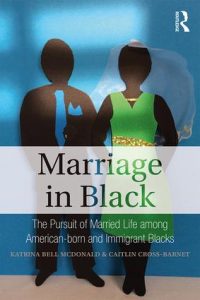
Marriage in Black: The Pursuit of Married Life among American-Born and Immigrant Blacks (Routledge, 2018) by Katrina Bell McDonald and Caitlin Cross-Barnet examines contemporary Black marriages in the United States. Based upon in-depth interviews with 60 couples, they examine the historical and continuing impact of racial inequalities in the United States on Black marriages, distinct features of Black marriages, and the diversity among Black marriages. Their interviewees included African American couples, immigrants from Africa and the Caribbean, and White American couples. I enjoyed reading the book and recently had the opportunity to interview the authors.

AK: What are some of the ways that you found racial inequalities in the United States impact Black marriages in contemporary society?

KBM and CC-B: There are so many angles to consider in response to this question. If we consider the legacy of African American life from the slave era onward, there have been enormous efforts by the state to exert social control over Black relationships. Under slavery, legal marriage was prohibited, but after emancipation, Black couples were pressured or forced to formalize their unions. The context of heterosexual marriage in the United States has historically been situated in White patriarchy, but the privilege accorded White men to support that model of marriage was never extended to Black men. Thus, you see a long history of paid employment among Black wives; married White women didn’t meet married Black women’s employment rates until the 1990s. Systemic racism is a constant for Black couples—structural barriers mean that couples have to negotiate discrimination in housing, employment, the criminal justice system, and everyday interactions with institutions ranging from government offices to the grocery store. That stress spills over into relationships and can create instability that is beyond a couple’s control. But then there also is an increasing proportion of the American Black population that is made up of immigrants. The context of marriage is different in Caribbean and African countries, but their cultural practices and meanings of marriage (in those countries as well as in the United States) don’t always conform to conventions in the United States. And then there is the question of assimilation. Institutionalized racism has historically prevented the assimilation of American-born Blacks into the full privileges of White American middle-class life, so for Black immigrants, what does assimilation mean?

AK: What other distinctive features did you find among Black marriages?

KBM and CC-B: Part of what we found is that there aren’t necessarily any universal features of Black marriage. Intersectional identities make it difficult to define “Black marriage” because individuals have many more components to their identities than race. Black families do have to confront particularly entrenched institutionalized racism, and that means there are certain problems Black couples are more likely to face or just fear—poverty, housing discrimination, incarceration. But when it comes to couples’ ideals or behavior, there are wide variations in marital ideals and practices by social class and immigration status in addition to variation by individuals, creating much more diversity among Black couples than we saw between Black couples and White couples (our sample included 14 White couples). Our sample was small—61 couples all living in the same geographic area—so there could be clearer patterns that would emerge in a larger group, but that would probably be true of any categorization of people, such as by social class or geographic location. That being said, we did find a few patterns that we thought were worthy of further investigation (see next question).

AK: One thing that struck me about your book was the diversity you found among the Black couples you interviewed. What were some differences you found among Black married couples?

KBM and CC-B: Sociologists have speculated that Black married couples are more egalitarian than couples of other ethnic backgrounds, particularly Whites, and because we were looking at Black couples from such diverse backgrounds, we were excited about investigating that idea more deeply. We did find that, regardless of their marital ideals, American-born Black couples were more likely than Whites or immigrant Blacks to share tasks and power fairly equally and that black husbands generally weren’t threatened by Black wives’ income earning power. Conservative religious values of headship and submission expressed by some American-born Black couples actually translated into more role sharing in daily life because the men were more involved with their families. No couple ever used the word “egalitarian,” but some couples professing to share everything “fifty/fifty,” still left the wife with most of the responsibility for housework and childcare even though she worked.

But the American-born Blacks were distinct from the Caribbean and African immigrants, who had radically different approaches to ideas of egalitarianism. African immigrants usually said they wanted to “adjust” or “adapt” to more egalitarian practices, which they saw as distinctly American and necessary to life in America. They generally weren’t fully egalitarian, but they were certainly not replicating the practices they had grown up with in their home countries, where they commonly compared their fathers to “dictators.” Caribbean immigrants, particularly men, were the opposite, wanting to maintain patriarchal power they would have had on the Islands. Caribbeans–and also whites—who were more conservative or traditional attached those values to economic power for men and felt strongly that men should be providers and that mothers shouldn’t work outside the home. For American-born Blacks, working wives and mothers were a norm regardless of the couples’ marital ideals.

Sometimes quantitative work can lead people to believe that an aggregate difference between two groups indicates that there is homogeneity within each group. When it comes to “Black marriage,” that perspective has often led people to view Black couples as deficient because marriage rates are lower than those among white couples, and poverty and divorce rates are higher.  But there are lots of Black couples who marry and work things out, and within the group of those who do, there are many approaches to being in a marriage.

Katrina Bell McDonald is Associate Professor of Sociology and Co-Director of Africana Studies at The Johns Hopkins University. Caitlin Cross-Barnet is a federal researcher and an Associate at the Hopkins Population Center. Arielle Kuperberg is an Associate Professor of Sociology at the University of North Carolina at Greensboro. Follow her on twitter at @ATKuperberg.

A brief report prepared for the Council on Contemporary Families by Dan Carlson, Assistant Professor, Family and Consumer Studies, University of Utah, daniel.carlson@fcs.utah.edu.

The stories inspired by the #MeToo movement reveal that despite decades of struggle for gender equality at work, patriarchy, misogyny, and the sexual objectification of women run deep. And yet the fact that some harassers, abusers, and predators are being held accountable indicates that proponents of gender equality continue to make progress.

But what’s happening on the home front? Has the gender revolution there stalled or is progress being made? Today, married men do roughly four hours of housework per week, up from two hours in 1965 but roughly the same as in 1995 (Bianchi et al. 2012). Married women perform much less housework today than in 1965 (14.2 hours vs. 30.4), but the amount hasn’t changed much since the mid-90s (14.2 hours vs. 15.8). Among youth, egalitarian attitudes about male authority at home and separate gender spheres increased from the 1960s through the mid-90s, but have reversed since, becoming more conventional.

Does this mean the gender revolution stalled? Not necessarily. Since the mid-90s, women have obtained a larger share of college degrees than men and increasingly earn as much or more than their partners, especially in the middle, working, and lower classes (Glynn 2012). Men have nearly tripled the amount of time they spend in direct care of children since 1965, with more than half of these gains occurring since the 90s (Bianchi et al. 2012) and twice as many men today are stay-at-home dads than 20 years ago, with four times as many saying they are doing it to care for their family (Pew Research Center 2014). Additionally, even though the attitudes of youth have become more conventional, results from the U.S. General Social Survey (GSS) indicate that after a lull in the mid-90s, U.S. adults’ valuation of gender egalitarianism has continued to increase since the mid-2000s (Shu and Meagher 2018).

In new research to be published later this month in Socius, my colleagues Amanda Miller, Sharon Sassler, and I find a significant increase in the proportion of low- to moderate-income parents sharing routine housework tasks between 1992 and 2006. In the 1990s, couples were most likely to share shopping (28%) and dishwashing (16%) and least likely to share laundry (9%) and house cleaning (12%). By 2006, the proportion of couples sharing house cleaning had nearly doubled, to 22 percent, and the proportion sharing the laundry had risen to 21 percent, an increase of 129 percent. The proportion who shared cooking rose from 13 percent to 21 percent while the proportion sharing dishwashing increased from 16 to 29 percent. The increase in shared shopping was less dramatic – from 28 to 30 percent—but it remains the most frequently shared task, now closely followed by dishwashing. And the percent of couples where men did the majority of cooking, cleaning, laundry, and dishes roughly doubled from 1992 to 2006.

The gender revolution can be measured not only by the way we arrange our lives, but also by the consequences of those arrangements. And that too appears to have changed. In earlier decades, couples who shared housework equally reported lower levels of marital and sexual satisfaction, and less frequent sex, than couples who adhered to a more “conventional” division of labor. But for married and cohabiting couples since the early 1990s, the reverse is true.  Although less than one-third of the couples we studied shared housework equally, these were the couples who, in contrast to couples in earlier decades, reported the highest marital and sexual satisfaction. In fact, this is the only group among which the frequency of sexual intercourse has increased since the early 90s. In our new study, we confirmed that egalitarian sharing of tasks has become more important for relationship quality. In 1992, the division of tasks mattered little for couples’ well-being. By 2006, couples who equally shared tasks demonstrated clear advantages over couples where one partner shouldered the load.

As it turns out, though, all housework isn’t created equal. Our new study reveals that some tasks are more closely associated with relationship quality than others.

For contemporary men, sharing shopping with their partner seems to be a turn on. Men who shared the shopping for their household not only reported greater sexual and relationship satisfaction than men who did the majority of this work, but also greater satisfaction than men whose partner did the majority of shopping. For cleaning and laundry, men reported lower relationship and sexual satisfaction and more discord when they did the majority of these tasks, but they were just as satisfied when these tasks were shared as when their partner did them.

For women, the shared task that mattered most for their satisfaction with their relationship was dishwashing. As of 2006, women who found themselves doing the lion’s share of dishwashing reported significantly more relationship discord, lower relationship satisfaction, and less sexual satisfaction than women who split the dishes with their partner. Sharing responsibility for dishwashing was the single biggest source of satisfaction for women among all the household tasks, and lack of sharing of this task the single biggest source of discontent.

One overarching pattern that emerged from our data is that the more common it is to share a task, the more damaging to relationship quality it is for just one partner to shoulder responsibility for it. This is why shopping and dish-washing appear to matter so much for relationship quality. It seems individuals and couples take stock of their arrangements in comparison to those around them, and those assessments of relative advantage or disadvantage come to shape their feelings about their arrangements and their relationships overall. This suggests that as the sharing of other tasks becomes more common, the benefits of sharing — and the costs of not sharing — increase. Such a pattern sounds less like a movement undergoing a stall and more like one that is continuing to build.

Picture by Pexels via pixabay

50 years ago a student was expelled from Barnard College for living with her boyfriend. In March 1968 an article published in The New York Times discussed a young unmarried couple that was living together but not married, sparking a national scandal and debate about morality. It was quickly discovered that the woman in question was Linda LeClair, who was later expelled from Barnard College over the matter; this incident was later dubbed “The LeClair Affair.”

In the years after The LeClair Affair, premarital cohabitation became trendy, and by the early 1970s every women’s magazine had published articles about celebrities living with unmarried partners. Rates of cohabitation skyrocketed; in the late 1960s less than 7% of first marriages among young women aged 18-35 began in premarital cohabitation. By the early 1980s over 40% of first marriages in this group were among couples that lived together beforehand, and rates rose to nearly 70% in the early 2010s*.

In the 1980s concern grew over this increase and debate raged over whether cohabitation was the reason for a recent increase in divorce. Some said it was the type of people who cohabited that had a higher divorce rate because of their lower levels of financial preparedness, lesser religiosity, and higher likelihood of having divorced parents, while others argued it was the act of living together itself that caused couples to later divorce. More recently, research (including mine) has found cohabitation is not associated with a higher risk of divorce once factors like the ages at which they form their unions are taken into account, and that this is true even if couples have a child prior to marriage.

But even though it doesn’t cause divorce, there is still a problem with premarital cohabitation: as cohabitation went from new trend to the new normal, it has also increasingly been undertaken by those who don’t have the financial means to marry directly. Gaps in education between premarital cohabitors and couples that marry directly have been growing steadily since the 1970s. In 2010-2015, nearly 50% of young women marrying their first husband without living together first had a college degree; this rate was only 34% among women marrying after living together first*.

This growing gap positions cohabitation as a new facet of family inequality. Young adults want to pay down debt and become financially stable before entering marriage; this is an increasingly elusive goal, especially for those who do not complete a degree, so they enter cohabitation instead of marriage while waiting for more financial stability. Those with less education also are more likely to rush into cohabitation to make ends meet, some before they are ready, or with a less-than-ideal partner that a longer courtship would have revealed.

Today’s Linda LeClair wouldn’t be living with her boyfriend because it is trendy, but because she is up to her eyeballs in student loan debt, driving an Uber to survive, and struggling to establish herself in a career that could bring some stability and health insurance. After decades of disinvestment in public higher education by state governments, a minimum wage that has not kept pace with inflation, and an increasing number of young adults working in the “gig economy” that offers no stability and few benefits, it’s no wonder that young adults today have the highest rates of premarital cohabitation in U.S. history – and also have the lowest rates of marriage and childbearing. More affordable public higher education and more stable job opportunities that pay a living wage for young adults at all levels of education would allow more to shape their relationships according to their desires, instead of out of financial necessity.

*Numbers based on author’s analysis of the 1988 National Survey of Families and Households (N=3594) and multiple waves of the National Survey of Family Growth (1995, 2002, 2006-2010, 2011-2015, N=9420), examining women who married between age 18 and 35.  

Arielle Kuperberg is an Associate Professor of Sociology and Director of Undergraduate Studies at the University of North Carolina at Greensboro. Follow her on twitter at @ATKuperberg

Recently I interviewed Sociologist Alicia Walker, whose book The Secret Life of the Cheating Wife: Power, Pragmatism, and Pleasure in Women’s Infidelity (Lexington Books) will be released on November 15, 2017. She is an Assistant Professor of Sociology at Missouri State University. In her book, she reports on the results of interviews with 46 heterosexual married or partnered women who used the website Ashley Madison to intentionally seek out and form affairs with other men. The book develops a sociology of infidelity, examining issues related to the meaning of marriage, power, social norms in affairs, and why women have them.

AK: You found that the women in your book often had affairs because they were trying to preserve their marriage. How could an affair help preserve a marriage?

AW: For the women of the study, these outside partnerships served as a release valve for the resentment, hurt feelings, and deprivation they experienced in their primary partnerships (marriages, or pre-existing long-term relationships). The women talked about being able to better to overlook the challenges in their relationships, as well as the daily irritants of shared living quarters because they had this secret source of pleasure in their lives. Additionally, for women whose primary partnerships were sexless and/or orgasmless, these outside partnerships function as a space of sexual freedom and sexual pleasure, which is sorely missing in their “real lives.” These women reported that without the relief these outside partnerships provide, they would be forced to exit their primary partnerships. For most of the women I interviewed, remaining in their primary partnerships was a chief goal. Thus, the relief provided by these outside partnerships proved crucial for these women to stay in primary partnerships, where their own sexual pleasure and needs were not being addressed.

AK: One of the things I find fascinating about the book is how social norms (informal social rules) are completely upended in affairs compared to other romantic or sexual relationships. Women avoided forming emotional ties with their partners, and were not seeking to form long-term romantic partnerships, which counteracts narratives we normally hear about gender and relationships. What were some of the ways you found the norms about affairs differ from other relationships?

AW: What is really fascinating about these outside partnerships is that there are no established expectations for how the women are supposed to behave. As a result, women could step out of typical expectations of gender around dating and sex. Even in traditional online dating, we take those expectations with us online. Without established norms and procedures, the participants in these outside partnerships make them up as they go along.

The women of this sample reported an extensive vetting process designed to protect themselves–and their families by extension–and to find a suitable partner without wasting a lot of time and energy. The amount of care and calculation applied stood out as different from partnering initiated face-to-face, where we often walk blindly into relationships under the magical influence of chemistry.

The freedom the women felt to set boundaries struck me as interesting as well. Frank discussions of preferred sexual acts, stamina, and scheduling take place as soon as the initial exchange. If those details do not match up, the conversation does not continue. There is none of the “oh, we have so much in common, I should overlook the other stuff” because these women don’t get that far with men who don’t fill the bill. The women had the freedom to create outside partnerships where the sole focus was their own pleasure. That’s very different than the other relationships in their lives. Overall, the amount of power and freedom the women exercise in their outside partnerships is much more than what we often see them employ in their marriages.

AK:  Your sample – women who used Ashley Madison – allowed you to explore some behaviors that may be common to any sexual relationship formed with partners met online. What are some of the things women in your study did specifically because they met their partners through an online website? How might this experience differ from people who have affairs but don’t actively seek them out on the internet?

AW: Women specifically vetted for sexual preferences and skills, which we do not typically do in relationships initiated face-to-face. We rarely see this among folks who meet at work, through friends, or social settings. We do not habitually ask new suitors about their genital size before we have invested a lot of time in the relationship. We simply find out in the moment, at which point we may already be so invested in that relationships that we are unwilling to walk away.

But these women dismissed any potential partners whose sexual desires, stamina, scheduling, or physical traits did not mesh with the women’s preferences. Compatibility in all areas drove the associations.

While an outside partnership formed with a coworker, neighbor, or family friend may be heady and exciting to the point that we set aside our good sense, outside partnerships formed online override the exhilaration of flirtation to make decisions based solely on the man’s potential to bring the pleasure the women sought.

Alicia Walker is an Assistant Professor of Sociology at Missouri State University, and author of The Secret Life of the Cheating Wife: Power, Pragmatism, and Pleasure in Women’s Infidelity. Arielle Kuperberg is an Associate Professor and Director of Undergraduate Studies in Sociology at the University of North Carolina at Greensboro. Follow her on twitter at @ATKuperberg.

picture by louda2455 via pixabay

Assortative mating – the tendency of people to marry those similar to themselves – has become a popular explanation for increased economic inequality across American families (see the NYT, the Economist, or the NYT Upshot).

The idea is that if people are increasingly matching with partners who have similar economic prospects, families will be increasingly divided between those who pool two large paychecks and those who pool two small paychecks. More assortative mating increases spouses’ economic similarity, which in turn increases inequality.

Our research, however, shows that assortative mating has played a minor role in the increase of spouses’ economic similarity and its impact on inequality. More important than changes in whom people marry are changes in what happens after they marry. In particular, the well-known and dramatic increase in wives’ employment within marriage are responsible for the bulk of the effects of increased spousal economic resemblance on inequality.

That is, the rise of spouses’ economic similarity increased inequality not because there are more “power couples” who match with one another, but because both wives and husbands today are more likely to realize their economic potential during marriage, whereas in the past only one (usually the man) would do so.

Explaining increased spousal economic resemblance

The appeal of assortative mating as an explanation for spousal economic resemblance and inequality is based on well-known social and economic shifts. Declines in gender inequality in education and the workplace mean that women’s socioeconomic standing is increasingly similar to men’s. For instance, it is easier for a man with a PhD to match with a female PhD today than in 1970. These compositional shifts alone may drive increases in assortative mating.

In addition, men’s and women’s preferences for partners have shifted towards valuing similarities rather than differences, rising income gaps between college and non-college workers imply that individuals can lose more by “marrying down”, and growing residential segregation by income restricts opportunities to meet partners outside ones’ own income bracket.

This focus on assortative mating, however, has tended to overlook what happens after couples match, that is, how families organize their economic life: who is bringing money in, how much, who is dropping out of the labor force, and for how long? Overlooking these questions is surprising given the magnitude of changes in the economic organization of families.

The rise of wives’ and mothers’ employment since the 1960s shifted the modal division of paid labor from breadwinner/homemaker to dual-earner. As women are participating in the labor force for more time than in the past, their earnings are closer to men’s for more of their married lives. These shifts have the potential to increase the economic similarity of spouses, even without any increase in assortative mating.

The importance of these changes suggests that the rise of spouses’ economic resemblance could largely be a function of what happens after marriage, not the sorting process that happens before marriage.

And this is exactly what our study finds.

Contrary to what has often been assumed, we show that the contribution of assortative mating to the inequality-generating effects of spouses’ economic similarity is very small. This is because there is no evidence that economic assortative mating has substantially increased in the last four decades; newlyweds are not more economically similar today than they were in the 1970s.

Instead, couples have become more economically similar during marriage, due to the increase in wives’ labor force participation. This shift in couples’ division of paid labor is the driving force behind the rise of spouses’ economic similarity and its impact on inequality.

Implications

We underscore two implications of this finding. One is that more attention should be paid to the effects of the economic organization of families on inequality. There is a lot more to be unpacked about how and why shifts in the division of paid labor during marriage can increase inequality. For instance, is it about “power couples” being more able to sustain the dual-earner model during parenthood? Is it because those with more education tend to have fewer children than those with less education?

Another implication is that it is necessary to follow couples through their married lives to distinguish what family-level processes contribute to inequality. Researchers often measure assortative mating using averages across all couples in the population, thereby lumping together variation that exists at the time of marriage and variation that evolves during marriage. This might not be problematic for measures that do not change much over individuals’ lives, like education or race, but it is clearly misleading for measures that vary systematically over time, such as labor supply or earnings.

In sum, the division of paid labor within families is key to understanding the future of inequality across American families. Assortative mating on earnings has been the focus of prior work, but has played only a small role shaping the economic resemblance of spouses and its contribution to inequality.

Pilar Gonalons-Pons is an Assistant Professor in the Department of Sociology at the University of Pennsylvania. Christine Schwartz is a Professor in the Department of Sociology at the University of Wisconsin-Madison.

This article summarizes findings fromTrends in Economic Homogamy: Changes in Assortative Mating or the Division of Labor in Marriage?in Demography. For a free, pre-publication version of the article, click here. This post was published on 10/17/17 at Work in Progress.

Originally posted on scatterplot on 10/9/17

In a recent Wall Street Journal op-ed, Mark Regnerus argues that men aren’t getting married because “sex has become rather cheap” (the op-ed is behind a paywall, but you can read excerpts here), and he elaborates the argument in a book he recently published (full disclosure: I haven’t read the book and don’t plan to). You may remember Regnerus from his article “Gay parents are bad, mmmkay?” the now-infamous study in which he used seriously flawed methods to conclude gay parenting has negative effects, by comparing the kids of gay people (many of whom had gotten divorced from the child’s other-sex parent, had never parented with a same-sex partner, or had never even lived with their child), to kids of people in intact heterosexual marriages. Turns out when comparisons are instead made between kids of people in intact heterosexual marriages and kids of those in intact same-sex couples, the kids turn out pretty much the same.

Now he’s back to tell us that the reason the marriage rate is so low these days is that these darn women keep giving it away for free and don’t face any consequences, or as multiple journalists have put it; “Why buy the cow when you can get the milk for free?” That is, sex is too easy to get these days with the rise of loose morals, internet hookup websites and even pornography, and not costly enough in consequences now that we have reliable contraception and legal abortion access (good thing the government is making it more expensive then). As a result, men don’t have to bother with commitment or fidelity or even with trying to be an appealing partner.

What is the underlying assumptions of this argument? You got it: Men like sex. A lot. Casual sex though, not relationship sex. They only wanted relationships and commitment because that was the only way to get sex. Now that they can have sex without it, they’d rather just go with the sex and not the relationships.

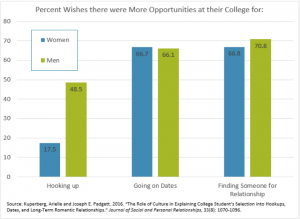
I had the opportunity to test out some of these ideas using a survey of over 24,000 students at 22 different colleges and universities around the United States, and recently published the results. The survey asked whether students wished they had more opportunities for hooking up, going on dates, or finding someone to have a relationship with at their college.

Our results counteract the idea that men want sex and not relationships. Yes, men want hookups more than women- more than twice as many men as women said they wanted more opportunities for hooking up. But they were much more likely to wish they had more opportunities for going on dates than for hookups, and even more likely to say they wanted to find someone to have a relationship with. In fact, they were even more likely than women to say they wanted opportunities for relationships (although the difference was small).

Our sample was only college students, who may be unique in several ways. For one, more educated people are more likely to eventually get married – the decline in marriage rates since the 1980s is largely driven by lower marriage rates among the less educated. What about the less educated men – the ones who are actually less likely to marry in recent decades?

As it happens, a few years ago I did another study focusing on educational differences in marriages in 20 cities, and why less educated men and women don’t marry as much as the highly educated. We focused on the type of couples most likely to have a good reason (and social pressure) to get married- parents who have children outside of marriage. We found that by the time their child was 5 years old, over 30% of these fathers with a college degree were married to their child’s mother, versus only 14% of fathers with a high school degree or less.

We also found that local labor market conditions explained the gap. Those with lower education had poorer job prospects, facing higher unemployment rates than those with more education. Regardless of whether an individual parent was employed, in cities where those with low levels of education had better job prospects (and lower unemployment rates), they were more likely to marry, and the marriage gap was smaller than in cities where they had worse job prospects.

Women’s employment prospects mattered for those with low levels of education (maybe because those with low levels of education were more likely to expect to depend on both spouses’ incomes), but men’s employment prospects were important at every level of education. If men had better job prospects, they were more likely to get married.

The real reason for the decline in marriage isn’t loose morals – it’s worsening economic conditions. The well-paying jobs that men could get at lower levels of education have eroded away, as have the unions that fought for and protected those wages. Although women have gained more equality in the workplace and at home, many retain traditional ideas about not “marrying down”, which for highly educated women may include not marrying men with lower levels of education or excessive student loans they can’t quickly pay off. For less educated women, that includes the many unemployed or underemployed men without a college education.

Meanwhile, the ‘transition to adulthood’- full time employment, financial independence, and a stable living situation – has been prolonged in recent years for both men and women. More and more young adults attend college, and graduate school, often moving in pursuit of education. Many then continue to move, sometimes multiple times, to build towards a well-paying career attractive to potential marriage partners, and stable enough to set down roots that can accommodate families in which both partners have careers. Many have student loans, which limits the financial stability they hope to achieve before marriage. Instead, they move in together, taking advantage of recent more liberal social norms in that regard, while building towards financial stability before entangling themselves legally. These patterns underlie drops in marriage rates, as couples wait until older ages to settle down and marry until they feel stable enough to do so.

Stability is the key feature of this equation. In his op-ed, Regnerus dismisses the idea that men’s wages underlie marriage trends, by citing a recent study finding that areas that have had a fracking boom have not had a subsequent increase in marriage rates. But fracking, a process that extracts local resources and then by necessity requires a move to new areas with new resources, hardly seems the type of long-term stable career that can underlie a 40 or 50 year marriage. The uneven sex-ratio in areas that have seen a fracking boom – 1.6 men for every woman in areas where the fracking boom is heaviest according to the New York Times – probably doesn’t help either.

The good news is that marriages that form at older ages tend to be more stable, and have lower divorce risks- leading to an overall lower divorce rate among young adults today. On the other hand, couples are more likely to have children outside of marriage, leading to less stable family situations for those children, which are associated with a number of disadvantages compared to the children of married parents.

The solution is not to tell women to shut their legs, or to make birth control more expensive. The solution is to build an economy in which young adults can get established in stable, well-paying jobs. The solution is to build an economy in which the jobs that are necessary for society to run, but don’t require a college degree, still pay a living wage. The solution is to properly fund higher education, so that graduates aren’t spending hundreds of dollars a month paying off their debt to the government until they are in their 40s. The solution is to build opportunity. If the opportunity is there, marriage rates will follow.

Arielle Kuperberg is an Associate Professor and Director of Undergraduate Studies in Sociology at the University of North Carolina at Greensboro. Follow her on twitter at @ATKuperberg.

A fact sheet prepared for the Council on Contemporary Families to mark Unmarried and Single Americans Week, September 17-23, by Bella DePaulo, Ph.D., Academic Affiliate, Psychological & Brain Sciences, University of California, Santa Barbara. 

September 17-23, 2017 is Unmarried and Single Americans Week. Today, more than 45 percent of all Americans 18 and older are unmarried (divorced, widowed, or never-married), up from 28 percent in 1970. Contrary to stereotypes, single people typically lead happy and healthy lives. They maintain vital ties to friends, family, children, and communities, often providing practical and emotional support to others.

The proportion of unmarried Americans has hit an all-time high.

  • Of adults 18 and older, 110.6 million are divorced, widowed, or have never married. Never-married people are the biggest group of unmarried Americans, accounting for 63.5 percent. Another 23.1 percent are divorced and the other 13.4 percent are widowed.
  • Half the labor force is comprised of unmarried individuals.
  • Only 14.6 million of these unmarried Americans (7.3 million couples) are cohabiting with a romantic partner. Of those, 867,000 are cohabiting with a same-sex partner. By contrast, 96 million Americans 18 and older are neither married nor cohabiting with a romantic partner.
  • The median age at which people first marry, among those who do marry, has reached an all-time high of 29.5 for men and 27.4 for women. And researchers predict that 1 in 4 of today’s young adults will reach age 50 without ever having married.
  • The age at which people marry has become much more spread out than the past, so some of these folks will go on to marry, but record numbers of American spend the majority of their adult lives outside marriage. It is time to stop seeing singlehood as a temporary way-station.

Like everybody else, unmarried Americans live in many different kinds of households and communities.

  • More Americans than ever before, 35.4 million, live alone. That is more than twice the number of unmarried Americans who are cohabiting with a romantic partner. Lone households are now more common than married-couple households containing children.
  • Most unmarried Americans, though, do not live alone. Their living arrangements are more diverse than ever. Some single people, including single parents, live with family in multigenerational or extended family households. Others live with friends, or with friends and family. Single mothers sometimes share homes with other single mothers. Unmarried Americans also live in cohousing communities and other neighborhoods where people commit to being part of a community.

Single people are often stereotyped as isolated and lonely and depressed. In fact, the majority of single Americans live happy and healthy lives.

  • One of the most important protective factors against loneliness is having friends. And single people have more friends than married people. They also provide more practical help and emotional support to their parents, siblings, friends, and neighbors.
  • People who marry are typically just as healthy, and sometimes even a bit healthier, when they are single than after they marry.
  • People who marry and stay married sometimes experience an increase in satisfaction with their lives in the early years of their marriage, but that honeymoon effect usually does not last. Over time, people who marry are typically no happier than they were when they were single.
  • A study of more than 16,000 people found that only 10 percent experienced a significant increase in well-being after marriage, while 6 percent experienced a sharp decrease. The rest stayed the same.
  • Among women 57 and older, women who are married, cohabiting, dating, or single but not dating experience similar levels of loneliness, depression, and stress. For men, when there are differences, they favor those who are cohabiting rather than those who are married; men who are dating are no better off than single men without partners.

Unmarried Americans play important roles in raising the next generation.

For more information, contact Dr. Bella DePaulo at belladepaulo@gmail.com and read her blog: Living Single, at Psychology Today.