marriage

the way we never wereAnother Quarter Century of Family Change and Diversity

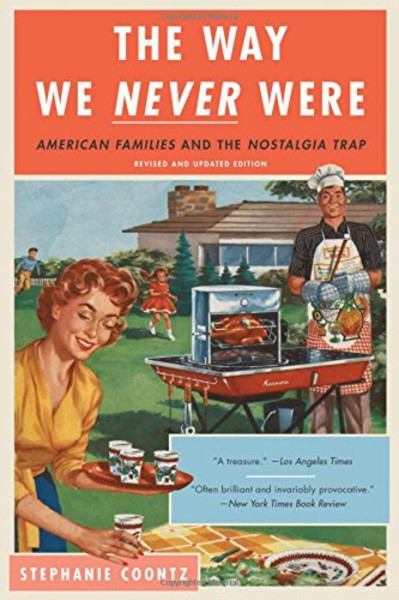
Editor’s note: In 1992—the year the U.S. presidential campaign erupted into a culture war over family values—Stephanie Coontz published The Way We Never Were: American Families and the Nostalgia Trap. The title itself offered the pithy concept, and the book demonstrated that diversity and change have always been hallmarks of American family life: “Leave It to Beaver” was not a documentary. This week (March 29, 2016) Coontz released a substantially revised and updated edition of The Way We Never Were. Below, she provides a brief review of ten things that have changed for the better in the past quarter century, three that have stayed the same, and two that have gotten worse.

In 1992, political leaders and pundits were predicting that changes in family forms and gender roles were leading America into disaster. Were they right? 

  1. Whatever happened to the Super Predators? In the early 1990s criminologists were predicting “a blood bath of violence” unleashed by “tens of thousands of severely morally impoverished juvenile super-predators” – all supposedly a result of rising rates of unwed births. But between 1993 and 2010, sexual assaults and intimate partner violence reported dropped by more than 60 percent. According to the FBI’s Uniform Crime Reporting Statistics, the murder rate in 2013 was lower than at any time since the records began in 1960. Since 1994, juvenile crime rates have plummeted by more than 60 percent, even though the proportion of children born out of wedlock has risen to 40 percent.
  1. How about crack babies? In the 1980s and 1990s, newspapers headlined an epidemic of “crack babies” in the inner city, with kids permanently damaged by their mothers’ use of crack cocaine during pregnancy. This led to a wave of punitive legal actions against such women. But follow-up studies have since revealed that children from the same high-poverty areas who had not been exposed to cocaine in utero were equally likely to have developmental and intellectual delays as babies born with cocaine in their systems. As I documented in The Way We Never Were, the big risk to these children was the pollution, violence, and chronic stress of deeply impoverished and neglected communities – including lead poisoning damage that was going on for years before it hit the headlines in 2016 because of the disaster in Flint.
  1. Did career women start “out-sourcing” their children’s developmental care? As women gained more high prestige jobs in the late 1990s, that’s what many experts feared. In fact, however, even as mothers’ work hours increased, their child-care hours increased too, while fathers’ child-care time tripled. Today, both single and working moms spend more time with their children than married homemaker mothers did back in 1965.


more...

photo via pixabay
photo via pixabay

Cross-posted with permission from Gender & Society.

Since 2002, federal and state governments in the United States have spent over $1 billion from the welfare budget on marriage and relationship education programs through the Healthy Marriage Initiative. This federal policy seeks to encourage marriage and the many social and economic benefits the government claims are associated with it—less poverty and domestic violence, better physical and mental health, higher academic achievement—by helping couples develop relationship skills focused on improving communication and resolving conflict. The federal agency in charge of overseeing healthy marriage funding recommends that curricula used in marriage education programs address how couples think about gender, specifically their beliefs about differences between men and woman and what they expect spouses to do based on gender. Many marriage education curricula address these topics because gendered expectations often influence how couples experience marriage and what they commonly argue about, namely housework, childcare, and earning money.

To understand how marriage education programs funded by the government teach about gender, communication, and power within marriage, I analyzed twenty curricula approved for use in healthy marriage programs and participated in a training session, workshop, or class for eighteen of these same curricula. I specifically wanted to know if and how the curricula reinforced or challenged stereotypes of gender responsibilities—such as the beliefs that women should be caretakers and men should be family breadwinners—and whether the programs taught couples about how social inequalities between women and men shape couples’ abilities to share power and family labor.

I found that some programs assumed men and women are fundamentally different in how they think, feel, and communicate, and recommended that couples use relationship skills to overcome these differences. For example, the Prevention and Relationship Enhancement Program, the most commonly used marriage education curriculum in healthy marriage programs, noted that men are more likely to pull away when couples argue, while women want to talk through disagreements. In discussing how women and men often act differently in romantic relationships, these curricula did not acknowledge how men’s greater power outside marriage often gives them more power to withdraw from conflict within marriage.

Other programs, however, taught couples to question the belief that men and women are fundamentally different and to avoid gender stereotypes in expectations of how their spouses should think and act. The African American Relationships, Marriages, and Family curricula emphasized that gender stereotypes can be harmful to relationships and that couples should learn to be flexible when dividing work and care responsibilities. Another program, The Third Option, taught couples that they should “redefine the power struggle” within marriage by prioritizing cooperation over competition, as in a doubles game of tennis where spouses are on the same team. By focusing on fairness, equality, and shared power, many of the curricula provided limited tools for challenging gender difference and power within marriage by teaching couples strategies that privilege individual abilities, inclinations, and availability regardless of gender.

Nevertheless, the strategies for verbal negotiation taught by these programs did not address how gender inequalities—such as women’s overall lower pay—often create a power imbalance between husbands and wives tilted in favor of men, even when couples share egalitarian gender views. Gendered power exists in the broader society through unequal opportunities for women and men—or what sociologists call institutionalized gender inequalities—not just between two people in a couple. Government-sponsored marriage and relationship education programs therefore have contradictory implications for promoting greater gender equality. They encourage couples to question how narrow ideas of gender “roles” shape marital conflict and unhappiness. Yet, they are funded with money diverted from welfare programs that primarily support single mothers and children, while they teach that gender is a set of individual inclinations to be discussed and negotiated rather than a relationship of power connected to larger systems of inequality and state action.

As a case of what I call interpersonal gender interventions, healthy marriage programs focus on teaching individuals that gender equality primarily lies in developing and negotiating more egalitarian gender attitudes. Yet, interventions that promote ideas about equality will have limited utility if individuals learn to develop more egalitarian beliefs in the absence of institutional changes that enable them to act on these values. Policies need to do more than help couples redefine the marital power struggle through relationship skills; they must promote equitable access to education, employment, and stable earnings that allow partners to create fair, safe, and loving relationships. Only then will partners have truly equal power to express, pursue, and achieve their interests within marriage and family relationships.

Jennifer Randles is assistant professor of sociology at California State University, Fresno. Her article, “Redefining the Marital Power Struggle Through Relationship Skills: How United States Marriage Education Programs Challenge and Reproduce Gender Inequality,” is published in the April 2016 30 (2)  issue ofGender & Society. To view the article, click here.

photo via pixabay
photo via pixabay

Fifteen percent and 22 percent: These are estimated rates of white and black Americans born in 2010 who will not ever marry by age 85. These numbers, though, are not (so far) warranting a national reconsideration of the way that we treat unmarried people–socially or legally. As demonstrated by several recent editorials, the benefits to inclusivity for unmarried people would extend well beyond the large group of people who are unable to enjoy the many legal benefits of marriage. In February, three Council on Contemporary Families (CCF) scholars showed the variety of ways that everyone—married and unmarried alike—will benefit from a reconsideration of the place of the unmarried in America.

Stephanie Coontz, CCF Director of Research and Public Education, gave a demographic update showing that an increasing number of people will be harmed if our current social policies regarding unmarried individuals do not change. An estimated 25 percent of today’s young people will remain unmarried until their 40s, and perhaps 40 percent of those currently married will divorce, leading to the question, “Single or married: Does it really matter anymore?” Because a significant portion of this large group of singles will eventually marry, there are fewer differences between those who are married and those who are single.

Bella DePaulo, CCF expert and Project Scientist at UC Santa Barbara, wrote that, “Everything you think you know about single people is wrong.” In reviewing many of the negative stereotypes that work to legitimize a system that privileges married over single living, DePaulo reminded readers that singles are often the ones picking up the slack in their various communities—they are more likely to help family, friends, and neighbors, and are more likely to “value meaningful work.” And by many measures, single people are just as well off as those who are married.

Donna L. Franklin, past co-chair of CCF, and Angela D. James, CCF expert, discussed the negative repercussions for everyone when the specter of the single takes a front seat to bigger public policy issues. Fifty years ago, Daniel Patrick Moynihan talked about the supposed “tangle of pathology” that was black (single mother) family life, and these negative stereotypes still hold. Today, amid poverty and police brutality, encouraging black women to marry is a top priority for policy makers. Franklin and James asserted that “Black families matter,” and recommended social policy responses that benefit the growing number of single mother families by addressing the real structural inequalities facing black families.

Combined, these perspectives converge on the idea that providing singles and their families with the rights that offer parity with other family structures—especially married families—will benefit all of us.

Braxton Jones is a graduate student in sociology at the University of New Hampshire, and serves as a CCF Graduate Research and Public Affairs Scholar.

I decided to take a methods course in the Women’s Studies department this spring. The first assignment was to identify a word central to our research interests and to trace the etymology of our choice. As a sociologist primarily interested in families and inequality, I decided on the word marriage, thinking it might offer insight into the transformation of American families today.

Marriage Definitions_timeline
. . . . …………… |Marriage Definitions Timeline

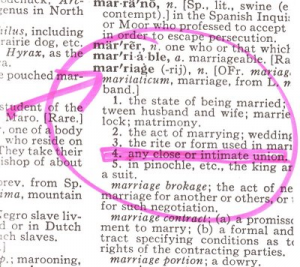
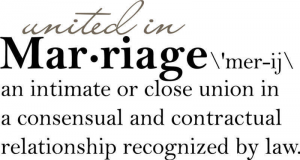
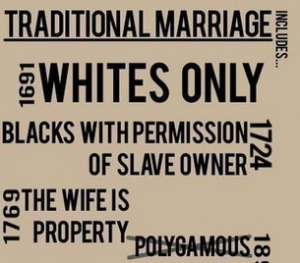
Although marriage has been a universal social institution throughout recorded history, with one exception (the Na people of China), there is no consensus on a definition of marriage.[i] When researching the word’s origins, I started where I always do, with historian and family scholar Stephanie Coontz. In her book “Marriage, a History: From Obedience to Intimacy, or How Love Conquered Marriage,” Coontz details in Chapter 2 the historical challenges of defining precisely what marriage means. Across societies and time, marriage has included (but has not been limited to) the union of: two families; one man and one woman; one woman and one ghost; one man and many women; two people who have a child together; and one woman and all brothers in a family. More recently, regulations of personal unions have centered around age, race, and sex (e.g., in the U.S., minimum age limits, Loving v. Virginia, Obergefell v. Hodges).

While marriage regulates social rights and obligations, nearly every function of marriage has been achieved by a mechanism other than marriage in one society or another. According to Coontz, stories that marriage was invented either for the protection of women or to keep women oppressed are probably not true. More likely, Coontz argues, marriage was an informal social mechanism to organize the daily tasks of life, sexual relationships, and child rearing. As greater economic disparity grew, marriage transitioned from functioning as a vehicle for creating community connections into a means to consolidate resources and transmit property. The meaning of marriage shifted dramatically in the twentieth century, moving from an institutional marriage to a companionate marriage.[ii] Essentially, spouses were assumed to be each other’s friend, a role not central to earlier definitions of marriage.[iii] The second transition was from companionate marriages to individualized marriages. In this conceptualization, the emphasis is on personal development whereby marriage leads to fulfillment and growth for both partners.

It is challenging to untangle contemporary definitions of marriage from definitions of wife and husband. Wife is a noun, defined in relation to another. According to Merriam-Webster dictionary, wife means “the woman someone is married to.” Wives often take on adjectives such as military wife, political wife, housewife, and so on.[iv] Author Anne Kingston reports the first appearance of the word wife in the Bible is in Genesis 2:18: “And the Lord God said, it is not good that the man should be alone; I will make him an help meet for him.” As a concept, wife understood, quite literally, as a helpmate. Husband, on the other hand, is either a noun or a verb, meaning “a male partner in a marriage,” “to save,” “a frugal manager,” or “to till the ground, to cultivate.”

Last year, the definition of marriage was central to the U.S. Supreme Court case Obergefell v. Hodges, which ultimately granted same-sex couples the right to marry in the U.S. While a somewhat oversimplified interpretation, the case hinged on the Justices’ acceptance that the definition of marriage evolves over time.[v] Justice Kennedy wrote, on behalf of the majority: “The history of marriage is one of both continuity and change. Changes, such as the decline of arranged marriages and the abandonment of the law of coverture, have worked deep transformations in the structure of marriage, affecting aspects of marriage once viewed as essential. These new insights have strengthened, not weakened, the institution. Changed understandings of marriage are characteristic of a Nation where new dimensions of freedom become apparent to new generations.” Kennedy added, “This view of marriage as timeless and unchanging was contradicted by an abundance of scholarly work.”[vi]

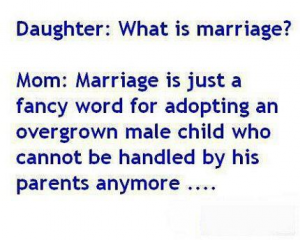
For further fun, I decided to see what Google images appear with the search term “marriage definition.” Some of my favorites, because they are insightful, funny, appalling, or thought-provoking, are posted below. Full disclosure, I skipped the hate-filled images.

m2m6
Joanna R. Pepin is a PhD candidate in the Department of Sociology at the University of Maryland. She primarily researches romantic relationships and inequality, such as power between partners and the association between romantic partnerships and social stratification.

Follow her on Twitter: @CoffeeBaseball

[i] Coontz, Stephanie. 2005. Marriage, a History: How Love Conquered Marriage. Reprint edition. New York: Penguin Books.

[ii] Cherlin, Andrew J. 2004. “The Deinstitutionalization of American Marriage.” Journal of Marriage and Family 66(4):848–61.

[iii] Burgess, Ernest W. and Harvey J. Locke. 1945. The Family: From Institution to Companionship. New York: American Book Company.

[iv] Kingston, Anne. 2004. The Meaning of Wife: A Provocative Look at Women and Marriage in the Twenty-First Century. New York: Picador.

[v] Obergefell v. Hodges. 576 U.S. ___ 2015. Justia Law. Retrieved February 1, 2016 (https://supreme.justia.com/cases/federal/us/576/14-556/).

[vi] Perry, David M. 2015. “A New Right Grounded in the Long History of Marriage.” The Atlantic, June 26. Retrieved February 1, 2016 (http://www.theatlantic.com/politics/archive/2015/06/history-marriage-supreme-court/396443/).

via Flickr Creative Commons

CCF former Co-Chair Joshua Coleman posted this on 1/25/16 for The New York Times’ Room for Debate dialogue sparked by the Times’ burning interest “Hillary Clinton Deals with Her Husband’s Transgressions.”

It’s hard enough for couples to navigate the pain of an affair without everybody and their media outlets weighing in on it. To have your child exposed to jokes and lurid speculation about their parents’ marriage, sex lives and motivations is something that would severely test the strongest of couples. But when one or both parents fail that test and join in on the blaming and mudflinging, their children suffer immensely. While Hillary Clinton’s alleged attempts to discredit the women with whom her husband cheated may not be considered a good form of sisterhood, it could be a reasonable act of motherhood.

I’ve seen this dynamic played out in many of the wealthy Silicon Valley families that I work with in the Bay Area after an affair. As a psychologist and family therapist, I’ve witnessed far too many parents perfectly willing to ruin their children’s lives by exposing them to the most unseemly aspects of their mother’s or father’s actions, with the lame explanation that they’re doing it for the child’s benefit.

So while Hillary Clinton’s alleged attempts to discredit the women with whom her husband cheated may not be considered a good form of sisterhood, it certainly could be considered a reasonable act of motherhood.

I don’t assume that Clinton stayed with her husband after his affairs because of her ambition. These are two people who care intensely about shared goals and values, something that can allow couples to recover from infidelity. But I certainly wouldn’t blame her if she did stay for such practical reasons. I also wouldn’t blame her if she didn’t want to put herself or her daughter through a divorce, especially given the tabloid lens through which it would be viewed and commented on daily.

In the United States, we have elevated romantic love to such dizzying heights that staying together for practical reasons or because you think it’s better for your kids is somehow considered an act of existential cowardice. Only the starry­eyed pursuit of romantic love is considered a worthy enough compass on which to navigate one’s life. This is one reason we have higher rates of marital and cohabitation dissolution, and faster rates of recoupling, than most other countries ­­ creating heightened exposure to transitions and instability that are harmful to children.

Children and career often operate in a kind of fog of war where we have to choose our priorities based on our best guess of which commitment should be prioritized. “Life doesn’t always hand us the option of successfully maintaining an alliance between our marital goals, our aspirations for our children and our ideological commitments,” notes sociologist Barbara Risman, a fellow at the Center for Advanced Study in the Behavioral Sciences at Stanford.”

The Clintons have managed to keep their marriage intact, successfully raise a healthy daughter, despite the public humiliation, and Bill Clinton now seems to prioritize his wife’s aspirations in the same way that she had to prioritize his many years before. I’ve sure seen a lot more destructive reactions to infidelity in my practice.

I’ve sure seen a lot more destructive reactions to infidelity in my practice.

Joshua Coleman, the author of “When Parents Hurt: Compassionate Strategies When You and Your Grown Child Don’t Get Along”, is a senior fellow at the Council on Contemporary Families, as well as a private practice psychologist.   

Photo by cvrcak1 via Flickr

Fifteen years ago, the going wisdom on cohabitation was that marriages preceded by living together were more likely to fall apart—that news is out of date. Several pieces from CCF share more current work on cohabitation, including the key observation that cohabitation itself is no longer associated with more or less risk of divorce in any subsequent marriage. Other recent pieces cover cohabitation and housework, childrearing, and remarriage.


This briefing paper was prepared as part of an online symposium Moynihan+50: Family Structure Still not the Problem for the Council on Contemporary Families and published jointly by CCF and the Institute for Women’s Policy Research (IWPR).

Executive Summary

In The Negro Family: The Case for National Action, published in 1965, Daniel Patrick Moynihan famously argued that the fundamental obstacle to racial equality was the instability of Black families, and especially the prevalence of single-mother families. That same year, he predicted that the spread of single-parent families would result not only in rising poverty and inequality but also in soaring rates of crime and violence. Half a century later, we report that the changes in family structure that concerned him have continued, becoming widespread among Whites as well, but that they do not explain recent trends in poverty and inequality. In fact, a number of the social ills Moynihan assumed would accompany these changes have actually decreased.

  • Even as single-parent families have become more prevalent in all race/ethnic groups, especially among Black families, poverty rates have fallen, partly because of effective welfare programs, and partly because of increased education and job opportunities (especially for women). In 1967 more than 60 percent of single-mother families were poor. Today, according to new, adjusted poverty calculations, that poverty rate has been almost halved, falling to 35 percent.
  • During the period of greatest change in family structure, educational levels rose for Black children and young adults. Today, almost 90 percent of Black young adults are high school graduates, compared with only about 50 percent in the 1960s; Black college completion rates have doubled, from less than 10 to almost 20 percent.
  • Since 1994 juvenile crime rates have plummeted by more than 60 percent for Blacks and Whites alike, even though marriage rates have continued to fall and the proportion of children born out of wedlock has reached 40 percent.
  • Although it is true that single-parent families are more likely to be poor than two-parent ones, we show that fluctuations in poverty rates since the 1990s cannot be explained by changes in family structure.
  • Marriage is no protection against racial inequality. Black and Latino children in married-couple families are, respectively, three- and four-times more likely to be poor than White children in such families.

One of the legacies of the Moynihan Report has been to focus attention on changing family structure, rather than on other factors that are more amenable to policy intervention. While marriage promotion programs have proven ineffective, evidence suggests that increasing employment opportunities and wage levels, anti-discrimination policies, and social safety nets have considerable potential to reduce poverty, increase economic and educational opportunity, and decrease racial inequality. more...

J.K. Califf, Flickr.

One of the consistent findings of sociological research in recent decades has been that couples who had a child before getting married had substantially higher odds of divorcing than couples who married first. This held true even when researchers controlled for other factors that tend to distinguish such couples from those who marry directly—education, family background, race and ethnicity. But considering the tremendous increase in premarital cohabitation and childbearing over the past quarter century, and in light of new evidence that many other longstanding “laws” of marriage and divorce have been overturned (e.g., see “It’s Not Just Attitudes: Marriage Is Also Becoming More Egalitarian”; Are Individuals Who Marry at an Older Age Too Set in Their Ways to Make Their Marriages Work?), we set out to investigate whether this particular sociological “rule” still applies. more...

Horia Varlan, Flickr CC.

Does marriage lead women to take on a larger share of housework? In the 1950s and 1960s, marriage was clearly unfair to women. The social and legal definition of marriage made it a woman’s duty, but not a man’s, to provide services in and around the home. Husbands had the final say over many family matters, such as where a couple would live and how the finances were managed. Married women were expected to take care of the meals and housework without any assistance from their husbands, whether they worked outside the home or not.

Values have changed since then, but some scholars argue that marriage still carries powerful role expectations that differ by gender and that lead women to start doing more housework and men to start doing less. Since the 1990s, several studies have compared the behavior of couples who are married and couples who live together. They find that unmarried cohabiting couples split the housework and paid work more equally than married couples, where wives tend to do a larger share of unpaid housework and husbands to do more paid work. Some have concluded from this comparison that there is something about marriage roles, and the expectations surrounding those, that causes couples to become more traditional after marriage.

But these studies were not comparing the same types of couples before and after marriage. They were comparing all cohabitors, even ones that didn’t intend to ever get married, with all married couples, even those that did not cohabit before marriage. more...

Online dating is starting to look a bit more like the idealized world of a Bennetton ad.

Despite growing approval of interracial dating, researchers have long documented the existence of a racial hierarchy within the dating world, with white women and men the most preferred partners, blacks the least preferred, and Asians and Hispanics in between. But where do the growing numbers of biracial and multiracial individuals fit into this hierarchy? Do they too get ranked by descending shades of lightness?

Between 2000 and 2010, the number of individuals who identified themselves to Census takers as being of two or more races increased by a third. These nine million individuals still represent less than three percent of the population. But studies predict that by the year 2050, nearly one in five Americans may claim a multiracial background. How will this affect dating and marriage patterns in the United States? more...