Tag Archives: immigration/citizenship

Self-Identification among Hispanics

In 1970, the U.S. Census added a “country of origin” question to its demographics section, which asks respondents if they are “of Hispanic, Latino, or Spanish origin.” But a new Pew Hispanic Center report indicates that, while these might be the official terms for those from Spanish-speaking countries and/or Latin America, they aren’t the preferred or most popular labels among those they’re supposed to identify. Only about 1 in 4 use the terms Hispanic or Latino most frequently to describe themselves:

Not surprisingly, identification with different labels differs among recent immigrants and those born in the U.S. Among the first generation, country of origin is the overwhelming preference, but by the third generation, just over 1 in 4 choose that as their most common self-identifier:

Most respondents had no preference between the terms Hispanic or Latino, but for those who did, Hispanic was more popular:

White was the most commonly-chosen racial identification:

Most respondents also said that while they think it’s important that Hispanics be able to speak Spanish in the U.S., that learning English is very important for success. By the second generation, almost all rate themselves as knowing English “pretty” or “very” well:

Conversely, among third-generation Hispanics, under half say they speak or read Spanish equally well:

Check out the full report for tons of additional information on identification, language use, etc.

Distrust for Atheists & the New Relevance of Faith

Cross-posted at Global Policy TV.

Recent research has unearthed the interesting finding that most Americans dislike atheists.  In fact, they strongly dislike atheists. Surveys suggest that they’d rather share a beer with almost anyone, even members of historically-hated groups: homosexuals, African-Americans, or Muslims (yes, even after 9/11).  This phenomenon is new in American society, as I’ll discuss below, and reflects a significant change in our social alliances.

But first, consider this data published by Penny Edgell and her colleagues in the American Sociological Review (full text).  It reveals that Americans believe that atheists, more than many other groups, are not likely to agree with their “vision of American society.”  Atheists topped the list, beating out the second contender, Muslims, by 13 percentage points.  Likewise, among the types of people Americans would not want their children to marry, atheists come first, beating out Muslims (again) by 14 points and African Americans by a full 20.

This dislike for atheists, by the way, isn’t on the wane.  While dislike of gays and lesbians has been easing, racism has become increasingly unacceptable, and religious diversity has become less contentious, intolerance for non-believers has held steady.

An even more recent article revealed that the reason people dislike atheists so much has to do with trust (cite).  Many people are skeptical that someone who doesn’t believe in God would do the right thing, given that they don’t imagine that a higher power is watching them and keeping score.  Atheists were more distrusted than Muslims, Jews, gay men, and feminists.  The only group that was as strongly suspected of bad behavior as atheists?  Rapists.

What is interesting in all this – above and beyond a clear prejudice against atheists – is the change in how Americans think about religion.  Until recently, members of different religious saw each other as enemies, not friends.  American history is characterized by “long-standing divisions among Protestants, Catholics, and Jews” (Edgell et al.). Many of us can remember how significant it was to elect the first Catholic president (something we take for granted as unremarkable now) and we are on the precipice of nominating a Mormon to run on the Republican ticket.

Indeed, historical data shows that Americans have been increasingly willing to vote for a Catholic or Jewish Presidential Candidate (as well as an African American and homosexual candidate), but their willingness to vote for an atheist is lagging behind:

The take home point has to do with shifting social alliances.  Now that most Americans have abandoned a strong dislike for members of other religions, it’s possible for The Religious to emerge as a socially-meaningful identity group.  In other words, once members of different religions begin to see each other as the same instead of different, they can begin to align together.  Suddenly atheists become an obvious foe.  Instead of one of many types of people who had lost their way (along with people of different faiths), atheists could emerge as uniquely problematic.  It is the building of cross-religious alliances, then, that undergirds the strong dislike for atheists specifically.

—————————

Lisa Wade is a professor of sociology at Occidental College. You can follow her on Twitter and Facebook.

“Not Quite White”: Arabs, Slavs, and Whiteness in the U.S.

A couple of years ago I posted a segment from the PBS series Faces of America focusing on the legal efforts by Syrian immigrants in the late 1800s and early 1900s to be officially recognized as White (and thus eligible for naturalized citizenship). It nicely illustrates the social construction of race and ethnicity, and the way  power struggles are embedded in the categories we recognize and who is assigned to each one.

In Not Quite White: Arabs, Slavs, and the Contours of Contested Whiteness, directors Jamil Khoury and Stephen Combs integrated scenes from Khoury’s play WASP: White Arab Slovak Pole and interviews with scholars from the Arab American and Polish American communities to “reflect upon contested and probationary categories of whiteness and the use of anti-Black racism as a ‘whitening’ dye.”

Thanks to Katrin for the link!

Why Do Latinos Protest More than Other Groups?

Cross-posted at Thick Culture.

As of the 2010 Census, Latinos represent 17 percent of the US population, but are woefully underrepresented in traditional forms of political participation like voting and making campaign contributions. The Pew Hispanic center reports that while Latinos represented 21% of all eleigible voters in 2010, they accounted for only 6.6% of midterm election voters.

One area where Latinos are more likely to participate when compared to non-Latino whites is in outsider forms of participation like protest activity. This form of activity became synonymous with Latino political participation during the 2006 Grand Marcha where 500,000 protesters packed streets to protest immigration bills. A 2006 CIRCLE study finds that Latino youth, while not engaged in formal types of participation were much more likely to report having engaged in a protest:

Although young Latinos are generally not as engaged as other racial/ethnic
groups, 25% said that they had participated in a protest—more than twice the
proportion of any other racial/ethnic group.

By comparison, only 11% of all youth surveyed had reported taking part in a protest. The accounts for why Latinos protest more than other groups vary but a main causal fator is the lack of access to formal political channels, particularly for non-citizens and undocumented immigrants. Lisa Martinez (2008) points out that Latinos are less likely to engage in protest activity when they live in places with high numbers of elected officials. Is the increase in Latino political engagement via protest simply the result of demographic realities (e.g. residents can’t vote) or is it a leading indicator of an overall dissatisfaction with politics?

——————————

Jose Marichal, PhD, is an assistant professor of political science at California Lutheran University. He teaches and writes about: public policy, race and politics, civic engagement, the Internet and politics, and community development.  He is founder of the blog ThickCulture.

Wait Times for U.S. Family Reunification Visas

Cross-posted at Jezebel.

Yesterday I posted about U.S. immigration trends, updated through 2010. Following up on that, Dolores R. found another immigration-related post by KPCC…this time, a look at the wait time to get a family-sponsored immigration visa. With the removal of strict, racialized quotas in 1965, the U.S. turned to a policy based on a set of priorities for deciding who would be granted a visa; among the various categories was a preference for those who had sponsoring relatives already living in the U.S., with different visas and priorities based on family relationship:

  • F1 = unmarried adult children of U.S. citizens
  • F2A = spouses and children (under age 21) of permanent residents
  • F2B = unmarried adult children of permanent residents
  • F3 = married adult children of U.S. citizens
  • F4 = siblings of adult U.S. citizens

According to the U.S. State Department, the annual minimum family-reunification visa target is 226,000 (note that this excludes spouses, parents, and minor children of U.S. citizens, who are highest priority for immigration and are exempt from immigration caps). The Immigration and Naturalization Act requires that family-sponsorsed (as well as employer-sponsored) visas be granted in the order that eligible potential immigrants applied. Unsurprisingly, many years there are more eligible applicants than there are available visas, leading to a backlog of individuals who qualify to immigrate but are waiting for a visa to become available. In particular, China, Mexico, India, and the Philippines are “oversubscribed,” meaning there is a significant backlog.

How long? The table below shows the cut-0ff date for visa applicants in each category as of January 2012. That is, the dates given here are the date by which a person had to apply to finally have a visa available this month; the 2nd column shows for all areas excluding the four countries singled out because of their particularly long wait times:

The least oversubscribed visa category is the F2A, where those now receiving visas will have waited a bit under 3 years. But look at some of the other dates listed. For F1, F2B, and F3 visas from Mexico, the people now at the head of the line have been waiting nearly two decades, having applied in 1992 or early 1993. F4 applicants from the Philippines have been waiting almost a quarter century, since 1988.

This is part of the reason why undocumented immigration continues, and arguments about fairness and waiting their turn in line may not be particularly compelling to individuals who want to reunite with family members in the U.S. Waiting a year, or two, or five, may seem reasonable. If you learn there’s a 20-year wait, the cost/benefit analysis of whether to wait for the visa to come through or to find other means may shift significantly, regardless of how otherwise law-abiding a person might be.

2010 U.S. Immigration Data

Dolores R. let us know that the Migration Policy Institute has a bunch of updated data and charts/graphs illustrating immigration trends in the U.S. through 2010 (via the KPCC website). So, in 2010, where did immigrants to the U.S. come from? As you may expect, the single largest source of immigrants was Mexico:

Looking at the region of birth of immigrants in the U.S. (in millions) over time reveals clear patterns:

Notice the shift over time, with fewer immigrants coming from Europe (red) but a major increase in the number of immigrants from Asian and Latin America (green and light blue), noticeable already by 1980. This reflects changes to U.S. immigration policy in 1965 that got rid of the old quota system that openly favored northern and western Europeans. The result was a major change in the demographics of U.S. immigrants.

As of 2010, immigrants made up about 13% of the total U.S. population — the highest level in decades, but still not at the all-time high levels seen at several points in the late 1800s/early 1900s:

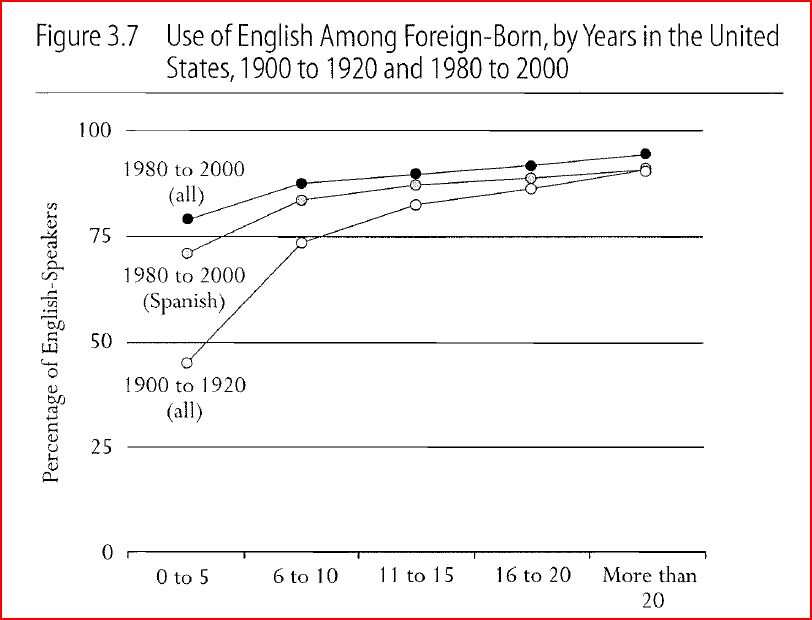
Lots more data at the MPI website, including a map where you can get very detailed information about the foreign-born population for each state. You might also want to check out our posts on U.S. immigration and geographic names, an interactive map of immigrant settlement patterns, English acquisition among U.S. immigrants, and a map of concentrations of speakers of various languages in the U.S.

The Class and Race Demographics of LGBT Families

Sonita M. sent in a report from the Movement Advancement Project about the state of lesbian, gay, bisexual, and transgender (LGBT) families.

LGBT families are more likely to be poor than non-LGBT families.  Nine percent of married cis-gender different-sex couples live in poverty, compared to 21% of gay male couples and 20% of lesbian couples:

LGBT couples may be more likely to be in poverty in part because of wage differentials between gays, lesbians, and their heterosexual counterparts.  Research shows that gay and bisexual men earn significantly less money than heterosexual men, whereas lesbians make somewhat more money than straight women.  Gay men would be more likely than heterosexual men to be in poverty, then.  But what about women? Women in same-sex couples face the same wage disadvantage that all women face, but also are not married to the heterosexual men that are making so much money (making it so that heterosexual women can make less money than gay women, but still be less likely to live in poverty). Make sense?  I hope so.

The second reason that LGBT couples with children are more likely than cis-gendered different-sex couples with children to live in poverty is that Black and Latino LGBT people are more likely than White LGBT people to be parents, and Blacks and Latinos are disproportionately poor to begin with:

Among same-sex couples, being a parent is also correlated with immigration status, which also correlates with class.  Non-citizens are more likely to be parents than citizens:


The two million children in America being raised by LGBT parents, then, are more likely to suffer from class disadvantage.  The authors of the report go on to discuss the ways in which formal policy and informal discrimination contribute to this state of affairs.

Via Andrew Sullivan.

—————————

Lisa Wade is a professor of sociology at Occidental College. You can follow her on Twitter and Facebook.

Cultural Patterns and Geographic Terms

Dolores R. sent a link to a map created by Derek Watkins to show how the names given to geographic features reflect cultural patterns. Using a database of names officially accepted by the U.S. Board of Geographic Names, Watkins mapped generic terms used in the names of streams (excluding “creek” and “river,” which are commonly used throughout the U.S and were plotted in a gray that fades into the background):

The generic terms reflect historical immigration patterns. “Kill” appears in areas of New York originally settled by the Dutch; “cañada,” “arroyo,” and “río” indicate areas of Spanish exploration and settlement in the Southwest; of course, Louisiana and the surrounding area still reflects its French heritage through the term “bayou.”

The map reflects internal migration and cultural diffusion within the U.S., as well. For instance, Watkins suggests that the patch of red in southwest Wisconsin, indicating the use of “branch,” may be due to the lead mining boom in the early 1800s. Lead mining attracted Appalachian miners to the area, and they may have influenced local naming practices, bringing along terms common in Appalachia.

For more on the interconnections between geographic names or terms and larger cultural patterns, Watkins suggests reading Names on the Land: A Historical Account of Place-Naming in the United States, by George Stewart (2008). Another excellent source is Wisdom Sits in Places: Landscape and Language among the Western Apache, by Keith Basso (1996).