Search results for The

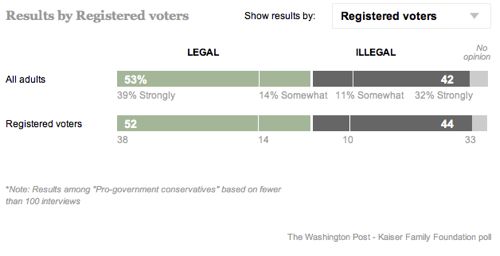
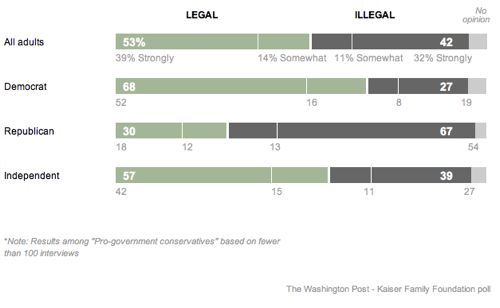
The Washington Post and the Kaiser Family Foundation released the results of a survey of 3,130 adults about their position on same-sex marriage. The survey found that just over half of all adults and registered voters thought same-sex couples should be able to get married:
Unsurprisingly, this varies greatly by political affiliation, with Democrats and Republicans mirroring each other — 2/3rds of Democrats support same-sex marriages, while the same proportion of Republicans oppose it. Well over half of Independents also agree that same-sex marriage should be legal:
You can also see the results by party clusters — that is, different groups within the parties (the Post unfortunately doesn’t describe the clusters). Urban liberals were most supportive (93%), while those identifying with the Tea Party were least (6%):
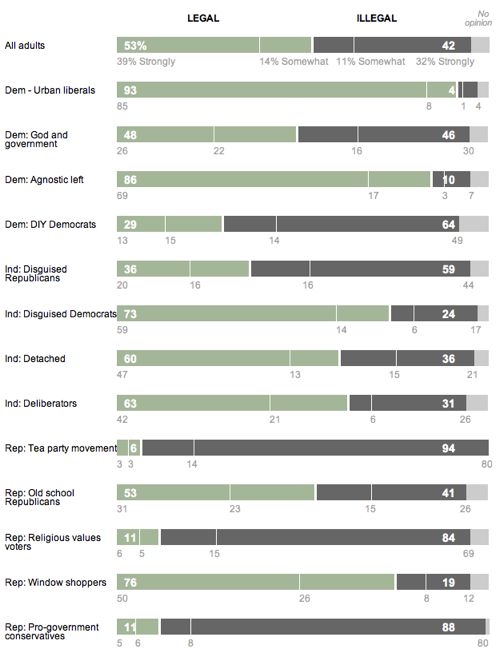
These numbers tell us a lot about why the Democratic party appears to be on the verge of adopting a platform that explicitly includes marital equality as a goal. This position is unlikely to alienate many people within the party or Independents who might lean Democratic, since only a small minority of both groups “strongly” oppose same-sex marriage. We’re at a point where a major political party can make the calculation that openly stating they support allowing gay and lesbian couples to get married helps its political chances more than it potentially hurts them.

Via the New Civil Rights Movement.

Apparently we’ve become such a sedentary/weight-obsessed society that we now have to watch our cat’s calories too.  See my kitten’s cute paws and the text in the lower right corner:

Lisa Wade, PhD is an Associate Professor at Tulane University. She is the author of American Hookup, a book about college sexual culture; a textbook about gender; and a forthcoming introductory text: Terrible Magnificent Sociology. You can follow her on Twitter and Instagram.

In Gay Rights at the Ballot Box, I analyze the long history of transgender smear tactics used by the Religious Right, a large social movement that opposes LGBT rights. One area where this occurs is the production of campaign ads addressing attempts to protect transgender individuals from discrimination. The ads almost always focus on either children or bathrooms.

Back in April, voters in Anchorage, Alaska, rejected Proposition 5, which would have created a law protecting residents from discrimination based on sexual orientation or gender identity. Such laws are primarily to protect lesbian, gay, bisexual and transgender (LGBT) residents. Transgender inclusion in the potential law was the focus of two commercials by the organization Protect Your Rights.

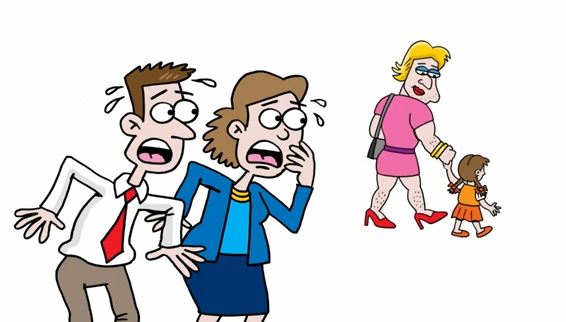
In both of these political ads, figures of large, hairy male-bodied individuals in dresses, described as “transvestites”, represented transgender inclusion. They present transgender individuals as grotesque and threatening. At the heart of these ads and other transgender smear tactics is anxiety about bodies in gender-segregated spaces that are typically occupied by women.

The women’s bathroom in particular is a site where gender conformity is policed. According to scholar Judith Halberstam in her book Female Masculinity, women’s bathrooms “operate as an arena for the enforcement of gender conformity…a sanctuary of enhanced femininity, a ‘little girl’s room’ to which one retreats to powder one’s nose or fix one’s hair” (p. 24). In this ad, the locker room operates in parallel way, as a space where gender conformity and bodies are strictly policed:

The other ad focused on the possibility of a “transvestite” getting hired at a daycare facility:

In addition to the use of stereotypically-presented “transvestites” to represent all transgender individuals as grotesque and laughable, the ads also argue that employers should have the right to discriminate if they think their customers are prejudiced toward a particular group or uncomfortable with them in certain jobs — an argument that has been used to resist allowing racial minorities and women into various careers. The ads also suggest that Anchorage is already sufficiently tolerant and thus doesn’t need to address the issues Proposition 5 supporters claimed were a problem.

Ads that raise fears about transvestites teaching in the classroom have been used since the 1970s during ballot measure campaigns, and the Religious Right has been raising concerns about transgender women in women’s bathrooms since the late 1980s. These two ads from the Anchorage Proposition 5 campaign are among the newest additions to the long tradition of ads that rely on stereotypes of LGBT individuals as predatory, dangerous to have around children, and having ulterior motives.

—————

Amy L. Stone is an associate professor of sociology at Trinity University in San Antonio, Texas.

First the marketing team for an energy drink out of Poland, called “Black,” hired a Black person, Mike Tyson, to personify its product.  Then, they surround him with White, female models and have the convicted rapist call himself a “beast” that can’t control himself.  Tag lines include “that’s the power of Black” and “Black power.”

So we have, in one ad campaign, the fetishization of Black men, the White supremacist portrayal of White women as the ultimate female, their objectification (see #3, he actually hands one out in the second ad), the trivialization of his crime (he can’t control himself, LOL right!?), the use of animalistic language to refer to Black people, and the appropriation of the Black Power movement.  Anyone see anything else?  Does it matter that this comes out of Poland and not the U.S.?

Thanks to Tom Megginson at Work That Matters for the heads up.

Lisa Wade, PhD is an Associate Professor at Tulane University. She is the author of American Hookup, a book about college sexual culture; a textbook about gender; and a forthcoming introductory text: Terrible Magnificent Sociology. You can follow her on Twitter and Instagram.

In subarctic climates — ones in which the mean annual temperature is below 32° — the soil is frozen all year round.  It’s damn cold, but a nice base on which to build.  Until climate change starts melting the permafrost, of course.

These two now crooked buildings can be found in Dawson City, Canada.  Carleton University geographers have shown that the average temperatures have been increasing, melting the permafrost, and destabilizing the town.

This image reminds me that I am only barely beginning to understand climate change and its consequences.  How we will pay for climate change, and who will do so, is something I suspect I’ll learn much more about in the coming years.

Via Boing Boing.

Lisa Wade, PhD is an Associate Professor at Tulane University. She is the author of American Hookup, a book about college sexual culture; a textbook about gender; and a forthcoming introductory text: Terrible Magnificent Sociology. You can follow her on Twitter and Instagram.

Cross-posted at Neuroskeptic.

“Personality differences” between people from different countries may just be a reflection of cultural differences in the use of “extreme” language to describe people.

That’s according to a very important paper just out from an international team led by Estonia’s René Mõttus.

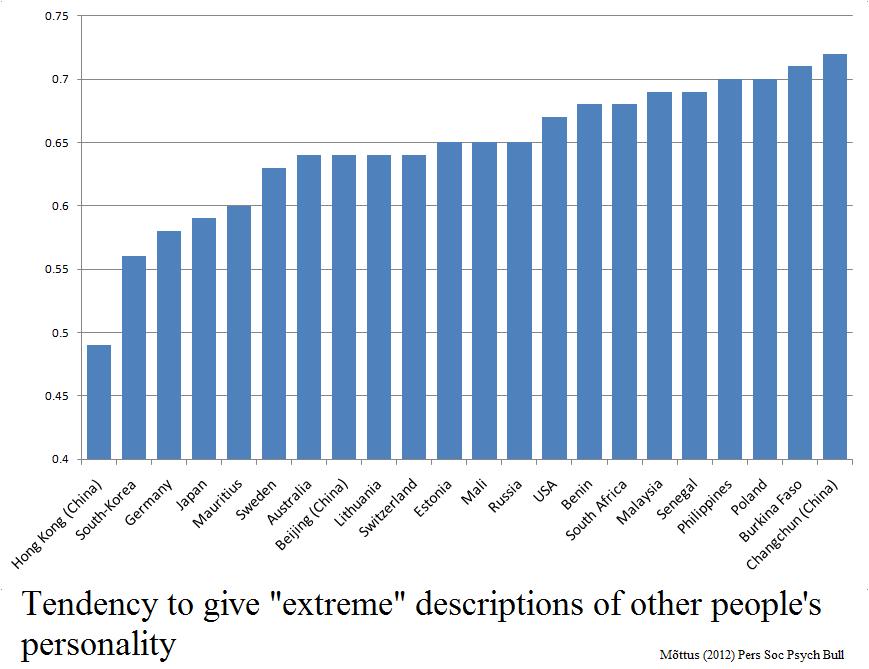
There’s a write up of the study here. In a nutshell, they took 3,000 people from 22 places and asked them to rate the personality of 30 fictional people based on brief descriptions (which were the same, but translated into the local language). Ratings were on a 1 to 5 scale.

It turned out that some populations handed out more of the extreme 1 or 5 responses. Hong Kong, South Korea and Germany tended to give middle of the road 2, 3 and 4 ratings, while Poland, Burkina Faso and people from Changchun in China were much more fond of 1s and 5s.

The characters they were rating were the same in all cases, remember.

Crucially, when the participants rated themselves on the same personality traits, they tended to follow the same pattern. Koreans rated themselves to have more moderate personality traits, compared to Burkinabés who described themselves in stronger tones.

Whether this is a cultural difference or a linguistic one is perhaps debatable; it might be a sign that it is not easy to translate English-language personality words into certain languages without changing how ‘strong’ they sound. However, either way, it’s a serious problem for psychologists interested in cross-cultural studies.

I’ve long suspected that something like this might lie behind the very large differences in reported rates of mental illness across countries. Studies have found that about 3 times as many people in the USA report symptoms of mental illness compared to people in Spain, yet the suicide rate is almost the same, which is odd because mental illness is strongly associated with suicide.

One explanation would be that some cultures are more likely to report ‘higher than normal’ levels of distress, anxiety — a bit like how some make more extreme judgements of personality.

So it would be very interesting to check this by comparing the results of this paper to the international mental illness studies. Unfortunately, the countries sampled don’t overlap enough to do this yet (as far as I can see).

Source: Mõttus R, et al (2012). The Effect of Response Style on Self-Reported Conscientiousness Across 20 Countries. Personality and Social Psychology Bulletin PMID: 22745332

————————

Neuroskeptic blogs anonymously here.  You can also follow him on Twitter.

At the journal Epidemiology, John Cunningham published a proof-of-concept article aimed to show that Twitter is a useful and viable method of data collection.

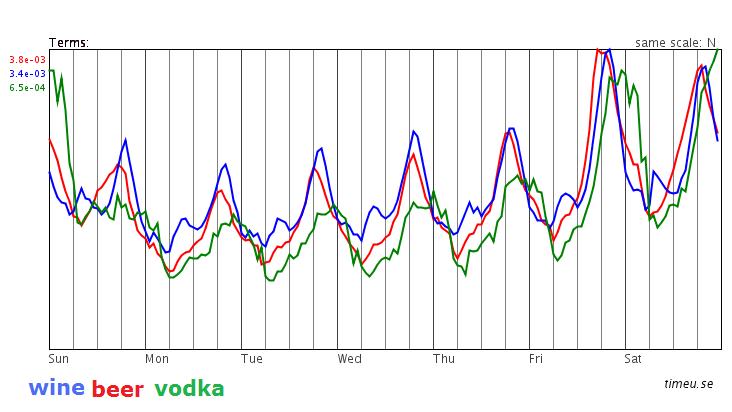
His data captured the incidences of the words “wine,” “beer,” and “vodka” over the course of a week.  The figure shows that people are tweeting about these spirits more-or-less in unison, that they tend to do so increasingly towards the end of each day, and that wine and beer are weekday favorites, but vodka comes out ahead on the weekends, especially as the night wears on:

So, I thought that was kinda neat!  Now we know something about when and what people are (tweeting about) drinking and also that Twitter is good for something other than sending people messages that everyone else can see, but no one else can understand.

*Via Neuroskeptic, from whom I borrowed this great title.

Lisa Wade, PhD is an Associate Professor at Tulane University. She is the author of American Hookup, a book about college sexual culture; a textbook about gender; and a forthcoming introductory text: Terrible Magnificent Sociology. You can follow her on Twitter and Instagram.

Elizabeth sent in a link to a long and judicious New York Times article about biologically-male, gender-variant children, written by Ruth Padawer.  It’s well done, laying out the struggles even liberal-minded parents go through, including the mixed messages they get from “experts.”  It also briefly addresses the hormonal and genetic research, but acknowledges that the measures of femininity and masculinity used in these studies — and in daily life — are socially constructed.  That is, what is considered masculine or feminine is different across cultures and changes over time.

The picture of three boys at a camp for gender-variant children, waiting for their turn in a fashion show, was particularly interesting (photo by Lindsay Morris). I was struck by not just the emphasis on the dress/skirt, but the nail polish, jewelry, and high heels (on at least two of the children).  Their poses are also striking, for their portrayal of not just femininity, but sexualized femininity. It’s hard to say, but these boys look pretty young to me, and yet their (or their camp counselors?) idea of what it means to be a girl seems very specific to an adult hyperfemininity.  (After all, even most biological girls don’t dress/act this way most of the time and lots of girls explicitly reject femininity; Padawer comments that 77% of women in Generation X say they were tomboys as kids.)

In contrast, girls, when they enact a tomboy role — and now I’m off into speculation-land — don’t seem to go so far into the weeds.  We don’t see girls dressing up like lumberjacks or business men in suits and ties.  They don’t do tomman, they do tomboy.  There’s something more woman about how some of these boys perform femininity.

Some research on tomboys shows that girls who adopt it are sometimes, in part, trying to put off the sexual attention that comes with growing up.  So perhaps tomboyism is a way of rejecting one’s maturing body.  In contrast, perhaps femininity appeals to some boys because we adultify and sexualize young girls; it’s a form of grown up play as well as gender deviance?

Who knows.  The truth is — and the article does a good job of communicating this — we have no idea what’s going on here.

Lisa Wade, PhD is an Associate Professor at Tulane University. She is the author of American Hookup, a book about college sexual culture; a textbook about gender; and a forthcoming introductory text: Terrible Magnificent Sociology. You can follow her on Twitter and Instagram.