statistics

In this post, I’d like to make an argument about a way to understand how the Democratic party seems to be making messaging and policy decisions. An argument like this can’t be made in a vacuum—or in 1,500 words. Nor can any one or even ten reasons be decided upon for why the leaders of a party do what they do. But I recognize a pattern in how the DNC and leadership has acted over the past decade and I want to work that through here. So please forgive any indication that I am not a policy wonk or political analyst—I do not claim to be, nor do I wish to be either. more...
Welcome to the fourth and final installment to my series on the history of the Quantified Self. If you’re just joining us, be sure to review parts one, two, and three, wherein I introduced and explored a project that seeks to build a genealogical relationship between an already analogous pair: eugenics and the contemporary Quantified Self movement. The last two posts appear to have, at best, complicated, and at worst, failed the hypothesis: critical breaks along both of the genealogies elucidated within each post seem more like chasms which make eugenics and QS difficult to connect in a meaningful way. At the root of this break seems to be the fundamental tenets underlying each movement. Eugenics, with its emphasis on hereditarily passed physical and psychological traits, precludes the possibility that outside, environmental influences may lead to changes in an individual’s bodily or mental makeup. The Quantified Self, on the other hand, is predicated on the belief that, by tracking the variables associated with one’s activities or environment, one might be able to make adjustments to achieve physical or psychological health. On the surface, then, there is an incommensurability between the two fields. However, by understanding how the technologies of the two movements work in the context of the predominant form of Foucauldian governmentality and biopower of their respective times, we may be able to resolve this chasm. more...

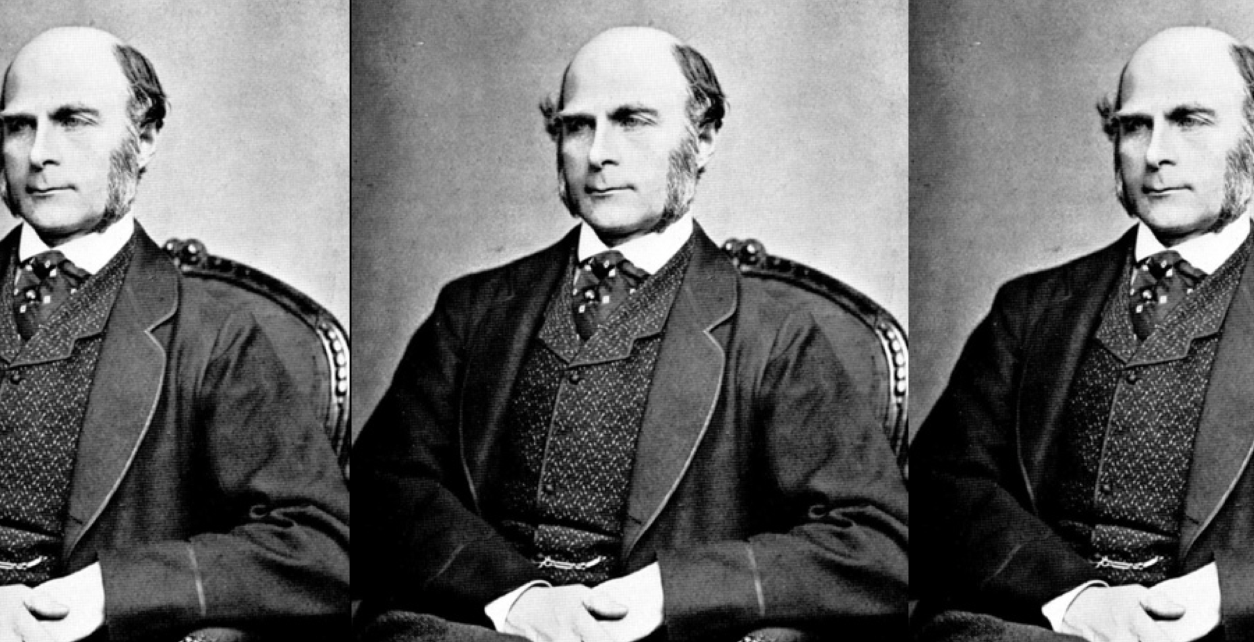
Welcome to part three of my multi-part series on the history of the Quantified Self as a genealogical ancestor of eugenics. In last week’s post, I elucidated Francis Galton’s influence on experimental psychology, arguing that it was, largely, a technological one. In an oft-cited paper from 2013, researcher Melanie Swan argues that “the idea of aggregated data from multiple…self-trackers[, who] share and work collaboratively with their data” will help make that data more valuable—be it to the individual tracking, physician working with them, corporation selling the device worn, or other stakeholder (86). No doubt, then, the value of the predictive power of correlation and regression to these trackers. Harvey Goldstein, in a paper tracing Galton’s contributions to psychometrics, notes that Galton was not the only late-nineteenth century scientist to believe that genius was passed hereditarily. He was, however, one of the few to take up the task of designing a study to show genealogical causality regarding character, thanks once again to his correlation coefficient and resultant laws of regression. more...

Last week, I began an attempt at tracing a genealogical relationship between eugenics and the Quantified Self. I reviewed the history of eugenics and the ways in which statistics, anthropometrics, and psychometrics influenced the pseudoscience. This week, I’d like to begin to trace backwards from QS and towards eugenics. Let me begin, as I did last week, with something quite obvious: the Quantified Self has a great deal to do with one’s self. Stating this, however, helps place QS in a historical context that will prove fruitful in the overall task at hand. more...

In the past few months, I’ve posted about two works of long-form scholarship on the Quantified Self: Debora Lupton’s The Quantified Self and Gina Neff and Dawn Nufus’s Self-Tracking. Neff recently edited a volume of essays on QS (Quantified: Biosensing Technologies in Everyday Life, MIT 2016), but I’d like to take a not-so-brief break from reviewing books to address an issue that has been on my mind recently. Most texts that I read about the Quantified Self (be they traditional scholarship or more informal) refer to a meeting in 2007 at the house of Kevin Kelly for the official start to the QS movement. And while, yes, the name “Quantified Self” was coined by Kelly and his colleague Gary Wolf (the former founded Wired, the latter was an editor for the magazine), the practice of self-tracking obviously goes back much further than 10 years. Still, most historical references to the practice often point to Sanctorius of Padua, who, per an oft-cited study by consultant Melanie Swan, “studied energy expenditure in living systems by tracking his weight versus food intake and elimination for 30 years in the 16th century.” Neff and Nufus cite Benjamin Franklin’s practice of keeping a daily record of his time use. These anecdotal histories, however, don’t give us much in terms of understanding what a history of the Quantified Self is actually a history of. more...

Polling

Horse-race style political opinion polling is an integral a part of western democratic elections, with a history dating back to the 1800’s. Political opinion polling originally took hold in the first quarter of the 19th century, when a Pennsylvania straw poll predicted Andrew Jackson’s victory over John Quincey Adams in the bid for President of the United States. The weekly magazine Literary Digest then began conducting national opinion polls in the early 1900s, followed finally by the representative sampling introduced the George Gallup in 1936. Gallup’s polling method is the foundation of political opinion polls to this day (even though the Gallup poll itself recently retired from presidential election predictions).

While polling has been around a long time, new technological developments let pollsters gather data more frequently, analyze and broadcast it more quickly, and project the data to wider audiences. Through these developments, polling data have moved to the center of election coverage. Major news outlets report on the polls as a compulsory part of political segments, candidates cite poll numbers in their speeches and interviews, and tickers scroll poll numbers across both social media feeds and the bottom of television screens. So central has polling become that in-the-moment polling data superimpose candidates as they participate in televised debates, creating media events in which performance and analysis converge in real time. So integral has polling become to the election process that it may be difficult to imagine what coverage would look in the absence of these widely projected metrics. more...

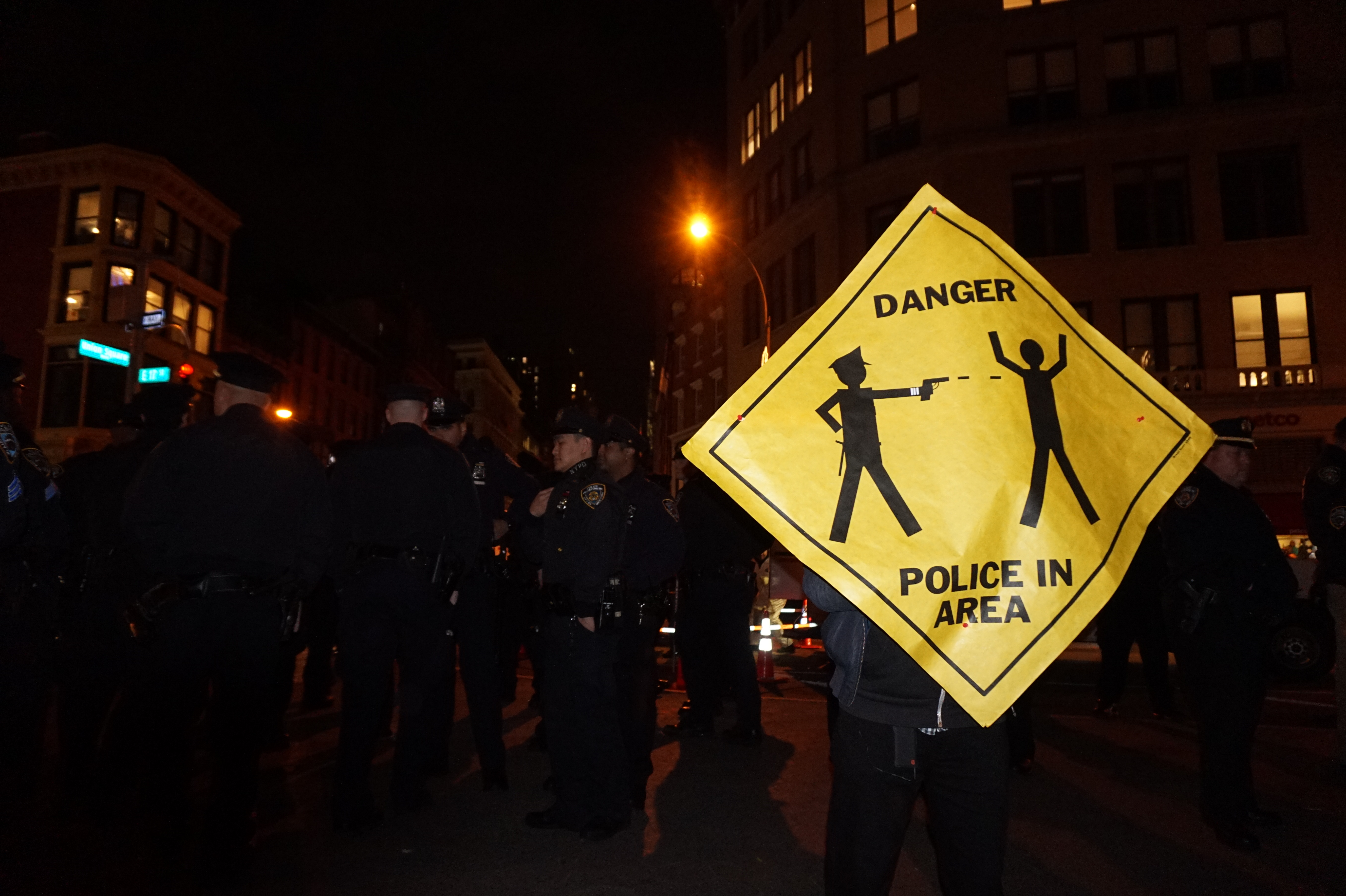
Ferguson Protest, NYC 25th Nov 2014

Statistics are never objective. Rather, they use numeric language to tell a story, and entail all of the subjectivity of storytelling. Indeed, the skilled statistician, like the skilled orator, can bring an audience into the world of their creation, and get the audience to buy fully into the logic of this world. Numbers, like words, are tools of communication, persuasion, connection, and dissent.  Statistics are not objective. But my goodness, statistics can be powerful.

Check out this particularly compelling statistical story about Ferguson Missouri: more...

Today we’re reposting our most popular guest post of the year. This essay has garnered a lot of attention and for good reason: it speaks directly to a kind of liberal racism that is endemic to the institutions and professions that see themselves as the good guys in this problem. -db

Police_in_riot_gear_at_Ferguson_protests

This past December, most major American news outlets ran a story about police shooting statistics and race. No matter where they were situated on the political spectrum, journalists, pundits, and researchers tried to answer the question: Are American police disproportionately targeting and killing black people? The answers were universally supported by data, statistics, claims of objectivity, and a rhetoric of uncomfortable truths. Their conclusions, however, were all over the map. more...


emotion 1

Emotional Contagion is the idea that emotions spread throughout networks. If you are around happy people, you are more likely to be happy. If you are around gloomy people, you are likely to be glum.

The data scientists at Facebook set out to learn if text-based, nonverbal/non-face-to-face interactions had similar effects.  They asked: Do emotions remain contagious within digitally mediated settings? They worked to answer this question experimentally by manipulating the emotional tenor of users’ News Feeds, and recording the results.

Public reaction was such that many expressed dismay that Facebook would 1) collect their data without asking and 2) manipulate their emotions.

I’m going to leave aside the ethics of Facebook’s data collection. It hits on an important but blurry issue of informed consent in light of Terms of Use agreements, and deserves a post all its own. Instead, I focus on the emotional manipulation, arguing that Facebook was already manipulating your emotions, and likely in ways far more effectual than algorithmically altering the emotional tenor of your News Feed. more...

The Cyborgology blog turns one today! [our first post]

We are thrilled with the blog’s success and the community that has grown around it. It has been exciting to see the increase in page views, high quality comments, and discussions on sites like Twitter and Facebook. The Faux-Vintage photo essay took on a life of its own and a recent post on Chomsky was rewritten for Salon.com (here). The blog has advanced a theoretical position we call “augmented reality,” positioned art as theoretically significant, focused on social justice issues and has played host to much audio and video from a range of events. The highlight was watching this community come to life at the Theorizing the Web conference that grew out of the blog.

We began Cyborgology to fill a void we observed in popular and academic discourse: conversations about technology often lacked theory, and theoretical debate often neglects technology.

Since we created the blog 365 days ago, more...