
race

Via aclu.org.
Via aclu.org.

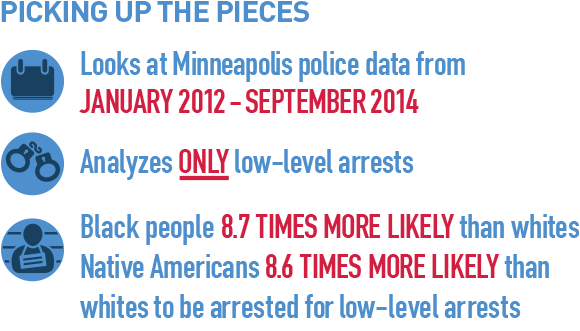
A recently released ACLU investigation a found that black residents of Minneapolis were 8.7 times more likely to be arrested for low-level offenses than white residents between January 2012 and September 2014. The report is the latest in eight city case studies, all of which “describe police departments that reserve their most aggressive enforcement for people of color.” The Minneapolis City Council also recently repealed spitting and lurking ordinances, two examples of the low level offenses cited by the report. Recent sociological research strikes a similar chord; it demonstrates how modern law enforcement isn’t just about crime, but controlling groups of people with minor rules and regulations.

Public discussion about crime tends to focus on felonies, but the majority of law enforcement activity today is geared toward misdemeanors. Even without conviction and sentencing, these minor offenses bring more people into the criminal justice system. The procedural hassle of dealing with a minor criminal record means more people are under this systematic control at any given time, regardless of their guilt or innocence.
The ACLU report finds people experiencing homelessness are the most vulnerable to this system, and many are charged for minor offenses that directly result from being homeless (like panhandling or sleeping outside). Many cities criminalize these behaviors as a way to control space, even to the point that those with criminal records are barred from entering certain neighborhoods.
This law enforcement isn’t just about crime, but also about power in communities of color. Neighborhood-level analysis shows that the stereotypical relationship between race and violent crime rates disappears for communities with more African Americans politically organizing and serving, either in office or on civilian review boards for the police. One of the ACLU’s recommendations to improve the situation in Minneapolis is to establish such review boards.

Race’s role in higher education gets a lot of press. Recent challenges to admissions procedures and classes on race highlight problems with whiteness, raising questions about the state of college diversity.  But what often gets left out of these conversations is the impact of diversity on learning itself and the nuances of how these impacts differ between students.

A diverse student environment can have a positive effect on learning, especially since students from other backgrounds can help each other think about topics differently. In addition, students can learn from the lived experiences of their out-group peers.
While diversity has overall beneficial impacts for the educational process, these outcomes are not created equal. White students are more likely to connect class concepts to abstract theory or class contexts rather than personal experiences, and they are more likely to join in class discussions than are black students.
Students from different backgrounds connect to professors, faculty, and educational spaces differently, affecting their scores and educational success. Notably, this affects the way educators teach and grade. Nonwhite students, particularly under a white teacher, are more likely to feel alienated in the classroom, participate less, and receive lower scores.

By Evan Stewart, Jack Delehanty, Ryan Larson, and Stephen Suh

The shooting of three young adults in Chapel Hill, North Carolina, raises a number of questions about hate crimes in the United States. All three victims were Muslim, and interviews with their family members about previous conflicts indicate the killings may have been motivated by anti-Islamic sentiment. On the other hand, police released a statement that the killings were motivated by a parking dispute, and the regional U.S. attorney called them “an isolated incident.” Research shows the social context of a crime matters, even when it isn’t officially labeled a “hate crime.”

Hate crimes are retaliatory and respond to particular social events and contexts. Racialized talk of hate crime, especially when discussed over the Internet, is provoked by anxieties over close social ties to minorities—such as interracial marriage or integrated neighborhoods—more than economic competition. Time, neighborhood, and labeling factors all point to social context as a necessary tool to understand hate crimes.
Social context is often ignored in hate crime data. Government offices and watchdog organizations often define hate crimes differently than others, and their data focus on the number of attacks rather than contextual risk factors. This makes it difficult to study hate crimes, especially when witness reports or police records show a parking dispute.
Anti-Islamic attitudes are also central to the UNC case. Emerging research indicates these attitudes are unique in the U.S. context as well, where racial bias interacts with cultural bias against public religious practice in a particular political climate.

President Obama’s recently unveiled proposal would make two years of community college freely available to most students who graduate from high school, maintain a 2.5 or greater GPA, and are enrolled at least half time. Others have pointed out that students must also be from families earning $200,000 or less annually to be eligible for the free tuition. Universal access to community college is a popular idea in some circles, but is it really the most effective way to increase equality of opportunities?

How students attend college is changing. Half of students who begin at a four-year college attend at least one other school before graduating (or otherwise leaving school), and over a third take some time off after enrolling initially. Disadvantaged students are more likely to follow interrupted pathways to degree completion, so differences in patterns of college attendance could be influencing social class differences in graduation rates (and thus inequality in opportunities).
While community colleges improve college access and extend post-secondary educational opportunities to underserved groups, they aren’t closing the gap between advantaged and disadvantaged groups in terms of program completion. As a result, they don’t necessarily reduce racial and socioeconomic inequities. However, enrolling in a community college modestly increases the probability of completing a bachelor’s degree among disadvantaged students who would not have otherwise attended college (the majority of community college-goers).
More education yields economic benefits in earnings, occupation and employment. It also provides non-economic benefits in areas like marriage, fertility, social participation, and physical and mental health. The returns on a four-year college degree are greatest for marginal students—those whose decision to attend college could be swayed by free access to community college. Completing an associate’s degree or certain certificates that involve at least a year of coursework can also lead to much greater income when compared to just taking some courses.

Attorney General Eric Holder has reduced the ability of law enforcement agencies to seize assets without a criminal conviction, an “informal measure” of policing known as civil forfeiture. The program had been expanded by the 1984 Comprehensive Crime Control Act in an effort to curtail the sale and distribution of illegal drugs, and it has since allowed law enforcement agencies to divide and keep the majority of proceeds seized from forfeitures.

Proponents argue that civil forfeiture makes certain crimes less profitable and redistributes resources for socially beneficial programs. Critics say it might be part of a “hidden economic agenda” behind “tough on crime” initiatives and can lead to due process infringements
Institutional contexts are important: 40% of law enforcement agencies report dependence on the revenue produced from civil forfeitures. Agencies in states with strict forfeiture policies tend to use federal “equitable sharing” policies more often, even after accounting for factors such as official crime rates and drug arrests. This suggests agencies try to maximize their returns on civil forfeiture seizures.
Law enforcement agencies operating in high inequality areas and more conservative voting districts seize more value per drug arrest. This ratio also increases with agency complexity but drops in districts with higher black populations. Agencies may use more formal measures, such as arrests, in majority minority areas.

Charles Blow recently devoted his Times column to relaying the news that his son, a junior at Yale, was racially profiled and detained at gunpoint by campus police. Blow mentions that he was glad he had had “the talk” with his son—how to deal with police as a black man:

This is the scenario I have always dreaded: my son at the wrong end of a gun barrel, face down on the concrete. I had always dreaded the moment that we would share stories about encounters with the police in which our lives hung in the balance, intergenerational stories of joining the inglorious “club.”

When that moment came, I was exceedingly happy I had talked to him about how to conduct himself if a situation like this ever occurred. Yet I was brewing with sadness and anger that he had to use that advice.

Blow is not the only parent to impart such advice—recall New York Mayor Bill de Blasio’s controversial comment about advising his biracial son in dealings with police. Poor, middle-class, and even rich and well-known* parents of children of color advise their children on how to stay safe—to thrive, they must survive.

Scholars call how parents talk to their children about racial discrimination and how to cope with it “preparation for bias,” and it is just one practice among several that comprise ethnic-racial socialization.
Sociologist Patricia Hill Collins powerfully conveys how this work is done by black women sharing child-rearing responsibilities within woman-centered networks.
And these lessons seem necessary: Black adolescent males report repeated negative interactions with police and black mothers report constant worry about the well-being of their sons, who they believe are profiled and targeted by both police and other citizens.
Parents emphasize racial barriers and protocol to prepare their children for racism, often using role-playing to demonstrate how to reduce risk in reacting (or not reacting) to discrimination.

*For his part, Blow’s son acknowledged his own class privilege in having his experience so widely publicized, a statement his father shared on Twitter.

With more troops coming home from Iraq and Afghanistan, this Veterans Day sees a unique push for public awareness about the challenges that accompany a return to civilian life. Starbucks CEO Howard Schultz has a new book and A&E a new reality show, and the social science shows why we want to pay attention to veterans after they return from service. We have a few previous TROT posts on issues within the military, but unique problems arise in a civilian world which can often be less hospitable than the regiment.

Military service provides a number of social benefits upon returning home. The positive image of having served can even overcome negative stereotypes in civilian life and help advance veterans who have a history of delinquency.
After service, however, institutional problems in civilian life mean veterans don’t all face the same challenges when they return home. For example, the G.I. Bill offered a wide range of education and housing benefits, but historic racial inequality in civilian institutions often made it harder for vets of color to collect those benefits. Today, female vets are more likely to face unemployment than males. However, those with only a high school degree often do earn more than non-vets with only a high school degree, and they are more likely to be enrolled in college.
We can still do a lot of work to improve the military, particularly in leadership and adjudication, but it also has a history of positive institutional changes to address issues like racial inequality and reduce the risks of service for certain minority groups.


On Thursday, November 6, Minneapolis-Saint Paul ABC affiliate KSTP ran a story claiming Minneapolis Mayor Betsy Hodges had “flashed a gang sign” with a “known felon” during a get out the vote drive in North Minneapolis. The photo shows Hodges embracing and pointing at a young black man, and him pointing back. To support the headline that law enforcement officials were “outraged” by Hodges’s interactions with this man, KSTP reporter Jay Kolls quoted retired Minneapolis police officer Michael Quinn, who accused Hodges of “legitimizing gangs who are killing our children.” The story drew an immediate backlash in other press outlets and on social media. Writing in the Star Tribune, University of St. Thomas law professor Nekima Levy-Pounds criticized the media’s routine portrayal of black men as dangerous criminals and argued that such stories desensitize people to institutional racism. Twitter users deployed the hashtag #pointergate to criticize KSTP and Kolls for their inflammatory reporting, and by mid-day Friday, #pointergate was the top non-sponsored hashtag in the U.S. What might KSTP have expected to gain from running a story like this? Should it have anticipated the furious backlash? And should we be surprised that the reaction on Twitter is as big a story as the original report? Playing on fear has long been a media tactic for drawing attention to stories, but the fear of crime and gangs is a special case.

News media organizations construct their stories as secular morality plays that deploy a “discourse of fear,” which transforms news consumers into victims of the problems that the stories construct. The use of these “problem frames” has increased during the 2000s, and the media applies them much more frequently to stories about race, drugs and gangs.
Social media allows marginalized groups to share frustration much more quickly and publicly. In these symbolic conflicts, both sides escalate their positions through the same venues, like Twitter, and the side that escalates fastest usually prevails. KSTP’s silence on Twitter has given their critics full, uncontested voice, and allowed them to make their protest itself a news item.

A new survey from the Pew forum sheds light on widespread online harassment. Young adults in the study reported experiencing more bullying overall, and women were more likely to have been stalked or sexually harassed. These are serious crimes, but routine harassment also isn’t harmless. A new viral video and recent piece from The Daily Show capture women’s everyday experiences with street harassment and catcalling in public. These accounts bring bullying back to light, and social science research shows how and why harassment emerges. 

Bullying isn’t just meaningless cruelty; it is one way groups enforce social norms (especially around gender and race). Challenging harassment often means criticizing society’s deeply held beliefs.
Bullying and harassment are also advanced through social organization. Bullying can emerge when an organization is in chaos and can’t moderate unequal relationships around race and gender, and our legal protection of free speech often makes anti-harassment efforts hard to enforce.

Along with the national release of Dear White People earlier this month, PBS recently debuted a series with a unique take on US race relations called The Whiteness Project. Citing a lack of critical examination of whiteness and white identity as its motivation, the program conducts one-on-one interviews with white Americans “from all walks of life and localities.” In part one of the series, participants from Buffalo, NY are shown responding openly, sometimes jarringly, to questions about race, whiteness, and white privilege. Whitney Dow, the producer/director of The Whiteness Project, claims that through these interviews, the project hopes to examine “both the concept of whiteness itself and how those who identify as ‘white’ process their ethnic identity.”

Scholars from numerous disciplines have written thoughtfully and critically about Whiteness and how it pertains to U.S. race relations. Matthew M. Hughey and Matt Wray, both TSP contributors, have also written on the subject.