politics

Americans, and even the sociologists among us, tend to think about crime as a problem related to people and their economic characteristics. Crime, we theorize, is caused by poverty or relative poverty (larger differences between the haves and have nots), joblessness, more lucrative underground occupations, or an insufficient safety net.

Other scholars have examined non-economic correlates of crime. One study of serial killing, for example, found that these crimes were more common in big cities with higher percentages of single-person households. The anonymity of a bustling metropolis, plus the likelihood of finding people all alone in their apartment, may attract killers, tempt people who otherwise wouldn’t kill, or both. Reducing people’s isolation might be protective.

Another interesting non-economic factor that has gotten recent attention is lighting. When early lighting companies began lobbying cities to install the first street lights at the end of the 1800s, they argued that bright lights would certainly deter crime. Historian Ernest Freeberg, in his book The Age of Edison, writes that:

…lighting companies marketed their product as noting less than a police force on a pole. After nightfall, urban parks became notorious danger zones, a haven for the city’s dregs and an infernal playground of indecency. Now all that could end, not by converting sinners or reforming criminals, but by harnessing light’s power of exposure.

City leaders were swayed and artificial nighttime lighting in parks and streets eventually became an expected and routine part of city-building.

15540252507_30c511d3a7_z
Photo by Shinichi Higashi, Flickr Creative Commons.

But does it work? The consensus appears to be maybe a little and no. The no comes from a new study, a natural experiment published in 2015. Since 2000, cities in England and Wales have reduced street lighting to save money and reduce carbon emissions. The study, led by social and environmental health researcher Rebecca Steinbach, found no clear correlation between turning the lights down and a rise in crime (or car crashes, for that matter).

I’m excited by this research on the relationship between crime and non-economic characteristics of cities, whether the hypotheses bear out or not. It gives us creative ideas about how we might reduce crime — above and beyond the all-important economic issues — and may also show us where we might be wasting our resources.

Lisa Wade, PhD is an Associate Professor at Tulane University. She is the author of American Hookup, a book about college sexual culture; a textbook about gender; and a forthcoming introductory text: Terrible Magnificent Sociology. You can follow her on Twitter and Instagram.

TSP_Assigned_pbk_978-0-393-28445-4Assigned: Life with Gender is a new anthology featuring blog posts by a wide range of sociologists writing at The Society Pages and elsewhere. To celebrate, we’re re-posting four of the essays as this month’s “flashback Fridays.” Enjoy! And to learn more about this anthology, a companion to Wade and Ferree’s Gender: Ideas, Interactions, Institutions, please click here.

.

Is the “Mrs. Degree” Dead?, by Laura Hamilton, PhD

In 1998 I was a first-year student at DePauw University, a small liberal arts college in Indiana. A floor-mate of mine, with whom I hung out occasionally, told me over lunch that she was at college primarily to find a “good husband.” I nearly choked on my sandwich. I had assumed that the notion of the “Mrs. Degree” was a relic of my parents’ era—if not my grandparents’. Surely it had gone the way of the home economics major and women’s dormitory curfews.

8435526776_b47fb121c5_z
Photo via clemsonunivlibrary flickr creative commons

Years later, I — along with my co-director, Elizabeth A. Armstrong — would embark on a five year ethnographic and longitudinal study of a dormitory floor of women at a public flagship in the Midwest. As part of my dissertation, I also interviewed the women’s parents. What I found brought me back to my first year of college. A subset of parents wanted their daughters to be “cookie-baking moms”—not successful lawyers, doctors, or businesswomen. They espoused gender complementarity—a cultural model of how women should achieve economic security that relied on a co-constructed pairing of traditional femininity and masculinity. That is, men were to be economic providers and women supportive homemakers. This was a revised “Mrs.” Degree, in the sense that marriage during college, or even right after, was not desirable. College women were to build the traits and social networks that would hopefully land them a successful husband eventually, but it was assumed best to wait until men had proven themselves in the labor market before entering a marriage.

This was not the only cultural model to which women on the floor were exposed. In fact, those coming in primed for complementarity were in the minority. However, as I show in my article, “The Revised MRS: Gender Complementarity at College,” far more women left college leaning toward gender complementarity than their previous gender socialization suggested. Something was happening on the college campus — where women were, ironically, out-achieving men — that shifted them toward performing an affluent, white, and heterosexual femininity, marked by an emphasis on appearance, accommodation to men, and a bubbly personality.

I argue that gender complementarity is not just a characteristic of individual women, but is actually encouraged by the institutional and interactional features of the typical, four-year, public state school. Midwest U, like other schools of its kind, builds a social and academic infrastructure well-suited to high-paying, out-of-state students interested in partying. The predominately white Greek system — a historically gender-, class-, and racially-segregated institution — enjoys prominence on campus. An array of “easy” majors, geared toward characteristics developed outside of the classroom, allow women to leverage personality, looks, and social skills in the academic sphere. These supports make it possible for peer cultures in which gender complementarity is paramount to thrive. Women who want to belong and make friends find it hard — if not impossible — to avoid the influence of the dominant social scene on campus, located in fraternities and Greek-oriented bars.

This structure of campus life is not incidental. In recent years, cuts to state and federal support for higher education have led mid-tier public institutions like Midwest U to cater to the socially-oriented and out-of-state students who arrive with gender complementarity interests. These class-based processes have implications for the type of social and academic climate that all students find upon arriving at Midwest University.

The problem is, however, that most women need to accrue the skills and credentials that translate into a solid career. An institution supporting gender complementarity does them a serious disservice — potentially contributing to gendered differences in pay after college. The situation is particularly problematic for students not from the richest of families: Affluent women espousing complementarity form the type of networks that give them reasonable hope of rescue by a high-credentialed spouse, and heavy parental support means that they can afford to be in big cities where they mix and mingle with the “right” men. Women from less affluent backgrounds lack these resources, and are often reliant on their own human capital to make it after college.

The gradual shift from higher education as a public good — funded heavily by the state — to a private commodity — for sale to the highest bidder — has significantly stalled not only progress toward class equality, but certain forms of gender equality as well. Change is going to require unlinking the solvency of organizations like Midwest U from the interests of those can afford, and thus demand, an exclusionary and highly gendered social experience.

Laura T. Hamilton, PhD is an assistant professor of sociology at the University of California, Merced. Her recently published article, “The Revised MRS: Gender Complementarity at College,” appears in the April 2014 issue of Gender & Society; this post originally appeared at their blog. She is the author of Parenting to a Degree: How Family Matter’s for College Women’s Success and, with Elizabeth Armstrong, Paying for the Party: How Colleges Maintain Inequality.

Many are aghast at a cartoon recently released by a well-known right-leaning cartoonist, Ben Garrison. Rightly, commentators are arguing that it reproduces the racist stereotype that African American women are more masculine than white women. I’ll briefly discuss this, but I want to add a twist, too.

The block versus cursive font, the muscularity and the leanness, the strong versus swishy stance, the color and cut of their dresses, the length of their hair, the confrontational versus the compliant facial expression, and the strategically placed, transphobic bulge in Michelle Obama’s dress — you could hardly do a better job of masculinizing Michelle and feminizing Melania.

This is a racist stereotype not only because it posits that black women are unattractive, unlikable, and even dangerous, but because it has its roots in American slavery. We put middle class white women on pedestals, imagining them to be fragile and precious. But if women were fragile and precious, how could we force some of them to do the hard labor we forced on enslaved women? The answer was to defeminize black women. Thanks for keeping the stereotype alive, Ben Garrison.

What I’d like to add as a twist, though, is about Michelle’s expression, purposefully drawn as both ugly and judgmental. Michelle’s face isn’t just drawn as masculine, it’s aimed at Melania and she isn’t just sneering, she’s sneering at this other women.

The cartoon also places women in competition. It tells a sexist story of ugly (black) women who are hateful toward beautiful (white) women. It tells a story in which women are bitter and envious of each other, a ubiquitous story in which women tear each other down and can’t get along. It’s a terrible stereotype, demeaning and untrue (except insofar as patriarchal relations make it so).

And it’s especially reprehensible when it’s layered onto race.

Lisa Wade, PhD is an Associate Professor at Tulane University. She is the author of American Hookup, a book about college sexual culture; a textbook about gender; and a forthcoming introductory text: Terrible Magnificent Sociology. You can follow her on Twitter and Instagram.

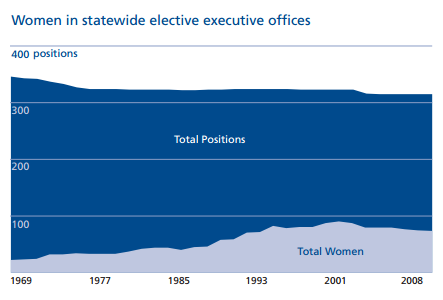
NPR recently aired a story about female lawmaker’s representation state by state. According to the story, Colorado has the most women; female lawmakers make up 42% of that total. Wyoming had the least, with women only representing 13% of state lawmakers.

NPR’s experts suggested that term limits in Colorado and a female-friendly party leadership were behind their high number of female legislators, whereas a change in Wyoming from multi-member to single-member district in the 1990s was unfavorable to women (because voters have to pick only one and tend to lean toward men when they have to make hard choices). The story also mentioned voting rules and the difficulty of balancing home, work, and lawmaking responsibilities.

In fact, sociologists have been studying this issue in depth for some time and a few years ago Deborah Carr summarized the reigning wisdom on why women are less likely to be politicians. She highlighted six factors to explain the gender gap in the US Congress:

  1. Women have to face sexism (e.g., glass ceiling – Nancy Pelosi used the term marble ceiling in her inaugural speech as Speaker in 2007), especially voters’ sex role stereotyping “what women can and should be.”
  1. Women are not in the “pipeline,” suggesting that not enough women are in careers that have historically led to political office.
  1. Because of gendered wealth and income inequality, women don’t as often have enough money to run multi-dollar campaigns, nor access to social networks full of big donors.
  1. Women have different interests, focusing on “issues related to family and social welfare, rather than national defense and international relations.”
  1. Women are less likely to be risk-takers than their male counterparts, perhaps explaining why women must be asked several times before they seriously consider launching campaigns.
  1. Women opt out of politics because of family responsibilities.

4

To improve female participation in politics, we should promote more gender-neural political environments. Political parties should take further steps to recruit and support female candidates, as Colorado seems to be doing. We should repeatedly encourage women to run for office since they take a lot of encouragement before they seriously consider launching candidacies. More importantly, we need to seed the pipeline by encouraging young girls to get involved in student government and see governing as compatible with their interests and abilities.

Sangyoub Park, PhD is a professor of sociology at Washburn University. His research interests include social capital, demographic trends, and post-Generation Y.  

One word in the headlines last week seemed like a throwback to an earlier era:

As Trump moves to soften his image, Democrats seek to harden it

The Washington Post

Donald Trump to reshape image, new campaign chief tells G.O.P.

The New York Times

Trump surrogates say GOP front-runner “projecting an image” during primaries

— Fox News

It was in the 1960s that politicians, their handlers, and the people who write about them discovered image. The word carries the cynical implication that voters, like shoppers, respond to the surface image rather than the substance – the picture on the box rather than what’s inside.  A presidential campaign was based on the same thing as an advertising campaign – image.  You sold a candidate the same way you sold cigarettes, at least according to the title and book jacket of Joe McGinnis’s book.

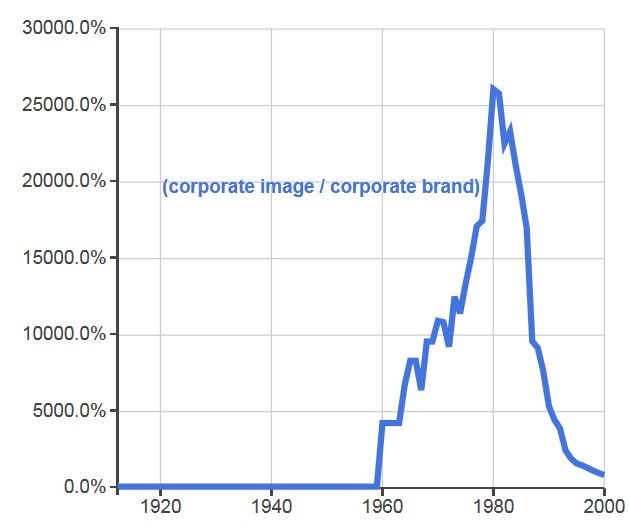
Then, sometime around 1980, image began to fade. In its place we now have brand. I went to Google N-grams and looked at the ratio of image to brand in both the corporate and the political realm. The pattern is nearly identical.


The ratio rises steeply from 1960 to 1980 – lots more talk about image, no increase in brand. Then the trend reverses. Sightings of image were still rising, but nowhere nearly as rapidly as brand, which doubled from 1980 to 2000 in politics and quadrupled in the corporate world.

Image sounds too deceptive and manipulative; you can change it quickly according to the needs of the moment. Brand implies permanence and substance (not to mention Marlboro-man-like rugged independence and integrity.) No wonder people in the biz prefer brand.

Decades ago, when my son was in grade school, I met another parent who worked in the general area of public relations. On seeing him at the next school function a few weeks later, I said, “Oh right, you work in corporate image-mongering.” I thought I said it jokingly, but he seemed offended. He was, I quickly learned, a brand consultant. Image bad; brand good.

In later communications, he also said that a company’s attempt to brand itself as something it’s not will inevitably fail.  The same thing supposedly goes for politics:

“One thing you learn very quickly in political consulting is the fruitlessness of trying to get a candidate to change who he or she fundamentally is at their core,” said Republican strategist Whit Ayres, who did polling for Rubio’s presidential campaign before he dropped out of the race. “So, is the snide, insulting, misogynistic guy we’ve seen really who Donald Trump is? Or is it the disciplined, respectful, unifying Trump we saw for seven minutes after the New York primary?

These consultants are saying what another Republican said a century and a half ago: “You can fool all the people some of the time, and some of the people all the time, but you cannot fool all the people all the time.”

This seems to argue that political image-mongers have to be honest about who their candidate really is. But there’s another way of reading Lincoln’s famous line: You only need to fool half the people every four years.

Originally posted at Montclair SocioBlog.

———————

Jay Livingston is the chair of the Sociology Department at Montclair State University. You can follow him at Montclair SocioBlog or on Twitter.

Wealth inequality in the U.S. is extreme, but global wealth inequality, illustrates a video by The Rules, is even more stunning. Some facts:

  • The top 20% control 80% of the world’s wealth.
  • The richest 2% control more wealth than the bottom half of the world’s population.
  • The richest 300 people on earth have more wealth than the poorest 3,000,000,000.
  • 200 years ago, rich countries were three times as rich as poor countries. Today, they are eighty times richer.
  • Rich countries give $130 billion dollars worth of aid to poor countries every year, but they extract $2 trillion each year thanks to global economic rules.

Here are their sources; or watch the four minute video:

The Rules wants to reveal and challenge the laws that govern our global economy. It is a distinctly sociological project, looking at how factors outside of individuals — or, in this case, countries — shape lives. Shaped strongly by the richest countries in their own best interest, rules governing the trading of goods and money are determining the economic solvency and future of countries.

When those rules are invisible, it can seem like struggling countries are just poorly managed or culturally problematic when, in fact, the rules ensure that the deck is stacked against them.

Hat tip to Martin Hart-Landsberg.

Lisa Wade, PhD is an Associate Professor at Tulane University. She is the author of American Hookup, a book about college sexual culture; a textbook about gender; and a forthcoming introductory text: Terrible Magnificent Sociology. You can follow her on Twitter and Instagram.

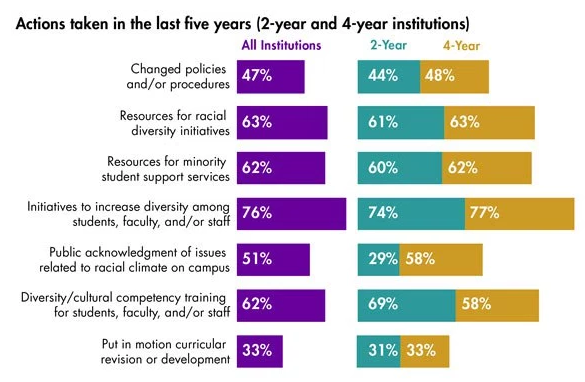
A survey of college and university presidents conducted earlier this year suggests that campus activists are making a difference. The American Council on Education asked 567 presidents about their experience with and response to activists on campus organized around racial diversity and justice.

Almost half (47%) of presidents at 4-year institutions said that such activism was occurring on their campuses and that the dialogue about such matters had increased (41%). The majority (86%) had met with student organizers more than once and more than half (55%) said that the “racial climate” on campus was more of a priority  than it had been just a few years ago. The trends for 2-year institutions were weaker, but in the same direction.

When asked what concrete steps they had taken to improve the racial climate, presidents reported a range of strategies:

5

As with all activism, progress requires vigilance, so it will be interesting to see how many of these efforts translate into real changes in climate. New policies and procedures can be toothless or even harmful, resources can be mis-spent and trainings can be terrible, public acknowledgement can be nothing but lip service, and curricular revision can die in committee. Still, these data point to the potential for activism to make a difference and are encouraging for those of us who care about this issue.

Cross-posted at Pacific Standard.

Lisa Wade, PhD is an Associate Professor at Tulane University. She is the author of American Hookup, a book about college sexual culture; a textbook about gender; and a forthcoming introductory text: Terrible Magnificent Sociology. You can follow her on Twitter and Instagram.

Earlier this year Brandy Zadrozny interviewed me for a Daily Beast story about the new CDC guidelines for alcohol consumption by women. It caused an outcry because it advised all women who could potentially become pregnant to completely abstain from alcohol as a way to prevent fetal alcohol spectrum disorders.

Responses across the blogosphere included several objections, including the fact that research shows that alcohol alone is not sufficient to cause fetal harm (enter poverty as a major confounding factor) and paternal drinking prior to conception is believed to contribute to incidence of these disorders, too, despite no advice to men of fertile age to refrain from any alcoholic consumption.

Interesting points, but an argument made by Renée Ann Cramer in Pregnant with the Stars gave what I thought was some interesting historical perspective.

Until feminists fought to make it otherwise, she explains, it was perfectly legal in America to refuse to allow women access to certain jobs because they might get pregnant. If the working conditions were too challenging or involved exposure to dangerous chemicals, women were considered unfit for the work by virtue of their always-potentially-pregnant status. And if they did this work and harm did come to a child, it was considered a failure of the state to adequately protect her.

Feminists fought to make this “protectionism” illegal, demanding that women themselves have the right to decide, alongside men, if they wanted to take occupational risks. And they largely won this fight.

In turn, though, women themselves came under scrutiny. They were no longer excluded from certain jobs, but if they chose to do them, it was reasonable to judge them harshly for doing so. Cramer calls this the “responsibilization” of pregnancy. Now that women had the right to handle their pregnancy (or pre-pregnancy) however they wished, they (and not the state) would be held responsible for doing so in ways that society approved or disapproved.

This is what the CDC guidelines are doing. It’s not legal to “protect” women from harming her not-yet-existing fetus by refusing to serve her alcohol. Women have the same rights as men. But with rights comes responsibilization and if women don’t make the choices endorsed by their communities, the health industry, and even the federal government, they can expect to be surveilled, judged, and possibly bullied into doing so.

Cross-posted at Pacific Standard.

Lisa Wade, PhD is an Associate Professor at Tulane University. She is the author of American Hookup, a book about college sexual culture; a textbook about gender; and a forthcoming introductory text: Terrible Magnificent Sociology. You can follow her on Twitter and Instagram.