gender: history

Eric S. sent us a link to the webpage for the Sun-Maid Girl, the girl used to represent Sun-Maid raisins. Here is the original painting of the first Sun-Maid Girl, Lorraine Collett Peterson:

The logo was most recently updated in 1970; here is the current incarnation:

In discussing the original painting, the website says,

Sometimes we forget that in 1915 there were no electric hair dryers, that television would not be invented for decades to come, and that automobiles were not in every home. Life was much simpler, more rural, a lot less hectic and sunbonnets were still part of women’s fashion in California.

I like the romanticization of the past there. In 1915…World War I was going on. I guess life was “less hectic” in that you didn’t have a Blackberry to check every 15 seconds, but overall, I’m not sure I’d say it was “simpler” in a way that implies everyone had time to just sit around eating raisins and drying their hair in the sun.

Also from the website:

To Payne, the sight of the red sunbonnet and the pretty girl in the morning sun was the ideal personification of E.A. Berg’s brand name SUN-MAID.

This might be an interesting addition to some of the images in this, this, and this post about the sexualization of food. Whereas the women in those instances are mostly explicitly sexualized, in this case, the product is being associated with an idealized, non-sexual “maiden” version of femininity. I just thought it might make a good contrast if you’re discussing connections between women and food–the use of female sexuality and idealized female chasteness as marketing tactics related to food products. I wonder if Sun-Maid has stayed with the de-sexualized icon because raisins are associated with children?

FYI, Sun-Maid was one of the companies boycotted by United Farm Workers of America, the group let by Cesar Chavez.

Thanks, Eric S.!

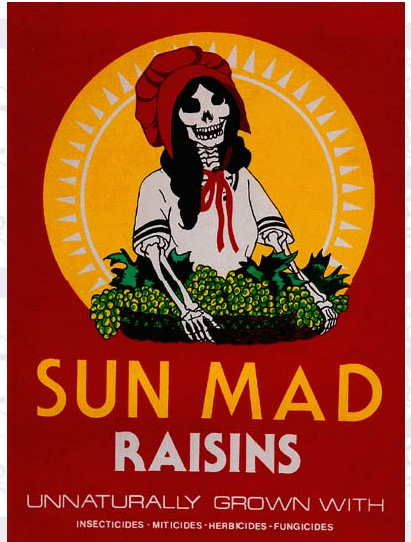
NEW: In a comment Adriana pointed us to Ester Hernandez’s parody of the Sun-Maid girl:
Thanks, Adriana!
One topic we cover in my sociology classes is the way the nature vs. nurture debate treats those two categories as though they are completely separate entities: “nature” is this fixed biological reality and “nurture” is all the social stuff we use to tinker around with nature as best we can. I point out to students that biology isn’t as fixed as we often think it is, and that seemingly “natural” processes are in fact often highly influenced by social factors.

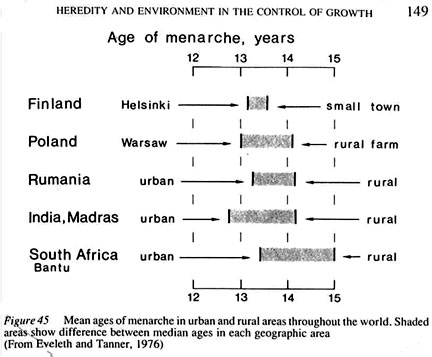
One good example of this is the age at which girls have their first periods (menarche). In the U.S. today, the average age at menarche is a little over 12 years (see source here), and that seems normal to us. But historically, this is odd; until quite recently, girls did not begin menstruating until well into their teens. Because girls have to develop a certain amount of body fat in order to menstruate, access to food affects age at menarche. And access to food is generally an indicator of all types of social factors, including societal wealth and the distribution of wealth within groups. In general, economic development increases access to sufficient levels of food, and thus reduces average age at menarche.

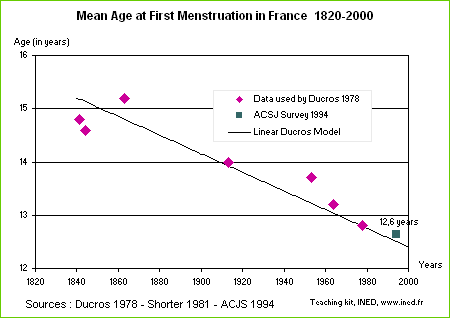
This graph of average age at menarche in France from 1840-2000 (found on the French National Institute for Demographic Studies website here) shows a clear decline, starting at over 15 years and now standing at under 13:

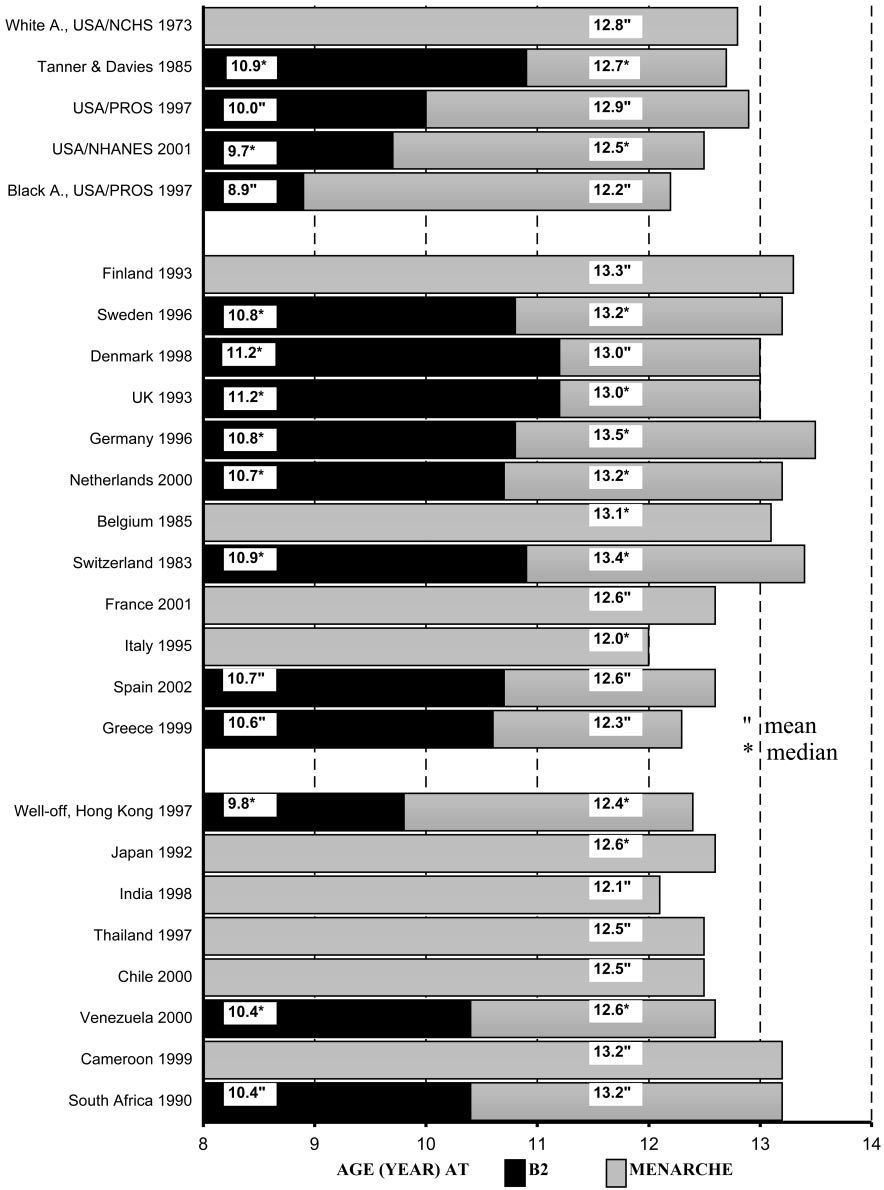
Below is a bar graph showing average age at menarche for a number of countries (found here; age at menarche is the grey bar); we see the oldest average age is 13 and a half years, in Germany. Note that the data are not all from the same year, and while most report mean age at menarche, some report median age, so though they show a general trend, they are not stricly comparable:

However, these average ages obscure the fact that access to resources is not equal within nations, and as we would expect, though average age at menarche has fallen for most nations over the past century, we continue to see differences in average age among groups within nations that seem to mirror differences in wealth. For instance, this graph (found at the Museum of Menstruation website here) shows differences in average age at menarche between urban and rural areas in several countries:

The example of the quite dramatic fall in average age at menarche, as well as continued differences within societies, is a very helpful example for getting across the idea that biology is not fixed. I explain to my students that though we have many biological processes (i.e., the ability to menstruate), social factors such as economic development and social inequality affect how many of those processes are expressed (i.e., how early girls being to menstruate, on average). For other examples of how social factors affect biology, see this post on average lifespan and this post on increases in height over time.

I’m currently pairing these images with the chapters “The Body’s New Timetable: How the Life Course of American Girls Has Changed” and “Sanitizing Puberty: The American Way to Menstruate” from The Body Project: An Intimate History of American Girls, by Joan Jacobs Brumberg (1997, NY: Vintage Books) in my women’s studies course. Brumberg argues that the decreasing age of menstruation has created new social pressures as there is an increasing gap between girls’ biological maturity (that is, being able to get pregnant at age 12 or so) and their mental and emotional maturity (they’re still 12 year old girls), a point activists were trying to make in these misguided PSAs about statutory rape. Brumberg argues that just as this was happening, American cultural understandings of menstruation turned it into a hygiene problem, not a maturational milestone, meaning we give girls information about tampons and sanitary pads but not much about what these changes really mean.

Just for fun, here is “The Story of Menstruation,” an animated cartoon put out by the Disney company in 1946. Millions of girls learned about menstruation from it in the ensuing decades, including that they could throwing their schedules off by getting too emotional or cold and that it’s ok to bathe as long as the water isn’t too hot or cold. It illustrates Brumberg’s point about how discusses of menstruation turned to scientific explanations of what was happening and advice about what was and wasn’t ok to do while menstruating, while mostly ignoring it’s emotional or social significance.

I also like the explanation at the beginning of why we refer to “Mother” nature–because she does all her work without anyone even noticing, just like moms. How nice.

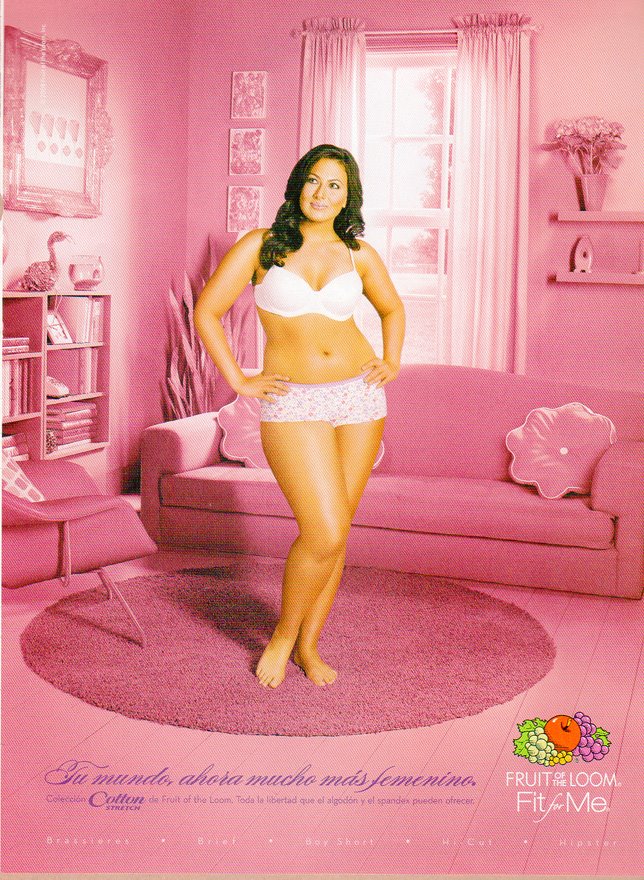
Multicult Classics posted these two Spanish-language Fruit of the Loom ads.  They are an extra nice example of the way that color is used to communicate gender:


Text: “Your world, now much more feminine.”

See also this post of kids with their stuff, these pictures of the Toys ‘R Us aisles, these breast cancer PSAs, and these guns marketed to women.

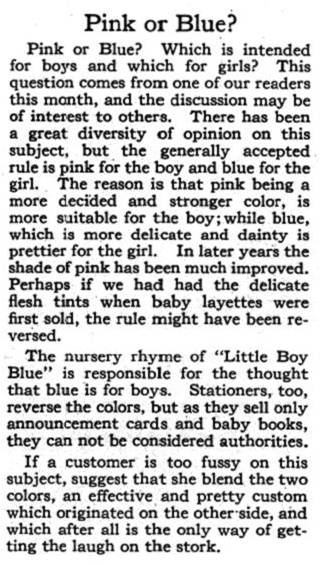
It’s obvious to us, today, that pink is for girls.  But it wasn’t until about the 1950s that our current gendered color scheme became widely accepted.  Before that, the colors were reversed.  In this excerpt for a vintage advice column (found here), we learn that:

“…the generally accepted rule is pink for the boy and blue for the girl.  The reason is that pink being a more decided and stronger color, is more suitable for the boy; while blue, which is more delicate and dainty is prettier for the girl.”

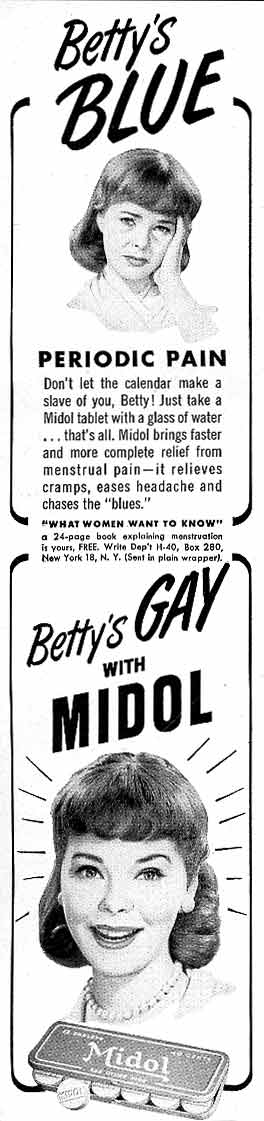
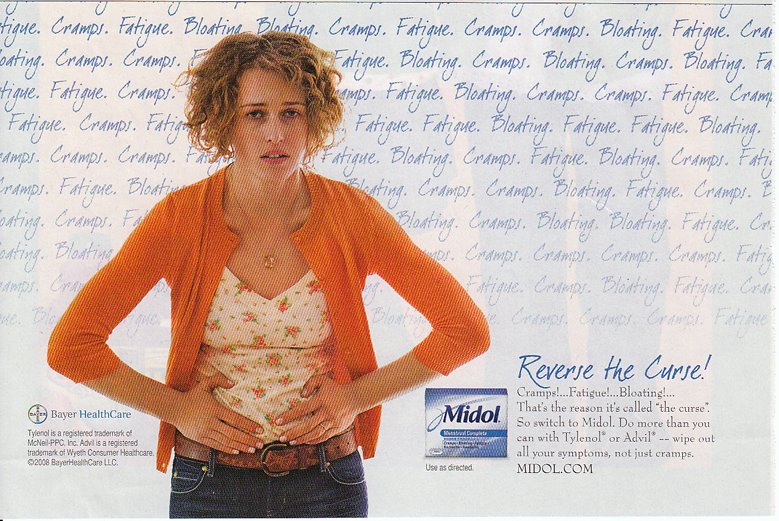
Hmmm… which Midol ad will you hate/love the most?

This one is from the 1960s (found here via Pam’s House Blend):

This one is from the 1990s (found at Feministing):

This is a brand new ad campaign from Midol (found at MultiCultClassics).  The text says “Reverse the Curse!”  The curse, of course, being women’s punishment for original sin. 

CORRECTION/CLARIFICATION: I am reposting this because I want to make clear that a couple of things that people picked up on in the comments are MY mistakes/confusing wording, not Jackson Katz’s. First, in regards to the Rambo movies, I was confusing Rambo:First Blood Par I, which came out in 1982, with Rambo:First Blood Part II, which came out in 1985, which is what Katz is quoting in the movie. I just googled the movie to find the year it came out and didn’t notice it was for Part I, not Part II. I have corrected that below.

As for the Terminator image, that is entirely my fault. I could not find the exact image Katz used in the documentary, though I searched for quite a while. I just put up an image I meant to be representative of both Terminator movies, and the one I used, as the commenters point ou, was not a good example of what I was saying. Since I can’t find the image Katz used, I have taken the Terminator image out of the post.

I just wanted to a) correct those two things and b) make it clear that they were my mistakes, not Katz’s.

*****

In the documentary Tough Guise: Violence, Media & the Crisis in Masculinity, Jackson Katz discusses how images of masculinity in pop culture have changed over time, and particularly how in the 1980s and 1990s images of male heroes got larger and more menacing, as well as hyper-violent. He uses Humphrey Bogart, Clint Eastwood, Sylvester Stallone, and Arnold Schwarzenegger as examples. I’m basing my discussion of the images from movies on Katz’s analysis.

In this image of Humphrey Bogart (found here) in The Maltese Falcon (1941), his gun is very small compared to his body. His body language is not particularly imposing or threatening. Keep in mind this was during World War II (though the U.S. had not joined yet) and that machine guns had been invented during the Civil War. So Humphrey Bogart conceivably could have been shown holding some sort of automatic weapon instead of a small handgun.

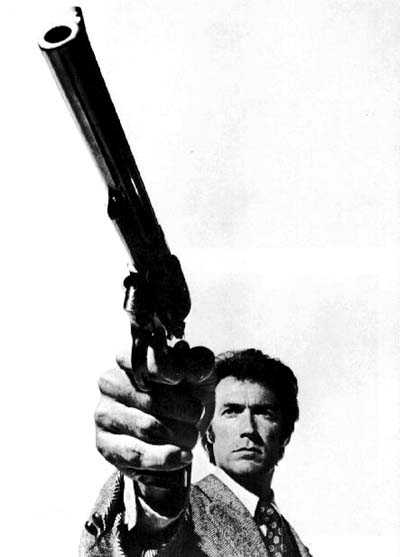
Then we have Clint Eastwood in Dirty Harry, from 1971 (found here). The gun has gotten much bigger and the body posture a bit more threatening.

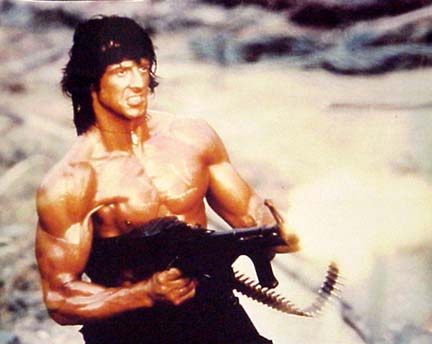
And in 1985 we get Rambo:First Blood Part II (found here), a military revenge fantasy in which a Vietnam vet gets to finish the war the U.S. military wasn’t “allowed” to win, presumably because of weak, feminized elements that controlled the government. Stallone’s body is huge and muscular, and the gun has gotten larger and more deadly.

Katz attributes these changes in images of masculinity to a growing concern in U.S. culture that we are somehow being “feminized” and becoming weak. He argues that the loss in Vietnam (or lack of an outright win, if you prefer) as well as political and economic gains by women and non-whites caused a cultural panic about the status of white men. As these men were supposedly losing power and status in everyday life, cultural images of them emphasized strength, power, and aggression as a version of ideal masculinity.

Here is a clip from Tough Guise:

And here’s a clip that takes the Tough Guise intro but adds some other images:

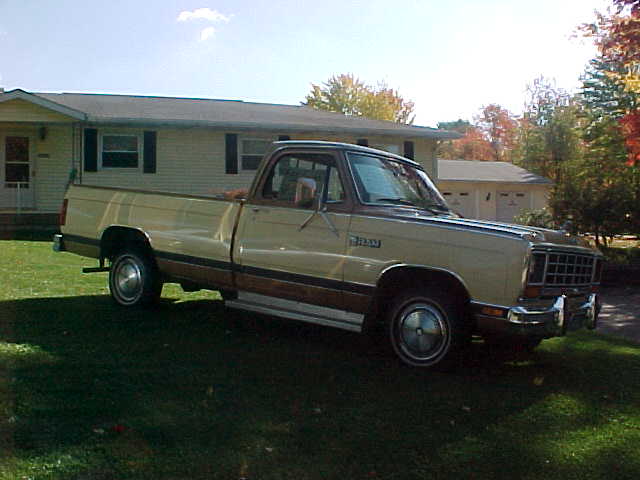
I was thinking about this because when I was in Oklahoma, I was around a lot of trucks, and specifically, a lot of old farm trucks. And one day when I was standing next to an old Dodge Ram, it hit me how much less…I don’t know…imposing it was than newer trucks. It seemed like a cute little toy truck. Here’s a picture of a 1985 Dodge Ram (found here):

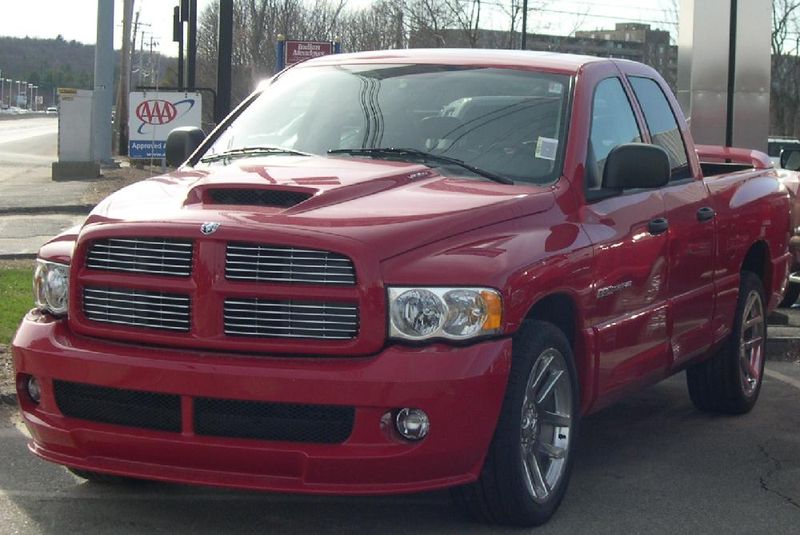
The 2005 version of the Dodge Ram (found here):

Looking at my family’s old farm trucks (and we’ve got a collection of rotting, rusting trucks dating from the 1950s on; I did not post pictures of our trucks because my grandma would kill me for exposing our farm junkiness to the world), I kept thinking, “We used to haul cattle with that?” or “That was considered sufficiently masculine at one point?” And the answer is, yes. Yes, they were.

Now, I’m certain that a lot of the redesigns had to do with advances in safety and efforts to improve fuel efficiency (by making the truck body more rounded, for instance). But there also seems to be a pattern in trucks today to design their headlights and grills to look sort of “mean,” if you will–like they’re snarling or growling.

I’m not necessarily saying there’s a connection between Katz’s work and the way trucks have been redesigned to look meaner and more aggressive…but it just got me thinking.

Of course, as a farm kid, what strikes me about trucks is the way the newer designs make them less functional for the types of things you see people doing in truck ads. While the cabs have gotten larger, making room for more passengers (that is, more like a car), the beds have gotten smaller, so you can’t carry as much (or as long of) stuff in them–and carrying stuff in the back is what you supposedly need a truck for. Yes, you can still stick more stuff in the back of, say, a new Dodge Ram than in a lot of cars, but I’m just sayin’. (Also, you’d be shocked at how much stuff I can get in the back of a Honda Civic if I lay the seat down and am really motivated. And my mom once brought a 130-pound calf home in the backseat of a car–I had the fun job of trying to keep him from attempting to crawl into the front. And we had a woman in my hometown who used to haul pigs around in the backseat of her Caddy.) A lot of things we used to haul around in the back of our trucks wouldn’t fit in the beds of new trucks, or you couldn’t fit nearly as much of them. And of course the majority of people who buy trucks for their big motors aren’t doing the types of things (driving through extremely rocky or muddy country, hauling trailers full of cattle, etc.) that require such a huge motor in the first place. So why not just buy a car?

Just some thoughts that struck me while hanging out on the farm.

Pro- and anti-natal policies are those that encourage and discourage childbearing respectively.  There’s an excellent article in the New York Times today about pro-natal efforts in Europe.  The population is falling there due to a low birth rate.

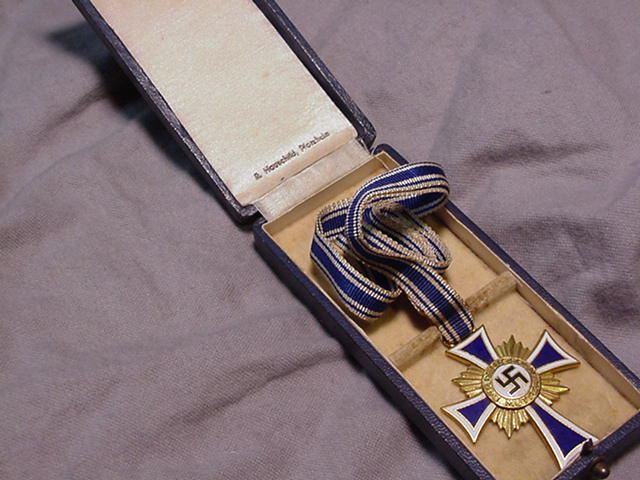
One of the things they mentioned in the article was the Third Reich “Mother’s Cross” (I found this one here).  Women who had four children were awarded a bronze medal, women who had six a silver, and women who had eight a gold. (This was a eugenic strategy, of course; an effort to increase the birthrate for pure, white people.) 

I think one of the most fascinating things about this medal is not so much the pro-natal, or even eugenic story, but the explicit linking of military service with motherhood.  There are plenty of good arguments to make that being a mother is a service to the nation just like military service.  After all, as is recognized in Europe, if women stop having babies, eventually there will be no nation at all.  Also, being a mother involves sacrificing yourself, taking time out of the labor force and, indeed, risking your life and health.  (Ann Crittenden makes this argument in The Price of Motherhood.)  Of course, in the U.S. we don’t value motherhood the way we value military service.   And, sigh, we are awarded no medals for bringing new human beings into existence.  We do, however, have pro-natalist policy.  The fact that we get a tax write-off for every child we have is a direct economic incentive to reproduce. 

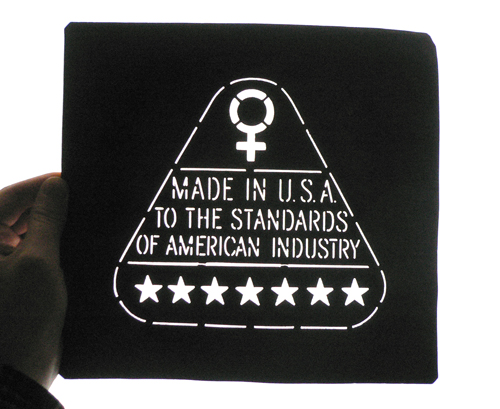
This is an image of brass stencil that was used to identify products made by women during WWII.

Found here thanks to Breck C.

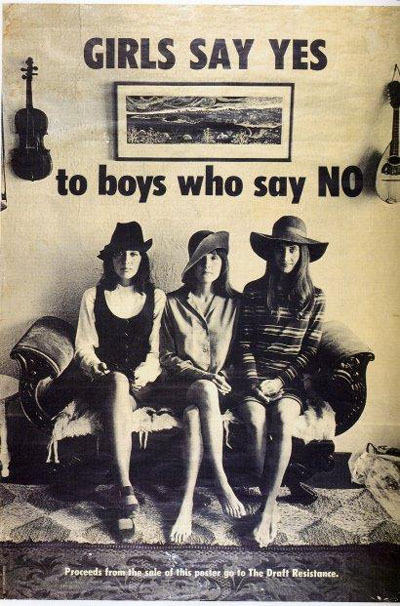
Vietnam-era anti-draft propaganda from The Draft Resistance offers girls to pacifist boys.

From Vintage Ads via Jezebel.