economics: capitalism

Ria sent along an example of something simultaneously routine and jarring.  Disney princess grapes:
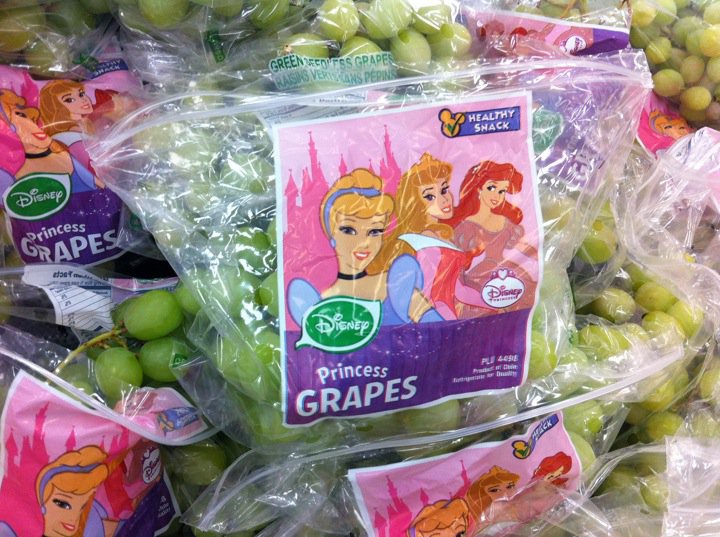
Thinking out loud here:  By now, in the U.S., we’re used to thinking about food being branded with mascots, movie/tv show characters, and even corporate entities.  When I posted about Cars– and Disney princess-themed diet snack packs, for example, it wasn’t the branding of food that interested me.  But there is something unfamiliar to me about the associating of grapes with Disney.  I think it has to do with the idea of processed versus “fresh” foods.  In this case, Disney is marking a (genetically-modified) natural product in its natural state.  This feels different than marking a brightly-colored, largely synthetic, already highly-branded foodstuff.  Can Disney really claim grapes?  Celery?  Red peppers?   To me, these are the last things in the grocery store that actually feel as if they come straight from the farmer.  Now they’re taking a detour through the happiest place on earth?

Ria links the new development in branding to the obesity panic and the push for kids to eat healthier food. And she’s suspicious of the linking of corporate interests to health.

What do think?  Are you as weirded out as I am?  Is Ria onto something?  What does it mean!?  What’s next?  Republican Party chicken breasts?  South Park brand brown rice?

Lisa Wade, PhD is an Associate Professor at Tulane University. She is the author of American Hookup, a book about college sexual culture; a textbook about gender; and a forthcoming introductory text: Terrible Magnificent Sociology. You can follow her on Twitter and Instagram.


The word “proletariat” “proletarian” refers to a member of the working class of a capitalist society, or the “proletariat.”  Combining the word with “precarious,” economist Guy Standing coined the term “precariat” to try to describe the reality of low wage workers in our modern, global economy.

In the ten-minute segment below, sent in by Jordan G., an interview with Standing is complimented by interviews with workers and activists in Britain.  He explains that new international labor markets have weakened the power of labor and strengthened that of employers.  The result is more jobs that are part time, with unpredictable hours, low wages, and few benefits.  This has been good for employers in that the risk inherent in capitalist enterprises has been transferred to the workers.  For example, if the hotel isn’t full, then the managers simply bring in fewer housekeepers.  This is hard on housekeepers, but easy on hotels.  Workers’ lives, then, are increasingly precarious, thus the term “precariat.”

Found at The Guardian via Global Sociology.

Lisa Wade, PhD is an Associate Professor at Tulane University. She is the author of American Hookup, a book about college sexual culture; a textbook about gender; and a forthcoming introductory text: Terrible Magnificent Sociology. You can follow her on Twitter and Instagram.
Harkening back to a day when grocery and ‘convenience’ stores did not exist, one was intimately aware of where one’s food was coming from. This is because leading a life of subsistence meant growing one’s own food. It meant raising animals and growing crops and then processing them into food.

As foodstuffs began to be commodified, that is, rendered a marketable good to be exchanged for capital — and largely controlled by transnational corporations — we began to lose understanding to where our food comes from. Arguably, the dearth of this understanding is illustrated by the fact that increasingly children believe that fruit and vegetables are something that comes from the grocery store rather than from the farm or the earth.

The effects of this phenomenon, known as distancing, have social, political and economic ramifications. Typically grocery store produce is devoid of any clues as to the conditions under which it was produced, save for the country of origin. This serves to make invisible the labour taken to cultivate the produce and instead presents the consumer with the end product. The conditions under which bananas are produced, for example, are particularly problematic given their use of toxic pesticides and lack of environmental and worker protection measures.

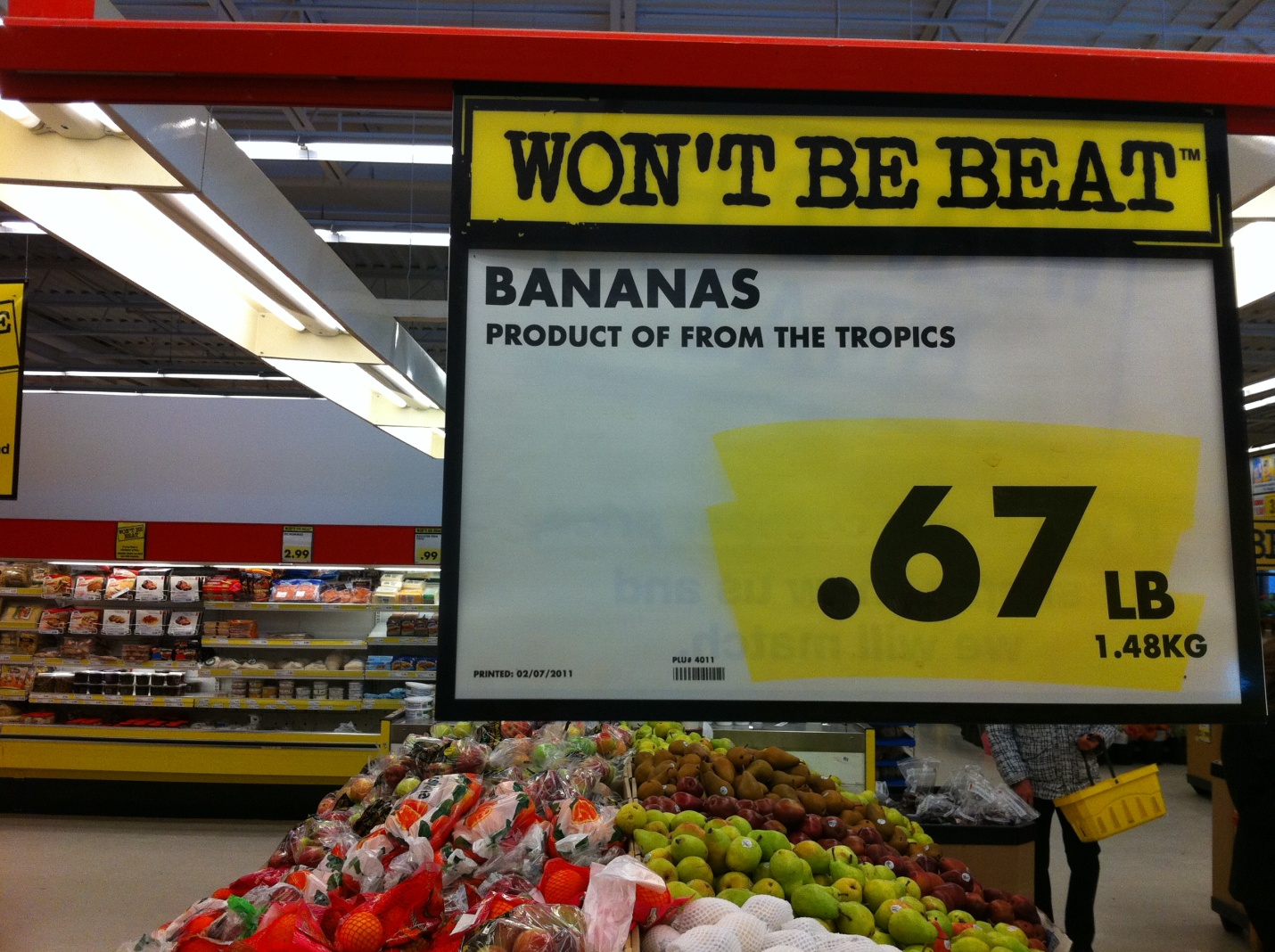
Accordingly, I was particularly struck when I noticed this produce sign at a local grocery store.

Here the source of the bananas is specified in a way that might help combat distancing.  But, in fact, knowing that these bananas are from the “tropics” does more to obfuscate than illuminate.  The tropics refers to no place in particular – technically referring to parts of South America, Africa, Asia, and the South Pacific.  Instead of a concrete agricultural source, then, pointing to the tropics simply creates a false sense of understanding, one that plays on consumers’ desires for (and stereotypes about) all things lush and tropical, leaving the consumers’ ignorance intact.

Kristina Vidug is pursuing a masters of arts degree in sociology at the University of Guelph in Ontario, Canada. Her research is on post-industrial risk management with a focus on women’s avoidance of synthetic chemicals in the domestic sphere. You can follow her “adventures in thesising” on her blog, jeez (kristina) louise.

If you are alive these days, and not already part of the undead masses yourself, you probably have noticed a staggering increase of zombie references in film, television, pop culture, videogames and the internet.

For instance, the big screen and small screen have both hosted a plethora of zombie films, e.g., 28 Days Later (2002), Shaun of the Dead (2004), and I Am Legend (2007). On television, we have seen the recent success of AMC’s The Walking Dead. And if you are on a college campus, you have probably seen undergraduates playing “Zombies Vs. Humans,” a game of tag in which “human” players must defend against the horde of “zombie” players by “stunning” them with Nerf weapons and tube socks. In videogames, we have seen the success of the Resident Evil franchise, Left 4 Dead, and Dead Rising. Finally, the internet is awash with zombie culture. From viral videos of penitentiary inmates dancing to Michael Jackson’s “Thriller,” to post-apocalyptic zombie societies, fansites, and blogs.

But what is the zombie and where does it come from?

What makes the zombie unique from other movie monsters is its unique place of origin. Whereas Frankenstein, Dracula, and the Wolfman all have ties to the Gothic literary tradition, the zombie stands apart in having a relatively recent (and proximal) origin. Theorists of zombie culture (such as Kyle Bishop or Jamie Russell), attribute the origin of the zombie to Haitian folklore and the hybrid religion of voodoo. But the zombie didn’t make its away into American culture until the 1920s and 30s, when sensationalist travel narratives were popular with Western readers. Specifically, W.B. Seabrook’s book The Magic Island, is often credited as the first popular text to describe the Haitian zombie. Additionally, the work of Zora Neale Hurston (specifically her 1937 book Tell My Horse) explores the folklore surrounding the zombie in Haitian mythology.

(Still from I Walked with a Zombie, 1943)

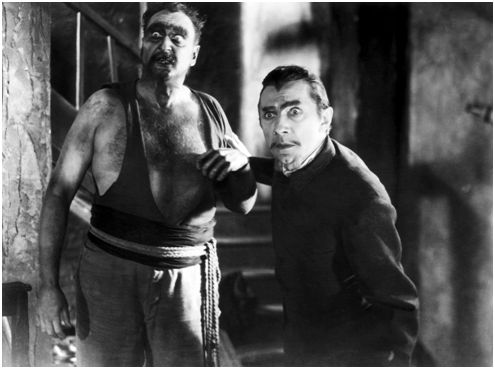
With the development of the motion picture, the zombie became a staple of horror, and a popular movie monster. The zombies of White Zombie (1932), Revolt of the Zombies (1936), King of the Zombies (1941), and I Walked with a Zombie (1943), however, were not the cannibalistic creatures we now know. These zombies were people put under a spell, the spell of voodoo and mystical tradition. In these films, the true terror is not be being killed by zombies, but of becoming a zombie oneself.

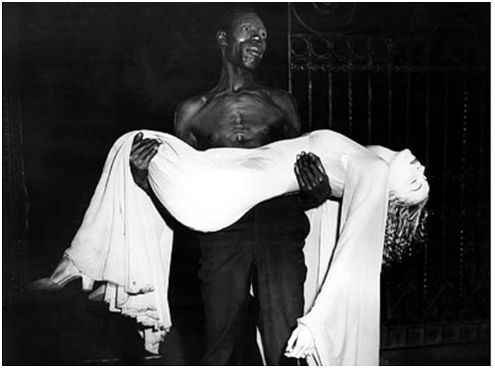
Bela Lugosi as ‘Murder’ Legendre, the mad scientist and his zombie slave:


What all these films have in common is their depiction of Voodoo and Haitian culture more generally as dangerous, menacing, and superstitious. Those who study colonial history note that the messages contained in these films present stereotyped versions of Haitian culture aimed largely at satisfying a predominantly white audience. Many of these films also contain an all white cast, with several members in blackface serving as comedic relief for the more “serious” scenes.

It’s interesting to see how the zombie has morphed into the cannibalistic creatures we now know. While the original zombie is a powerful metaphor for fears of the non-white Other and reverse colonization, the contemporary zombie largely reflects contemporary fears of loss of individuality, the excesses of consumer capitalism, environmental degradation, the excesses of science and technology, and fears of global terrorism (especially more recent renditions of the zombie post-9/11).

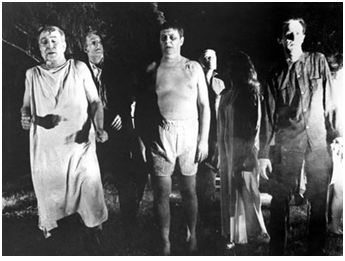
For instance, George A. Romero’s famous Night of the Living Dead (1968), the first film to feature the flesh-eating zombie, is often remarked as a not-so-subtle allegory to the Civil Rights Era and the militant violence perpetuated by Southern states against the Black protestors, as well as a critique of the Vietnam War. Romero himself has stated that he wanted to draw attention to the war through the images of violence contained in the film.

Cannibal zombies in Night of the Living Dead (1968):

Similarly, the Italian zombie horror film Let Sleeping Corpses Lie (1974) reflects fears of environmental degradation and pollution. In this film, the zombie epidemic is caused by an experimental pest-control machine, which sends radio waves into the ground. Although it solves the local pest problem for farmers, it also reanimates the dead in a nearby cemetery.

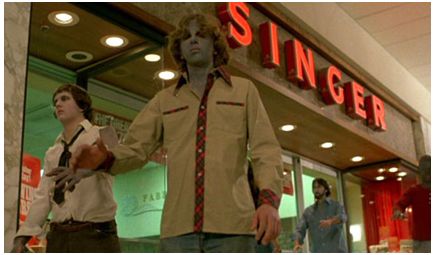
Zombie consumers in Romero’s second zombie flick Dawn of the Dead (1978):

Later zombies are used to symbolize the excesses of capitalism and militarism, respectively.  For example, in 28 Weeks Later (2007), we see the decay of social structures across the globe, as institutions that are supposed to protect us inevitably fail to do their job.  In this scene, protagonists attempt to escape the city just before the military firebombs it:

As we can see, the zombie has a unique cultural history and serves as a powerful metaphor for social anxieties. This movie monster might have come out of the Caribbean, but it became a powerful representation of modern fears when it met the silver screen. Perhaps the current failure of global social structures (global terrorism, environmental catastrophes, and the current economic downturn) has prompted the most recent “Zombie Renaissance.” Or maybe we are just gluttons for the “everyman” tales contained in each rendition of the zombie apocalypse, a point made by SocProf several months back. I do not know what the future holds, but one thing is certain: the zombie will continue to haunt us from beyond the grave.

David Paul Strohecker is getting his PhD in Sociology at the University of Maryland. He studies cultural sociology, theory, and intersectionality. He is currently working on a larger project about the cultural history of the zombie in film.

In two of my favorite earlier posts, I featured photographs by artist Edward Burtynsky.  These photos depicted the outcomes of our consumerist societies: giant repositories of recycle-able materials and the consequences of resource extraction.  In the same vein, J. Henry Fair has been taking photographs of industrial sites and environmental disasters from an even more distant place: small planes.


Lisa Wade, PhD is an Associate Professor at Tulane University. She is the author of American Hookup, a book about college sexual culture; a textbook about gender; and a forthcoming introductory text: Terrible Magnificent Sociology. You can follow her on Twitter and Instagram.
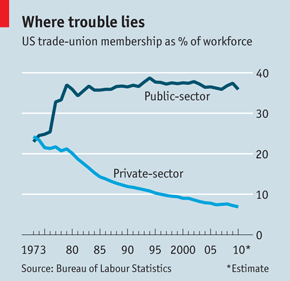
Laura Heron sent in a article from the Economist about changes in union membership. The article, which takes a fairly negative view of the effects of unionization, includes a graph, titled “Where trouble lies,” that illustrates how much union membership has shifted from the private to the public sector in the U.S. Today, 36% of public employees (7.6 million) are members of a union, while only about 7% of employees of private companies (7.1 million) are:

Such a change, from primarily private-sector and often blue-collar workers to government employees, many of whom will be white-collar, middle-class, and relatively highly educated, has significant consequences for employers, governments, employees, and the issues likely to be of primary concern to the labor movement more broadly.

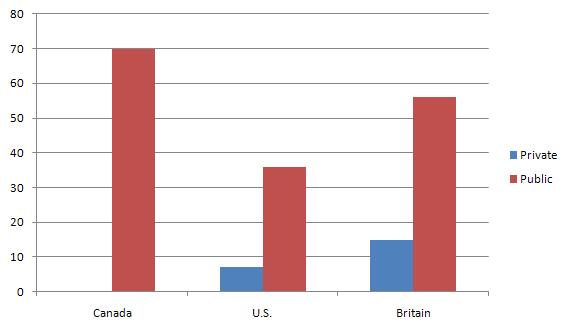
I used the data given in the article to create a chart comparing the percent of private- and public-sector employees in unions in Canada, the U.S., and Britain “today” (by which I assume they mean 2010, though they don’t specify, so be cautious there; also, they didn’t provide the private-sector rate for Canada, so I just used the data I had):

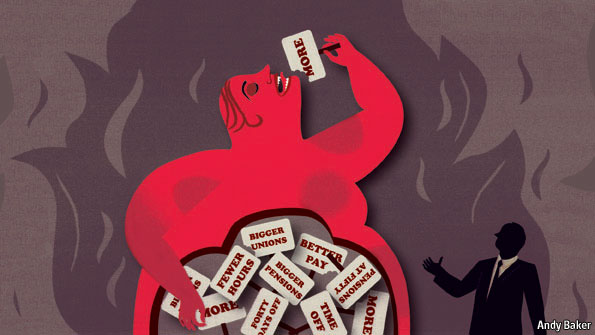
Aside from that, Laura’s attention was drawn to the post partially by the way labor was represented. To make sure we don’t miss the fact that unions are “trouble,” they illustrate the story with this image depicting labor as a fat, ravenous, naked figure devouring resources from the trim man in business attire:

A subsection of the article is also titled “Fattening the Leviathan,” and as the image at the end of the article makes clear, we need to cut this monster down to size:

It’s sort of the mirror image of the “fat cat” rhetoric often used to depict the wealthy as greedy individuals who gorge themselves on profits at the expense of workers. In either case, the central element that makes such rhetoric work is the perception of fat people as lazy, ravenous, greedy individuals who take more than their fair share of available resources.

In the 22-minute short film below, titled MouseTrapped 2010, employees of Florida’s Walt Disney World plead with Disney to negotiate a fair contract with their Union. The film is interesting on two accounts. First, is a good example of the low wages in many service industries. Sociologists refer to the “working poor” to describe people who work full-time and yet still cannot make ends meet. Some of the employees in this video take second jobs, live with their parents or siblings, routinely take food from church food banks, or receive food stamps.

Second, it is an example of a new bargaining tactic: widespread public pressure. This tactic is possible only because of developments in the last decade: the affordability and accessibility of the technology required to put together a short video like this and the medium of youtube that allows the employees to reach potentially millions of viewers for free. It’s working too; Jordan G. spotted this video at Boing Boing, one of the most widely read sites on the web.

Part I of II:

Part II of II:

Lisa Wade, PhD is an Associate Professor at Tulane University. She is the author of American Hookup, a book about college sexual culture; a textbook about gender; and a forthcoming introductory text: Terrible Magnificent Sociology. You can follow her on Twitter and Instagram.
“It was kind of unreal,” the Steamboat Springs, Colorado native said, describing his recent 34th birthday fete at Kandahar Airfield, better known as KAF. “At least for a few minutes, you could pretend you were somewhere else. It was like going back home” (source).

“I was expecting to arrive in a warzone but instead here I am wearing sunglasses in the sun and eating a baguette,” said Dimitra Kokkali, a NATO contractor newly arrived from Brussels. “On my first night I surprised my family by calling them from an outdoor rock concert” (source).

Time magazine slideshow, titled “R&R at Kandahar Airfield,” uses images to describe how the busiest airport in the world “tries to re-create the comforts of home for the coalition forces in Afgahnistan.” Kandahar Airfield is the busiest airport in the world because all supplies and troops pass through on their way to or from war in Iraq or Afghanistan. At any given time there are about 25,000 service members and civilian contractors at the airfield.

These images of the Kandahar’s “Boardwalk” recreation area are striking for a few reasons. First, they show a blurring of the line dividing the homefront and the warfront. The slide show includes images of service members using FaceBook in computer labs, and eating meals in their fatigues at TGI Fridays.

Second, these images reflect that there is increasing emphasis on how service members are supported and cared for by the military during wartime. These photos show the side of war that is not about fighting and danger—instead, they are about the comfort and making a foreign land where they are fighting as “homelike” as possible.

Third, these show the blurring of the boundary between the military and privately owned businesses. Civilian Contractors are augmenting military personnel during the wars in Iraq and Afghanistan and the inclusion of these civilian contractors in war zones has raised the issues of the safety of civilian workers and the costs of hiring corporations (Contexts).

Finally, as a consequence of the blurring of the boundaries of homefront and warfront, the division between the country of Afghanistan and the military is sharpened. Afghanis (except for those few with security clearance) are not allowed to shop or enjoy the free entertainment on the Boardwalk at Kandahar.  Meanwhile, service members can safely buy souvenirs on the Boardwalk itself.  Afghani culture is commodified as a tourist attraction in this theme park-like Boardwalk setting.

All of these images speak to the changing boundary between the homefront and the warfront, and as a result, changes in how we, as a country, view war. Instead of the images of brutality, death, and chaos that Americans saw in their living rooms on TV during Vietnam, for example, these images show the military taking care of service members who are being entertained, keeping in touch with loved ones, and having fun.

But as this service member describes, walking the Kandahar “Boardwalk” in a warzone is still a jarring experience:

“I couldn’t believe I was in Kandahar eating a double-dipped chocolate ice cream at sunset on a Saturday afternoon,” said Coleman, who was downing a strawberry smoothie from the French bakery behind him, where an Eiffel Tower climbs a wall above picnic tables with fake potted plants.

“It was a surreal experience,” he said, as a jet fighter roared across the sky, letting loose a stream of defensive white flares. “I remember thinking, ‘We’re in the heart of the war-zone. The bad guys are 10 miles away. And here we are eating soft-serve ice cream'” (source).

Wendy Christensen is a Visiting Assistant Professor at Bowdoin College whose specialty includes the intersection of gender,war, and the media.