economics: capitalism


This month thousands of sociologists met in Las Vegas for our annual meeting.  There were lots of opinions about the city and our accommodations at Caesar’s Palace.  In the two-minute clip below, a sociologist who studies cities, Sharon Zukin, offers her thoughts on Las Vegas:

Lisa Wade, PhD is an Associate Professor at Tulane University. She is the author of American Hookup, a book about college sexual culture; a textbook about gender; and a forthcoming introductory text: Terrible Magnificent Sociology. You can follow her on Twitter and Instagram.

The U.S. economy is in trouble and that means trouble for the world economy.

According to a United Nations Conference on Trade and Development report, “Buoyant consumer demand in the United States was the main driver of global economic growth for many years in the run-up to the current global economic crisis.”

Before the crisis, U.S. household consumption accounted for approximately 16 percent of total global output, with imports comprising a significant share and playing a critical role in supporting growth in other countries.

…as a result of global production sharing, United States consumer spending increas[ed] global economic activities in many indirect ways as well (e.g. business investments in countries such as Germany and Japan to produce machinery for export to China and its use there for the manufacture of exports to the United States).

In short, a significant decline in U.S. spending can be expected to have a major impact on world growth, with serious blow-back for the United States.

There are those who argue that things are not so dire, that other countries are capable of stepping up their spending to compensate for any decline in U.S. consumption. However, the evidence suggests otherwise.As the chart below (from the report) reveals, consumption spending in the U.S. is far greater than in any other country; it is greater than Chinese, German, and Japanese consumption combined.

consumption.jpg

Moreover, there is little reason to believe that the Chinese, German, or Japanese governments are interested in boosting consumer spending in their respective countries.  All three governments continue to pursue export-led growth strategies that are underpinned by policies designed to suppress wage growth (lower wages = cheaper goods = stronger competitiveness in international markets).  Such policies restrict rather than encourage national consumption because they limit the amount of money people have to spend.

For example, China is the world’s fastest growing major economy and often viewed as a potential alternative growth pole to the United States.  Yet, the Economist reveals that the country’s growth has brought few benefits to the majority of Chinese workers.

picture1.jpg

According to the U.S. Bureau of Labor Statistics, despite several years of wage increases, Chinese manufacturing workers still only earn an average of  $1.36 per hour (including all benefits).  In relative terms, Chinese hourly labor compensation is roughly 4 percent of that in the United States.   It even remains considerably below that in Mexico.

Trends in Germany, the other high-flying major economy, are rather similar. As the chart below shows, the share of German GDP going to its workers has been declining for over a decade.  It is now considerably below its 1995 level.  In fact, the German government’s success in driving down German labor costs is one of the main causes of Europe’s current debt problems — other European countries have been unable to match Germany’s cost advantage, leaving them with growing trade deficits and foreign debt (largely owed to German banks).

germany.jpg

The Japanese economy, which remains in stagnation, is definitely unable to play a significant role in supporting world growth.  Moreover, as we see below, much like in the United States, China, and Germany, workers in Japan continue to produce more per hour while suffering real wage declines.

japan.gif

For a number of years, world growth was sustained by ever greater debt-driven U.S. consumer spending.  That driver now appears exhausted and U.S. political and economic leaders are pushing hard for austerity.  If they get their way, the repercussions will be serious for workers everywhere.

Our goal should not be a return to the unbalanced growth of the past but new, more stable and equitable world-wide patterns of production and consumption.  Achieving that outcome will not be easy, especially since as the United Nations Conference on Trade and Development’s World Investment Report 2011 points out, transnational corporations (including their affiliates) currently account for one-fourth of global GDP.Their affiliates alone produce more than 10 percent of global GDP and one-third of world exports.  And, these figures do not include the activities of many national firms that produce according to terms specified by these transnational corporations.   These dominant firms have a big stake in maintaining existing structures of production and trade regardless of the social costs and they exercise considerable political influence in all the countries in which they operate.

In Buying In: What We Buy and Who We Are, Rob Walker discusses one of the central dilemmas facing marketers: they are trying to get large numbers of people to buy the same thing, while convincing them that doing so in no way makes them conformists. How do you “keep it real” (a phrase repeated ad nauseam by the marketers Walker interviewed) and appear authentic and non-conformist while trying to get as many people as possible to buy the same product?

One solution is to frame buying your product not as a boring act of conformity, but instead as a way of expressing your own unique personal identity. Buying a product you’ve seen advertised doesn’t detract from your authenticity, it enhances it — even if you’re buying a mass-produced product that thousands or even millions of other people purchased identical copies of.

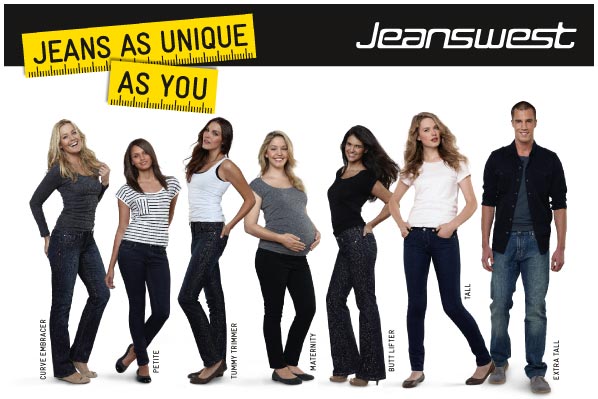
Bec G. sent in this an ad from Jeanswest Australia that illustrates this, asserting that their jeans are “as unique as you”:

Of course, as Bec pointed out, the models they chose to represent how unique Jeanswest customers are are all pretty uniformly thin, even the pregnant woman.

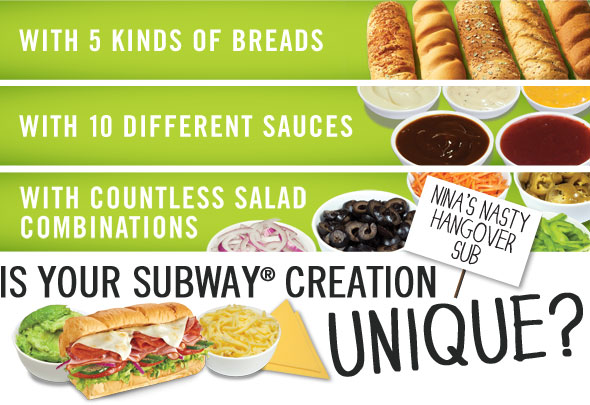
Sarah F. sent in another example. The Australian website for the sandwich chain Subway asks customers whether their preferred sandwich is unique:

I filled out the quiz, creating the only thing I ever get if I eat at Subway: a standard veggie sandwich, no tomatoes. I was then asked to give this amazing item its very own name, to be saved for posterity on the Subway website (if they approve the name): “You’ve just created a Sub that is a reflection of you, so let’s give it a name. Feel free to be creative, after all this is YOUR creation!”

Then it was time for the big reveal. The webpage reinforced the message that designing my very own personalized sandwich from their relatively limited stock list of ingredients is an important expression of my inner being:

I was so nervous! What if my sandwich wasn’t special? Was the honey oat bread too mainstream a choice? Oh, why didn’t I go with the chipotle sauce?!

But it all turned out ok!

In Australia, at least, I now know that my Subway sandwich choice separates me from the masses. What a relief!

In a capitalist economy, one way for an entrepreneur to succeed is by creating an insecurity and offering a product to address it.  I’m going to call “need creation” on You Go Girl, sent in by Clare.  The marketing for You Go Girl revolves around the “plume” released by your toilet.  Beware, it says, while you attempt to flush it your urine is actually rising from the toilet to descend on your toothbrush and your boyfriend’s nostrils.

The commercial suggests that you should use the product both for our health and because we should be embarrassed if someone can tell we’ve urinated.  Only women, however, who are stereotyped as being both cleaner and more concerned with hiding bodily functions, are targeted (note the name of the product).

This isn’t the only product aimed at reducing the odor associated with urination.  Fresh Drop Bathroom Odor Preventer is another option for those of us worried about our urine clouds, and this one is for men too!

Lisa Wade, PhD is an Associate Professor at Tulane University. She is the author of American Hookup, a book about college sexual culture; a textbook about gender; and a forthcoming introductory text: Terrible Magnificent Sociology. You can follow her on Twitter and Instagram.

David Banks, who blogs at Cyborgology, let us know that Gawker has posted an anti-union video Target shows to new hires. Apparently as some Target stores have started carrying groceries, some grocery workers’ unions have made efforts to unionize some stores, a move that Target, along with its larger big-box sibling, Wal-Mart, finds very threatening. The video includes a lot of common arguments — we’re all a family here, the union just wants your dues, etc. — along with some I found more unusual:

Full transcript here.

What I found especially striking was the segment starting at about 3:10, where they argue we don’t need unions because, basically, they were so effective in the past, they already fixed everything! There’s no more child labor, you can get worker’s comp if you’re injured…what more could you need a union for? So on the one hand, today unions are useless, empty organizations that just take your money and give you nothing, but in the past, they were great. Presumably employers only had to be told once to clean up, and then for all time everything is fixed.

I also liked David’s point about the video’s use of the idea of communal vs. individual action. On the one hand, the video repeatedly stresses the rights of the individual and suggests that unions interfere with an individual’s ability to make their own choices (and implying that all union contracts are identical and will be imposed on workers, rather than the outcome of negotiations). But as David points out, the video includes rather contradictory messages about individual and collective action, with the union presented as the bad collective but Target as the good, familial, happy collective:

The video manages to seamlessly contradict itself: the company is a communal entity while simultaneously granting each individual total autonomy. The union does the opposite- it pressures you into collective action while you’re trying to be a neoliberal individual, and it makes you break away from the “Target Family” when they’re trying to be communal.

Target has often avoided the negative publicity aimed at Wal-Mart about labor practices, treatment of workers, and anti-union activity; I know when I was an undergrad back in the ’90s, and anti-Wal-Mart activism was one of the topics of the day, some of my friends and I thought that shopping at Target instead of Wal-Mart meant we were really doing something meaningful in terms of opposing bad labor practices. But as this video illustrates, Target has fairly similar labor policies to Wal-Mart, whatever you think of them, just with less global market power to throw around.


In this 16-minute video Professor of Political Science Wendy Brown does a clear and concise job of outlining eight frightening changes that privatization will bring to higher education. The talk is part of a six-part “Save the University” teach-in at UC Berkeley.

Via John McMahon at Facile Gestures.

Lisa Wade, PhD is an Associate Professor at Tulane University. She is the author of American Hookup, a book about college sexual culture; a textbook about gender; and a forthcoming introductory text: Terrible Magnificent Sociology. You can follow her on Twitter and Instagram.

Cross-posted at OWNI.


Our BoingBoing friend, Cory Doctorow, has a great Ted Talk in which he gives an inspired and radical solution to the lack of privacy on the internet. To begin, he notes that Facebook, as just one example, doesn’t just allow, but incites disclosure by rewarding it, but only intermittently (a la B.F. Skinner and the Skinner box).

Meanwhile, parents try to protect children from disclosure and exposure with surveillance tools that block and report content.  This, Doctorow argues provocatively, only trains kids to accept surveillance as normal and unproblematic.  Instead of spying on our kids, he suggests, we should be teaching them to manipulate and avert involuntary disclosure, such that they grow up learning to question instead of accept the use and abuse of their personal information.

Lisa Wade, PhD is an Associate Professor at Tulane University. She is the author of American Hookup, a book about college sexual culture; a textbook about gender; and a forthcoming introductory text: Terrible Magnificent Sociology. You can follow her on Twitter and Instagram.

Way back in 2008 Gwen wrote a great post using data showing the ways in which social context influences average age of menstruation.  The average age is, it turns out, different across countries, across different groups within countries, and has been changing throughout history.  In the U.S., it has been dropping and the average age (note: average, not earliest) is now about 12-years-old.

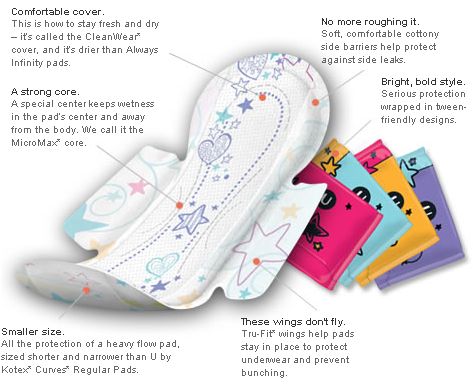
In response, Kotex has now introduced a website and a line of pads and panty liners for girls 8-years-old and up.  Leigh, from Wherapy, sent us a link.

Meant to appeal to tweens, the product is packaged with bright colors, stars, and hearts. It’s decidedly cute and girly:

And also a bit smaller than “regular” products:

I’m not exactly sure what to make of the whole thing.  The age of menarche (first menstruation) is going down.  And girls need (as we called it in my family) “personal products.”  And I’ll give it to Kotex that tweenifying the products with sparkles, stars, and hearts doesn’t just sell them, but may help girls feel better about getting their periods (on the assumption that some have mixed or negative feelings about it).

All that said.  This is a fascinating moment in U.S. history reflecting, simultaneously, capitalism, the social construction of youth, and the circular relationship between biology and society.

Via Jezebel.

Lisa Wade, PhD is an Associate Professor at Tulane University. She is the author of American Hookup, a book about college sexual culture; a textbook about gender; and a forthcoming introductory text: Terrible Magnificent Sociology. You can follow her on Twitter and Instagram.