bodies: prejudice/discrimination

Eyelid surgery is the third most common cosmetic procedure in the world.  Some are necessary for drooping eyelids that interfere with vision, others are undertaken in order to enable people to look younger, but many people choose these surgeries to make their eyes look more Western or whiter, a characteristic often conflated with attractiveness.

Recently Julie Chen — a TV personality and news anchor — revealed that she had undergone eyelid and other surgeries almost 20 years ago in order to comply with the standards of beauty and “relatability” demanded of her bosses.  She released these photos in tandem with the story:

1

Chen said that she was torn about whether to get the surgeries.  Her entire family got involved in the conversation and they split, too, arguing about whether the surgeries represented a rejection of her Chinese ancestry.

Ultimately, though, Chen was under a lot of pressure from her bosses.  One told her “you will never be on this anchor desk, because you’re Chinese.” He went on:

Let’s face it, Julie, how relatable are you to our community? How big of an Asian community do we have in Dayton? ‘On top of that, because of your heritage, because of your Asian eyes, sometimes I’ve noticed when you’re on camera and you’re interviewing someone, you look disinterested, you look bored.

Another man, a “big time agent,” told her: “I cannot represent you unless you get plastic surgery to make your eyes look bigger.”

While cosmetic surgeries are often portrayed as vanity projects, Chen’s story reveals that they are also often about looking “right” in a competitive industry. Whether it’s erotic dancers getting breast implants, waitresses getting facelifts, or aspiring news anchors getting eyelid surgery, often economic pressures — mixed with racism and sexism — drive these decisions.

Lisa Wade, PhD is an Associate Professor at Tulane University. She is the author of American Hookup, a book about college sexual culture; a textbook about gender; and a forthcoming introductory text: Terrible Magnificent Sociology. You can follow her on Twitter and Instagram.
Last year the Journal of the American Medical Association released a study aiming to determine the relationship between body mass index and the risk of premature death. Body mass index, or BMI, is the ratio between your height and weight. According to the National Institutes of Health, you are “normal weight” if your ratio is between 18.5-24.9.  Everything over that is “overweight” or “obese” and everything under is “underweight.”

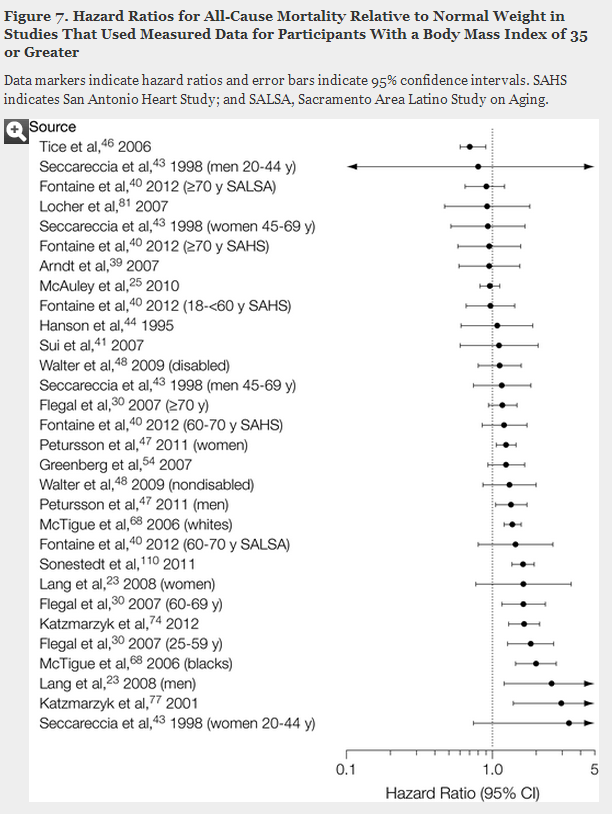
This study was a meta-analysis, which is an analysis of a collection of existing studies that systematically measures the sum of our knowledge.  In this case, the authors analyzed 97 studies that included a combined 2.88 million individuals and over 270,000 deaths.  They found that overweight individuals had a lower risk of premature death than so-called normal weight individuals and there was no relationship between being somewhat obese and the rate of early death. Only among people in the high range of obesity was there a correlation between their weight and a higher risk of premature death.

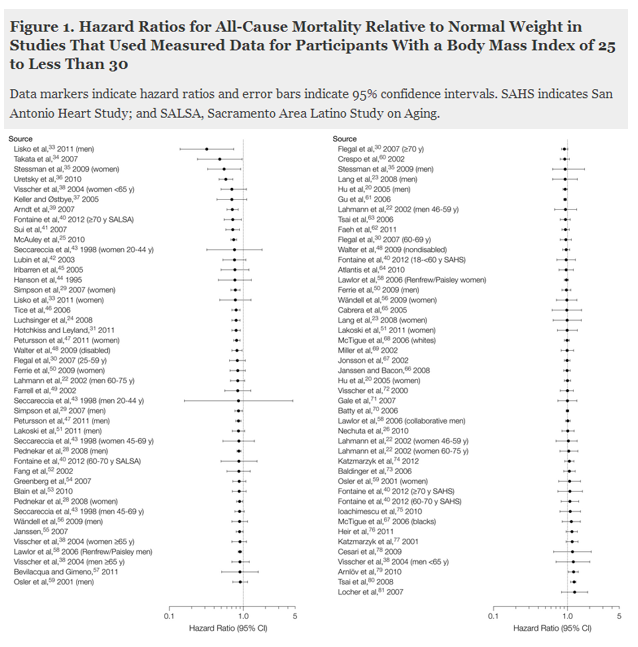
Here’s what it looked like.

This is two columns of studies plotted according to the hazard ratio they reported for people.  This comparison is between people who are “overweight” (BMI = 25-29.9) and people who are “normal weight” (BMI = 18.5-24.9).  Studies that fall below the line marked 1.0 found a lower rate of premature death and studies above the line found a higher rate.

25-29

Just by eyeballing it, you can confirm that there is not a strong correlation between weight and premature death, at least in this population. When the scientists ran statistical analyses, the math showed that there is a statistically significant relationship between being “overweight” and a lower risk of death.

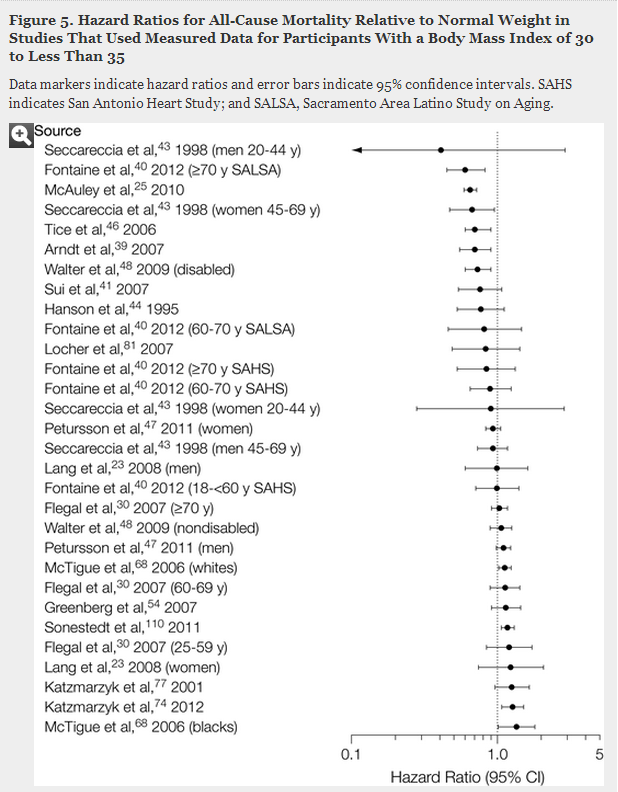
Here’s the same data, but comparing the risk of premature death among people who are “normal weight” (BMI = 18.5-24.9) and people who are somewhat “obese” (BMI = 30-34.9).  Again, eyeballing the results suggest that there’s not much correlation and, in fact, statistical analysis found none.

30-34.9

Finally, here are the results comparing “normal weight” (BMI = 18.5-24.9) and people who are quite “obese” (BMI = 35 or higher). In this case, we do see a relationship between risk of premature death in body weight.

35

It’s almost funny that the National Institutes of Health use the word normal when talking about BMI. It’s certainly not the norm — the average BMI in the U.S. falls slightly into the “overweight” category (26.6 for adult men and 25.5 for adult women) — and it’s not related to health. It’s clearly simply normative. It’s related to a socially constructed physical ideal that has little relationship to what physicians and public health advocates are supposed to be concerned with.  Normal is judgmental, but if they changed the word to healthy, they have to entirely rejigger their prescriptions.

So, do we even have an obesity epidemic? Perhaps not if we use health as a marker instead of some arbitrary decision to hate fat.  Paul Campos, covering this story for the New York Times, points out:

If the government were to redefine normal weight as one that does not increase the risk of death, then about 130 million of the 165 million American adults currently categorized as overweight and obese would be re-categorized as normal weight instead.

That’s 79%.

It’s worth saying again: if we are measuring by the risk of premature death, then 79% of the people we currently shame for being overweight or obese would be recategorized as perfectly fine. Ideal, even. Pleased to be plump, let’s say, knowing that a body that is a happy balance of soft and strong is the kind of body that will carry them through a lifetime.

Cross-posted at Adios Barbie.

Lisa Wade, PhD is an Associate Professor at Tulane University. She is the author of American Hookup, a book about college sexual culture; a textbook about gender; and a forthcoming introductory text: Terrible Magnificent Sociology. You can follow her on Twitter and Instagram.
A few days ago, Juliano Pinto kicked off the World Cup with a first kick.  It was a media stunt designed to make us verklempt.  Pinto is a paraplegic who wore a mind-controlled robotic exoskeleton to make his move.

We were to be awed by the technology, too, of course, which is being developed by the Walk Again Project, a scientific consortium.  Says the leading scientist on the project, “With enough political will and investment, we could make wheelchairs obsolete.”

Red Nicholson isn’t having it.

Ask any wheelchair user, particularly one who’s been in the game a while, and they’ll tell you that they’re far too busy living their life to sit there worrying about whether or not they’ll ever walk. We just get on and do.

From his point of view, the exoskeleton is for people who aren’t in wheelchairs.  Getting “non-walkers to walk again,” he says, is about making everyone else happy.  As for him, he says, he’s fine:

My wheelchair is a very capable tool and to be honest, the last thing I want is to be strapped to a District 9-esque robot and become a puppet in some corporation’s half-baked execution of an obsession…

In the meantime, he says, everyone’s concern with getting him to walk again suggests that he, and everyone else who uses a wheelchair, is living a pitiable life.  “These stories,” he says, “are unwittingly invalidating a unique way of life for millions of people around the globe who are really happy with their wheelchairs.”   So, he goes on record: “This is not my dream.”

William Peace, an anthropologist who also uses a wheelchair, goes further, arguing that the exoskeleton is harmful to people who are newly paralyzed.  The scientists developing the exoskeleton are “sell[ing] the dream of walking to newly paralyzed people who cannot imagine life as a wheelchair user.”  This is bad, he says, because it encourages people to reject their new body instead of accept it.   He writes: “the exoskeleton is symbolically and practically destructive to a newly paralyzed person.”

Instead of focusing on the one thing people using wheelchairs can’t do, Peace argues, we should focus on all the things they do everyday:

Work, make a decent living, and be autonomous. Own a home even. Have a family. Get married. In short, be ordinary. Walking is simply not required for all this nor should it be glorified.

Nicholson concurs: “My life as a wheelchair-user is a very good one.”

So hey, able-bodied media: quit making me feel like wheelchairs are a shitty, sub-par option. Stop beating your exoskeleton drum. And most of all, let go of your obsession with walking, because it’s totally overrated.

Cross-posted at Pacific Standard.

Lisa Wade, PhD is an Associate Professor at Tulane University. She is the author of American Hookup, a book about college sexual culture; a textbook about gender; and a forthcoming introductory text: Terrible Magnificent Sociology. You can follow her on Twitter and Instagram.
Usually, you want to match up with someone at about your level, or a little higher.  The trouble is that many people overestimate their own level.  Maybe that’s especially true of men.

One summer many years ago at the tennis courts, a guy I didn’t know  came over and asked me if I’d like to play. I hadn’t arranged a game with anyone, but I didn’t want to wind up playing some patzer.

“Are you any good?” I asked. He paused.

“Well, I’m not Jimmy Connors,” he said (I told this was many years ago), “but neither are you.”

In chess and other games, serious players have ratings. Give a roomful of possible partners, they can sort through the ratings and find a match with someone at roughly the same level.  It’s called assortative mating, though that term usually refers to the other kind of mating, not chess.  It’s the basis of the conflict in this poignant scene from “Louie.”

Vanessa is not a ten, neither is Louie.  According to principles of assortative mating, the tens will wind up with other tens, the nines with nines, and so on down the attractiveness scale. One problem in the “Louie” scene is that Louie seems to have an inflated view of his own attractiveness.  He’s aiming higher than Vanessa.  That’s typical.  So is the importance that Louie, the man, places on physical attractiveness. This excerpt begins with Louie telling Vanessa that she’s a really beautiful . . . . He can’t bring himself to say “girl”; he’s probably going to say “person.” But he’s obviously not saying what he thinks.

Or as Dan Ariely and colleagues concluded from their study of HotOrNot members:

[Men] were significantly more influenced by the consensus physical attractiveness of their potential dates than females were. [Men also] were less affected by how attractive they themselves were . . .  In making date choices, males are less influenced by their own rated attractiveness than females are.

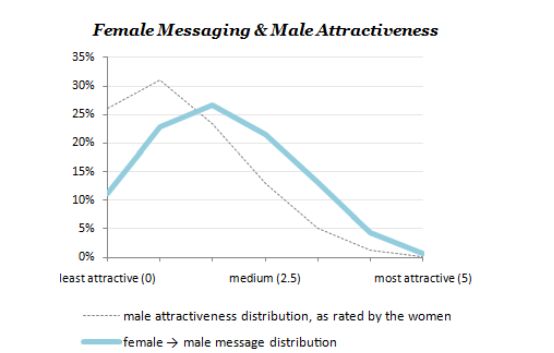
Another dating site, OK Cupid, found a similar pattern when they looked at data about who gets messages.  They asked their customers to rate profile photos of the opposite sex on a scale of 0 to 5. They then tracked the number of messages for people at each level of attractiveness.  The graph below shows what women thought and what they did – that is, how attractive they found men, and who they sent messages to.

1 (2) - Copy

Men who were rated 0 or 1 got fewer messages than their proportion in the population.  That figures. But even men who were only moderately attractive got more than their share. Generally, the fewer men at a level of attractiveness, the fewer total messages women sent. The 4s, for example, constituted only 2% of the population, and they got only 4% of all the messages.  The Vanessas on OK Cupid are not sending a lot of inquiries to guys who look like George Clooney.

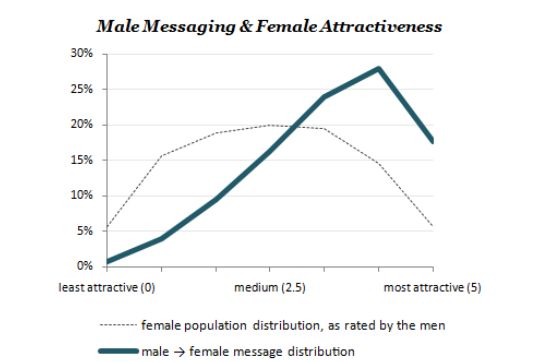
But look at the men.

1 (2)

Men are more generous in their estimates of beauty than are women. But they also ignore the Vanessas of the world (or at least the world of OK Cupid) and flock after the more attractive women.  Only 15% of the women were rated as a 4, but they received about 26% of the messages.  Women rated 5 received messages triple their proportion in the population.

What about those with so-so looks?  Women rated as 2s received only about 10% of the messages sent by men. But men at that same level received 25% of the messages women sent.  The women seem more realistic.

Vanessa too has no illusions about her own attractiveness. She refers to herself as “a fat girl,” and when Louie, trying to be kind, says, “You’re not fat,” she says: “You know what the meanest thing is you can say to a fat girl? [pause] ‘You’re not fat.’” But it’s only when she challenges Louie’s view of his own attractiveness that their relationship starts to change.

Y’know if you were standing over there looking at us, you know what you’d see?

What?

That we totally match. We’re actually a great couple together.

She doesn’t explain what she means by “totally match.” It could be their interests or ideas or personalities, but the imaginary stranger looking at them from over there couldn’t know about any of that. What that generalized other could see is that they are at roughly the same place on the assortative mating attractiveness scale.

Cross-posted at Pacific Standard.

Jay Livingston is the chair of the Sociology Department at Montclair State University. You can follow him at Montclair SocioBlog or on Twitter.

In case you were wondering, race is still important in the U.S., including in American sports. Deadspin put out a neat tool just in time for NFL draft weekend, allowing readers to see for themselves just how often different words are used to describe white and black athletes in draft scouting reports.  It turns out, for example, that a black prospect’s report is more likely to mention his “motor,” while the typical white player is more likely to be called a “worker.” “Freakish” shows up five times in black reports, and never in a white player’s. Black players are also more likely to be called “coachable.”

I downloaded the data to find out just what the “blackest” and “whitest’ words were. I then drew out the 50 words most likely associated with black and white athletes, respectively. The words are all vaguely football-ish, but upon reflection distinctive patterns emerge.

Some words leap out immediately. Reports on black athletes are far more likely to include the word “mother.” Conversely, white athletes’ reports mention “brothers” more often.  Black players’ reports more often include “driving”; reports on white athletes mention “drive.”

Dig a bit deeper, and some groupings appear. I created five rough categories for the most common “black” words, and another four for the most common white words:

Table 1: black word groups
Physicality upright, leaping, acceleration, pedal, driving, talented, runs, bounce, accelerates, chase, closes, tightness, track, radius, flexible, coordination, physicality
Violence jam, violent, disruptive
Positional all-purpose, cutback, touches, safety, open-field, pass-rush, cornerback, return, returner, cuts, gaps, gap, wr
Development loose, currently, support, stop, drop, interception, terms, directions
Other jones, auburn, vj, instead, wrap, disengage


 Table 2: white word groups
Quarterback delivery, accuracy, velocity, accurate, mobility, short-to-intermediate, throwing, placement, pocket, passer, release, throw, passing, arm, throws
Other positional leg, center, pressure, targets, touch, guard, under, offense, rushers, blocking, keeps, tackle
Intelligence intangibles, understands, intelligence, all-conference, smart,
experienced, sound, leader
Other onto, brother, backup, drive, 50, ends, base, ten, four-year, keeping, punch, left, timing

I was quite surprised just how pervasive the old tropes of the smart white leader athletes, and the talent and physical black athletes remain. The word “accuracy” is more than twelve times more likely to be associated with a white player than his black counterpart. Likewise, the words “understands,”(3.9 times) “intelligence” (3.0 times), and the sneaky “intangibles” (3.9 times) are all far more likely to be associated with white athletes.

Conversely, reports on black athletes are more likely to include “leaping” (6.3 times), “upright” (10.4 times), and “violent” (5.1 times). They comparatively rarely include words associated with quarterbacking, intelligence, or leadership.

What the numbers can’t tell us is how much of the difference can be ascribed to the scouts themselves allowing biases to creep in, and how much reflects ways in which athletes have been shaped to this point (i.e., coached to be violent,  encouraged to become leaders, etc). This is obviously an important question, but either way it is clear that race remains a hugely important filter affecting life chances, even in something as supposedly meritocratic as professional and near-professional sports.

A longer version of this post, with more details on methods, can be found at Politics All the Way Down.  Photo credit: Ron Almog, via wikimedia commons.

Stewart Prest is a PhD candidate in political science at the University of British Columbia in Vancouver, Canada.  You can follow him at his blog, Politics All the Way Down, and on Twitter.  Cross-posted at Pacific Standard.

Check out the comic at A Whole Lot of Something.

Lisa Wade, PhD is an Associate Professor at Tulane University. She is the author of American Hookup, a book about college sexual culture; a textbook about gender; and a forthcoming introductory text: Terrible Magnificent Sociology. You can follow her on Twitter and Instagram.
1

Writer and director Elena Rossini has released the first four minutes of The Illusionists.  I’m really excited to see the rest.  The documentary is a critique of a high standard of beauty but, unlike some that focus exclusively on the impacts of Western women, Rossini’s film looks as though it will do a great job of illustrating how Western capitalist impulses are increasingly bringing men, children, and the entire world into their destructive fold.

The first few minutes address globalization and Western white supremacy, specifically.  As one interviewee says, the message that many members of non-Western societies receive is that you “join Western culture… by taking a Western body.”  The body becomes a gendered, raced, national project — something that separates modern individuals from traditional ones — and corporations are all too ready to exploit these ideas.

Watch for yourself (subtitles available here):

Lisa Wade, PhD is an Associate Professor at Tulane University. She is the author of American Hookup, a book about college sexual culture; a textbook about gender; and a forthcoming introductory text: Terrible Magnificent Sociology. You can follow her on Twitter and Instagram.
Last week NPR reported that scientists now trace some of the rise of American obesity to the fear of fat.  Beginning in the 1970s, nutritionists began warning Americans to consume less fat.  This initiated the “low fat” and “fat free” crazes that still linger.

Yet, it now seems that people who followed the advice of nutritionists at the time — to eat less cheese, milk, and meat and more pasta, potatoes, and rice — were likely to get fatter, not skinnier.  The closer a person stuck to the dietary guidelines, the more weight they would gain and, the more weight they gained, the more others would pressure them to stick to the dietary guidelines.  The phrase “cruel irony” only begins to capture it.

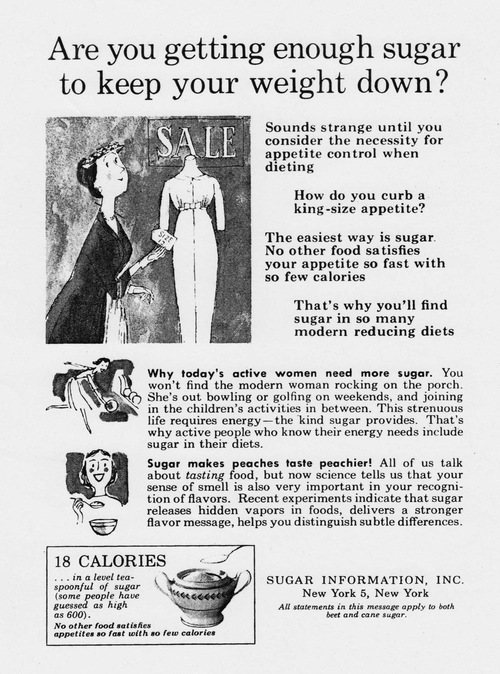
The ad below, from 1959, is a peek into another era.  Just a few years before the fear of fat began, the sugar industry was plausibly suggesting that eating more sugar was the best way to stay slim.  This was industry association propaganda, but no doubt the potato and pasta industries contributed to the story in the ’70s just as the meat and dairy industries are in on it today.

1

The revision of our nutritional guidelines reminds us to be skeptical of the conventional wisdom.  Moreover, it should inspire us all to check our tendency to judge others.  We don’t have perfect knowledge that allows us perfect control over our bodies.  Scientists are doing the best they can — and hopefully not taking too much funding from for-profit food industries — and individuals are restricted by whatever knowledge and resources they have.

Lisa Wade, PhD is an Associate Professor at Tulane University. She is the author of American Hookup, a book about college sexual culture; a textbook about gender; and a forthcoming introductory text: Terrible Magnificent Sociology. You can follow her on Twitter and Instagram.