bodies: prejudice/discrimination

In an era of body positivity, more people are noting the way American culture stigmatizes obesity and discriminates by weight. One challenge for studying this inequality is that a common measure for obesity—Body Mass Index (BMI), a ratio of height to weight—has been criticized for ignoring important variation in healthy bodies. Plus, the basis for weight discrimination is what other people see as “too fat,” and that’s a standard with a lot of variation.

Recent research in Sociological Science from Vida Maralani and Douglas McKee gives us a picture of how the relationship between obesity and inequality changes with social context. Using data from the National Longitudinal Surveys of Youth (NLSY), Maralani and McKee measure BMI in two cohorts, one in 1981 and one in 2003. They then look at social outcomes seven years later, including wages, the probability of a person being married, and total family income.

The figure below shows their findings for BMI and 2010 wages for each group in the study. The dotted lines show the same relationships from 1988 for comparison.
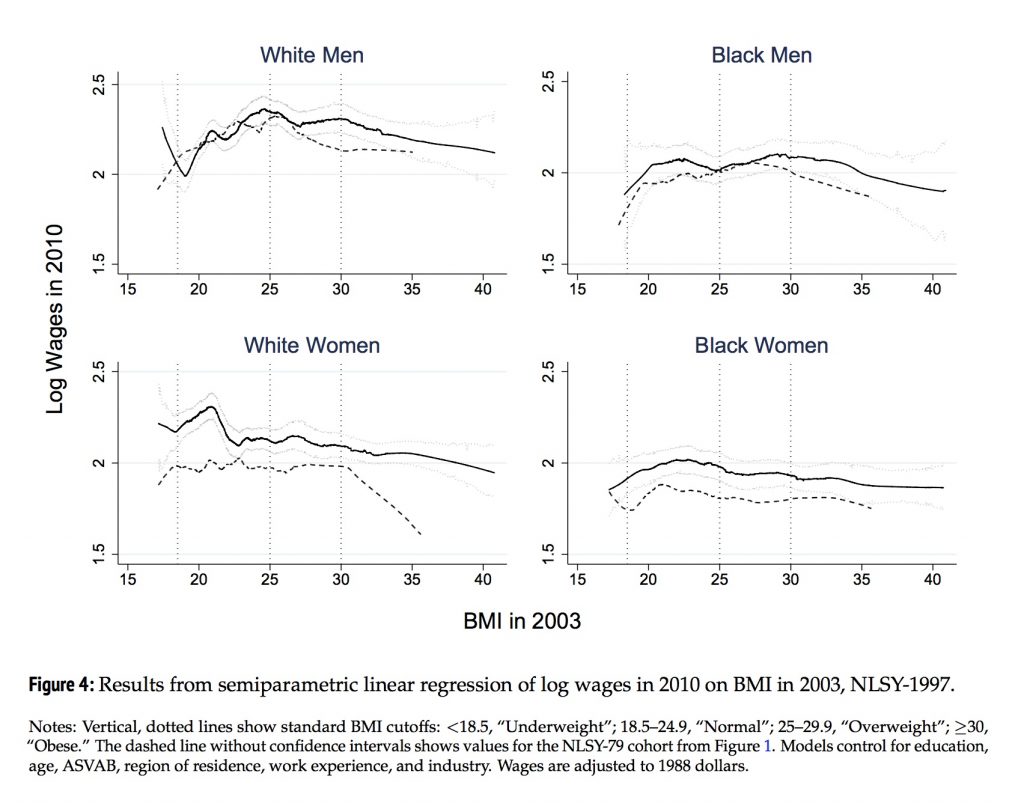
For White and Black men, wages actually go up as their BMI increases from the “Underweight” to “Normal” ranges, then levels off and slowly decline as they cross into the “Obese” range. This pattern is fairly similar to 1988, but check out the “White Women” graph in the lower left quadrant. In 1988, the authors find a sharp “obesity penalty” in which women over a BMI of 30 reported a steady decline in wages. By 2010, this has largely leveled off, but wage inequality didn’t go away. Instead, that spike near the beginning of the graph suggests people perceived as skinny started earning more. The authors write:

The results suggest that perceptions of body size may have changed across cohorts differently by race and gender in ways that are consistent with a normalizing of corpulence for black men and women, a reinforcement of thin beauty ideals for white women, and a status quo of a midrange body size that is neither too thin nor too large for white men (pgs. 305-306).

This research brings back an important lesson about what sociologists mean when they say something is “socially constructed”—patterns in inequality can change and adapt over time as people change the way they interpret the world around them.

Evan Stewart is an assistant professor of sociology at University of Massachusetts Boston. You can follow his work at his website, or on BlueSky.

1Many hope that Misty Copeland is ushering in a new era for ballet. She is the first female African American ballet dancer to have the role of Principal Dancer at the American Ballet Theatre. She has literally changed the face of the dance.

Race is a central and important part of her story, but in A Ballerina’s Tale, the documentary featuring her career, she describes herself as defying not just one, but three ideas about what ballerinas are supposed to look like: “I’m black,” she says, and also: “I have a large chest, I’m muscular.”

In fact, asked to envision a prima ballerina, writes commentator Shane Jewel, what comes to most of our minds is probably a “perilously thin, desperately beautiful, gracefully elongated girl who is… pale as the driven snow.” White, yes, but also flat-chested and without obvious muscularity.

It feels like a timeless archetype — at least as timeless as ballet itself, which dates back to the 15th century — but it’s not. In fact, the idea that ballerinas should be painfully thin is a new development, absorbing only a fraction of ballet’s history, as can clearly be seen in this historical slideshow.

It started in the 1960s — barely more than 50 years ago — in response to the preferences of the influential choreographer George Balanchine. Elizabeth Kiem, the author of Dancer, Daughter, Traitor, Spy, calls him “the most influential figure in 20th century dance,” ballet and beyond. He co-founded the first major ballet school in America, made dozens of dancers famous, and choreographed more than 400 performances. And he liked his ballerinas wispy: “Tall and slender,” Kiem writes, “to the point of alarm.” It is called, amongst those in that world, the “Balanchine body.”


We’re right to view Copeland’s rise with awe, gratitude, and hope, but it’s also interesting to note that two of the the ceilings she’s breaking (by being a ballerina with breasts and muscles) have only recently been installed. It reminds me how quickly a newly introduced expectation can feel timeless; how strongly it can ossify into something that seems inevitable; how easily we accept that what we see in front of us is universal.

In The Social Construction of Reality, the sociologists Peter Berger and Thomas Luckmann explain how rapidly social inventions “harden” and “thicken.” Whoever initiates can see it for what it is — something they created — but to whoever comes next it simply seems like reality. What to Balanchine was “I will do it this way” became to his successors “This is how things are done.” And “a world so regarded,” Berger and Luckmann write, “attains a firmness in consciousness; it becomes real in an ever more massive way, and it can no longer be changed so readily.”

Exactly because the social construction of reality can be so real, even though it was merely invented, Copeland’s three glass ceilings are all equally impressive, even if only one is truly historic.

Lisa Wade, PhD is an Associate Professor at Tulane University. She is the author of American Hookup, a book about college sexual culture; a textbook about gender; and a forthcoming introductory text: Terrible Magnificent Sociology. You can follow her on Twitter and Instagram.

Why do so many Americans continue to support Donald Trump with such fervor?

Hillary Clinton now leads Donald Trump in presidential polls by double-digits, but Trump’s hardiest supporters have not only stood by him, many have actually increased their commitment. It seems clear that in a little less than a month’s time, tens of millions of Americans will cast a vote for a man who overtly seeks to overthrow basic institutions that preserve the American ideal such as a free pressfreedom of religionuniversal suffragethe right of the accused to legal counsel, and the right of habeas corpus. This is over-and-above his loudly proclaimed bigotry, sexism, boasts of sexual assault, ableism, history of racial and anti-Muslim bias, and other execrable personal characteristics that would have completely destroyed the electoral prospects of past presidential candidates.

Trump is a uniquely odious candidate who is quite likely going to lose, but more than 40% of Americans plan to vote for him. The science of group conflict might help us understand why.

Photograph by Gage Skidmore via Flickr
Photograph by Gage Skidmore via Flickr.

In a powerful 2003 article in the journal American Psychologist, Roy Eidelson and Judy Eidelson foreshadowed Trump’s popularity. Drawing on a close reading of both history and social science literature, they identified five beliefs that — if successfully inculcated in people by a leader — motivate people to initiate group conflict. Trump’s campaign rhetoric deftly mobilizes all five.

  • Confidence in one’s superiority: Trump constantly broadcasts a message that he and his followers are superior to other Americans, whereas those who oppose him are “stupid” and deserve to be punched in the face. His own followers’ violent acts are excused as emanating from “tremendous love and passion for the country.”
  • Claims of unjust treatment: Trump is obsessed with the concept of fairness, but only when it goes his way. Given his presumed superiority, it naturally follows that the only way he and his supporters could fail is if injustice occurs.
  • Fears of vulnerability: Accordingly, Trump has overtly stated that he believes the presidential election will be rigged. His supporters believe him. In one recent poll, only 16 percent of North Carolina Trump supporters agreed that if Clinton wins it would be because she got more votes.
  • Distrust of the other: Trump and his supporters routinely claim that the mediagovernmenteducational institutions, and other established entities are overtly undermining Trump, his supporters, and their values. To many Trump supporters, merely being published or broadcast by a major news outlet is evidence that a fact is not credible, given the certainty they have that media professionals are conspiring against Trump.
  • A sense of helplessness: When Trump allows that it’s possible that he might lose the election because of fraud, conspiracy, or disloyalty, he taps into his followers’ sense of helplessness. No matter how superior he and his followers truly are, no matter how unjustly they are treated, there is little that they can do in the face of a nation-wide plot against him. Accordingly, many of Trump’s most ardent supporters will see the impending rejection of their candidate not as a corrective experience to lead them to reconsider their beliefs, but as further evidence that they are helpless in the face of a larger, untrustworthy outgroup.

By ably nurturing these five beliefs, Trump has gained power far beyond the level most could have dreamed prior to the present election cycle.

It seems clear that, if and when Trump loses, he won’t be going anywhere. He has a constituency, stoked by effective rhetorics shown to propel people to group conflict, one some of his supporters are already preparing for. And, since he has convinced so many of his supporters that he alone can bring the changes they desire, it is a surety that he will use their mandate for his own future purposes.

Sean Ransom, PhD is an assistant clinical professor in the Department of Psychiatry and Behavioral Sciences at Tulane University School of Medicine and founder of the Cognitive Behavioral Therapy Center of New Orleans. He received his PhD in clinical psychology at the University of South Florida.

TSP_Assigned_pbk_978-0-393-28445-4Assigned: Life with Gender is a new anthology featuring blog posts by a wide range of sociologists writing at The Society Pages and elsewhere. To celebrate, we’re re-posting four of the essays as this month’s “flashback Fridays.” Enjoy! And to learn more about this anthology, a companion to Wade and Ferree’s Gender: Ideas, Interactions, Institutions, please click here.

.

When Your Brown Body is a White Wonderland, by Tressie McMillan Cottom, PhD

This may meander.

Miley Cyrus made news this week with a carnival-like stage performance at the MTV Video Music Awards that included life-size teddy bears, flesh-colored underwear, and plenty of quivering brown buttocks. Almost immediately after the performance many black women challenged Cyrus’ appropriation of black dance (“twerking”). Many white feminists defended Cyrus’ right to be a sexual woman without being slut-shamed. Yet many others wondered why Cyrus’ sad attempt at twerking was news when the U.S. is planning military action in Syria.

I immediately thought of a summer I spent at UNC Chapel Hill. My partner at the time fancied himself a revolutionary born too late for all the good protests. At a Franklin Street pub one night we were the only black couple at a happy hour. It is one of those college places where concoctions of the bar’s finest bottom shelf liquor is served in huge fishbowls for pennies on the alcohol proof dollar. I saw a few white couples imbibing and beginning some version of bodily grooving to the DJ. I told my partner that one of them would be offering me free liquor and trying to feel my breasts within the hour.

He balked, thinking I was joking.

I then explained to him my long, storied, documented history of being accosted by drunk white men and women in atmospheres just like these. Women asking to feel my breasts in the ladies’ restroom. Men asking me for a threesome as his drunk girlfriend or wife looks on smiling. Frat boys offering me cash to “motorboat” my cleavage. Country boys in cowboy hats attempting to impress his buddies by grinding on my ass to an Outkast music set. It’s almost legend among my friends who have witnessed it countless times.

My partner could not believe it until not 30 minutes later, with half the fishbowl gone, the white woman bumps and grinds up to our table and laughing tells me that her boyfriend would love to see us dance. “C’mon girl! I know you can daaaaannnce,” she said. To sweeten the pot they bought our table our own fishbowl.

My partner was stunned. That summer we visited lots of similar happy hours. By the third time this scene played out my partner had taken to standing guard while I danced, stonily staring down every white couple that looked my way. We were kicked out of a few bars when he challenged some white guy to a fight about it. I hate such scenes but I gave my partner a break. He was a man and not used to this. He didn’t have the vocabulary borne of black breasts that sprouted before bodies have cleared statutory rape guidelines. He didn’t know the words so he did all he knew how to do to tell me he was sorry this was my experience in life: he tried to kick every white guy’s ass in Chapel Hill.

I am not beautiful. I phenotypically exist in a space where I am not usually offensive looking enough to have it be an issue for my mobility but neither am I a threat to anyone’s beauty market. There is no reason for me to assume this pattern of behavior is a compliment. What I saw in Cyrus’ performance was not just a clueless, culturally insensitive attempt to assert her sexuality or a simple act of cultural appropriation at the expense of black bodies. Instead I saw what kinds of black bodies were on that stage with Cyrus.

Cyrus’ dancers look more like me than they do Rihanna or Beyonce or Halle Berry. The difference is instructive.

Fat non-normative black female bodies are kith and kin with historical caricatures of black women as work sites, production units,  subjects of victimless sexual crimes, and embodied deviance. As I said in my analysis of hip-hop and country music cross-overs, playing the desirability of black female bodies as a “wink-wink” joke is a way of lifting up our deviant sexuality without lifting up black women as equally desirable to white women. Cyrus did not just have black women gyrating behind her. She had particularly rotund black women. She gleefully slaps the ass of one dancer like she intends to eat it on a cracker. She is playing a type of black female body as a joke to challenge her audience’s perceptions of herself  while leaving their perceptions of black women’s bodies firmly intact.  It’s a dance between performing sexual freedom and maintaining a hierarchy of female bodies from which white women benefit materially.

The performance works as spectacle precisely because the background dancers embody a specific kind of black female body. That spectacle unfolds against a long history of how capitalism is a gendered enterprise and subsequently how gendered beauty norms are resisted and embraced to protect the dominant beauty ideal of a certain type of white female beauty.

Being desirable is a commodity. Capital and capitalism are gendered systems. The very form that money takes — paper and not goods — is rooted in a historical enterprise of controlling the development of an economic sphere where women might amass wealth. As wealth is a means of power in a capitalistic society, controlling this means of acceptable monies was a way of controlling the accumulation, distribution and ownership of capital.

For black women, that form of money was embodied by the very nature of how we came to be in America.

Our bodies were literally production units. As living cost centers we not only produced labor as in work but we produced actual labor through labor, i.e. we birthed more cost centers. The legendary “one drop” rule of determining blackness was legally codified not just out of ideological purity of white supremacy but to control the inheritance of property. The sexual predilections of our nation’s great men threatened to transfer the wealth of white male rapists to the children born of their crimes through black female bodies.

Today much has changed and much has not. The strict legal restriction of inheritable black deviance has been disrupted but there still exists a racialized, material value of sexual relationships. The family unit is considered the basic unit for society not just because some god decreed it but because the inheritance of accumulated privilege maintains our social order.

Thus, who we marry at the individual level may be about love but at the group level it is also about wealth and power and privilege.

Black feminists have critiqued the material advantage that accrues to white women as a function of their elevated status as the normative cultural beauty ideal. As far as privileges go it is certainly a complicated one but that does not negate its utility. Being suitably marriageable privileges white women’s relation to white male wealth and power.

The cultural dominance of a few acceptable brown female beauty ideals is a threat to that privilege. Cyrus acts out her faux bisexual performance for the white male gaze against a backdrop of dark, fat black female bodies and not slightly more normative cafe au lait slim bodies because the juxtaposition of her sexuality with theirs is meant to highlight Cyrus, not challenge her supremacy. Consider it the racialized pop culture version of a bride insisting that all of her bridesmaids be hideously clothed as to enhance the bride’s supremacy on her wedding day.

Only, rather than an ugly dress, fat black female bodies are wedded to their flesh. We cannot take it off when we desire the spotlight for ourselves or when we’d rather not be in the spotlight at all.

This political economy of specific types of black female bodies as a white amusement park was ignored by many, mostly because to critique it we have to critique ourselves.

When I moved to Atlanta I was made aware of a peculiar pastime of the city’s white frat boy elite. They apparently enjoy getting drunk and visiting one of the city’s many legendary black strip clubs rather than the white strip clubs. The fun part of this ritual seems to be rooted in the peculiarity of black female bodies, their athleticism and how hard they are willing to work for less money as opposed to the more normative white strippers who expect higher wages in exchange for just looking pretty naked. There are similar racialized patterns in porn actresses’ pay and, I suspect, all manner of sex workers. The black strip clubs are a bargain good time because the value of black sexuality is discounted relative to the acceptability of black women as legitimate partners.

There is no risk of falling in love with a stripper when you’re a white guy at the black strip club. Just as country music artists strip “badonkadonk” from black beauty ideals to make it palatable for to their white audiences, these frat boys visit the black body wonderland as an oddity to protect the supremacy of white women as the embodiment of more and better capital.

My mentor likes to joke that interracial marriage is only a solution to racial wealth gaps if all white men suddenly were to marry up with poor black women. It’s funny because it is so ridiculous to even imagine. Sex is one thing. Marrying confers status and wealth. Slaveholders knew that. Our law reflects their knowing this. The de rigueur delineation of this difference may have faded but cultural ideology remains.

Cyrus’ choice of the kind of black bodies to foreground her white female sexuality was remarkable for how consistent it is with these historical patterns. We could consider that a coincidence just as we could consider my innumerable experiences with white men and women after a few drinks an anomaly. But, I believe there is something common to the bodies that are made invisible that Cyrus might be the most visible to our cultural denigration of bodies like mine as inferior, non-threatening spaces where white women can play at being “dirty” without risking her sexual appeal.

I am no real threat to white women’s desirability. Thus, white women have no problem cheering their husbands and boyfriends as they touch me on the dance floor. I am never seriously a contender for acceptable partner and mate for the white men who ask if their buddy can put his face in my cleavage. I am the thrill of a roller coaster with safety bars: all adrenaline but never any risk of falling to the ground.

I am not surprised that so many overlooked this particular performance of brown bodies as white amusement parks in Cyrus’ performance. The whole point is that those round black female bodies are hyper-visible en masse but individually invisible to white men who were, I suspect, Cyrus’ intended audience.

No, it’s not Syria but it is still worth commenting upon when in the pop culture circus the white woman is the ringleader and the women who look like you are the dancing elephants.

Tressie McMillan Cottom is a professor in the sociology department at Virginia Commonwealth University. She is the author of Lower Ed: How For-Profit Colleges Deepen Inequality in America. This essay first appeared at her blog, Some of Us Are Brave, in 2013. You can follow her on twitter at @tressiemc.

According to Nicole Arbout’s youtube video “Dear Fat People,” fat people deserve to be ridiculed and treated poorly. The comedian mocks obese people and accuses them of being lazy, smelly, self-destructive, and a burden to the health care system and those around them.  Fat people, she also suggests, cause heartache and embarrassment to their loved ones and are public nuisances to strangers by taking up too much space on airplanes and getting the closest spaces in shopping mall parking lots. Arbour even compares fat bodies to the Michelin Man and implores those who are overweight to put down the coke and fries, start exercising, and get healthy.

In case Arbour’s point was lost amid her six-minute diatribe, “Fat shaming is not a thing. Fat people made that up.”

But research proves otherwise.

Over a decade ago work supported by Yale University’s Rudd Center for Food Policy and Obesity showed that fifteen percent of respondents would be willing to give up 10 years of their lives to avoid being fat. Nearly one-half of respondents would give up one year of their lives to do the same. About eight percent of these same survey respondents also indicated they would rather have a learning-disabled child than an obese child (source). Such findings illuminate clearly the stigma associated with being obese as well as the fear that people have of being targets of the prejudice and discrimination stemming from it.

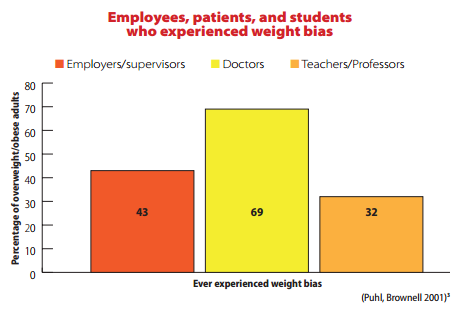
These fears are well founded. Obese people continue to face prejudice and discrimination in a wide variety of ways, according to recent research from the Rudd Report. In the educational system, overweight and obese children report being teased and bullied by peers and teachers alike.

Obesity also has consequences in the workplace. Those who are obese can expect to earn lower wages and be promoted less often than their thinner coworkers, despite positive work evaluations.

5

Overweight and obese people should not expect to find respite from the health care system either. Survey data consistently show that a significant number of doctors and nurses think obese patients are lazy, awkward, and noncompliant. Many of these same medical professionals also report being repulsed by such patients, attitudes which certainly affect the type and quality of care that obese patients receive.

To be sure, obesity contributes to health conditions like heart disease, some forms of cancer, diabetes, among others. It can also lead to early death, conclusions that Arbour’s video also makes. But obese people do not deserve to be ridiculed or discriminated against.

While Arbour now claims that “Dear Fat People” and the humor in it is satire, she perpetuates longstanding beliefs about overweight and obese people, legitimates the unfair treatment that they face on a daily basis, and proves that, yes, fat shaming is a thing.

Jacqueline Clark, PhD is an associate professor of sociology and chair of the department at Ripon College. Her research focuses on inequalities, the sociology of health and illness, and the sociology of jobs, work, and organizations.

Flashback Friday.

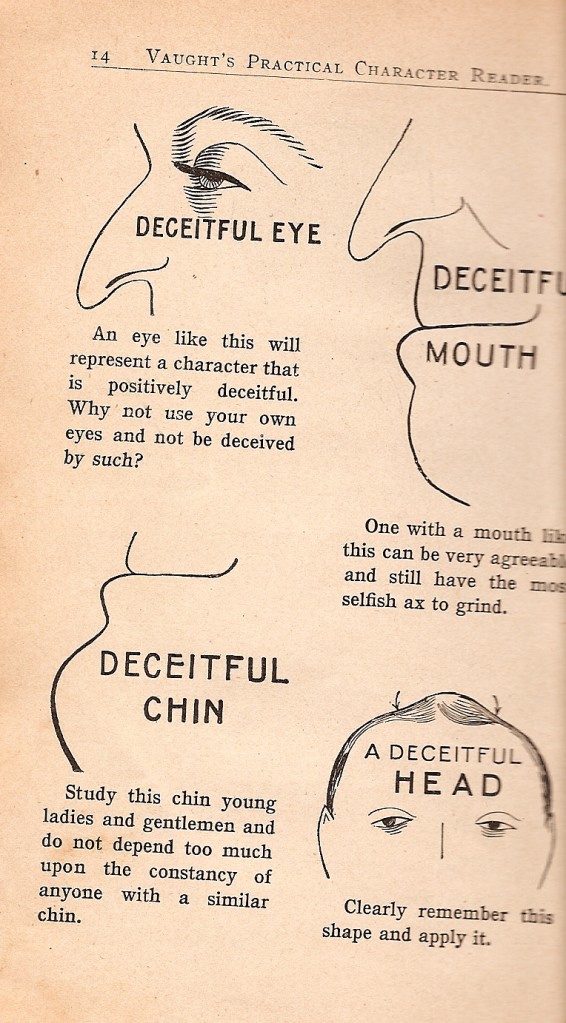
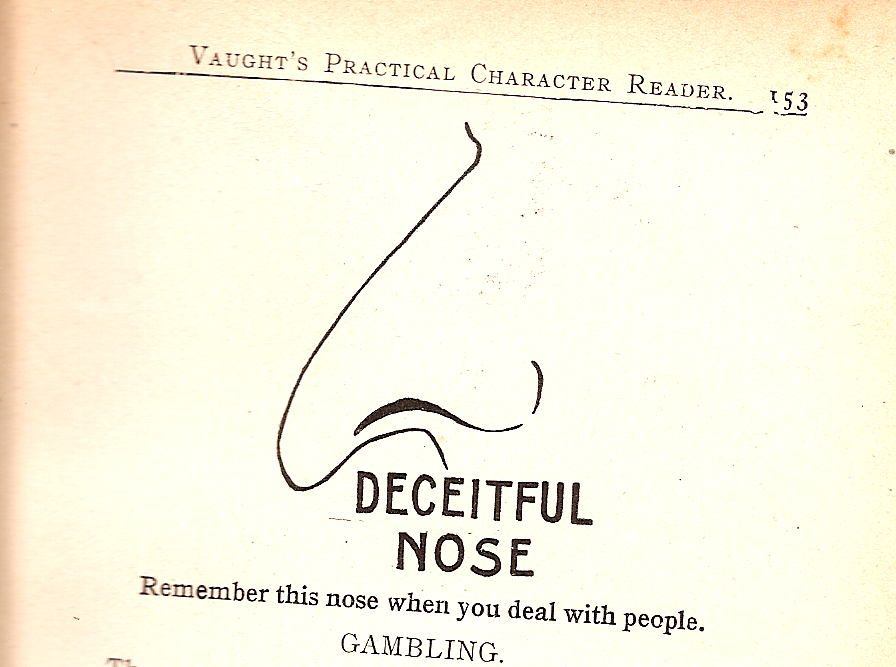
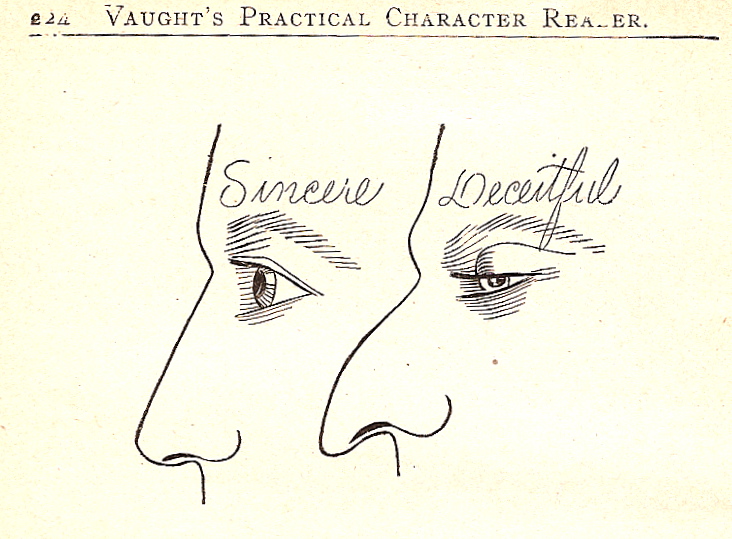
Reader Lindsey H. sent me a copy of a book called Vaught’s Practical Character Reader, apparently published in 1902 and revised in 1907 by Emily H. Vaught. Also available on Amazon. The book can best be described as an application of the theory of physiognomy, which is the idea that you can tell all kinds of things about a “person’s character or personality from their outer appearance” (wikipedia). Some images from Vaught’s book:

sc007ae911

sc007b3eec

sc007b4f96

The book is full of images in which the features stereotypically associated with Northern and Western Europeans, or the mythical Aryan race, are associated with sincerity, honestly, a work ethic, and every other positive character trait, whereas large and especially hooked noses and small, hooded, or almond-shaped eyes were indications of negative traits.

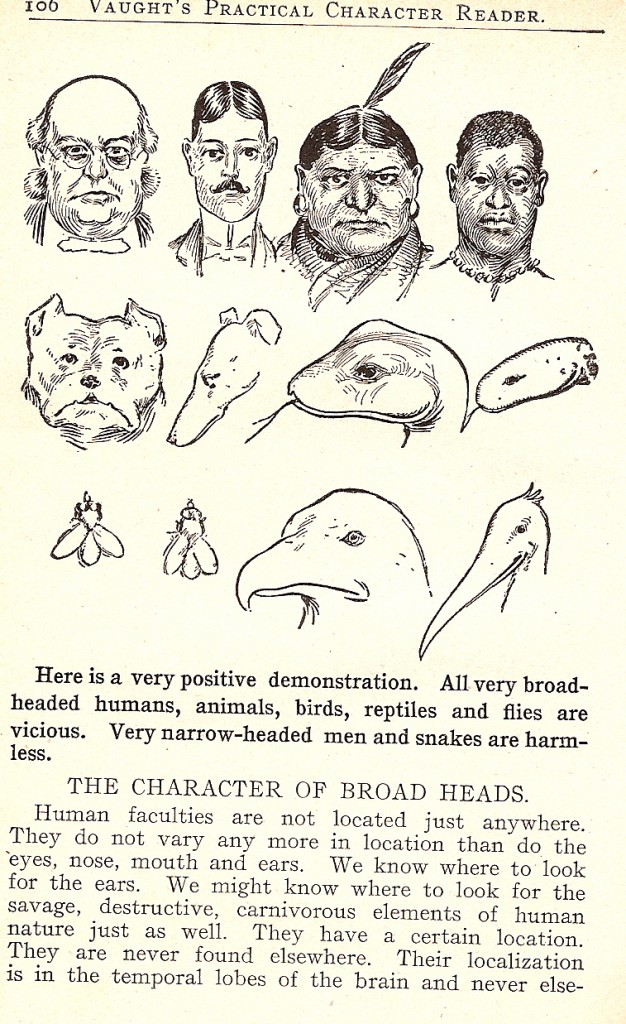
Here we learn that the broadness of a person’s face tells you whether they are vicious or harmless:

sc007b25a4

The text does not explain whether the implication is that all Native Americans are vicious and all Blacks are harmless, or if these are just examples and those races would have just as much variety as we see among Whites.

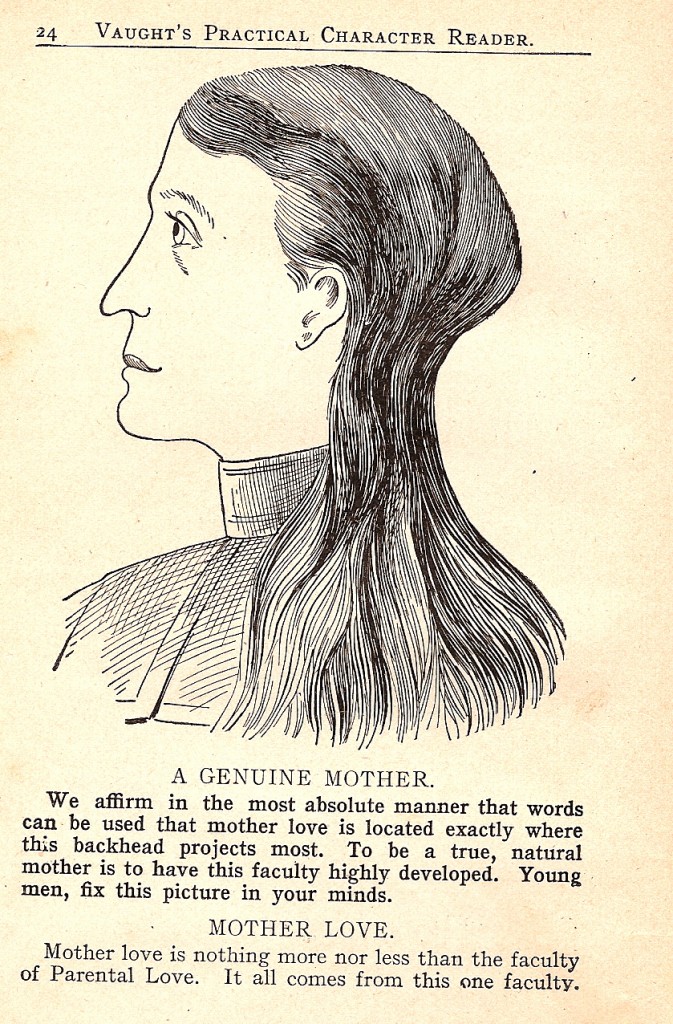
For those of you who are considering procuring yourself a wife, Vaught provides some tips on picking out a woman who will be a good mother (the same general head shape indicates a good father as well):

sc007b01f0

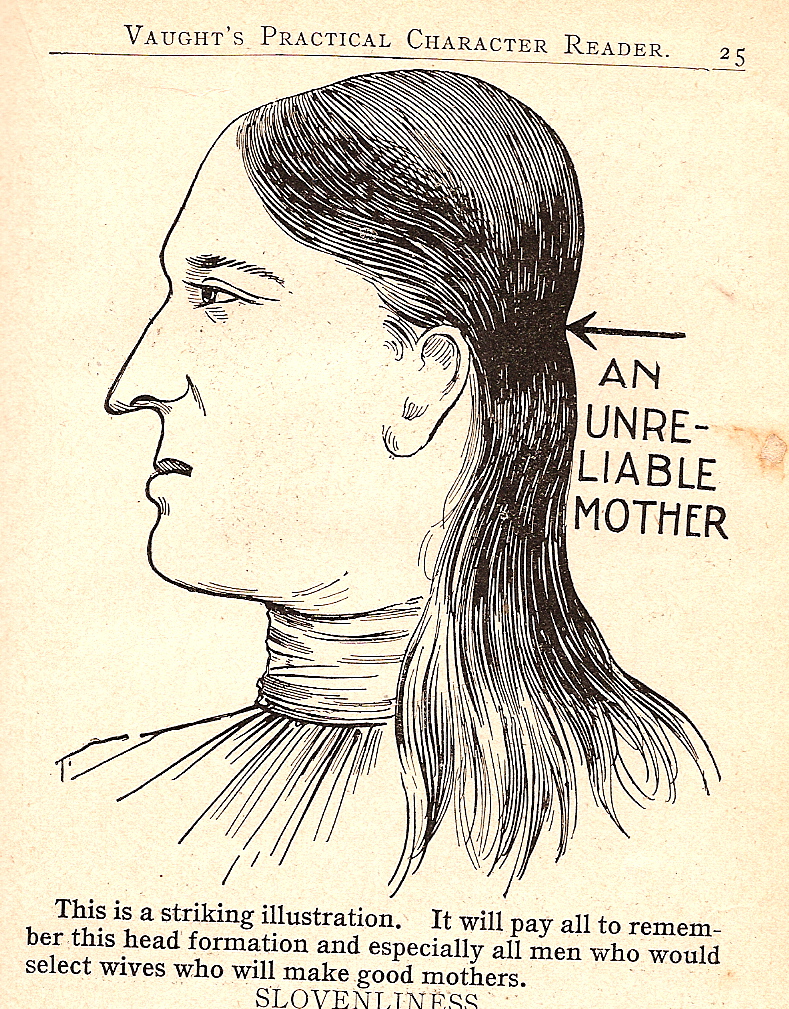
Avoid at all costs a man or woman with this head shape (notice the pointed nose, larger ears, and smaller eyes compared to the image above, in addition to the apparently super-important head protuberance):

sc007b1256

Also, based on the illustrations, apparently men who wear bowties are good fathers but those who wear neckties should arouse your suspicion. There is also a section titled “How to Pick Out a Good Child,” which I intend to take with me next time I am child shopping.

The back page advertises other books available from Vaught’s press, including Human Nature Year Book from the Human Science School and the new Text Book on Phrenology, which addresses “Heads Faces Types Races.”

I have seen examples of physignomy and phrenology before, and images of their practitioners measuring people’s heads and facial features, but I have never before seen an entire book devoted to it. These pseudosciences were taken quite seriously at the time, with “experts” showing that Africans and African Americans, for instance, had facial features that proved them to be less civilized and intelligent than those of European descent and that Jews were inherently deceitful.

Thanks a ton for sending it in, Lindsey!

Originally posted in 2009.

Gwen Sharp is an associate professor of sociology at Nevada State College. You can follow her on Twitter at @gwensharpnv.

Today is Love Your Body Day and is this is our favorite body positive post of the year, re-posted in celebration. 

Rachel Wiley delivers a provocative poem about her experience as a “fat girl” loved by a skinny boy.  My favorite part:

My college theater professor once told me
that despite my talent,
I would never be cast as a romantic lead.
We put on shows that involve flying children and singing animals
but apparently no one
has enough willing suspension of disbelief
to buy anyone loving a fat girl.

Watch the whole thing (transcript here):

If you liked, we also recommend Kara Kamos’ confession that she’s ugly, but can’t think of a good reason to care.  Hat tip to Polly’s Pocket.

Lisa Wade, PhD is an Associate Professor at Tulane University. She is the author of American Hookup, a book about college sexual culture; a textbook about gender; and a forthcoming introductory text: Terrible Magnificent Sociology. You can follow her on Twitter and Instagram.

W.E.B. DuBois (1934):

The colored people of America are coming to face the fact quite calmly that most white Americans do not like them, and are planning neither for their survival, nor for their definite future if it involves free, self-assertive modern manhood. This does not mean all Americans. A saving few are worried about the Negro problem; a still larger group are not ill-disposed, but they fear prevailing public opinion. The great mass of Americans are, however, merely representatives of average humanity. They muddle along with their own affairs and scarcely can be expected to take seriously the affairs of strangers or people whom they partly fear and partly despise.

For many years it was the theory of most Negro leaders that this attitude was the insensibility of ignorance and inexperience, that white America did not know of or realize the continuing plight of the Negro.  Accordingly, for the last two decades, we have striven by book and periodical, by speech and appeal, by various dramatic methods of agitation, to put the essential facts before the American people.  Today there can be no doubt that Americans know the facts; and yet they remain for the most part indifferent and unmoved.

– From “A Negro Nation Within a Nation.

Borrowed from an essay by Tressie McMillan Cottom. Photo from ibtimes.com.

Lisa Wade, PhD is an Associate Professor at Tulane University. She is the author of American Hookup, a book about college sexual culture; a textbook about gender; and a forthcoming introductory text: Terrible Magnificent Sociology. You can follow her on Twitter and Instagram.