Search results for The

Boy, you can’t open the paper these days without seeing something about how irrevocably fucked California’s finances are. With a budget deficit approaching a staggering $40 billion dollars, it’s worth noting that not only is their deficit the biggest in the country in absolute terms but also as a proportion of state GDP. That’s pretty impressive given that California’s economy is bigger than all but a handful of countries.

In my line of work, “Raiding the UCs” is a very real phenomenon. Faculty have seen salaries slashed by 20% (with talk of more cuts to come) while students have experienced dramatic tuition hikes – although it’s fair to note that in-state tuition before the hikes was far lower than in most states. The recent cuts come on the tail end of a 15 year trend that has seen the university system’s share of the state budget halved. With too many obligations and not enough money, it would make sense that cuts to a vital sector like education would be indicative of cuts across the board.

Oh.

Lost in the budget debate is the fact that California spends nearly 10% of its annual budget on the Department of Corrections. Eight billion dollars. Let’s see that with the zeroes: $8,000,000,000. This is, of course, in addition to other money spent on law enforcement and the criminal justice system. Such figures look reasonable only in comparison to a trainwreck like Michigan, where a mind-blowing 22% of the state budget is spent on warehousing the poor in prisons.

We can re-hash all the usual, obvious, and valid culprits – “guideline” sentencing, mandatory minimums, three strikes, a vast social underclass deriving minimal benefit from the state’s aggregate wealth – but we’d say nothing new. The more important questions is how prison systems, and California’s in particular, can absorb the coming increase in crime concomitant with an extended period of double digit unemployment. At a time when every agency needs to get cheaper, the CDC must continue to get bigger (and inevitably costlier) to provide a convenient dumping ground for society’s expendables.

This problem is fascinating because like the Federal budget there is no reasonable move that doesn’t make the situation worse. California can start paroling more people. With no jobs available even for Californians with clean criminal backgrounds, we can imagine how few ex-inmates will find an “honest” living and how high the rate of recidivism will be. It can adopt different sentencing guidelines, which is politically unlikely and will provide only gradual long-term relief. They can simply stop arresting and/or charging so many people, but that too is politically infeasible and may ultimately lead to increased crime levels. They can, as publications as mainstream as Time have noted, formally surrender in the War on Drugs and legalize weed. I will believe that when I see it (although I don’t entirely discount it as the budget situation gets progressively more desperate). They could simply slash the budget, which may not be realistic given the high fixed costs of the system and the current levels of overcrowding/understaffing.

Spending twice as much on prisons as higher education should prompt some soul searching. I won’t hold my breath; in all likelihood the status quo will be maintained and the share of the budget devoted to corrections will continue to increase. Devoting one of every ten tax dollars to locking up the poor is understood as the cost of doing business in a state and society that choose to solve the problem of a persistent underclass the same way it deals with trash; that is, by collecting it in cities and shipping it out to the middle of nowhere to be buried under a mountain of other garbage, never to be seen or thought of again.

—————————–

Ed is a Political Scientist who claims to finds “the spatial and geographic context of political behavior — partisanship, turnout, and public opinion” — particularly thrilling.  You can learn more, vaguely inappropriate, things about Ed here.  In the meantime, we’re thrilled to feature his post questioning California’s questionable budget priorities. He blogs at Gin and Tacos.

If you would like to write a post for Sociological Images, please see our Guidelines for Guest Bloggers.

Reader Clifford McC. and his (female) partner both receive Bicycling magazine (which, he explains, is more of a free advertisement that they get whether they want to or not).  In any case, this month’s issue was the 2010 Buyer’s Guide and, though the issues each received were identical, the one addressed to his partner was stickered:

The sticker read, “BONUS! SPECIAL WOMEN’S SECTION.”

Perhaps they were trying to be inclusive, but a sticker advertising a special women’s section just goes to show that the magazine is, first-and-foremost, for men.

For the same phenomenon elsewhere, see our posts featuring websites selling dinosaur toys and Legos(see “exhibit three”), each with a special section for girls.

Lisa Wade, PhD is an Associate Professor at Tulane University. She is the author of American Hookup, a book about college sexual culture; a textbook about gender; and a forthcoming introductory text: Terrible Magnificent Sociology. You can follow her on Twitter and Instagram.

Dmitriy T.M., Christina W., Kelly V., and George asked us to comment on Vajazzling. Dmitriy, who sent in the video link, said he was too frightened to press play, but I am very brave and now I know what vajazzling really is! It’s hard to know because the term “vajayjay” is, um, who knows what that word means… and the term “vagina” (which actually refers to what is otherwise known as the birth canal) is now used to mean the vulva and, apparently, anything within 12 inches of it.

In any case, the video below, in which a woman documents the vajazzling of her “vagina,” reveals that the term refers to the placing of a field of tiny crystals where your public hair would be. So, you essentially replace your pubic hair with shiny objects.

So, brave souls who pressed play, sociologically analyze away.

Lisa Wade, PhD is an Associate Professor at Tulane University. She is the author of American Hookup, a book about college sexual culture; a textbook about gender; and a forthcoming introductory text: Terrible Magnificent Sociology. You can follow her on Twitter and Instagram.

E. W. sent in a three-page internet ad for the 2010 Chevy Traverse.  The Traverse seats eight, but the ad campaign suggests that it is perfect for just four.  E.W. offers the play-by-play:

The first image of the ad shows a young boy and girl in the first row of seats in an SUV.  They are separated by at least a foot of space.  The young boy is poking the girl (presumably his sister) in the shoulder.

The following images show the two kids in various seating arrangements where they are always separated by the seating rows (one in front and one in back).

The end tag (car-two) states “Finally, you can separate them.”

“To summarize the ad in my words,” said E.W., “Buy a car that can seat 6 kids because you can’t control your 2.”

Or, in my words, in the face of an economic crisis peppered with sky-high fuel prices, we are desperate for another way to try to convince Americans that they need giant cars.

Lisa Wade, PhD is an Associate Professor at Tulane University. She is the author of American Hookup, a book about college sexual culture; a textbook about gender; and a forthcoming introductory text: Terrible Magnificent Sociology. You can follow her on Twitter and Instagram.

If you’re interested, I wrote a piece for The Daily Mirror about my recent trip to the LAPD’s “Behind the Scenes” exhibit here in Vegas (which got a lot of media attention when the Kennedy family protested the inclusion of bloody clothing from Robert Kennedy’s shooting). My friend Larry was interested in the politics involved–whose personal tragedy gets put on public display? Were the displays as sensationalistic as he suspected they would be? He was particularly interested in how the case of the Black Dahlia (aka Elizabeth Short) would be presented, and what the LAPD would think was appropriate to display for public consumption.

So I agreed to go take a look. And I was horrified in so many ways. Absolutely stunned. You can find the piece here.

This is the second post using material borrowed from the essay, “Facts and Fictions About an Aging America.”  Our online host, Contexts magazine, is offering some free content, including this essay, now through March 15th.  See yesterday’s post here.

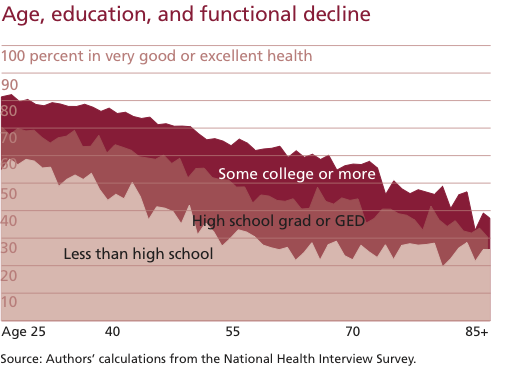
While people in industrialized countries live longer and healthier lives than ever, more educated people enjoy even less morbidity than less educated people.  The figure below illustrates the decline in mental and physical function over time for people with a college degree, a high school degree, and no degree at all:

The figure shows that more educated people experience “excellent health” than less educated at every age, except perhaps 85 and above.  Why might this be?

Well, higher educated people may come from wealthier families who were able to provide their children with health care, good nutrition, and exercise.  Having degrees may also correlate with jobs that are less harmful to the body and offer both health insurance and more free time to exercise.  Lower educational attainment is likely correlated with economic insecurity; a lifetime of struggling to make ends meet could create the kind of bad stress that interferes with both mental and physical health.

Other theories?  Thoughts on these?

Lisa Wade, PhD is an Associate Professor at Tulane University. She is the author of American Hookup, a book about college sexual culture; a textbook about gender; and a forthcoming introductory text: Terrible Magnificent Sociology. You can follow her on Twitter and Instagram.

Sometimes when we put up hyperfeminine clothes and toys for girls, people argue that no one has to buy those clothes, so there is no point in critiquing their existence.  The implication is that all conformity to gendered expectations is voluntary (on the part of both mothers and their daughters).

However, the recent furor over Shiloh Jolie-Pitts haircut and boyish outfit, sent in by Tara C., Cailin H., and Lindsay F., shows us that having a gender-consistent appearance isn’t simply voluntary; when you don’t perform gender, other people will police your choices.  In this case, people are questioning whether she is harming her child by turning her “into A BOY?”

In this case, of course, it’s mass media doing the policing (or inviting readers to do the policing).  In the lives of non-celebrities, this same sort of policing is often done by family members, friends, and even strangers.  For the non-conformist (parent), then, gender non-conformity can be a real drag.

Image borrowed from DListed.

Lisa Wade, PhD is an Associate Professor at Tulane University. She is the author of American Hookup, a book about college sexual culture; a textbook about gender; and a forthcoming introductory text: Terrible Magnificent Sociology. You can follow her on Twitter and Instagram.

Finally, a push-up panty for the penis!

It’s here and, thanks to Luis J.C.R., we all know about it.

Images and discussion after the jump because not safe for work.

more...