Search results for The

Shayna over at Food, Farms, and Famine posted about what the label “organic” means. The specific wording, and where on the package the statement is placed, is an indication of just how “organic” the product might be,

This video also discusses the meaning of various organic labels (put after the jump because it starts playing automatically):
more...

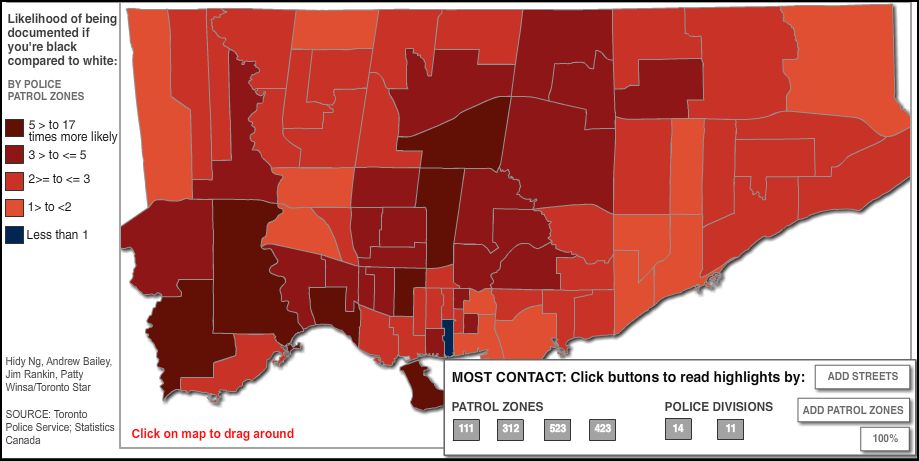
Michelle DuB. sent in some data from the Toronto Star, showing that blacks are more likely than whites to be stopped by police in every single patrol zone except for one.  The disproportion was even high in mostly white areas; they were stopped up to 17 times as often (darker red is most disproportion):

Click here for a video showing what some citizens and a bunch of Toronto police have to say.

See also our posts showing how the stopping of people on the street usually results in… nothing (other than people feeling harassed) and how racial profiling turns out to be ineffective anyway.

Lisa Wade, PhD is an Associate Professor at Tulane University. She is the author of American Hookup, a book about college sexual culture; a textbook about gender; and a forthcoming introductory text: Terrible Magnificent Sociology. You can follow her on Twitter and Instagram.

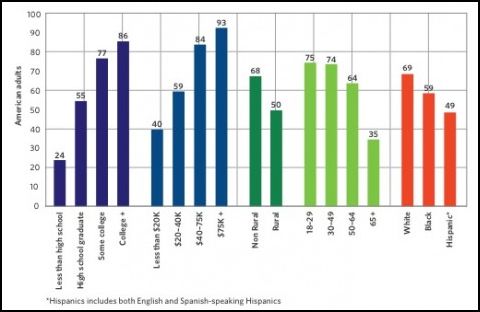
The image below shows who has broadband internet (as opposed to dial up or no internet at all). It was sent in by Dmitrity T.M., who sees no surprises here. Do you?

Lisa Wade, PhD is an Associate Professor at Tulane University. She is the author of American Hookup, a book about college sexual culture; a textbook about gender; and a forthcoming introductory text: Terrible Magnificent Sociology. You can follow her on Twitter and Instagram.

Carolyn L., who blogs at Remodel Minority, found these and other mascot costumes at Costume Shop.  They are, from left to right, the “Mexican Costume Mascot”, “Mandarin Man Chinese Costume”, “Native American Chief Costume Mascot,” “Native American Indian Costume”:

The costumes start at $887.   This reminds us that racist mascots are an industry, not just a poor choice.  It would be much more difficult to field a team called the Indians, the Gauchos, or the Orientals if there were no pre-made costumes to buy.

Lisa Wade, PhD is an Associate Professor at Tulane University. She is the author of American Hookup, a book about college sexual culture; a textbook about gender; and a forthcoming introductory text: Terrible Magnificent Sociology. You can follow her on Twitter and Instagram.

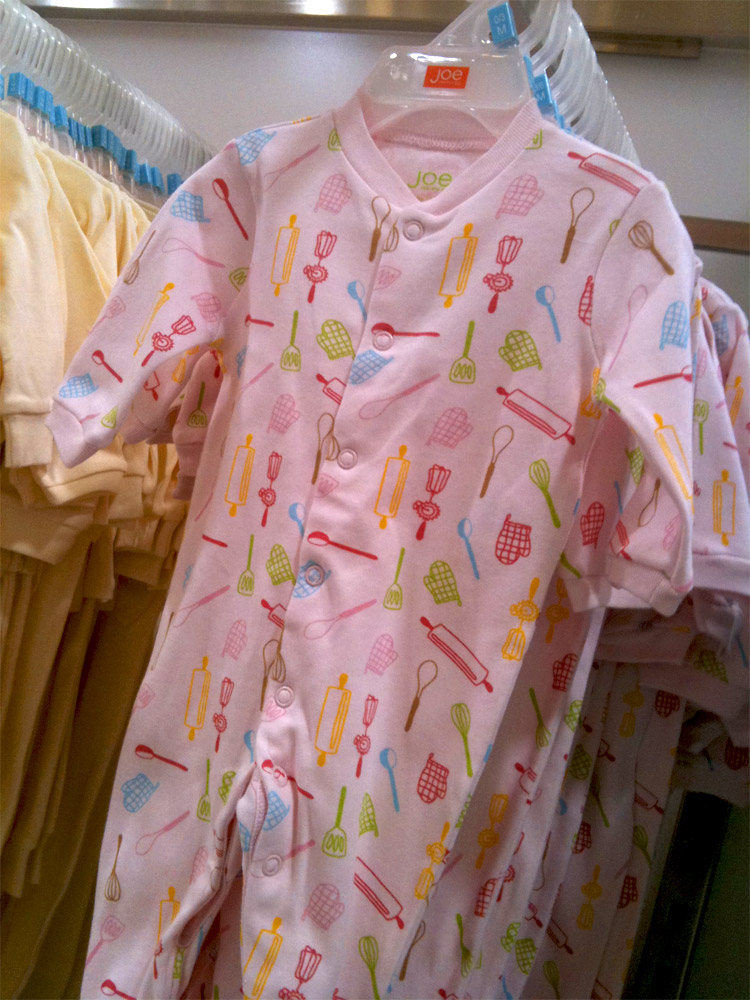
Just a reminder: being a girl means wearing pink and thematically attiring yourself in cooking and baking implements! Erica Glasier, who snapped and sent in the photo, writes:

The message is clear: little girls, you’re going to grow up cooking, and you’re going to like it. Needless to say the little blue jammies had no such future drudgery being celebrated on their fabric.

The pjs are Joe Fresh brand, sold at Superstore.

Lisa Wade, PhD is an Associate Professor at Tulane University. She is the author of American Hookup, a book about college sexual culture; a textbook about gender; and a forthcoming introductory text: Terrible Magnificent Sociology. You can follow her on Twitter and Instagram.

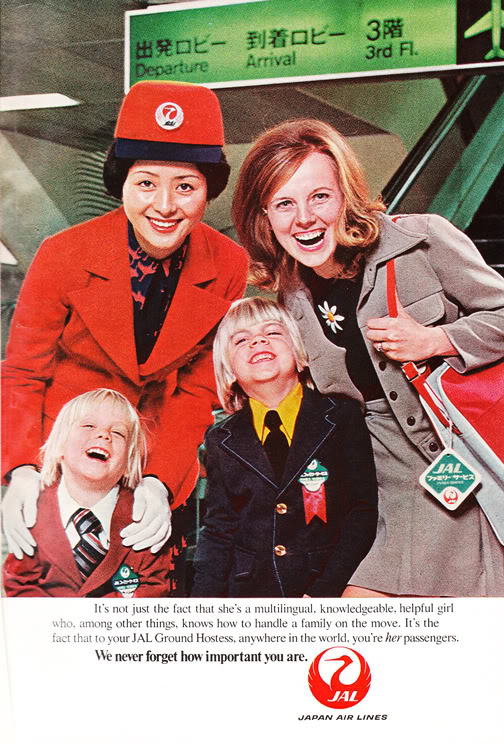
This vintage ad is a great example of the intersection of sexism and racism. She’s there for YOU because YOU, white family, are “important”:


Text:

It’s not just the fact that she’s a multilingual, knowledgeable, helpful girl who, among other things, knows how to handle a family on the move. It’s the fact that to your JAL Ground Hostess, anywhere in the world, you’re her passengers.

We never forget how important you are.

JAPAN AIR LINES

(Source: Vintage Ads.)

Lisa Wade, PhD is an Associate Professor at Tulane University. She is the author of American Hookup, a book about college sexual culture; a textbook about gender; and a forthcoming introductory text: Terrible Magnificent Sociology. You can follow her on Twitter and Instagram.


Sanguinity and Jen B. sent in a “That’s Gay” segment discussing, humorously, the discourse around figure skater Johnny Weir’s sexual orientation and whether he should be allowed to skate the way he does:

Quoting from The Sport Journal, Jen writes:

While figure skating is rumored to have the highest proportion of homosexual men of any amateur competitive sport, it is ironically a sport in which men must exhibit the most blatantly heterosexual signs to be successful and to receive commercial endorsements… at the 2001 World Championships in Vancouver when a well-known male Canadian skater was contacted by a gay magazine about the possibility of doing a feature story on him, he was told by Skate Canada that he must decline the request. As one coach said to me, “that is not the sort of picture that Skate Canada wants to paint for the country, especially in an international forum.” Every effort is made to construct such skaters as heterosexual.

We’ve posted on Skate Canada’s get “tough” campaign here.

Lisa Wade, PhD is an Associate Professor at Tulane University. She is the author of American Hookup, a book about college sexual culture; a textbook about gender; and a forthcoming introductory text: Terrible Magnificent Sociology. You can follow her on Twitter and Instagram.


Jay Smooth on why we should focus less on the dumb racist/sexist/asshole-y bullshit people like John Mayer say (and man, did he ever say some dumb bullshit) and more on, say, re-segregation of the public school system:

And just for fun, Jay Smooth discussing Chris Matthews’s comment that he “forgot” President Obama was black, and what that says about what we think racial equality would look like:

I get this with students a lot: they desperately want to deny ever noticing anyone’s race/ethnicity, because the discourse of color blindness states that the way to treat people equally and eradicate racism is to stop acknowledging racial categories at all. But when you simply start ignoring the role of an important socially-constructed category without actually eliminating the negative effect it has on those in certain categories, you aren’t ending racism. It’s just making it harder to talk about or address, since anyone who tries to start a conversation about racial inequality is accused of actually perpetuating inequality and/or being racist for bringing the topic up.

This ties back in with the first video–we are more comfortable with more symbolic or linguistic forms of combating racial inequality (so, say, people say they have a friend who “happens to be Black,” as though it’s something they never thought about until that very second) than the much more complicated, difficult, and long-term work of rooting out structural inequality.