Search results for The

JT sent along the following submission for grossest Halloween costume: the Jane Doe DOA.  That’s Jane Doe Dead on Arrival to you.  And isn’t she hot in her custom-made body bag and “choker”?
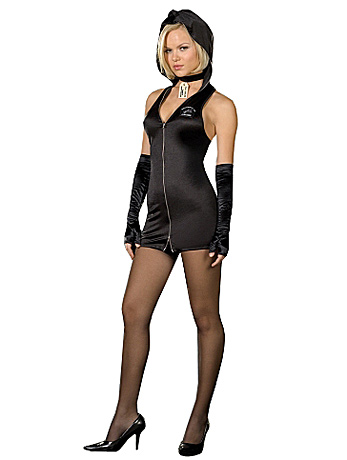
The description:

Although she doesn’t have much of a personality, she is still drop dead gorgeous in this body bag dress, I’m sure you have the personality and in this you will be gorgeous. Stretch satin mini dress with hood and a two way zipper front which can zip all the way up the hood, this is sleeveless and has a vest style finish at the back.  One breast has an outline of a body printed on to it an PROPERTY OF THE CORONER. Pack includes Coroners name tag fitted to a choker Jane Doe and matching fingerless gloves. (3 piece set). Fabrics are listed as 95% polyester and 5% spandex. and other accessories are available separately.

Lisa Wade, PhD is an Associate Professor at Tulane University. She is the author of American Hookup, a book about college sexual culture; a textbook about gender; and a forthcoming introductory text: Terrible Magnificent Sociology. You can follow her on Twitter and Instagram.

Many of you may have heard about NPR’s decision to fire commentator Juan Williams last week after he appeared on The O’Reilly Factor and made the following comments:

Look, Bill, I’m not a bigot. You know the kind of books I’ve written about the civil rights movement in this country. But when I get on the plane, I got to tell you, if I see people who are in Muslim garb and I think, you know, they are identifying themselves first and foremost as Muslims, I get worried. I get nervous.

Williams was widely criticized for the remarks after video of his appearance showed up on a number of liberal websites, and NPR quickly fired him, arguing that his comments about Muslims discredited him as a commentator (more on that below).

Muriel Minnie Mae, Duff M., and an anonymous contributor all let us know about the site Pictures of Muslims Wearing Things, created in response to the incident. The site deconstructs the idea of “Muslim garb” by showing…well, pictures of Muslims wearing things. New images (with awesome captions) are currently going up every few minutes, and it’s a great example of the diversity that exists among Muslims, variety that tends to get ignored in stereotypical depictions of Muslims (who are often conflated with Arabs and Middle Easterners, though the world’s largest Muslim population — over 200 million — is in Indonesia and only 20% of all  Muslims live in the Middle East and North Africa).

Even in the cases where individuals are wearing something that others might identify as clearly “Muslim”, such as hijab, is it fair to say they are “identifying themselves first and foremost as Muslims,” as Williams stated? Is it that Dalia, above, is stressing her Muslim identity above all else (say, more than being a professional, with the suit, or a married woman, with a wedding ring) by covering her hair? Or, perhaps, does covering her hair make individuals who are uncomfortable with Muslims unable to see her as anything but “first and foremost” a Muslim?

Side note: Since this post brings up the whole Juan Williams situation, I think I would be remiss if I didn’t point out that a number of commentators argue Williams’s comments are being unfairly decontextualized with a selectively-edited video. If you watch the full segment, he starts out with the comments above (the only part that got widely distributed), which indicate a personal discomfort with Muslims, but goes on to disagree with O’Reilly, saying that we don’t blame all Christians for the actions of Timothy McVeigh and that the concern should be not about Muslims, but about extremists. William Saletan of Slate says,

I’m not saying Williams is the world’s most enlightened guy. He’s wrong, for example, about the proposed Islamic Center near Ground Zero. And it’s certainly unsettling to hear him admit that he worries when he sees Muslims in distinctive dress. But admitting such fears doesn’t make you a bigot. Sometimes, to work through your fears, you have to face them honestly. You have to think through the perils of acting on those fears. And you have to explain to others why they, too, should transcend their anxieties or resentments and treat people as individuals.

Gwen Sharp is an associate professor of sociology at Nevada State College. You can follow her on Twitter at @gwensharpnv.


Latoya Petersen at Racialicious highlighted an interesting campaign ad. Funded by Citizens Against Government Waste, it features a future in which China has succeeded the United States as the world’s super power. It is supposed to frighten the reader by forecasting a world in which China rules America (cue ominous music and satisfied evil chuckling).

What is interesting to me is the assumption that drives the commercial: that the U.S. should be a super power, that it is naturally so (so long as it sticks to its founding principles), and that it would be wrong for China to be more powerful than the U.S.   The idea that self-satisfied Asian people would be in charge adds racist oomph to the threat.

Lisa Wade, PhD is an Associate Professor at Tulane University. She is the author of American Hookup, a book about college sexual culture; a textbook about gender; and a forthcoming introductory text: Terrible Magnificent Sociology. You can follow her on Twitter and Instagram.
A former CEO of World Wrestling Entertainment, Linda McMahon (R) is running in Connecticut for a seat in the U.S. Senate.  In an essay at the Huffington Post, sent in by Dr. Caroline Heldman, Jackson Katz explains that her company has promoted “…some of the most brutal, violent and hateful depictions of women in all of media culture over the past twenty years.”  The violence and misogyny in professional wrestling is an issue that Katz has taken on personally in his documentary, Wrestling with Manhood.

Media actors, he argued, have not focused on the substance of her company’s product, so much as its amazing success.  Katz, however, challenges the idea that her business acumen is more important than the fact that she spent 20 years promoting and excusing violence against women:

…incredibly, the rampant misogyny of McMahon’s WWE has gotten scant coverage during this fall’s U.S. senate campaign in Connecticut. Political reporters have largely rolled over and bought the McMahon campaign line that what goes on in professional wrestling is only entertainment, that the WWE has gotten more family-friendly in recent years, and that we should all just lighten up and focus on what really matters about Linda McMahon’s stewardship of the WWE: her savvy business skills and experience.

Hoping to bring attention to the kind of messages the WWE sent under McMahon’s leadership, Katz put together this 11-minute clip from his documentary (trigger warning):

Lisa Wade, PhD is an Associate Professor at Tulane University. She is the author of American Hookup, a book about college sexual culture; a textbook about gender; and a forthcoming introductory text: Terrible Magnificent Sociology. You can follow her on Twitter and Instagram.
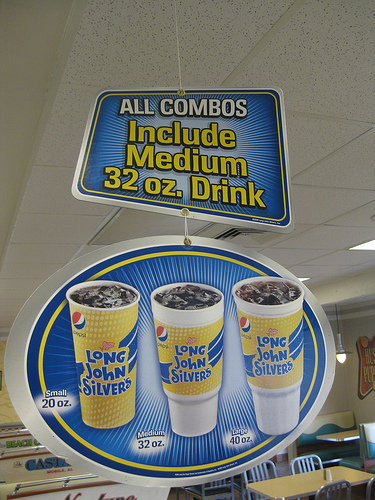
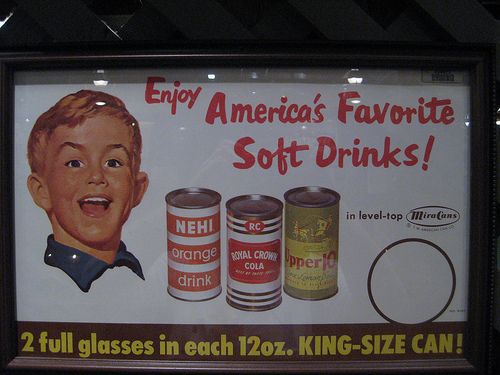
As we’ve talked about before, one marketing strategy to get people to buy more stuff is to manipulate sizes. In the case of clothing, companies often use “vanity sizing,” labeling clothes as a smaller size than they really are. Food serving sizes have followed a form of vanity sizing of their own, with portions getting larger over time. Ben Ostrowsky sent in a great example of changing norms of consumption, highlighting the enormous increase in what is considered a standard serving of soda.

In this 1950s ad for soda, the text proudly proclaims that a 12-oz. can is “king-size,” and includes 2 full servings:

Compare it to this sign at Long John Silver’s, where the smallest size is 20 oz., and a 32-oz. medium soda, presented as the default size, is nearly 3 times as large as the 1950s king-size double serving (though, as a reader pointed out and I didn’t think to mention, we do have to make some allowance for ice in the cup):

The gas station nearest me used to have fountain drink cups that started at 20 oz. I noticed recently they’ve completely dropped that size; the smallest cup you can now buy is 32 oz. The largest is a whopping 64 oz. I am actually curious how a person gets it home in their car, as I don’t see how it would fit in a standard cup holder. Perhaps you buckle it into an empty seat?

Of course, the larger the default size, the more product a company sells. For other examples of the push to increase portions or serving sizes, see Lisa’s post on manufacturers’ instructions for use.


Alex C. sent in an example of the belittling of men by men in the context of sport.  Two teenager fans of the Red Sox found themselves verbally assaulted by Yankee fans for the sin of sitting amongst them.  They surround the boys and sing, aggressively, to the tune of YMCA, after a mostly indecipherable lead in:

Why are you gay!
I saw you suckin’ it, D-I-C-K.
They have every size, you’re about to enjoy.
You can hang out with all the boys!
Why are you gay!
I saw you suckin’ some D-I-C-K.

It should be clear to everyone that this behavior represents a sick society. Team affiliation follows the rules of the minimal group paradigm: humans appear to be willing to form meaningful groups based on just about anything.  Sports just happens to be an arena in which hypermasculinity is rewarded, even demanded.  This makes it acceptable to be cruel to one another and makes it inevitable that that cruelty will take the form of hatred towards gay men (deemed masculine failures) in the form of homophobic slurs.  It’s not even that they think the kids are gay, but calling them gay is good for a laugh and a great insult.

This is what it’s like to be a man under patriarchy: moments of inhumanity in which men accept and reproduce hatred against others and moments of victimization when other men aim that hatred at you.

Lisa Wade, PhD is an Associate Professor at Tulane University. She is the author of American Hookup, a book about college sexual culture; a textbook about gender; and a forthcoming introductory text: Terrible Magnificent Sociology. You can follow her on Twitter and Instagram.

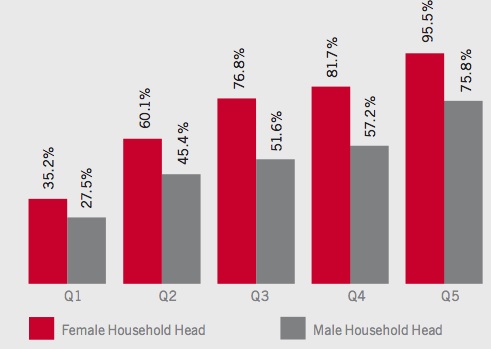
Emma M.H. sent us a link (via Jewish Philanthropy) to a study by the Center of Philanthropy, at Indiana University, about differences in financial donating by men and women. The report looks at data from a 2007 nationally representative survey of households, in which respondents were asked about their charitable giving in 2006. To isolate differences in giving, the report includes data only on single heads of household (whether never-married, divorced, or widowed), since in married households it’s difficult to distinguish who made the decision to donate (they point out that the literature is also very clear that married households are much more likely to donate than non-married households). You can get a copy of the actual questionnaire here.

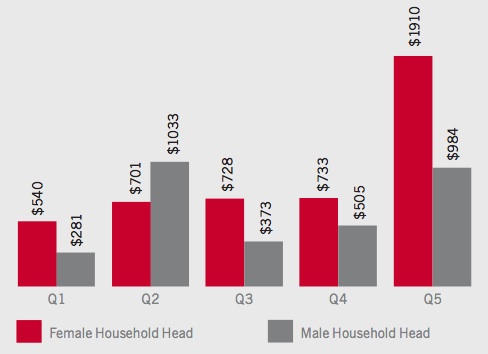
They break the data down by income as well, dividing them into quintiles (that is, each category contains 20% of respondents). The income quintiles are: Q1 = $23,509 or less, Q2 = over $23,509 but less than $43,500, Q3 = over $43,500 but less than $67,532, Q4 = over $67,532 but less than $103,000, and Q5 = $103,000+.

As we see, in each income category non-married women were more likely to donate to charities of some sort:

Women also generally gave more:

It’s interesting to me that the total amount of the giving doesn’t vary more by income for non-married women (the amount of reported giving is basically the same for the 2nd, 3rd, and 4th quintiles), yet varies so much for non-married men. Thoughts on what’s going on there?

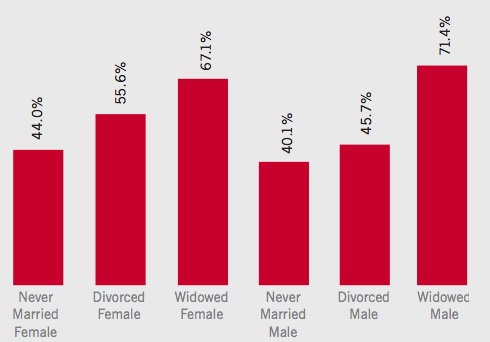
Likelihood of giving also varies quite a bit depending on type of single status — those who are widowed are quite a bit more likely to donate than the never-married, which is probably partially a factor of age and related factors like generally higher incomes/wealth:

As we’ve posted on in the past, women are also more likely to be involved in volunteer work.

I’d love to see a breakdown of where men and women donate, but the report didn’t provide that level of detail.

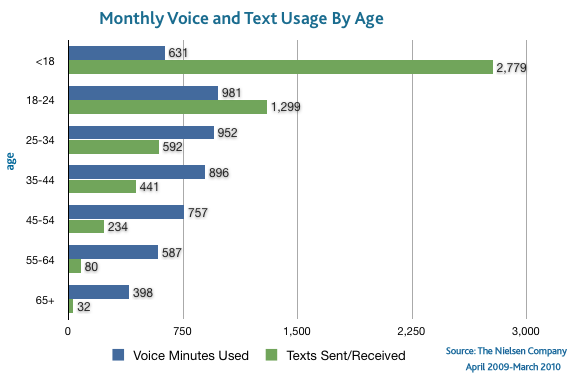
The Nielsen Company finds that the use of phone voice and text communication varies quite tremendously by age:

Lisa Wade, PhD is an Associate Professor at Tulane University. She is the author of American Hookup, a book about college sexual culture; a textbook about gender; and a forthcoming introductory text: Terrible Magnificent Sociology. You can follow her on Twitter and Instagram.