Search results for The

Yesterday Donald Trump appeared to suggest that defenders of the 2nd Amendment should assassinate Hillary Clinton if she is elected. Or maybe any judges she appoints to the Supreme Court. It wasn’t very clear.

Supporters rushed to his defense, suggesting he was joking. Here’s what a humor scholar, Jason P. Steed, had to say about that via Twitter:


You can follow Jason P. Steed on Twitter here.
Ever since Hillary Clinton became the Democratic nominee for president, commentators have been speculating as to how much being a woman will hurt her chances for election. The data suggest it won’t. In fact, if anything, what we know about American voting patterns suggests that being a woman is a slight advantage over being a man.

It’s not that there’s no sexism at all. Parents are more likely to encourage their sons to aspire to political office than their daughters. Women are more likely to be overburdened by childcare and housework when they’re married to men. Women are less likely than men to be tapped by powerful political party gatekeepers. And the media continues to produce biased news coverage.

But when women actually get on the ballot they are as likely to win an election as men. In fact, men in the United States seem rather indifferent towards a candidate’s sex, whereas women tend to prefer females.

Gender stereotypes still apply: voters tend to think that men are better at handling masculine areas of governance like foreign affairs and the economy, but they tend to think that women are better at feminized areas like health care and education. This means that being female can help or hurt a candidate, depending on which issues dominate the election. But, when looked at as an aggregate, gender stereotypes don’t hurt women more than men.

So, there’s one thing we can be reasonably sure of this November: If Clinton loses and Trump wins, it is unlikely to be because the American electorate is too sexist to elect a woman.

.

Lisa Wade, PhD is an Associate Professor at Tulane University. She is the author of American Hookup, a book about college sexual culture; a textbook about gender; and a forthcoming introductory text: Terrible Magnificent Sociology. You can follow her on Twitter and Instagram.

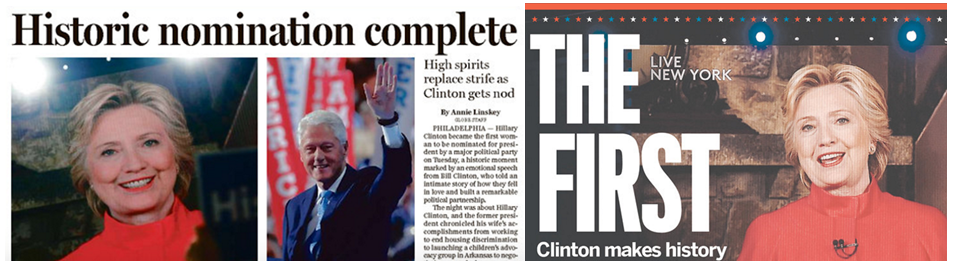
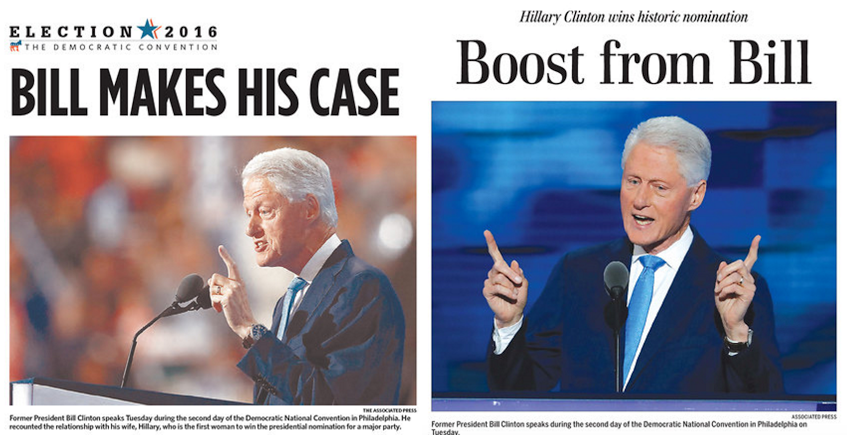
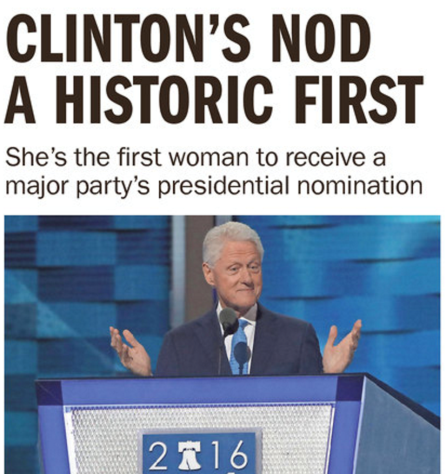
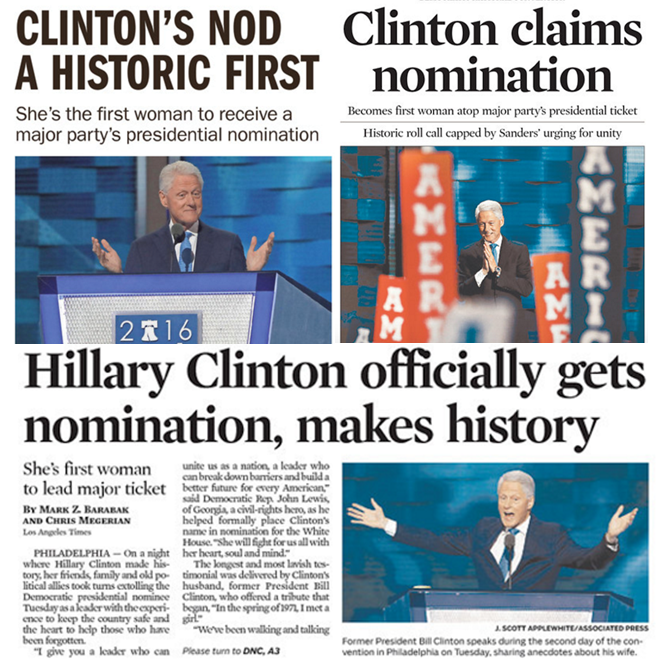
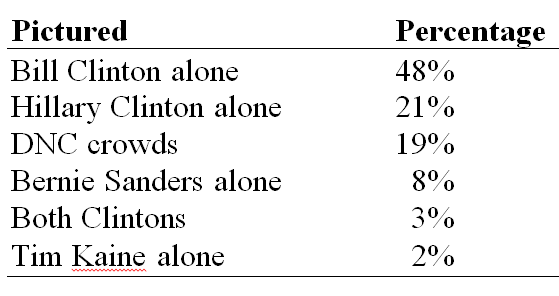
7On Tuesday the first female presidential candidate was officially nominated by a major party. Newspaper headlines across the country referenced the historic event with headlines like “Historic First!” and “Clinton Makes History!” but a surprising number featured photographs of Bill instead of Hillary Clinton. I coded the pictures of each of the 266 newspapers that ran the story on the front page on July 27th (cataloged at Newseum). Here’s the breakdown:
4

Somehow more than three-quarters of newspapers used photos of someone other than the nominee. Nearly the same number of newspapers showed pictures of the crowd at the DNC as the number that showed Hillary Clinton. A non-trivial number of newspapers only showed pictures of Senator Bernie Sanders and a few featured pictures of Vice Presidential Nominee Tim Kaine.

So, why? Why did nearly half of the U.S. newspaper front pages Wednesday morning show only pictures of Bill Clinton?

Let’s consider some explanations.

(1) Journalistic norms. Journalism is governed by a set of norms. One requires that any photo that illustrates an event should be taken from the event itself. Some have suggested that since Hillary Clinton wasn’t physically in attendance at the convention Tuesday evening, reporters couldn’t use a photograph of her. That fact that 21% of newspapers did use an image of Hillary Clinton, though, suggests that this can’t fully explain the numbers. Of the 55 images of Hillary Clinton, 21 used photographs of her video appearance at the convention; the rest used file photos. She may not have physically been there, but front pages like that of The Boston Globe and Newsday (below) show that journalistic norms can’t explain her overwhelming absence.
9(2) Hostile sexism. Sexism that’s hostile is aggressively and proactively anti-woman. Is it possible that some journalists are so uncomfortable with or opposed to a female presidential nominee that they just couldn’t stomach putting Hillary Clinton’s face on the front page? Maybe. There might be a few overtly sexist journalists who just refused to put Hillary on the cover, but that probably doesn’t explain such a high percentage of newspapers with no picture of the nominee.

(3) Supportive sexism. Perhaps journalists (unconsciously) felt that an important thing about her nomination was that she was endorsed by men. Political authority – the authority to speak in the public about political issues — is a masculine authority usually held by men. As a male politician and former president, Bill Clinton’s image lends authority to Hillary Clinton’s historic nomination. His words about her (his “nod”) have weight, giving legitimacy to her candidacy for an office that has always been held by a man. Headlines read “He’s With Her!” and another said “Bill makes his case!” She earned “Bills praise” and got a “boost.”  Maybe some journalists intuited that that was the real story.

16

(4) Bill Clinton’s own gender barrier. Former President Bill Clinton also gave a historic speech Tuesday evening as the first male spouse of the first female presidential candidate. As Rebecca Traister wrote for New York Magazine, “for the first time, the spouse wasn’t a wife. It was a husband, who was … [performing] submission.” Perhaps men’s gender bending is more inherently interesting since masculinity is more limiting for men than femininity is for women. Or maybe this is a more subtle form of sexism: finding things men do inherently more interesting just because men are doing them.

(5) A (gendered) failure of imagination. Maybe Bill Clinton appeared on so many covers because there was no one in the newsroom to notice that putting him on the front page was weird. Or no one with the authority and gall to speak up and say, “Uh, shouldn’t we use a picture of Hillary instead of Bill?” This may reflect the gender gap in journalism. Three out of five print journalists are male. It’s probably even more skewed at the top. With so many male journalists working on front pages across the country, it is plausible that they just didn’t think about gender or those that did were afraid to speak up.

All these explanations together, and likely ones I haven’t thought of, help explain why Hillary Clinton’s face was so absent from the story about her historic moment. The consequences are significant. Politics is still largely a man’s world, and conceptualized in terms of masculinity. U.S. politicians are overwhelmingly male. Only 6 state governors are female, and only 19.3% of U.S. representative seats are filled by women. Only 20 women serve in the U.S. senate. Showing images of a male politician, Bill Clinton, when a female politician has earned an historic victory, only continues this gendered order of politics.

Wendy M. Christensen is a professor of sociology at William Paterson University. Her research interests center on gender, the media, political mobilization, and the U.S. Armed Forces. You can follow her on twitter at @wendyphd.

FBI director, James Comey, didn’t call it the “Ferguson Effect.” Instead, he called the recent rise in homicide rates a “viral video effect” – a more accurately descriptive term for the same idea: that murder rates increased because the police were withdrawing from proactive policing. The full sequence goes something like this:  Police kill unarmed Black person. Video goes viral. Groups like Black Lives Matter organize protests. Politicians fail to defend the police. Police decrease their presence in high-crime areas. More people in those areas commit murder.

Baltimore is a good example, as Peter Moskos has strongly argued on his blog Cop in the Hood. But many cities, even those with all the Ferguson elements, have not seen large increases in homicide. New York, for example, the city where I live, had all of the Ferguson-effect elements. Yet the number of murders in New York did not rise, nor did rates of other crimes. Other factors – gang conflict, drugs, and the availability of guns – make a big difference, and these vary among cities. Chicago is not New York. Las Vegas is not Houston. All homicide is local.

There is another flaw with the viral-video theory: It assumes that the crime is a game of cops and robbers (or cops and murderers), where the only important players are the bad guys and the cops. If the cops ease up, the bad guys start pulling the trigger more often. Or as Director Comey put it,

There’s a perception that police are less likely to do the marginal additional policing that suppresses crime — the getting out of your car at 2 in the morning and saying to a group of guys, “Hey, what are you doing here?”

This model of crime leaves out the other people in those high-crime neighborhoods. It sees them as spectators or bystanders or occasionally victims. But those people, the ones who are neither cops nor shooters, can play a crucial role in crime control. In some places, it is the residents of the neighborhood who can get the troublesome kids to move off the corner. But even when residents cannot exert any direct force on the bad guys, they can provide information or in other ways help the police. Or not.

This suggests a different kind of Ferguson Effect. In the standard version, the community vents its anger at the cops, the cops then withdraw, and crime goes up. But the arrows of cause and effect can point in both directions. Those viral videos of police killing unarmed Black people reduce the general level of trust. More important, those killings are often the unusually lethal tip of an iceberg of daily unpleasant interactions between police and civilians. That was certainly the case with the Ferguson police department with its massive use of traffic citations and other fines as a major source of revenue. Little wonder that a possibly justifiable shooting by a cop elicited a huge protest.

It’s not clear exactly how the Full Ferguson works. Criminologist Rich Rosenfeld speculates that where people don’t trust the police, they are more likely to settle scores themselves. That may be true, but I wonder if it accounts for increases in killings between gang members or drug dealers. They weren’t going to call the cops anyway. Nor were people who have been drinking and get into an argument, and someone has a gun.

But maybe where that trust is absent, people don’t do what most of us would do when there’s trouble we cannot handle ourselves  –  dial 911. As in Director Comey’s version, the police are less a presence in those neighborhoods but not because they are afraid of being prosecuted for being too aggressive and not because they are being petulant about what some politician said, but because people there are not calling the cops.

Originally posted at Montclair SocioBlog.

Jay Livingston is the chair of the Sociology Department at Montclair State University. You can follow him at Montclair SocioBlog or on Twitter.

Flashback Friday.

U.S. women of color have historically been the victims of forced sterilization.  Sometimes women were sterilized during Cesarean sections and never told; others were threatened with termination of welfare benefits or denial of medical care if they didn’t “consent” to the procedure; teaching hospitals would sometimes perform unnecessary hysterectomies on poor women of color as practice for their medical residents.  In the south it was such a widespread practice that it had a euphemism: a “Mississippi appendectomy.”

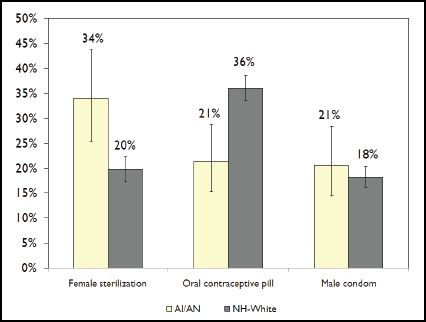
Interestingly, today populations that were subject to this abuse have high rates of voluntary sterilization.  A recent report by the Urban Indian Health Institute included data showing that, compared to non-Hispanic white women (in gray), American Indian and Alaskan Native women (in cream) have very high rates of sterilization:

Iris Lopez, in an article titled “Agency and Constraint,” writes about what she discovered when she asked Puerto Rican women in New York City why they choose to undergo sterilization.

During the U.S. colonization of Puerto Rico, over 1/3rd of all women were sterilized.  And, today, still, Puerto Rican women in both Puerto Rico and the U.S. have “one of the highest documented rates of sterilization in the world.”  Two-thirds of these women are sterilized before the age of 30.

Lopez finds that 44% of the women would not have chosen the surgery if their economic conditions were better.  They wanted, but simply could not afford more children.

They also talked about the conditions in which they lived and explained that they didn’t want to bring children into that world.  They:

…talked about the burglaries, the lack of hot water in the winter and the dilapidated environment in which they live. Additionally, mothers are constantly worried about the adverse effect that the environment might have on their children. Their neighborhoods are poor with high rates of visible crime and substance abuse. Often women claimed that they were sterilized because they could not tolerate having children in such an adverse environment…

Many were unaware of other contraceptive options.  Few reported that their health care providers talked to them about birth control. So, many of them felt that sterilization was the only feasible “choice.”

Lopez argues that, by contrasting the choice to become sterilized with the idea of forced sterilization, we overlook the fact that choices are primed by larger institutional structures and ideological messages.  Reproductive freedom not only requires the ability to choose from a set of safe, effective convenient and affordable methods of birth control developed for men and women, but also a context of equitable social, political and economic conditions that allows women to decide whether or not to have children, how many, and when.

Originally posted in 2010. Cross-posted at Ms. 

Lisa Wade, PhD is an Associate Professor at Tulane University. She is the author of American Hookup, a book about college sexual culture; a textbook about gender; and a forthcoming introductory text: Terrible Magnificent Sociology. You can follow her on Twitter and Instagram.

A set of polls by Reuters/Ipsos — the first done just before Cruz and Kasich dropped out of the primary race and the second sometime after — suggests that, when it comes to attitudes toward African Americans, Republicans who favored Cruz and (especially) Kasich have more in common with Clinton supporters than they do Trump supporters.

The first thing to notice is how overwhelmingly common it still is for Americans to believe that “black people in general” are less intelligent, ruder, lazier, and more violent and criminal than whites. Regardless of political affiliation of preferred candidate, at least one-in-five and sometimes more than one-in-three will say so.

But Trump supporters stand out. Clinton and Kasich’s supporters actually have quite similar views. Cruz’s supporters report somewhat more prejudiced views than Kasich’s. But Trump’s supporters are substantially more likely to have negative views of black compared to white people, exceeding the next most prejudiced group by ten percentage points or more in every category.
2

These differences are BIG. We wouldn’t be surprised to see strong attitudinal differences between Democrats and Republicans — partisanship drives a lot of polls — but for the size of the difference between Democrats and Republicans overall to be smaller than the size of the difference between Trump supporters and other Republicans is notable. It suggests that the Republican party really is divided and that Trump has carved out a space within it by cultivated a very specific appeal.

Lisa Wade, PhD is an Associate Professor at Tulane University. She is the author of American Hookup, a book about college sexual culture; a textbook about gender; and a forthcoming introductory text: Terrible Magnificent Sociology. You can follow her on Twitter and Instagram.

The barbershop holds a special place in American culture. With its red, white, and blue striped poles, dark Naugahyde chairs, and straight razor shaves, the barbershop has been a place where men congregate to shore up their stubble and get a handle on their hair. From a sociological perspective, the barbershop is an interesting place because of its historically homosocial character, where men spend time with other men. In the absence of women, men create close relationships with each other. Some might come daily to talk with their barbers, discuss the news, or play chess. Men create community in these places, and community is important to people’s health and well-being.

But is the barbershop disappearing? If so, is anything taking its place?

In my study of high-service men’s salons — dedicated to the primping and preening of an all male clientele — hair stylists described the “old school” barbershop as a vanishing place. They explained that men are seeking out a pampered grooming experience that the bare bones barbershop with its corner dusty tube television doesn’t offer. The licensed barbers I interviewed saw these newer men’s salons as a “resurgence” of “a men-only place” that provides more “care” to clients than the “dirty little barbershop.” And those barbershops that are sticking around, said Roxy, one barber, are “trying to be a little more upscale.” She encourages barbers to “repaint and add flat-screen TVs.”

When I asked clients of one men’s salon, The Executive, if they ever had their hair cut at a barbershop, they explained that they did not fit the demographic. Barbershops, they said, are for old men with little hair to worry about or young boys who don’t have anyone to impress. As professional white-collar men, they see themselves as having outgrown the barbershop. A salon, with its focus on detailed haircuts and various services, including manicures, pedicures, hair coloring, and body waxing, help these mostly white men to obtain what they consider to be a “professional” appearance. “Professional men… they know that if they look successful, that will create connotations to their clients or customers or others that they work with — that they are smart, that they know what they’re doing,” said Gill, a client of the salon and vice-president in software, who reasoned why men go to the salon.

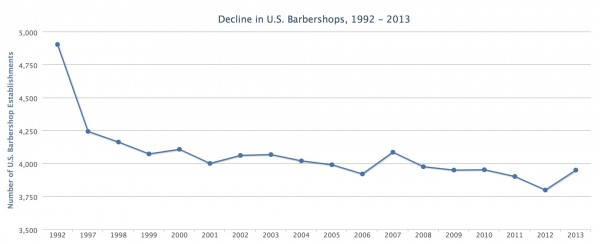
Indeed the numbers support the claim that barbershops are dwindling, and it may indeed be due to white well-to-do men’s shifting attitudes about what a barbershop is, what it can offer, and who goes there. (In my earlier research on a small women’s salon, one male client told me the barbershop is a place for the mechanic, or “grease-monkey,” who doesn’t care how he looks, and for “machismo” men who prefer a pile of Playboy magazines rather than the finery of a salon). According to Census data, there is a fairly steady decline in the number of barbershops over twenty years. From 1992-2012, we saw a 23% decrease in barbershops in the United Stated, with a slight uptick in 2013.

U.S. Census Bureau, Statistics of U.S. Businesses, www.census.gov.

But these attitudes about the barbershop as a place of ol’, as a fading institution that provides outdated fades, is both a classed and raced attitude. With all the nostalgia for the barbershop in American culture, there is surprisingly little academic writing about it. It is telling, though, that research considering the importance of the barbershop in men’s lives focuses on black barbershops. The corner barbershop is alive and well in black communities and it serves an important role in the lives of black men. In her book, Barbershops, Bibles, and BET, political scientist and TV host, Melissa Harris-Perry, wrote about everyday barbershop talk as important for understanding collective efforts to frame black political thought. Scholars also find the black barbershop remains an important site for building communities and economies in black neighborhoods and for socializing young black boys.

And so asking if the barbershop is vanishing is the wrong question. Rather, we should be asking: Where and for whom is the barbershop vanishing? And where barbershops continue as staples of a community, what purpose do they serve? Where they are disappearing, what is replacing them, and what are the social relations underpinning the emergence of these new places?

In some white hipster neighborhoods, the barbershop is actually making a comeback. In his article, What the Barbershop Renaissance Says about Men, journalist and popular masculinities commentator, Thomas Page McBee, writes that these places provide sensory pleasures whereby men can channel a masculinity that existed unfettered in the “good old days.” The smell of talcum powder and the presence of shaving mugs help men to grapple with what it means to be a man at a time when masculinity is up for debate. But in a barbershop that charges $45 for a haircut, some men are left out. And so, in a place that engages tensions between ideas of nostalgic masculinity and a new sort of progressive man, we may very well see opportunities for real change fall by the wayside. The hipster phenomenon, after all, is a largely white one that appropriates symbols of white working-class masculinity: think white tank tops with tattoos or the plaid shirts of lumbersexuals.

When we return to neighborhoods where barbershops are indeed disappearing, and being replaced with high-service men’s salons like those in my book, Styling Masculinityit is important to put these shifts into context. They are not signs of a disintegrating by-gone culture of manhood. Rather, they are part of a transformation of white, well-to-do masculinity that reflects an enduring investment in distinguishing men along the lines of race and class according to where they have their hair cut. And these men are still creating intimate relationships; but instead of immersing themselves in communities of men, they are often building confidential relationships with women hair stylists.

Kristen Barber, PhD is a sociologist at Southern Illinois University and the author of Styling Masculinity: Gender, Class, and Inequality in the Men’s Grooming Industry. She blogs at Feminist Reflections, where this post originally appeared.

*Thank you to Trisha Crashaw, graduate student at Southern Illinois University, Carbondale, for her work on the included graph.

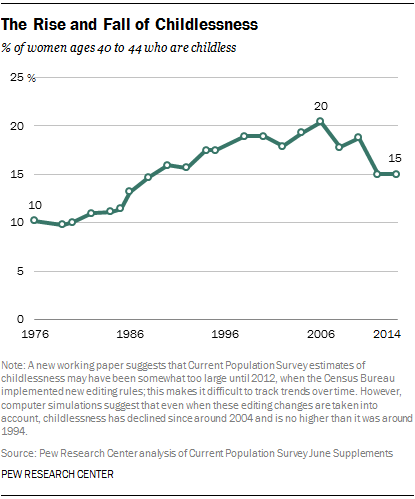
Media have tended to depict childfree people negatively, likening the decision not to have children to “whether to have pizza or Indian for dinner.” Misperceptions about those who do not have children have serious weight, given that between 2006 and 2010 15% of women and 24% of men had not had children by age 40, and that nearly half of women aged 40-44 in 2002 were what Amy Blackstone and Mahala Dyer Stewart refer to as “childfree,” or purposefully not intending to have children.

Trends in childlessness/childfreeness from the Pew Research Center:

4

Blackstone and Stewart’s forthcoming 2016 article in The Family Journal, “There’s More Thinking to Decide”: How the Childfree Decide Not to Parent, engages the topic and extends the scholarly and public work Blackstone has done, including her shared blog, We’re Not Having a Baby.

When researchers explore why people do not have children, they find that the reasons are strikingly similar to reasons why people do have children. For example, “motivation to develop or maintain meaningful relationships” is a reason that some people have children – and a reason that others do not. Scholars are less certain on how people come to the decision to to be childfree. In their new article, Blackstone and Stewart find that, as is often the case with media portrayals of contemporary families, descriptions of how people come to the decision to be childfree have been oversimplified. People who are childfree put a significant amount of thought into the formation of their families, as they report.

Blackstone and Stewart conducted semi-structured interviews with 21 women and 10 men, with an average age of 34, who are intentionally childfree. After several coding sessions, Blackstone and Stewart identified 18 distinct themes that described some aspect of decision-making with regard to living childfree. Ultimately, the authors concluded that being childfree was a conscious decision that arose through a process. These patterns were reported by both men and women respondents, but in slightly different ways.

Childfree as a conscious decision

All but two of the participants emphasized that their decision to be childfree was made consciously. One respondent captured the overarching message:

People who have decided not to have kids arguably have been more thoughtful than those who decided to have kids. It’s deliberate, it’s respectful, ethical, and it’s a real honest, good, fair, and, for many people, right decision.

There were gender differences in the motives for these decisions. Women were more likely to make the decision based on concern for others: some thought that the world was a tough place for children today, and some did not want to contribute to overpopulation and environmental degradation. In contrast, men more often made the decision to live childfree “after giving careful and deliberate thought to the potential consequences of parenting for their own, everyday lives, habits, and activities and what they would be giving up were they to become parents.”

Childfree as a process

Contrary to misconceptions that the decision to be childfree is a “snap” decision, Blackstone and Stewart note that respondents conceptualized their childfree lifestyle as “a working decision” that developed over time. Many respondents had desired to live childfree since they were young; others began the process of deciding to be childfree when they witnessed their siblings and peers raising children. Despite some concrete milestones in the process of deciding to be childfree, respondents emphasized that it was not one experience alone that sustained the decision. One respondent said, “I did sort of take my temperature every five, six, years to make sure I didn’t want them.” Though both women and men described their childfree lifestyle as a “working decision,” women were more likely to include their partners in that decision-making process by talking about the decision, while men were more likely to make the decision independently.

Blackstone and Stewart conclude by asking, “What might childfree families teach us about alternative approaches to ‘doing’ marriage and family?” The present research suggests that childfree people challenge what is often an unquestioned life sequence by consistently considering the impact that children would have on their own lives as well as the lives of their family, friends, and communities. One respondent reflected positively on childfree people’s thought process: ‘‘I wish more people thought about thinking about it… I mean I wish it were normal to decide whether or not you were going to have children.’’

Braxton Jones is a graduate student in sociology at the University of New Hampshire, and serves as a Graduate Research and Public Affairs Scholar for the Council on Contemporary Families, where this post originally appeared.