Search results for The

Flashback Friday.

Does the modeling industry fetishize whiteness?

It turns out that the answer is: it does and it doesn’t.  Ashley Mears, a model turned sociologist, found that high fashion models are overwhelmingly white, but that commercial modeling — the kind you see in catalogs for stores like Target, TJ Maxx, and JC Penney — is much more racially inclusive.  Similarly, extreme thinness is more pronounced among high fashion models, whereas commercial models tend to have a few more inches around their waists.

Mears says that the difference has to do with the contrasting purposes of the different modeling worlds.  High fashion is supposed to be, by definition, unattainable.  The women used in high fashion, then, should be the most idealized, with bodies that are among the most difficult to attain and beauty that is the most rareified.  In this context, whiteness is a marker of elite status because white femininity, thanks to white supremacy in U.S. culture, is the most purely feminine femininity of all.

In contrast, the commercial market is actually designed to sell clothes to everyday people.  In this case, they want consumers to identify with their models.  Their models aren’t supposed to signify social distance, they’re supposed to be just like us.  Using more diverse models and models who are less waif-like helps accomplish those goals.

Screen shot from the JC Penney catalog, thanks to reader Chelsea S.:

Originally posted in 2010.

Lisa Wade, PhD is an Associate Professor at Tulane University. She is the author of American Hookup, a book about college sexual culture; a textbook about gender; and a forthcoming introductory text: Terrible Magnificent Sociology. You can follow her on Twitter and Instagram.

Modern journalism is reliant on the idea of objectivity. Even when truth is elusive, if journalists write a balanced story, they can be said to have done a good job.

But what if a story doesn’t have two sides? Sometimes journalists continue to write as if they do, as they did in regards to human caused climate change for a decade. Other times they do so wholly disingenuously, counterposing authoritative voices against ones they know carry no weight with their audience, as they did and still do with coverage of female genital cutting. At still other times, they abandon objectivity altogether, counting on a national consensus so strong that no one could possibly accuse them of being biased, as many did after 9/11.

I think this is the source of some of the discomfort with the media coverage of this election.

What does a journalist do when the editorial board of the Washington Post calls one candidate a “unique threat to American democracy”; the New York Timescalls him a “poisonous messenger” appealing to “people’s worst instincts”; the Houston Chronicle’s calls him “dangerous to the nation and the world,” a man that should “make every American shudder”; and the far-right National Review’s calls him a “menace”? What does a journalist do when conservative newspapers like the Dallas Morning News call him “horrify[ing]” and endorse a Democrat for president for the first time in almost 100 years? Is this still the right time to be objective? Is this a 9/11 moment?

I suspect that journalists themselves do not know what to do, and so we are seeing all of the strategies playing out. Some are trying hard to hew to the traditional version of balance, but covering asymmetrical candidates symmetrically makes for some odd outcomes, hence accusations of false equivalence and misinforming the public. Some are counting on a consensus, at least on some issues, assuming that things like constitutional rights and anti-bigotry are widespread enough values that they can criticize Trump on these issues without seeming partisan, but it doesn’t always work. Still others are aiming down the middle, offering an imbalanced balance, as when journalists reference the support of David Duke and other white supremacists as their own kind of dog-whistle politics.

Meanwhile, readers each have our own ideas about whether this election deserves “balanced” coverage and what that might look like. And so do, of course, the thousands of pundits, none of whom are accountable to journalistic norms, and the millions of us on social media, sharing our own points of view.

It’s no wonder the election is giving us vertigo. It is itself out of balance, making it impossible for the country to agree on what objectivity looks like. Even the journalists, who are better at it than anyone, are failing. The election has revealed what is always true: that objectivity is a precarious performance, more an art than a science, and one that gains validity only in relation to the socially constructed realities in which we live.

It’s just that our socially constructed reality is suddenly in shambles. Post-truth politics doesn’t give us a leg to stand on, none of us can get a foothold anymore. Internet-era economic realities have replaced the news anchor with free-floating infotainment. Political polarization has ripped the country apart and the edifices we’ve clung to for stability—like the Republican Party—are suddenly themselves on shaky ground. The rise of Trump has made all of this dizzyingly clear.

We’re hanging on for dear life. I fear that journalists can do little to help us now.

Lisa Wade, PhD is an Associate Professor at Tulane University. She is the author of American Hookup, a book about college sexual culture; a textbook about gender; and a forthcoming introductory text: Terrible Magnificent Sociology. You can follow her on Twitter and Instagram.
Flashback Friday.

I was waiting for my connecting flight at Chicago O’Hare, and spotted this advertisement on the opposite side of our gate. It reads:

“Chicago is the Potawatomi word for onion field. Apparently, the Potawatomis didn’t have a word for global business center.”

This is an example of the use of Indigenous language and imagery that many people wouldn’t think twice about, or find any inherent issues with. But let’s look at this a little deeper:

  • The use of past tense. It’s not “The Potawatomis don’t have a word for…” it’s “The Potawatomis didn’t…” Implying that the Potawatomi no longer exist or are using their language.
  • The implication that “Indians” and “Global Business Center” aren’t in congruence. Which is assuming that Natives are static, unchanging, and unable to be modern and contemporary. “Potawatomi” and “Onion Field” are fine together, because American society associates Indians with the natural world, plants, animals, etc. But there is definitely not an association between “Potawatomi” and “Global Business”.

But, in reality, of course Potawotomis still exist today, are still speaking their language, and do have a word for Global Business Center (or multiple words…).

Language is constantly evolving, adapting to new technology (remember when google wasn’t a verb?) and community changes.  I remember reading a long time ago in one of my Native studies classes about the Navajo Nation convening a committee to discuss how one would say things like “computer” or “ipod” in Navajo language, in an effort to preserve language and culture and promote the use of Navajo language among the younger generation.

In fact, here’s an awesome video of a guy describing his ipod in Navajo, complete with concepts like “downloading” (there are subtitles/translations):

Native peoples have been trading and communicating “globally” for centuries, long before the arrival of Europeans. To imply that they wouldn’t have the ability to describe a “Global Business Center” reeks of a colonialist perspective (we must “civilize” the savage! show him the ways of capitalism and personal property, for they know not of society!).

Thanks, Chicago, for giving me one more reason to strongly dislike your airport.

Originally posted in 2010.

Adrienne Keene, EdD is a graduate of the Harvard Graduate School of Education and is now a postdoctoral fellow in Native American studies at Brown University. She blogs at Native Appropriations, where this post originally appeared. You can follow her on Twitter.

Originally posted at Reports from the Economic Front.

For years now the wealthy and their media have hammered on the need for lower taxes on their income, arguing that this would encourage investment, job creation, and growth.  The tax burden on the wealthy has indeed been lowered in one way or the other, but only the wealthy have benefited. In particular, our public sector and the activities it supports — public infrastructure, education, health care and human services, etc. — have suffered.

Apparently, people are starting to draw the right lesson from this experience.  As the Washington Post reports:

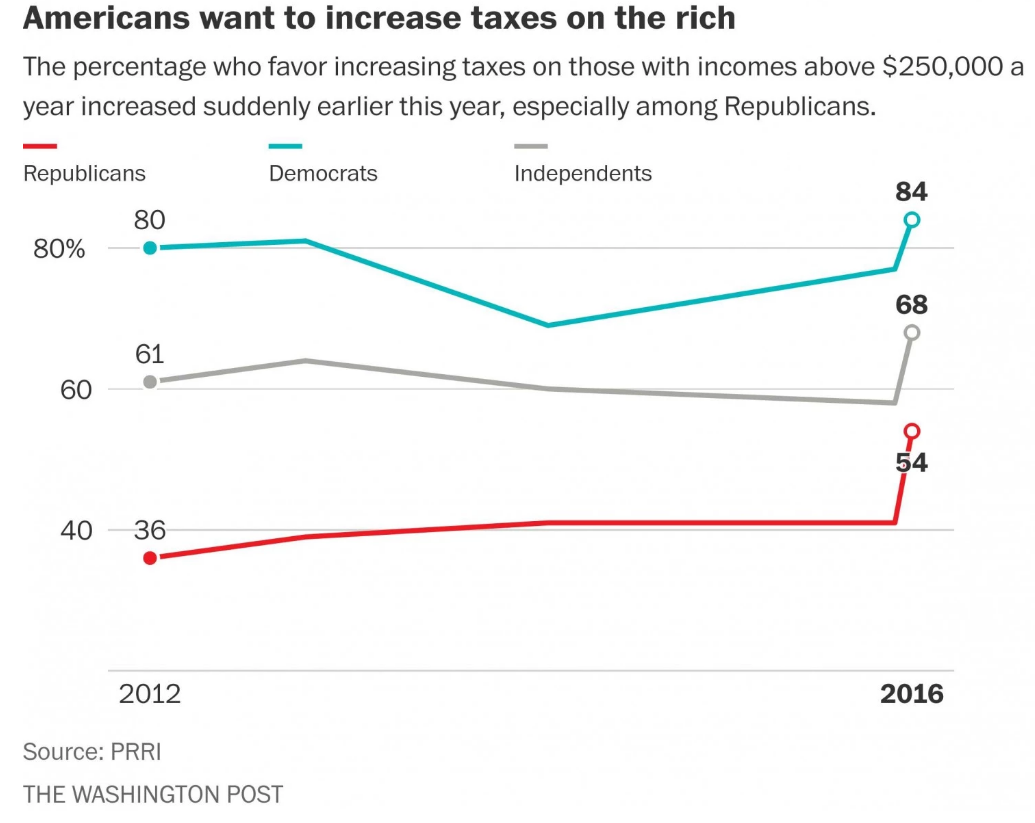
The results from the Public Religion Research Institute and the Brookings Institution [survey] show that 54 percent of Republicans support increasing taxes on those with incomes over $250,000 a year, an increase of 18 percentage points since the last presidential election in 2012. Among Americans as a whole, 69 percent support an increase.

tax increase

While the change in opinion was greatest for Republicans, as the figure above shows, the survey also found increased support for greater taxes on the rich among both Democrats and Independents.  The fact that this support began spiking early in the year suggests that the change is tied to the election process, although it is unclear whether the campaigns are driving the growing support for higher taxes on the wealthy or people are just taking advantage of the process to express their desire for change.

Martin Hart-Landsberg is a professor of economics at Lewis and Clark College. You can follow him at Reports from the Economic Front.

Flashback Friday.

In the U.S. men’s and women’s bikes are built differently, with women’s bikes lacking the bar that goes from the handlebar to just below the seat. The bar is a matter of tradition.  According to Andrea at Bike City Recyclery, when women began riding bikes in the 1800s, they were required to wear heavy skirts.  The low bar allowed them to mount the bikes “modestly” and was a space for their skirts to go.  Back then, bikes also had “clothes-guards” that would keep women’s skirts from being caught up in the mechanics of the bike.  This picture is from the 1890s:

Today most women riding a bike do not wear heavy skirts and clothes-guards are rare, but the low bar persists.  This ad from 1971 assures parents that  “girl bikes” can be converted to “boy bikes” and vice versa. The upper bar is purely “decorative,” but boys apparently must have it.

Selected text:

A popular 16-inch beginner’s bike. Top bar removes easily to convert it from a boy’s to a girl’s bike in minutes… The perfect first bike that’s built to last from child to child.

This goes to show how strongly we invest in purely symbolic gender differentiation.  There is no need for a high bar and there is no need to differentiate bikes by gender in this way. We could do away with the bar distinction in the same way that we did away with the clothes-guard. But the bar is a highly visible signal that we are committed to a gender binary (men and women are “opposite” sexes). It is some men and the defenders of masculinity who are most opposed to this because collapsing the gender differentiation means collapsing a devalued category into a valued category. For individuals who embrace the valued category, this is a disaster. A male-coded bike frame is just one small way to preserve both the distinction and the hierarchy.

Originally posted in 2010.

Lisa Wade, PhD is an Associate Professor at Tulane University. She is the author of American Hookup, a book about college sexual culture; a textbook about gender; and a forthcoming introductory text: Terrible Magnificent Sociology. You can follow her on Twitter and Instagram.

The great Louisiana Floods of 2016 have led to the closure of at least 22 of the state’s 70 public school districts, with additional districts calling off classes as a precaution given the immense devastation. This means that as many as one-third of the state’s public school students were out of school last week ,and potentially for many weeks to come. That equates to more than 241,000 children who are not in classrooms where they belong; and these figures do not even account for the many thousands of private and charter school students also out of school across the water-logged state.

2

Almost exactly 11 years ago, Hurricane Katrina disrupted some 370,000 school-age children. For our book, Children of Katrina, we spent nearly a decade examining how their lives unfolded in the years after the catastrophe. We focused on education as a key “sphere” of children’s lives. It is a special sphere in that it is unique to children and youth and it has specific time parameters: when the window for schooling is gone, children cannot get it back. Missing school means missing critical stages in cognitive and social development and likely suffering irreparable harm in terms of their intellectual growth, development, and future educational goals.

The school sphere, as with the other spheres of children’s lives, is marked by inequality, with some students having access to greater advantages than others. Some school districts, often segregated by race and class, have more resources and support than others; some families have the ability to enroll children in private schools that require tuition or arrange to be in a high-quality school district, while other families do not have those options.

Keeping this in mind, and recognizing the importance of education during displacement and recovery, there are many things that can and should be done, to support disaster affected children and youth and their educational process. These include:

  • Reopening schools (including childcare centers and pre-schools) as quickly as possible after a disaster; this means allocating proper resources to repair, rebuild, and/or revive schools in disaster zones;
  • In receiving communities that receive large numbers of displaced children and youth, providing pathways for their rapid enrollment;
  • Offering emotional support through optional peer-oriented and/or peer-led support groups as well as licensed professional counselors, social workers, and school therapists;
  • Training all school staff—from upper-level administrators, to teachers, to custodians—how to be supportive of children and youth who have been affected by disaster as well as those who are in receiving communities who are now welcoming disaster-affected youth into their classrooms;
  • Designing and implementing disaster preparedness, response, and recovery curriculum within classrooms;
  • Providing opportunities for children to help their schools’ and classmates’ recovery; this could, for example, come in the form of service learning, fundraising, mentoring programs, or community action activities;
  • Offering immediate and long-term support for teachers, who are often recovering from disaster themselves; this may include financial, professional, and emotional support;
  • Intervening against bullying and stigma that may be attached to “disaster survivor” status for youth; reminding these professionals that bullying may be exacerbated based on region of origin, gender, age, race, or other characteristics;
  • Integrating displaced children in classrooms with familiar faces if possible;
  • Making school days as predictable as possible and re-establishing routines within classrooms and schools;
  • Allowing children and youth the opportunity to work on projects that help them process their disaster experience;
  • Funding school programs in arts, music, drama, and creative writing to encourage expression and foster healing.

Alice Fothergill, PhD is an associate professor of sociology at the University of Vermont. She is a member of the Social Science Research Council Research Network on Persons Displaced by Katrina. Fothergill’s book, Heads Above Water: Gender, Class, and Family in the Grand Forks Flood, examines women’s experiences in the 1997 flood in North Dakota. She is also co-editor of Social Vulnerability to Disasters.

Lori Peek, PhD is an associate professor of sociology and Co-Director of the Center for Disaster and Risk Analysis at Colorado State University. She also serves as the Associate Chair for the SSRC Task Force on Hurricane Katrina and Rebuilding the Gulf Coast and is a member of the SSRC Research Network on Persons Displaced by Katrina. Peek is the author of the award-winning book Behind the Backlash: Muslim Americans after 9/11 and co-editor of the volume Displaced: Life in the Katrina Diaspora.

Together, Fothergill and Peek are the authors of the award-winning book, Children of Katrina, the longest-term ethnographic study of children in disaster.

Flashback Friday.

Is it true that Spanish-speaking immigrants to the United States resist assimilation?

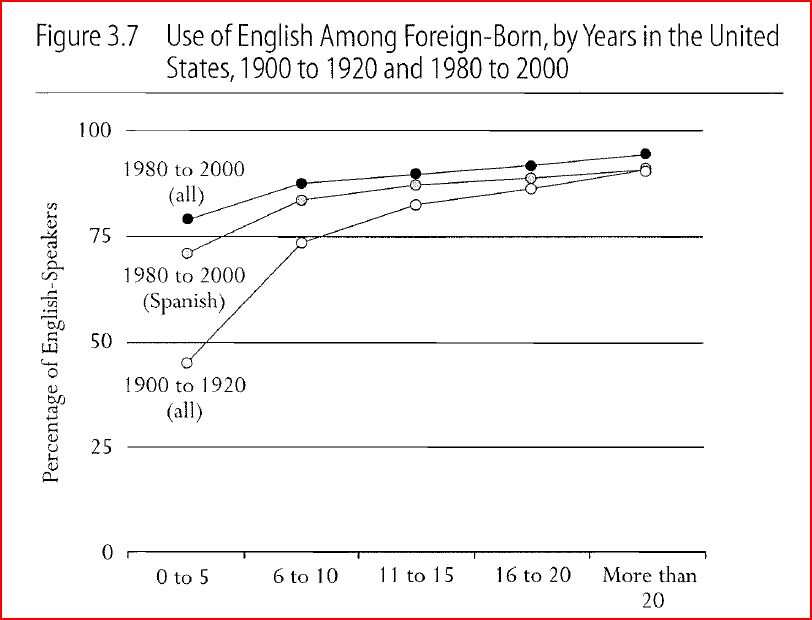
Not if you judge by language acquisition and compare them to earlier European immigrants. The sociologist Claude S. Fischer, at Made in America, offers this data:

The bottom line represents the percentage of English-speakers among the wave of immigrants counted in the 1900, 1910, and 1920 census. It shows that less than half of those who had been in the country five years or less could speak English. This jumped to almost 75% by the time they were here six to ten years and the numbers keep rising slowly after that.

Fast forward 80 years. Immigrants counted in the 1980, 1990, and 2000 Census (the top line) outpaced earlier immigrants by more than 25 percentage points. Among those who have just arrived, almost as many can speak English as earlier immigrants who’d been here between 11 and 15 years.

If you look just at Spanish speakers (the middle line), you’ll see that the numbers are slightly lower than all recent immigrants, but still significantly better than the previous wave. Remember that some of the other immigrants are coming from English-speaking countries.

Fischer suggests that the ethnic enclave is one of the reasons that the wave of immigrants at the turn of the 20th century learned English more slowly:

When we think back to that earlier wave of immigration, we picture neighborhoods like Little Italy, Greektown, the Lower East Side, and Little Warsaw – neighborhoods where as late as 1940, immigrants could lead their lives speaking only the language of the old country.

Today, however, immigrants learn to speak with those outside of their own group more quickly, suggesting that all of the flag waving to the contrary is missing the big picture.

Originally posted in 2010.

Lisa Wade, PhD is an Associate Professor at Tulane University. She is the author of American Hookup, a book about college sexual culture; a textbook about gender; and a forthcoming introductory text: Terrible Magnificent Sociology. You can follow her on Twitter and Instagram.

Originally posted at Scatterplot.

Olympic fever has hit! As we all marvel at the power, precision, and grace of the athletes, a more disturbing commentary has also emerged, one that diminishes women athletes’ accomplishments, defines them by the men around them, places them in tired tropes of sex objects, or infantilizes them as “girls.” Some journalists, in combination with a robust social media discussion, are calling this bad behavior out. But should we be so surprised?

According to past research, no. In our work, we see this as a more pervasive issue, and women’s collegiate coaching is a prime example. When Title IX was enacted in 1972 approximately 90% of women’s teams were coached by women; in 2014 that number dropped to 43%. Women comprise only 23% of head coaching positions. Why are women coaches – especially of women’s teams – being left out? We talked to 9 female and 12 male coaches of women’s and men’s teams and many of their own explanations suggest a view of fundamental and “natural” differences between men and women.

.

Talking to Coaches… Gender Matters

In general, the qualities of sport – competition, confidence, physical strength, aggression – are seen as masculine, while characteristics of cooperation, passivity, and dependency are coded feminine, raising suspicions about women’s capacity to excel. Masculine dominance has helped to define the parameters of what it means to be a coach.

Interestingly, coaching may be seen as an example of conflicting masculine roles. Given the low pay and high time commitment, coaching undermines the traditional male family role as breadwinner. As this male head women’s tennis coach explains,

I’ve been kind of lucky… I didn’t feel like I had to make a certain amount of money, X amount of dollars to be happy. So I was ok with where I was at salary wise… I think that the key to that is having a wife that also works, and that we can still make it happen, and sort of live the way we want to live and be happy.

Many of the men echoed the idea that without a spouse’s support, a coaching career would be difficult. Although respondents all felt women opt out of coaching due to family pressures, none felt that men needed to opt out to support their families. Arguably, the relationship between masculinity and athletics provides men with the social compensation necessary to remain in coaching in a way that does not operate for women.

Especially when asked why women don’t coach men, many of the respondents did not think women would have the strength, athleticism, authority, and leadership abilities to be effective men’s coaches. As a male head men’s soccer coach expresses:

I think the game is slightly different. The understanding of the nuances of the men’s game versus the women’s game… for a female to go into a men’s athletic team and command respect from those guys, it’s difficult. A female wouldn’t be able to step in and play seven versus seven and be able to play at the same level. Not technically, not tactically, I mean simply physically…just the strength factor.

Other arguments highlight the assumed biological connection between men and leadership. A female assistant women’s soccer coach argued that “the leadership gene is much more apparent in guys, it’s much more inherent in them.” Additionally challenging is the perception that taking orders and guidance from a female threatens masculinity and calls into question male superiority in a male dominated field. A former male head golf coach notes,

A woman coach is going to have to work harder to gain respect from a guy player than a male coach will have to work from a female player. … [Individuals are] raised to say if a guy’s leading, you give them a little benefit of the doubt. A woman has to prove herself, and until she does there’s going to be doubt.

By internalizing and enforcing stereotypes a gender pecking-order can be preserved. As this woman, an assistant women’s soccer coach, suggests, socialization improves men’s leadership ability:

When girls are socialized… it’s share, everyone in groups, be nice to everyone; guys are taught much more of competitiveness… a guy leader comes out in a group much easier… because in a girl’s environment it’s no one should be above anyone else… guys and girls are just different. They’re socialized different.

Stereotypes about men’s competitiveness and women’s need for emotional bonding were prevalent, and if these are carried into hiring decisions it is easy to see why male coaches are favored. Yet, if gender differences are so stark, we would expect to see same-sex coaching across the board, instead of the current disparity. Instead, this difference only legitimated women’s absence and was not used to question men’s presence as coaches of women’s teams. None of the women said they wanted to coach men’s teams and nor were they upset at being denied access to these positions. Respondents were more in favor of increasing women coaching women, but did not question or challenge any of the main gender stereotypes. This man, a former head men’s golf coach said,

I’m a fan of a woman coaching women’s sports, if skill levels are equal, because there are certain intangibles – I don’t understand the woman animal as well on certain things.

Shattering the “Glass Wall”?

Coaches we interviewed recognized the role that resources and opportunities played in incentivizing men into coaching women, but none challenged any aspect of the system. Respondents automatically buy into the “glass wall” such that 50 percent of jobs (those coaching men) are off-limits, thus if women coach approximately 50 percent of women’s teams, it’s “fair.” We see that unquestioned assumptions of gender difference supported perceptions that masculinity and men were superior to femininity and women. Twenty years ago scholars on this topic said it is beliefs in male athletic superiority that justify gender disparities in coaching, and according to these interviews little has changed. So, yes, observers should continue to call out the failures of Olympic commentators to treat women athletes equally, but as we say goodbye to Rio, let’s not forget how these issues are shaping coaches’ and athletes’ experiences every day.

Catherine Bolzendahl is a professor of sociology and the co-author of Counted Out: Same Sex Relations and Americans’ Definitions of Family. Vanessa Kauffman is a PhD student.  Both are at the University of California, Irvine. Jessica Broadfoot-(Lee) is an alum and was a member of the women’s tennis team and a two-time Big West Scholar-Athlete..