If it were to happen that the decision as to whether the tomato was a fruit or vegetable made it to the highest court of the land — if such a strange thing were to happen — certainly the botanist’s opinion would weigh heaviest. Right?

Nope.

In fact, this decision did make it all the way to the Supreme Court. It happened in 1893. The case was brought by a tomato importing family by the last name of Nix. At the time, the law required that taxes be collected on vegetables that were imported, but not fruit.

The lawyers for the Nix family argued that the tomato is a fruit and, therefore, exempt from taxation. They were, of course, correct. Botanists define fruit according to whether it plays a reproductive role. So, any plant product with one or more seeds is a fruit, whereas vegetables don’t have seeds. Fruits are ovaries, for lack of a better term. All other plant products — stems, roots, leaves, and some seeds — are vegetables.

But the Supreme Court said, essentially, “We don’t care” and gave their gavel a good pound. Here’s some of the text of their unanimous opinion:

Botanically speaking, tomatoes are the fruit of a vine… But in the common language of the people, whether sellers or consumers of provisions, all these are vegetables which are grown in kitchen gardens, and which, whether eaten cooked or raw, are… usually served at dinner in, with, or after the soup, fish, or meats which constitute the principal part of the repast, and not, like fruits generally, as dessert.

The judges were referring to the common understanding, which has more to do with how we use the plant products than how plants use them. Your typical chef roughly divides plant products according to whether they’re sweet or savory. Fruits are sweet. Vegetables are savory and used for main courses and sides. It’s all about whether you eat them for dinner or dessert. And that’s what the Supreme Court upheld.

Culinary vs. botanical categorization (source):

2

Since the culinary scheme dominates our colloquial understanding, we mis-classify lots of other things, too. Zucchini, bell peppers, eggplants, string beans, cucumbers, avocado, and okra — all fruit. Rhubarb is a vegetable. No seeds. Pineapples are fruits. “Ah ha!” you say, “I’ve never noticed a pineapple having seeds!” That’s because commercial growers sell us seedless pineapples. Who knew. Berries are fruit, but strawberries, blackberries, and raspberries are not actually berries. Isn’t this fun?

Bruno Latour and Steve Woolgar, in Laboratory Life: The Social Construction of Scientific Facts, wrote:

If reality means anything, it is that which “resists” the pressure of a force. … That which cannot be changed at will is what counts as real.

We often think of cultural facts as somehow less real than biological ones. For the Nix family, though, biology mattered naught. They still had to pay the damn tax on their tomatoes. Culture is real, folks. Social construction is not just something we do to reality; for all intents and purposes, it is reality.

Cross-posted at Pacific Standard.

Lisa Wade, PhD is an Associate Professor at Tulane University. She is the author of American Hookup, a book about college sexual culture; a textbook about gender; and a forthcoming introductory text: Terrible Magnificent Sociology. You can follow her on Twitter and Instagram.

Thanks for the comic about meta-analyses, xkcd.

Click to enlarge:2
From Business Insider; h/t Gin and Tacos.

Lisa Wade, PhD is an Associate Professor at Tulane University. She is the author of American Hookup, a book about college sexual culture; a textbook about gender; and a forthcoming introductory text: Terrible Magnificent Sociology. You can follow her on Twitter and Instagram.
Flashback Friday.

I have always found it bizarre that lipstick is supposed to make a woman’s lips more irresistible, yet kissing a woman with lipstick gets sticky red or pink smudge all over both faces. So women dress up and look all gorgeous and then their dates can’t kiss them. Or, it’s the end of the night and a woman wants her date to kiss her, does she put on lipstick or go for the chapstick?  Gah, being a woman is hard. And I supposed it can’t be that easy being the person who wants to kiss her in that situation either.

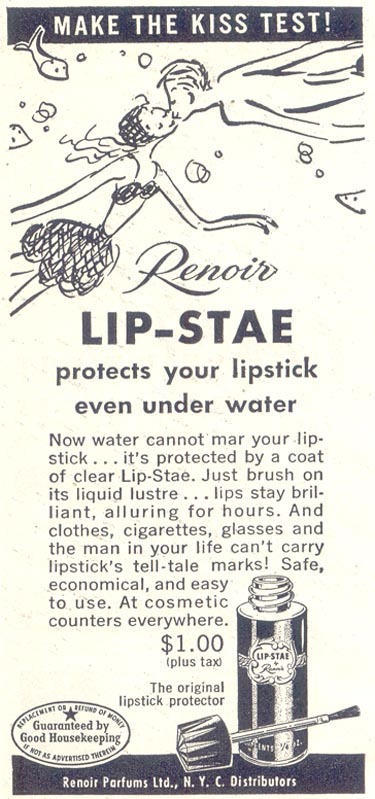
It’s odd to me that this kiss-ability paradox is never addressed in lipstick advertising.  So I was intrigued to see it in this vintage ad:

2b3b0750

Text:

Now water cannot mar your lipstick… it’s protected by a coat of clear Lip-Stae.  Just brush on its liquid lustre… lips stay brillint, alluring for hours.  And clothes, cigarettes, glasses and the man in your life can’t carry lipstick’s tell-tale marks!  Safe, economical, and easy to use. At cosmetic counters everywhere. (my emphasis)

There is so much to unpack here, but I think it all revolves around the fact that women are supposed to wear makeup, but pretend that the face that they put on is their real face.  As the copy reads, lipstick leaves “tell-tale marks.”  Those marks reveal a degree of deception regarding her true attractiveness and, in fact, this is exactly how makeup was characterized in the Victorian era.  This is why a woman’s lipstick must remain on her lips (and be left nowhere else) even when swimming or kissing.  Because, in principle, she’s not wearing lipstick at all.

This post originally appeared in 2009.

Lisa Wade, PhD is an Associate Professor at Tulane University. She is the author of American Hookup, a book about college sexual culture; a textbook about gender; and a forthcoming introductory text: Terrible Magnificent Sociology. You can follow her on Twitter and Instagram.

Americans have become increasingly critical of public policy as a means of addressing social problems.  Many believe that these policies don’t work; the reality is that public policies are often subverted in ways that make them ineffective or even counterproductive.

Take taxes and inequality.  As Danny Vinik, writing in the New Republic explains:

The vast majority of Americans—both liberals and conservatives—believe that state and local taxes should also be progressive. That’s the finding of a new report released by WalletHub Monday. The researchers surveyed 1,050 Americans on what they thought the combined rate of state and local taxes should be at various income levels. Not surprisingly, liberals want the rate structure to be a bit more progressive than conservatives do, but their responses [as the following chart shows] were relatively similar:

1 (3)

However the reality is quite different.  State and local taxes are actually quite regressive.  The Institute for Taxation and Economic Policy studied the “fairness of state and local tax systems by measuring the state and local taxes that will be paid in 2015 by different [non-elderly] income groups as a share of their incomes.”  They did this state by state and, as presented below, on an overall basis.  As we can see, the lower the income, the greater the state and local tax burden.

1 (4)

Here are some of the report’s key findings:

  • Virtually every state tax system is fundamentally unfair, taking a much greater share of income from low- and middle-income families than from wealthy families. The absence of a graduated personal income tax and overreliance on consumption taxes exacerbate this problem.
  • In the 10 states with the most regressive tax structures (the Terrible 10) the bottom 20 percent pay up to seven times as much of their income in taxes as their wealthy counterparts. Washington State is the most regressive, followed by Florida, Texas, South Dakota, Illinois, Pennsylvania, Tennessee, Arizona, Kansas, and Indiana.
  • Heavy reliance on sales and excise taxes are characteristics of the most regressive state tax systems. Six of the 10 most regressive states derive roughly half to two-thirds of their tax revenue from sales and excise taxes, compared to a national average of roughly one-third . Five of these states do not levy a broad-based personal income tax (four do not have any taxes on personal income and one state only applies its personal income tax to interest and dividends) while four have a personal income tax rate structure that is flat or virtually flat.
  • States commended as “low tax” are often high tax states for low-and middle-income families. The 10 states with the highest taxes on the poor are Arizona, Arkansas, Florida, Hawaii, Illinois, Indiana, Pennsylvania, Rhode Island, Texas, and Washington. Seven of these are also among the “terrible ten” because they are not only high tax for the poorest, but low tax for the wealthiest.

In short, we know how to construct tax policies that can lessen inequality, but we’re not using state and local taxes to do it.

Cross-posted at Reports from the Economic Front and Pacific Standard.

Martin Hart-Landsberg is a professor of economics at Lewis and Clark College. You can follow him at Reports from the Economic Front.

Karl Marx argued that capitalist modes of production always involve the exploitation of the working class by the owning class. The owning class are the capitalists. They secure the means of production — the factories, tools, and machinery — and employ workers to use those resources to produce goods.

When these goods are sold, capitalists extract the surplus value. This isn’t an magical good that blinks into existence thanks to the Capital Fairy, it’s a concrete good derived directly from the exploitation of the working class. Surplus value only exists when workers are paid less than the value they added with their work. If they were paid as much as their work was worth, capitalists would break even. And that’s not what they have in mind.

This comic at A Softer World illustrates this idea perfectly.

In other words, if capitalists paid workers what their work was actually worth, there wouldn’t be any profit left to skim off the top, leaving the rest of us with a value deficit.

Lisa Wade, PhD is an Associate Professor at Tulane University. She is the author of American Hookup, a book about college sexual culture; a textbook about gender; and a forthcoming introductory text: Terrible Magnificent Sociology. You can follow her on Twitter and Instagram.

I am so grateful to reader Emma Farais for recommending that I look into the history of the leotard. It was invented by — well, who else — Jules Léotard.

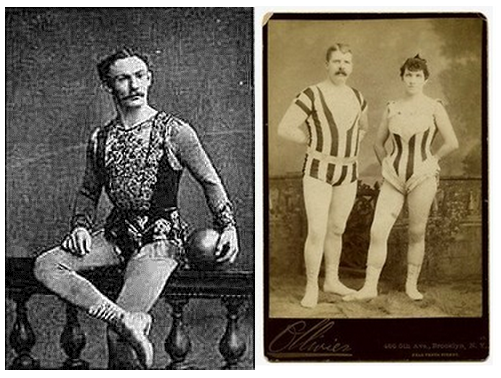
Born in 1842, Jules grew up to be an acrobat. He is credited with inventing trapeze and performed with French circuses. He invented and then began performing in leotards and he was a big hit. According to the Victoria and Albert Museum:

The original leotard was an all-in-one knitted suit. It allowed freedom of movement, was relatively aerodynamic and there was no danger of a flapping garment becoming entangled with the ropes. Even more importantly, it showed off his physique to its best advantage.

He was a huge hit with the ladies. Alas, he died at age 28. Or 32, depending on the source.

But the leotard lived on. Leotards were adapted for women, but the form and function were similar. Think vintage muscle men and women.

Jules Léotard, circa 1850 (left); Circus Strong Man and Women, circa 1890 (right):4

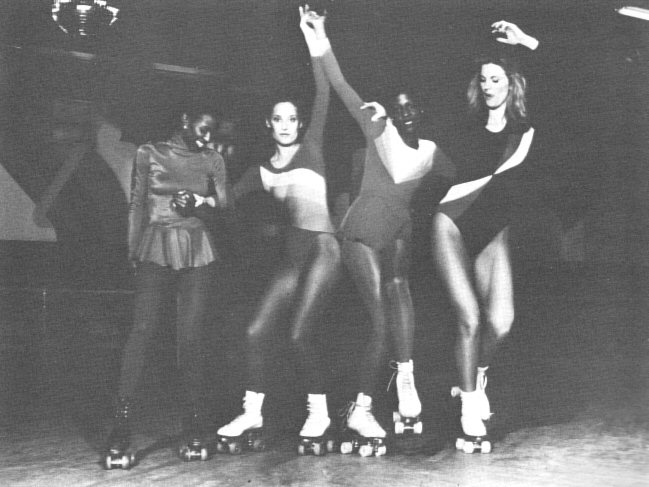
Male dancers, athletes, and thespians wore leotards well into the ’70s. Eventually, though, disco happened. Disco fashion emphasized leotard fashion for women, as this roller disco shot from the Empire Rollerdome reveals:

2

(Oh, to be a roller disco queen in ’70s Brooklyn. Sigh.)

Men eventually abandoned leotards as they became increasingly popular with women. We saw the same pattern, of course, with high heels and cheerleading: male flight from feminizing fashions and activities. The more women wore leotards, the less men wore them. Eventually, companies stopped making leotards for men altogether.

To the disappointment of all the (het) ladies, I’m sure.

Today, a Google Image search for leotard returns all ladies. Mostly girls, in fact. Not a guy in the bunch:

4

I can only think of two arenas in which leotards for men still hold sway: wrestling and professional weight lifting. And, now I guess we know why.

Lisa Wade, PhD is an Associate Professor at Tulane University. She is the author of American Hookup, a book about college sexual culture; a textbook about gender; and a forthcoming introductory text: Terrible Magnificent Sociology. You can follow her on Twitter and Instagram.
You like!  Here are our most appreciated posts this month:

Editor’s pick:

Top funny:

Social media milestone!

We reached 70,000 fans on Facebook this month. We’ll keep trying to feed interesting, useful, and funny sociological stuff. Thanks everybody!

Social Media ‘n’ Stuff:

Finally, this is your monthly reminder that SocImages is on TwitterFacebookTumblrGoogle+, and Pinterest.  I’m on Facebook and most of the team is on Twitter: @lisawade@gwensharpnv@familyunequal, and @jaylivingston.

Lisa Wade, PhD is an Associate Professor at Tulane University. She is the author of American Hookup, a book about college sexual culture; a textbook about gender; and a forthcoming introductory text: Terrible Magnificent Sociology. You can follow her on Twitter and Instagram.