For many Reddit users, these are dark times indeed. With the banning of r/fatpeoplehate and other subreddits that did not curtail harassment and vote brigading, followed more recently by the sudden dismissal of Reddit employees including Victoria Taylor, many users are criticizing the increase in top-down administrative decisions made under the leadership of interim CEO Ellen Pao.  Alongside these criticisms are accusations that the “PC” culture of safe spaces and “social justice warriors” has eroded the ideological foundations of Reddit culture–freedom of speech, democracy, and the right to be offensive under any circumstances. Meanwhile, Reddit’s biggest competitor voat.co is having a hard time keeping their servers functioning with the massive influx of traffic.

14

The abrupt and unexplained dismissal of Victoria Taylor has become a particularly vivid rallying point for disgruntled users. Many moderators set their subreddits to private or restricted submissions, effectively making Reddit unusable and invisible for a vast majority of visitors. “The Blackout” (aka #TheDarkening) lasted from late Thursday (7/2) until Friday afternoon when most subreddits came back online; it is one of several tactics used so far in the “Reddit Revolt.” At this time a change.org petition calling for Ellen Pao to step down is nearing 200,000 supporters.

One of the more confusing elements of the revolt is the target of redditors’ anger. Who is to blame for this perceived assault on liberty and the free exchange of ideas? For now, two seemingly opposed forces are bearing the brunt of accusation. These are Ellen Pao, under the influence of commercial interests, and social justice activists who criticize Reddit for tolerating and perpetuating hateful discourse. No one is speaking up on the cause of Taylor’s dismissal, which has led to speculation that she was fired for refusing to comply with the increasingly commercial motivations of Reddit admins, that she would not relocate from New York to San Francisco, or that she did not sufficiently manage the controversial Jessie Jackson AMA. Without more information, and in the context of other recent changes to Reddit, users alternate between blaming encroaching corporatism or PC freedom police who are finally ruining the internet.

So, how can these two forces both be responsible for the changes taking place on Reddit, and in other media such as television and gaming? Consider that a cornerstone of the Gamer Gate fiasco has been the assertion that market forces, not SJW activism, should determine the content and character of video games. Opposition to greater inclusivity in games, such as more central female, minority, and queer characters, has often been justified through free market rhetoric; the assertion is that men are the primary consumers of games, and that their demographic preferences do – and should – determine content. Any other force driving game design is perceived as ideologically motivated, propagandizing, and an assault on liberty.

If video game production companies are acquiescing to the demands of activists, they have not been forthcoming about it. Instead, they claim to be adapting to a marketplace in which women, people of color, and LGBTQ individuals occupy an ever increasing consumer base. Perhaps the activist/consumer dichotomy is more distracting than useful, given that the voices most critical of capitalism’s ability to turn identity into a commodity are also the ones advocating to see a bit of themselves in their beloved games. Here again, people are caught between wanting to see their values and identities reflected back at them in the media that they love, and coming to terms with what capitalist logics do to those values and identities.

On its face, the simultaneous blame directed at SJWs and commercialization seems at odds. But given the ability of neoliberal late capitalism to commodify identity and the self, and to turn nearly any element of culture into a profitable enterprise, this muddiness is a logical outcome of the contradictions of capitalism that Marx believed would be its downfall. Instead, neoliberalism and identity politics send capitalism into overdrive as the need to colonize ever expanding markets and commodify even the most absurd abstractions turns anti-capitalist ideology into easily packaged products. Rather than disturbing the supposed working-class false consciousness, the contradiction has accounted for it and marketed it back to the very people it exploits. It’s only a matter of time before Walmart starts selling a t-shirt that reads “Social Justice Warrior!” in yellow glitter.

Also central to the Reddit Revolt are discussions of labor and exploitation. Many on Reddit have remarked on the betrayal of moderators by the admins. Mods develop and manage Reddit content on their own time and for no compensation, a service admins rely on for the site to function and be profitable. In exchange, mods have historically been given relative freedom within the subreddits they moderate. Now that this freedom is being restricted or, as in the case with Victoria Taylor, decisions are made at the admin level without consulting or even informing mods, mods and users are taking the opportunity to air more general grievances, like the lack of investment in the site’s infrastructure.

Here is the centerpiece of the Reddit Revolt paradox: what is a redditor relative to the admins, or to the site itself? Redditors perceive themselves as members of a community, or perhaps as customers of the site. In many instances they even see themselves as workers generating content for the site to the benefit of the admins. But redditors are not customers, nor are they simply workers — they are the product.

To complicate this further, the Reddit Revolt requires all of us to grapple with digital and affective labor, and its tendency to blur the categories of workers, products, and consumers. Ellen Pao’s job is not to make Reddit a happy community, it is to sell the attention of redditors to advertisers. And even as users begin to understand that Reddit is less like a community and more like a factory, they seem less clear on their position within this factory. Redditors are not so much customers engaged in a boycott or even laborers on strike, they are products. As products, the only effective protest movement redditors could possibly engage in would be to remove themselves from the market. Hence, the blackout.

But the fact is, Reddit admins can shoulder the brunt of a couple of blackout days. Given how quickly the front page returned to normal it seems unlikely that any sustained movement will take hold. And while they may make promises to users about changes to come, Reddit admins will continue to do what all successful corporate entities require — turn a profit, often at the expense of those who use, make, or even are the product.

It’s to be expected that redditors feel betrayed by the powers that be for undermining the perceived ethos of Reddit as a community in which ideas — any ideas — can be freely exchanged. But there is perhaps a deeper betrayal that has not been articulated in the dominant narrative of the Reddit Revolt. That is the betrayal of western rationalism itself, and the notion that free markets and free speech are two articulations of a deeper, natural order that ultimately works in favor of the masses. The rhetorical relationship between freedom of expression and freedom of markets performs key ideological work for the perpetuation of an American-flavored narrative that capitalism is the great equalizer. While events like the Citizens United Supreme Court case occasionally highlight the absurdity of this argument, it is pervasive and often unseen. That cornerstone of western rationalism that so many redditors love is playing out in ways that they really really do not love. And the rupture will require more than dank memes and mental gymnastics to reconcile.

Cross-posted at Cyborgology.

Britney Summit-Gil is a graduate student in Communication and Media at Rensselaer Polytechnic Institute. She tweets occasionally at @beersandbooks.
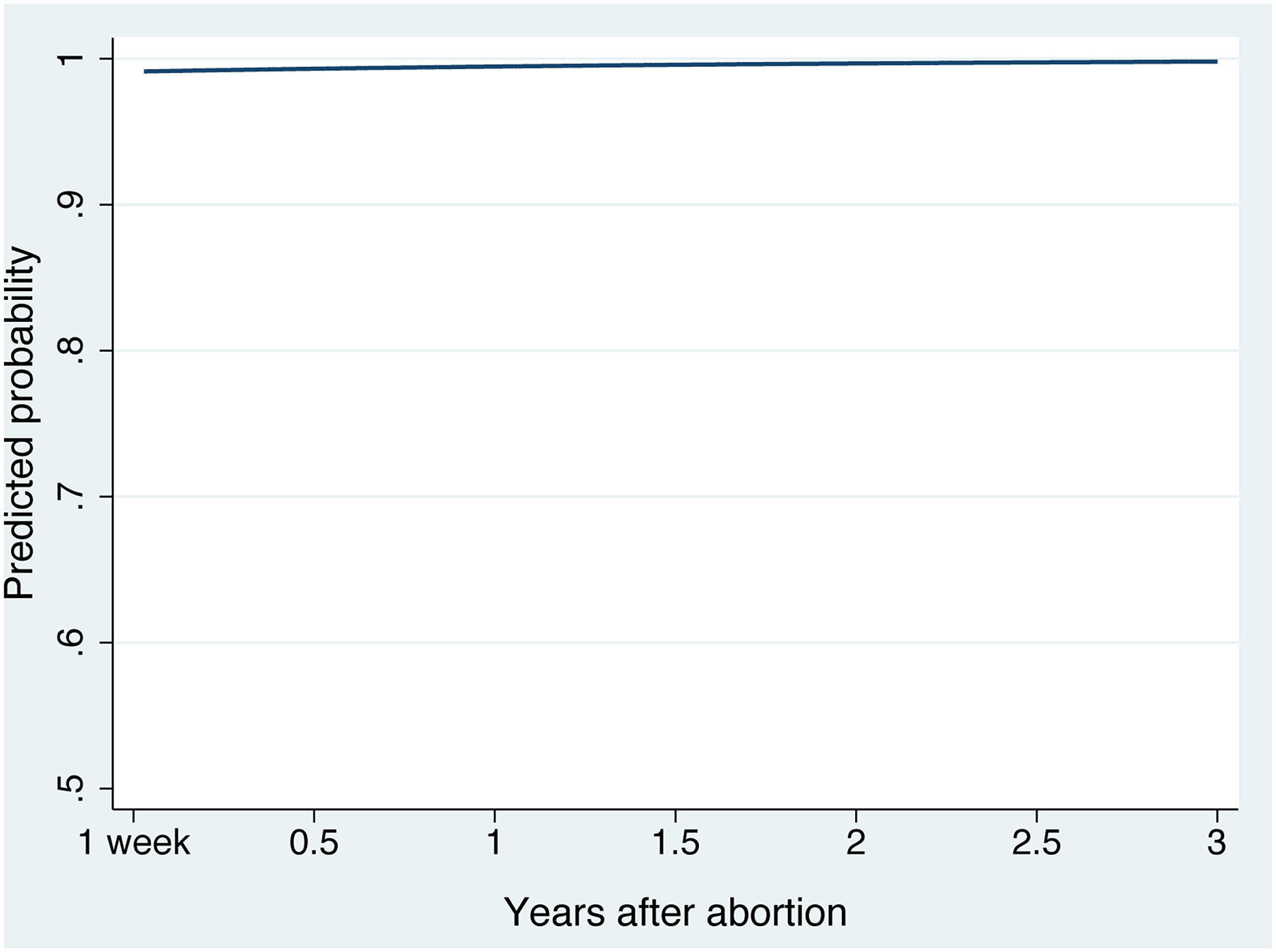
A new article reports the findings from a longitudinal study that followed 667 women who had early- and later-term abortions for three years after their procedure. Dr. Corinne Rocca and her colleagues asked women if they felt that the abortion was the “right decision” at one week and approximately every six months thereafter.

This is your image of the week:


Percent of women reporting that abortion was the right decision over three years:

2

Over 99% of the women said that the abortion was the right decision at every time point. The line that looks like the upper barrier of the graph? That’s the data.

Overall, measures of negative emotions were relatively low — an average score of under 4 on a 16-point scale at one week and declining to about 2 at three years — and were higher for women who had a more difficult time deciding whether to get an abortion or who subsequently had planned pregnancies. Whether the abortion occurred in the first trimester or near the legal limit did not correlate with emotional response.

In contrast, women reported twice as many positive emotions at one week. Over time, positive feelings about the abortion declined along with negative ones, suggesting that the experience became less emotionally charged overall with distance from the procedure.

Lisa Wade, PhD is an Associate Professor at Tulane University. She is the author of American Hookup, a book about college sexual culture; a textbook about gender; and a forthcoming introductory text: Terrible Magnificent Sociology. You can follow her on Twitter and Instagram.

Flashback Friday.

The AP has an interesting website about wildfires from 2002 to 2006. Each year, most wildfires occurred west of the Continental Divide. Many of these areas are forested. Others are desert or shortgrass prairie.

There are a lot of reasons for wildfires–climate and ecology, periodic droughts, humans. The U.S. Fish and Wildlife Service reports that in the Havasu National Wildlife Refuge, the “vast majority” of wildfires are due to human activity. Many scientists expect climate change to increase wildfires.

Many wildfires affect land managed by the Bureau of Land Management. For most of the 1900s, the BLM had a policy of total fire suppression to protect valuable timber and private property.

Occasional burns were part of forest ecology. Fires came through, burning forest litter relatively quickly, then moving on or dying out. Healthy taller trees were generally unaffected; their branches were often out of the reach of flames and bark provided protection. Usually the fire moved on before trees had ignited. And some types of seeds required exposure to a fire to sprout.

Complete fire suppression allowed leaves, pine needles, brush, fallen branches, etc., to build up. Wildfires then became more intense and destructive: they were hotter, flames reached higher, and thicker layers of forest litter meant the fire lingered longer.

As a result, an uncontrolled wildfire was often more destructive. Trees were more likely to burn or to smolder and reignite a fire several days later. Hotter fires with higher flames are more dangerous to fight, and can also more easily jump naturally-occurring or artificial firebreaks. They may burn a larger area than they would otherwise, and thus do more of the damage that total fire suppression policies were supposed to prevent.

In the last few decades the BLM has recognized the importance of occasional fires in forest ecology. Fires are no longer seen as inherently bad. In some areas “controlled burns” are set to burn up some of the dry underbrush and mimic the effects of naturally-occurring fires.

But it’s not easy to undo decades of fire suppression. A controlled burn sometimes turns out to be hard to control, especially with such a buildup of forest litter. Property owners often oppose controlled burns because they fear the possibility of one getting out of hand. So the policy of fire suppression has in many ways backed forest managers into a corner: it led to changes in forests that make it difficult to change course now, even though doing so might reduce the destructive effects of wildfires when they do occur.

Given this, I’m always interested when wildfires are described as “natural disasters.” What makes something a natural disaster? The term implies a destructive situation that is not human-caused but rather emerges from “the environment.” As the case of wildfires shows, the situation is often more complex than this, because what appear to be “natural” processes are often affected by humans… and because we are, of course, part of the environment, despite the tendency to think of human societies and “nature” as separate entities.

Originally posted in 2010.

Gwen Sharp is an associate professor of sociology at Nevada State College. You can follow her on Twitter at @gwensharpnv.

While it seems that much of the discourse around curbing gun violence focuses on the need to keep guns out of the hands of the mentally ill, these two issues — gun violence and mental illness — “intersect only at their edges.” These are the words of Jeffrey Swanson and his colleagues in their new article examining the personality characteristics of American gun owners.

To think otherwise, they argue, is to fall prey to the narrative of gun rights advocates, who want us to think that “controlling people with serious mental illness instead of controlling firearms is the key policy answer.” Since the majority of people with mental illnesses are never violent, this is unlikely to be an effective strategy while, at the same time, further stigmatizing people with mental illness.

What is a good strategy, then, short of the unlikely event that we take America’s guns away?

Swanson and colleagues argue that a better policy would be to look for signs of impulsive, angry, and aggressive behavior and limit gun rights based on that. Evidence of such behavior, they believe, “conveys inherent risk of aggressive or violent acts” substantial enough to justify limiting gun ownership.

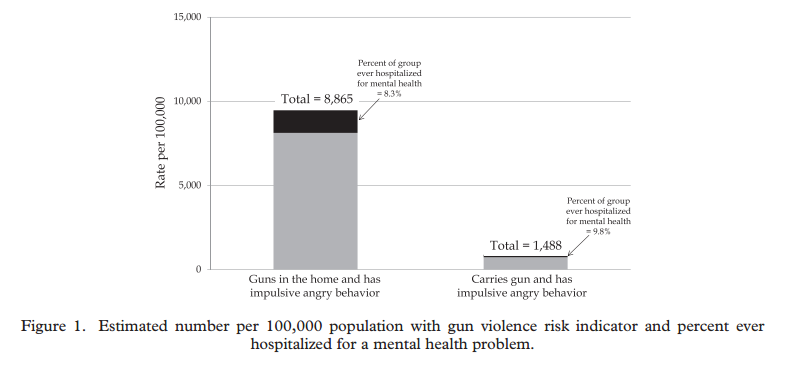
Using a nationally representative data set, they estimate that 8,865 people out of every 100,000 both (1) owns at least one gun and (2) exhibits impulsive angry behavior: angry outbursts, smashing things in anger, or losing their temper and engaging in physical fights. If I do my math right, that’s almost 22 million American adults (~321,300,000 people minus the 23% under 18 divided by 100,000 and multiplied by 8,865).

1,488 out of those 100,000, or almost 3.6 million, also carries a gun outside the home. People who owned lots of guns (six or more) were four times as likely to both have anger issues and carry outside the home.

The numbers of angry and impulsive people who own and carry guns, importantly, far exceeds the number of people who have been hospitalized for mental illness. This is a dangerous population, in other words, much larger than the one currently excluded from legal gun ownership.

2

“It is reasonable to imagine,” Swanson and his colleagues conclude, that people who are angry, aggressive, and impulsive have an arrest history. Accordingly, they advocate gun restrictions based on indicators of this personality type, such as convictions for misdemeanor violence, DUIs, and restraining orders. This, they think, would do a much better job of reducing gun violence than a focus on certified mental illness.

H/t to gin and tacos. Cross-posted at Pacific Standard.

Lisa Wade, PhD is an Associate Professor at Tulane University. She is the author of American Hookup, a book about college sexual culture; a textbook about gender; and a forthcoming introductory text: Terrible Magnificent Sociology. You can follow her on Twitter and Instagram.

SocImages has a Tumblr where all of the posts that pop up here (and more) get re-posted and go all over the internet. And a few days ago it gave me this post.

While I was working on the page, I saw a really interesting example of the kind of thoughtlessness that happens when designers aren’t thinking about all their potential users. Here’s a screenshot of what I encountered; it’s a timeline of all the things that had happened on the page in reverse chronological order, except the very top line, which is the interesting part. It reads:

SCREAM: You’ll never see it coming. TONIGHT.

Here’s a screenshot:5

As a female and, more importantly a woman-on-the-internet, my first gut reaction was that I was going to have to forward it to the FBI. You see, it’s an ad for something on MTV — and I realized that in the 2nd second — but, in the 1st second, I thought it was someone threatening to kill me.

I don’t mean to be overly dramatic about this. Even in the 1st second, my reaction was more well, hell than omg I’m gonna die, but I do wonder whether the ad managers at Tumblr or MTV ever considered the possibility that this way of advertising might be genuinely scary to someone, even if just for a second. I wonder if the managing team has anyone on it who is also a woman-on-the-internet. Or anyone who’s job it is to specifically think about the diversity of their users and how different strategies might affect them differently.

One doesn’t have to be routinely subject to threatening comments and messages to have the reaction I did. I could be someone who just left an abusive partner, someone who’s been attacked before, a witness in a criminal trial, a doctor who performs abortions or, christ, a black preacher in the South. Or maybe just someone who doesn’t appreciate an advertisement that, through an intended double meaning, implies that I, personally, am about to be attacked. That’s not funny, or fun, to everyone.

This kind of thing seems to happen all the time. Another example might be the Nikon camera feature, designed to warn you if someone blinked, that thinks Asian people have their eyes closed; the HP face-tracking webcam that can’t see black people; the obsessive health-tracking app that can’t be deleted off your iphone, even if you have an eating disorder; or the fact that it seems to track everything except menstrual cycles, making female-bodied people invisible.

This is one of the arguments for why businesses need diverse staff. Greater diversity — especially if everyone is explicitly given permission to raise issues like these — would make it far more likely that companies could avoid these gaffes and make products better for everyone.

Lisa Wade, PhD is an Associate Professor at Tulane University. She is the author of American Hookup, a book about college sexual culture; a textbook about gender; and a forthcoming introductory text: Terrible Magnificent Sociology. You can follow her on Twitter and Instagram.

A new tumblr titled Every Word Spoken posted a quote from George Gerbner that goes like this:

Representation in the fictional world signifies social existence; absence means symbolic annihilation.

It’s the rallying cry for writer and performer Dylan Marron, who runs the tumblr. It’s exactly what it sounds like: a movie cut down to feature just the lines spoken by non-white people. He’s just getting started, but it looked to me like so far the longest clip is less than 1 minute long, most are around 30 seconds and this includes a few seconds at the beginning of each where they show the title.

In addition to showing us that people of color with speaking roles are almost non-existent — symbolically annihilated — the roles they play tell disturbing stories. Overwhelmingly, in the videos he’s picked so far, they are in service occupations (500 Days of Summer); literally maids (Enough Said); or with stereotypical accents (Wedding Crashers). And, oh hey movie people, making the only person of color with lines a doctor (The Fault in Our Stars; Black Swan) gets you no bonus points in my book. Nice try.

But THESE. These were the best ones…

Noah:

Into the Woods:

This project is calling out the movie industry in a simple, powerful way. Just the facts, ma’am. Time for change.

Lisa Wade, PhD is an Associate Professor at Tulane University. She is the author of American Hookup, a book about college sexual culture; a textbook about gender; and a forthcoming introductory text: Terrible Magnificent Sociology. You can follow her on Twitter and Instagram.

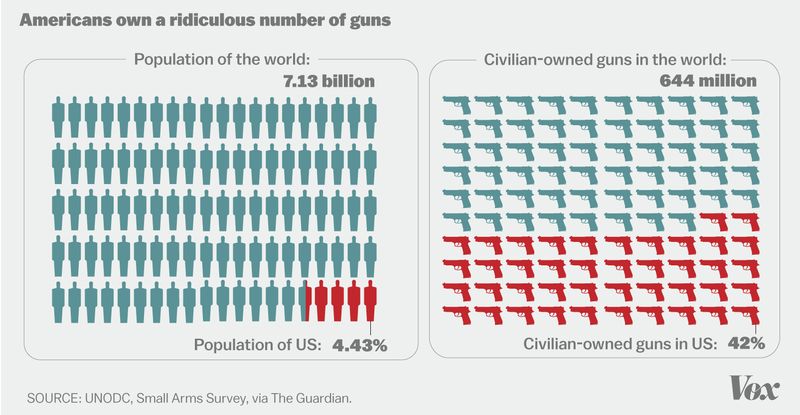
According to Vox, the U.S. has 4.43% of the world’s population and almost 42% of the world’s population of civilian-owned guns.

This is your image of the week:

2

It’s hard to say exactly, but there may be as many guns as there are people in the U.S., or even more guns than people. Since not everyone is a gun owner, that means that the typical gun owner owns more than one. In fact, they own, on average, 6.6 guns each. Two-thirds of the guns in the U.S. are in the hands of 20% of the population. Gun manufacturers know this and market accordingly.

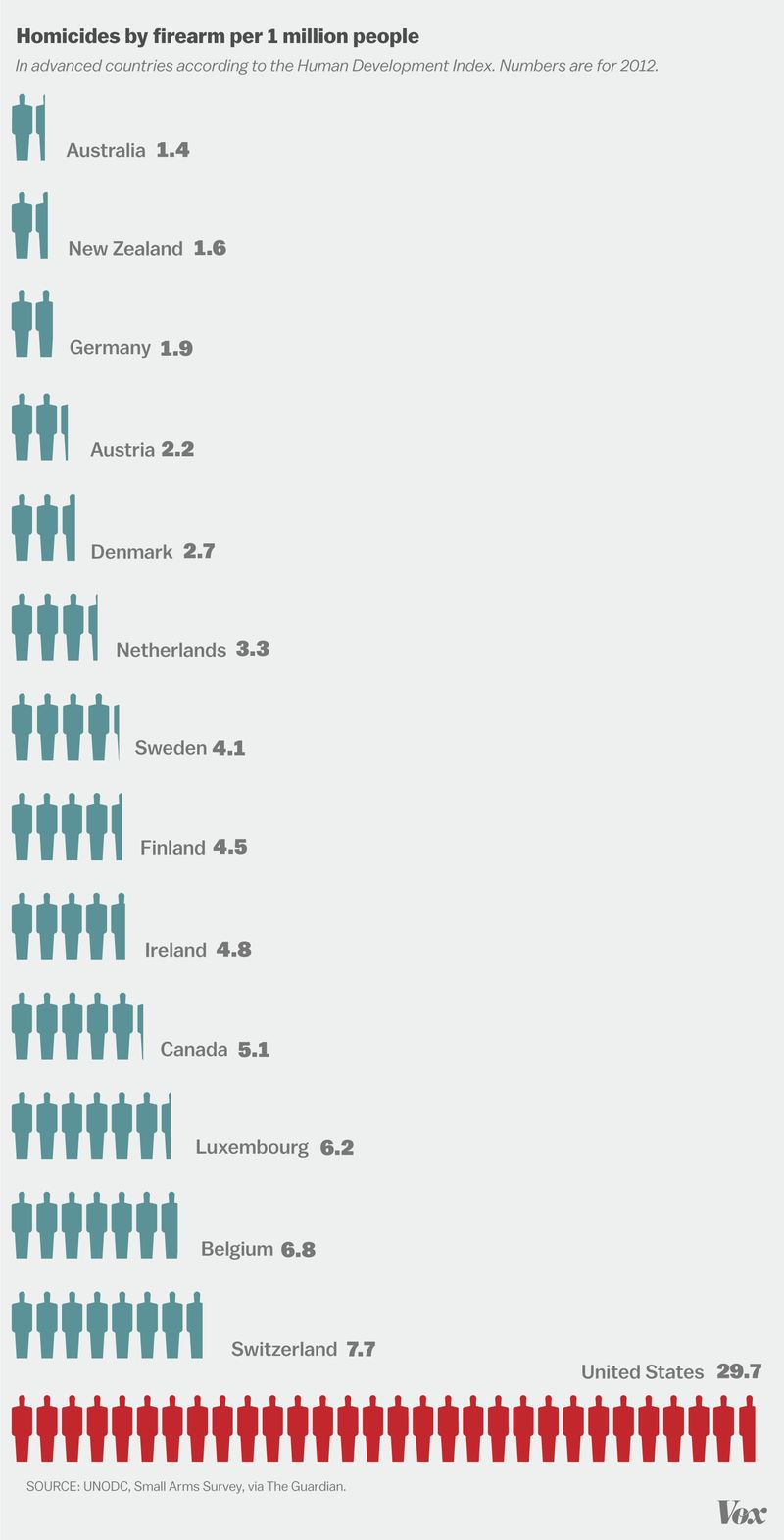
Gun ownership is correlated with both gun homicide and suicide. Accordingly, we also have the highest rate of gun violence of any developed country. In 2013, there were 21,175 gun suicides and 11,208 gun homicides.

4

This data was collected by the UNODC and compiled by the Guardian.

Lisa Wade, PhD is an Associate Professor at Tulane University. She is the author of American Hookup, a book about college sexual culture; a textbook about gender; and a forthcoming introductory text: Terrible Magnificent Sociology. You can follow her on Twitter and Instagram.

Flashback Friday.

The common sense assumption about success in sport often involves the belief that success is a result of innate talent and intensive practice. The more of both you have, the better you are. However, who is good at a particular sport is also the result of how that sport is organized. Sports have rules and those rules are made by the people who have the power to enforce their own ideas about what the rules should be over and against less powerful people with other ideas.

Long distance ski jumpers benefit from maximizing their surface area while simultaneously decreasing their weight. The less they weigh and the more drag they can produce, the farther they go. Their bodies are the primary source of weight and, as a result, there is incredible pressure for competing ski jumpers to be as thin as possible.

After criticism that the sport was creating an incentive for disordered eating, the International Ski Federation began penalizing jumpers who had a body mass index below 20. These skiers were required to jump with shorter skis, the primary source of drag. The hope was that the shorter skis would balance out the incentive for thinness, allowing jumpers to be competitive without starving themselves.

So, who wins isn’t only related to talent and practice. It is also a consequence of rules that no longer make the ability to train while starving oneself an advantage. This is a great example of the way that we write rules that shape the context for success in a sport.

—————————————

In light of this, it’s really interesting to consider the fact that ski jumping was the last Olympic event that excluded women. Women were given their first ski jumping event in 2014, though they still have one and the men have three.

The International Olympics Committee and the International Ski Federation listed a myriad of reasons for this, ranging from claims that the sport is not yet developed enough, to the idea that adding women would crowd an already overwhelmed Olympic schedule, to the assertion that the sport is not “…appropriate for ladies from a medical point of view.”

The rationales seem transparently thin, leading to the suggestion that the real reason that women weren’t allowed to compete — and still aren’t on parity with men — is because they might kick ass. If being lighter is an advantage, then women might beat men at the sport. In fact, during the time women’s future in Olympic ski jumping was being debated, the world record holder on the ski jump track at that year’s Olympics was held by a woman: Lindsey Van.

Sociologists recognize sport as a terrain on which social claims about gender are demonstrated. Not letting women play is one way that the mythology of men’s physical dominance has been maintained. Football is an excellent example. Women aren’t allowed to play football, it is asserted, because they are not big enough and would get hurt. Of course, rules that make size so critical to success in football also exclude the majority of men (who aren’t big enough to play either). If we organized football by weight classes, instead of gender, women could play football, and so could all of the men who are excluded as well. But, if we organized football by weight classes, we couldn’t claim that women were too small, weak, and fragile to play it.

It will be interesting to see how the future of women’s ski jumping plays out.

Originally posted in 2010.

Lisa Wade, PhD is an Associate Professor at Tulane University. She is the author of American Hookup, a book about college sexual culture; a textbook about gender; and a forthcoming introductory text: Terrible Magnificent Sociology. You can follow her on Twitter and Instagram.