Alex C. sent in an example of the belittling of men by men in the context of sport.  Two teenager fans of the Red Sox found themselves verbally assaulted by Yankee fans for the sin of sitting amongst them.  They surround the boys and sing, aggressively, to the tune of YMCA, after a mostly indecipherable lead in:

Why are you gay!
I saw you suckin’ it, D-I-C-K.
They have every size, you’re about to enjoy.
You can hang out with all the boys!
Why are you gay!
I saw you suckin’ some D-I-C-K.

It should be clear to everyone that this behavior represents a sick society. Team affiliation follows the rules of the minimal group paradigm: humans appear to be willing to form meaningful groups based on just about anything.  Sports just happens to be an arena in which hypermasculinity is rewarded, even demanded.  This makes it acceptable to be cruel to one another and makes it inevitable that that cruelty will take the form of hatred towards gay men (deemed masculine failures) in the form of homophobic slurs.  It’s not even that they think the kids are gay, but calling them gay is good for a laugh and a great insult.

This is what it’s like to be a man under patriarchy: moments of inhumanity in which men accept and reproduce hatred against others and moments of victimization when other men aim that hatred at you.

Lisa Wade, PhD is an Associate Professor at Tulane University. She is the author of American Hookup, a book about college sexual culture; a textbook about gender; and a forthcoming introductory text: Terrible Magnificent Sociology. You can follow her on Twitter and Instagram.
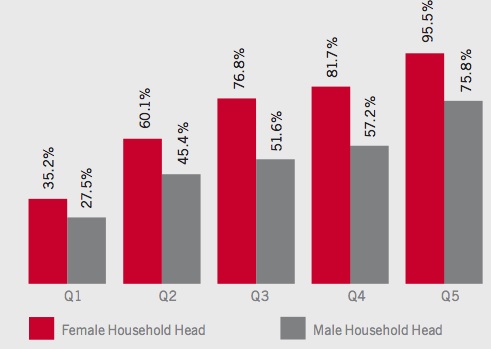
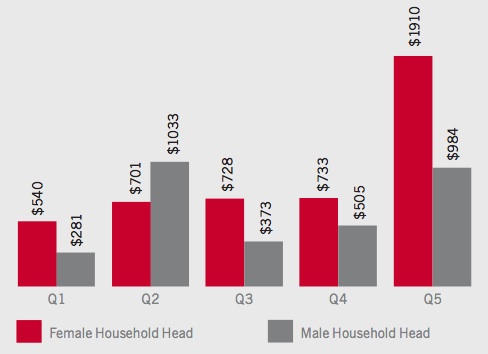
Emma M.H. sent us a link (via Jewish Philanthropy) to a study by the Center of Philanthropy, at Indiana University, about differences in financial donating by men and women. The report looks at data from a 2007 nationally representative survey of households, in which respondents were asked about their charitable giving in 2006. To isolate differences in giving, the report includes data only on single heads of household (whether never-married, divorced, or widowed), since in married households it’s difficult to distinguish who made the decision to donate (they point out that the literature is also very clear that married households are much more likely to donate than non-married households). You can get a copy of the actual questionnaire here.

They break the data down by income as well, dividing them into quintiles (that is, each category contains 20% of respondents). The income quintiles are: Q1 = $23,509 or less, Q2 = over $23,509 but less than $43,500, Q3 = over $43,500 but less than $67,532, Q4 = over $67,532 but less than $103,000, and Q5 = $103,000+.

As we see, in each income category non-married women were more likely to donate to charities of some sort:

Women also generally gave more:

It’s interesting to me that the total amount of the giving doesn’t vary more by income for non-married women (the amount of reported giving is basically the same for the 2nd, 3rd, and 4th quintiles), yet varies so much for non-married men. Thoughts on what’s going on there?

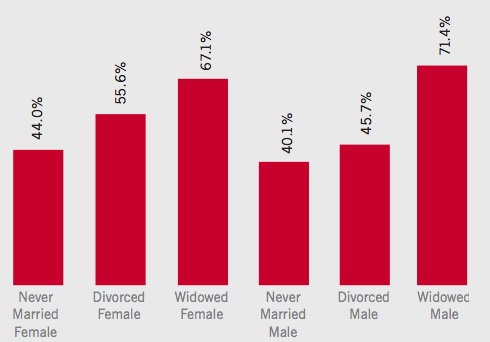
Likelihood of giving also varies quite a bit depending on type of single status — those who are widowed are quite a bit more likely to donate than the never-married, which is probably partially a factor of age and related factors like generally higher incomes/wealth:

As we’ve posted on in the past, women are also more likely to be involved in volunteer work.

I’d love to see a breakdown of where men and women donate, but the report didn’t provide that level of detail.

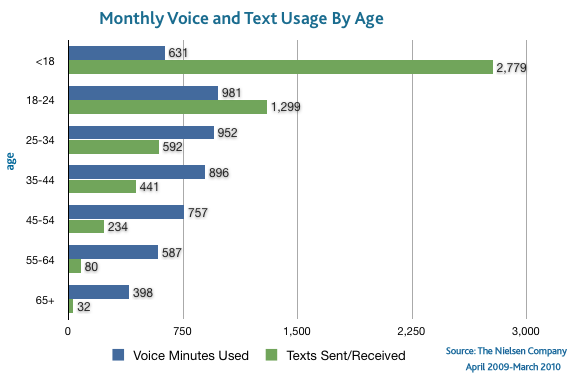
The Nielsen Company finds that the use of phone voice and text communication varies quite tremendously by age:

Lisa Wade, PhD is an Associate Professor at Tulane University. She is the author of American Hookup, a book about college sexual culture; a textbook about gender; and a forthcoming introductory text: Terrible Magnificent Sociology. You can follow her on Twitter and Instagram.

In a society in which masculinity is valued over femininity, like the U.S., the words “woman” and “girl” (not to mention words like “pussy,” “bitch,” and “cocksucker”) are effective slurs against both men and women. The flipside of this, of course, is that acting like a man is considered good. Acting like a man means being powerful, assertive, and effective. In masculinized arenas, like politics, both men and women are expected to act like men and being accused of being a woman is an effective slur against any politician.

Case in point: Dmitriy T.M. sent a 30-sec Politico video in which Sharron Angle tells Harry Reid to “man up.”

Politico reports five other instances in which candidates of both sexes delivered this chide to opponents. The fact that both men and women find this insult useful suggests that everyone has accepted sexism in politics and is willing to endorse and manipulate it to win. But, while the slur may help individual women and men win races, it ultimately affirms the idea that politics is no place for a woman.

Lisa Wade, PhD is an Associate Professor at Tulane University. She is the author of American Hookup, a book about college sexual culture; a textbook about gender; and a forthcoming introductory text: Terrible Magnificent Sociology. You can follow her on Twitter and Instagram.

In this 12-minute RSA Animate video, Education Professor Sir Ken Robinson explains why we need to change the way we educate new generations.   Children, he says, “…are living in the most intensely stimulating period in the history of the earth.”   Yet we are still educating them according to a model invented during the industrial revolution that emphasizes conformity, standardization, and coming up with the “right” answer.  Today the future is coming faster and faster and we need to teach children to be able to thrive in change and uncertainty.  Watch the video for his thoughts on what to do next (and what Oklahoma has to do with it):

Thanks to education activist and friend, Diallo Shabazz, for the link!

Lisa Wade, PhD is an Associate Professor at Tulane University. She is the author of American Hookup, a book about college sexual culture; a textbook about gender; and a forthcoming introductory text: Terrible Magnificent Sociology. You can follow her on Twitter and Instagram.
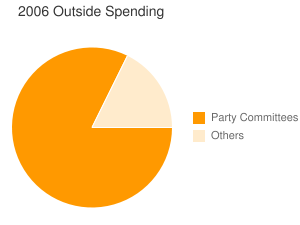
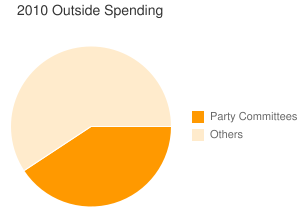
The Sunlight Foundation, a non-profit group interested in government transparency, has a couple of charts that reflect the enormous growth in spending by outside groups (i.e., organizations other than the parties or the candidates themselves):

According to data obtained from the Federal Election Commission, fifty-nine percent of all outside spending on independent expenditures has come from non-party aligned groups while only forty-one percent comes from the party committees. This is a dramatic change from the 2006 midterms (as of October 19, 2006) when party committees accounted for eighty-two percent of all outside spending on independent expenditures and non-party aligned committees accounted for eighteen percent.

This includes those that actively support or oppose a candidate and advocate voting in a particular way; it isn’t counting the independent “electioneering communications,” where groups take a clear stance toward a candidate’s policies but don’t explicitly say to vote for or against them.

Here is the breakdown of spending from 2006:

And 2010:

Of course, the major cause for this was the Supreme Court’s decision in Citizens United v. Federal Election Committee. The decision allows outside groups to spend unlimited amounts and to actively take positions in ads, as long as they don’t specifically advocate voting for or against candidates and don’t coordinate with campaigns. They also are not required to disclose their donors.

Both Democrats and Republicans receive support from such groups, though Republicans benefit more thus far. For a breakdown of specific types of spending (including both independent spending and electioneering communications), the Sunlight Foundation has a great database here.


Michelle N. sent us a video by the ever-fabulous Sarah Haskins, this time on the use of scientific imagery and language in skin care commercials. Michelle says,

In these advertisements, complex, scientific-sounding language is used to obscure the actual simplicity of the beauty product and the “conditions” they aim to correct (body-aging anyone?)…Since when do we refer to lotion as a “serum”?


In this video, sociologist Andrew Cherlin describes how marriage is still here, and still embraced, but much less stable and compulsory.

Lisa Wade, PhD is an Associate Professor at Tulane University. She is the author of American Hookup, a book about college sexual culture; a textbook about gender; and a forthcoming introductory text: Terrible Magnificent Sociology. You can follow her on Twitter and Instagram.