Cross-posted at Montclair SocioBlog.

The politics of motherhood reared its head again last month when Hilary Rosen, who the news identified as a “Democratic strategist,” said that Ann Romney (Mrs. Mitt) had “never worked a day in her life.” (A NY Times article is here.)

“Worked” was a bad choice of words.  Raising kids and taking care of a home are work, maybe even if you can hire the kind of help that Mrs. Romney could afford.  Rosen’s comment implied that family work is not as worthwhile as work in the paid labor force.  That’s not such an unreasonable conclusion if you assume that we put our money where our values are and reward work in proportion to what we think it’s worth.  Mitt’s supporters use this value-to-society assumption to justify the huge payoffs Romney derived from those leveraged buyouts at Bain Capital.*

Even Mrs. Romney apparently felt that there must be some truth to the enviability of a career.   Why else would she refer to stay-at-home motherhood as a career?  “My career choice was to be a mother.”

Still, regardless of the truth of Rosen’s remark, it was insulting.**  Stay-at-home motherhood is work – a job.

But is it a good job?

A recent Gallup poll provides some more evidence as to why stay-at-home moms might be both envious or resentful of their employed counterparts.  Gallup asked women about the emotions, positive and negative, that they had felt “a lot” in the previous day.  Gallup then compared the stay-at-home moms, employed moms, and employed women who had no children at home.

The stay-at-home moms came in first on every negative emotion.  Some of the differences are small, but the Gallup sample was more than 60,000 so these differences are statistically significant.   The smallest difference was for Stress – no surprise there, since paid work can be stressful.  Worry and Anger too can be part of the workplace.  The largest differences were for Sadness and Depression.  Stay-home moms were 60% more likely to have been sad or depressed.

Gallup also asked about positive feelings (Thriving, Smiling or Laughing, Learning, Happiness, Enjoyment), and while the differences were smaller, they went the same way, with stay-at-home moms on the shorter end.  Still it’s encouraging that 86% of them had Experienced Happiness 86%; so had 91% of the employed moms.

Money matters.  As Rosen said,

This isn’t about whether Ann Romney or I or other women of some means can afford to make a choice to stay home and raise kids. Most women in America, let’s face it, don’t have that choice.

Gallup found a small interaction effect.  The stay-at-home mom-employed difference was greater for low-income women.

The Gallup poll does not offer much speculation about why stay-at-home moms have more sadness and less happiness. One in four experienced “a lot” of depression yesterday.  That number should be cause for concern.

Maybe women feel more uncertain and less able to control their lives when they depend on a man, especially one whose income is inadequate.  Maybe stay-at-home moms find themselves more isolated from other adults. Maybe they are at home not by choice but because they cannot find a decent-paying job. Or maybe money talks, and what it says to unpaid stay-at-home moms is society does not value your work.  Nor, in comparison with other wealthy countries, does US society or government provide much non-financial support to make motherhood easier.

The late Donna Summer sang,

She works hard for the money
So you better treat her right

But how right are we treating women who work hard for no money?

——————————-

* For example, Edward Conrad is a former partner of Romney.  In a recent article in the Times Magazine, Adam Davidson writes, “If a Wall Street trader or a corporate chief executive is filthy rich, Conrad says that the merciless process of economic selection has assured that they have somehow benefitted society.”

** Hillary Clinton committed a similar gaffe twenty years ago in response to a reporter’s question about work and family “I suppose I could have stayed home and baked cookies and had teas, but what I decided to do was to fulfill my profession which I entered before my husband was in public life”

Today I thought we’d do another round-up of gendered children’s stuff, since we’ve gotten a number of submissions. So here we go.

Missy C. noticed that the manufacturer’s product description listed on Amazon for one of the Fisher Price Imaginext Sky Racers took for granted that the toy was for boys, not, say, “kids”:

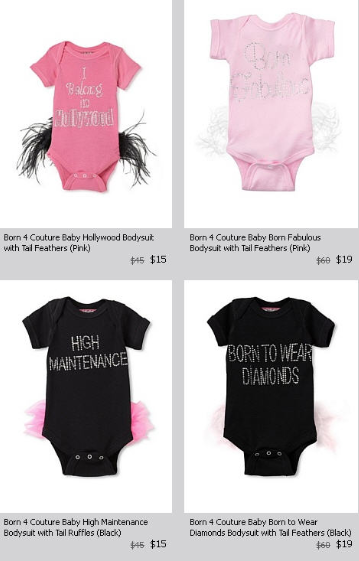
Monica C., meanwhile, noticed another example of the association of girls with a diva-ish princess center-of-attention persona when looking at onesies for sale at My Habit. Options included “born fabulous,” “high maintenance,” “born to wear diamonds,” and “it’s all about me,” among others:

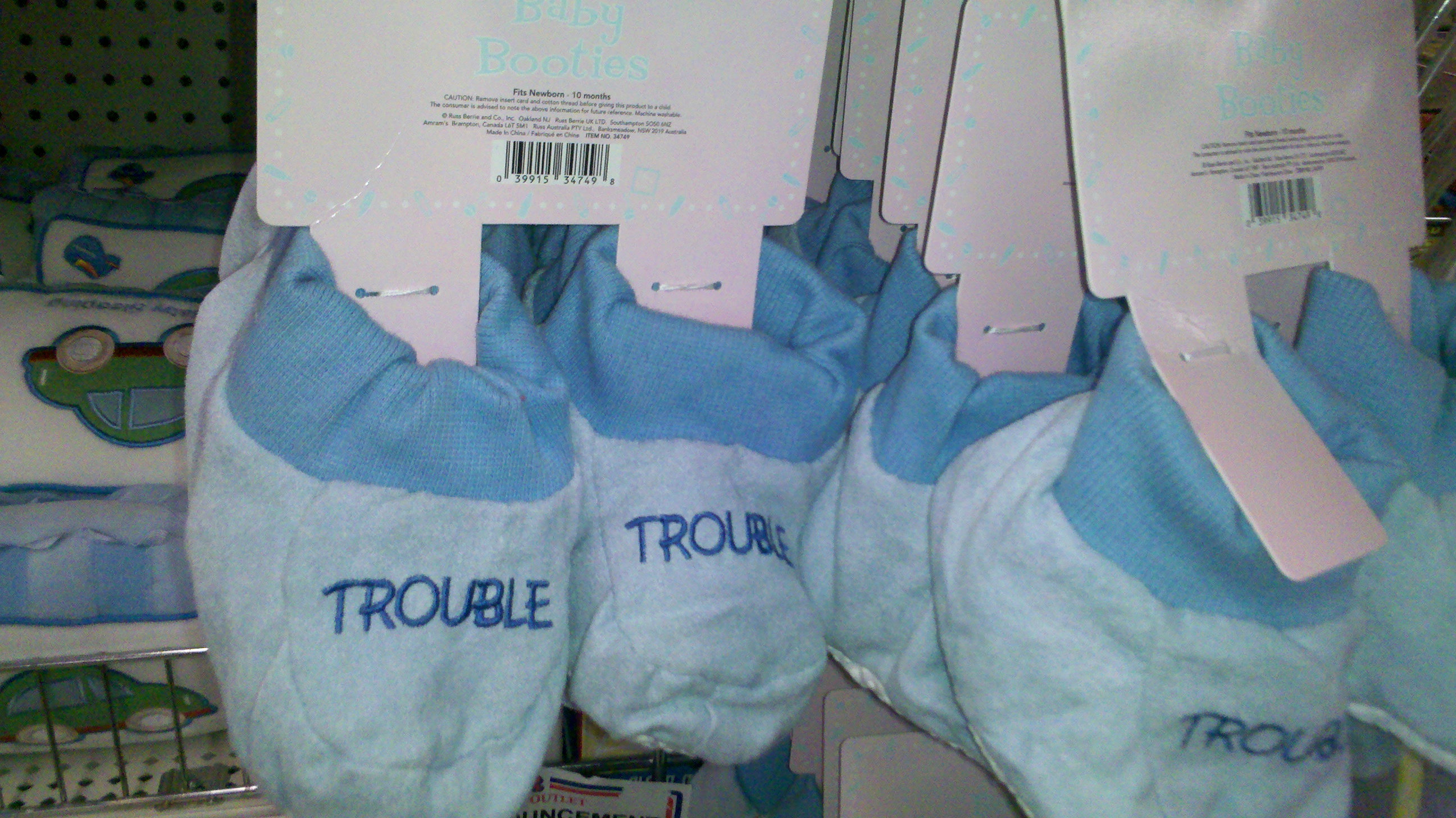
Similarly, Melanie J. saw some baby booties for sale at retail chain JR’s in North Carolina that reinforce the idea that boys are mischievous while girls are materialistic:

You can buy them gendered vitamins as well. Nathan, who writes at 1115, sent in this photo he took at Target:

Pete & Emily in Norwich, UK, noticed that you can now allow your hamsters to inhabit gendered worlds too, if you’d like; they sent us this photo they took at a pet store:

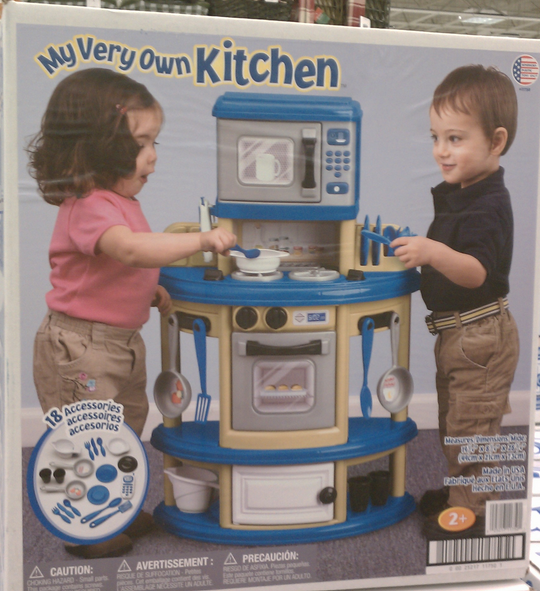
But we do have two counter-examples this time! Jackie H. took a photo of a kitchen set she saw for sale at Meijer, which shows both a boy and a girl using it:

And Isabeau P.S., Jesse W., and Anne Sofie B. all sent in images from the catalog for Swedish toy maker Leklust (two of the images were discussed at Mommyish):


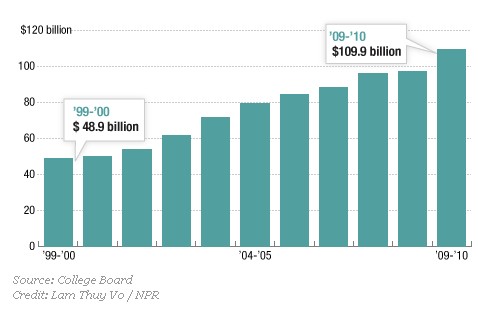
You’ve probably heard someone in media or politics bemoan the ballooning student debt in the U.S.  In fact, debt has been rising.  It’s more than doubled in the last ten years (that’s a more than 100% increase):
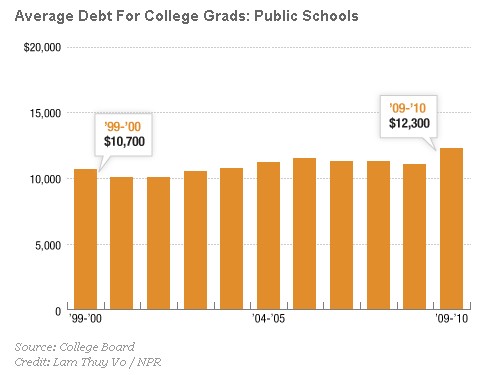
This debt, though, can’t be attributed primarily to the rising cost of education, as Planet Money explains.  The average debt load for a student graduating from a public school, for example, has risen by 20%:
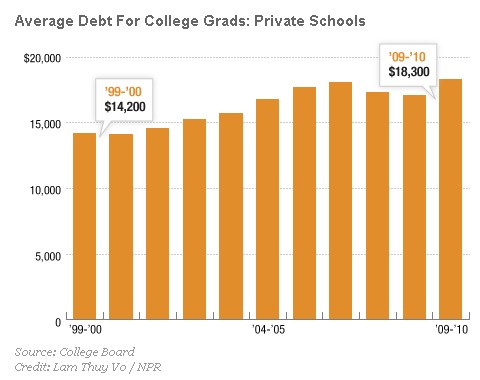
The average debt load for a student coming out of a private school has gone up a bit more, but still not enough to account for the leap in overall student debt.
The increase in debt, it turns out, is largely accounted for by an increase in the number of people going to college.  In 1970, 8,500 8,500,000 people enrolled in college in the Fall; in 2009, that number exceeded 20,000 20,000,000 (source).  A more than 100% increase.

So, the story isn’t quite as dire as we might think.  This may be little consolation, though, for my students who walked across the stage yesterday.  Congrats, Seniors! :)

Lisa Wade, PhD is an Associate Professor at Tulane University. She is the author of American Hookup, a book about college sexual culture; a textbook about gender; and a forthcoming introductory text: Terrible Magnificent Sociology. You can follow her on Twitter and Instagram.

Last week, the Census Bureau announced that as of July 1, 2011, for the first time the majority (50.4%) of babies under age 1 in the U.S. were not non-Hispanic Whites. Animal New York posted a video by Jay Smooth discussing the reactions to and implications of this news:

You can see the NYT article Jay Smooth parodies here, but note that the graph is mislabeled. The line labeled “White” actually only represents the data for non-Hispanic Whites, while the line labeled “Non-White” includes births to White Hispanics, so the terminology they used doesn’t accurately reflect what the graph illustrates.

We seem to have a way of regularizing the pain felt by working people—worsening living conditions become little more than background noise to business as usual. 

The situation for the unemployed is a case in point.  We have a complex, but comparatively miserly, unemployment compensation system. 

Workers are generally entitled to 26 weeks of unemployment benefits.  However, there are two programs that potentially extend the benefit period for the unemployed. The first is the Emergency Unemployment Compensation (EUC) program, which was enacted in 2008 in response to the economic crisis.  As the table below shows, the EUC offers workers in states with high rates of unemployment up to 53 additional weeks of benefits. 

weeks-of-benefits.jpg

Workers who exhaust both their regular unemployment insurance and EUC benefits can receive additional support through the second program, the permanent federal-state Extended Benefits (EB) program.  As the table above shows, that program offers a maximum of 20 extra weeks of benefits depending on state unemployment rate levels.  However, there is an additional provision to the EB program that is now coming into play with negative consequences.  

As Hanna Shaw, of the Center on Budget and Policy Priorities, explains: 

A state may offer additional weeks of UI benefits through EB if its unemployment rate reaches certain thresholds . . . and if this rate is at least 10 percent higher than it was in any of the three prior years.  But unemployment rates have remained so elevated for so long that most states no longer meet this latter criterion (referred to as the “three-year lookback”). 

Because of this lookback provision hundreds of thousands of unemployed workers are now losing benefits, not because conditions are improving but because they are not continuing to worsen. The table below highlights the 25 states that have been forced to stop providing EB benefits this year and the number of workers in each state that have been cut adrift as a result.  Look at California–more than 95,000 workers have lost their benefits so far this year despite the fact that the state unemployment rate is almost 11 percent.

5-14-12ui-table.jpg

This is no accidental outcome.  In fact, according to Shaw,

Policymakers could have addressed the “lookback” when they extended federal UI at the beginning of the year, but they didn’t.  Instead, Congress not only allowed EB payments to fade out, but it also made changes that over the course of the year will reduce the number of weeks of benefits available in the temporary Emergency Unemployment Compensation (EUC) program, which provides up to 53 additional weeks to the long-term unemployed based on the unemployment rate in their state.

How serious is the long term unemployment problem?  Check out the chart below.  As it shows, the share of the labor force that is unemployed for more than 26 weeks is higher than at any point in the last six decades.  Perhaps even more striking is the fact that 41.3 percent of the 12.5 million people who were unemployed in April 2012 had been looking for work for 27 weeks or longer.

 222-ltu-opt.jpg

In terms of the master narrative, this is just another of the necessary adjustments required to stabilize the “system;” no need for alarm.  Makes you wonder about the aims of the system, doesn’t it?


Martin Hart-Landsberg is a professor of economics at Lewis and Clark College. You can follow him at Reports from the Economic Front.


This weekend is commencement at my college, Occidental, and I thought it the perfect day to post new data on the job experiences of recent graduates.  The data, a survey of 444 people in who graduated between 2007 and 2011, comes from a report out of Rutgers.

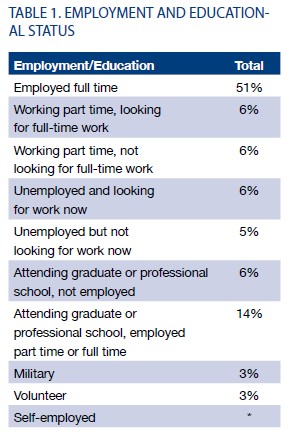
Just over half of the sample had a full-time job; 12% were un- or underemployed and looking for full-time work.

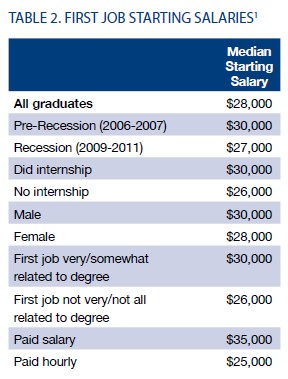
The recession appears to have depressed earnings by about $3,000. Pre-recession grads were making, on average, $30,000, while post-recession grads took in $27,000:

A third of students (35%) reported that their first job out of college was “not at all related” or “not very closely related” to their major. Almost half saw their first job as temporary and just “to get you by” (though this would drop to 36% when asked about their current job). Only half thought that their first job required a college degree.

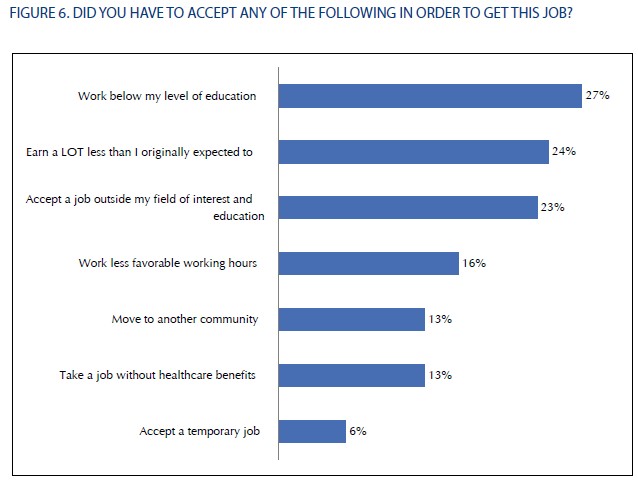
A significant proportion of students felt that they’d had to sacrifice something important to secure their job: 27% reported that they were working below their level of education, 24% took a job that paid less than they expected to earn, and 23% were working outside of their interests and training:

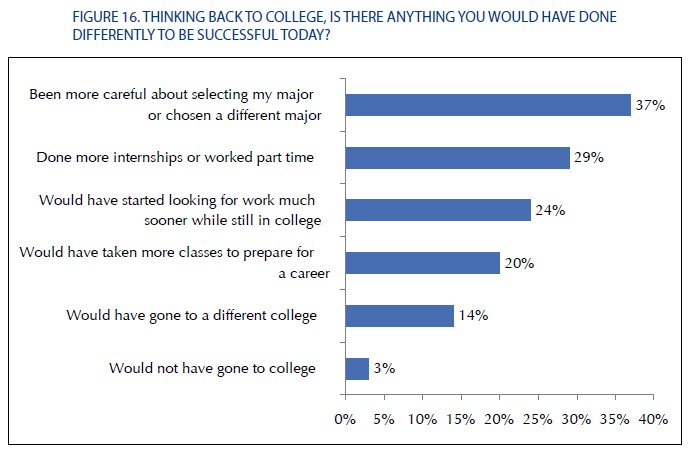
Many graduates would have done things differently. Notably a third said they would have re-thought their choice of major:

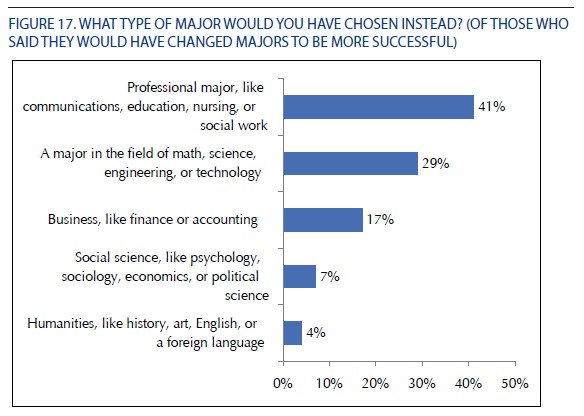
And most of them would have been more likely to have chosen a professional major (e.g., education or nursing) or one in a “STEM” field (e.g., science, technology, engineering, or math).

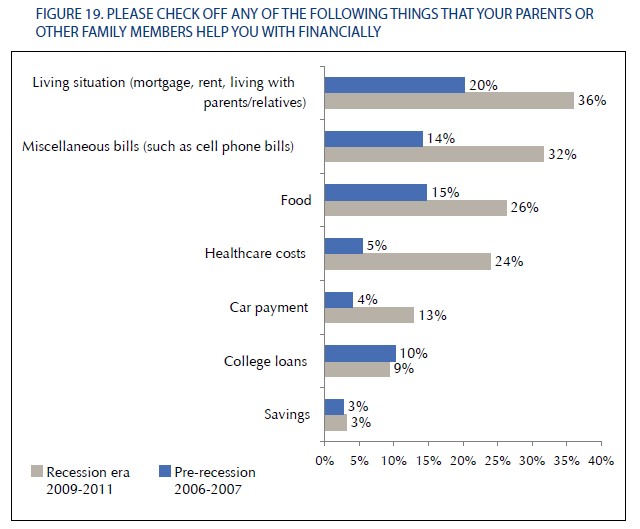
Recession-era grads are much more likely to be getting help from their parents, compared to pre-recession grads:

Lisa Wade, PhD is an Associate Professor at Tulane University. She is the author of American Hookup, a book about college sexual culture; a textbook about gender; and a forthcoming introductory text: Terrible Magnificent Sociology. You can follow her on Twitter and Instagram.

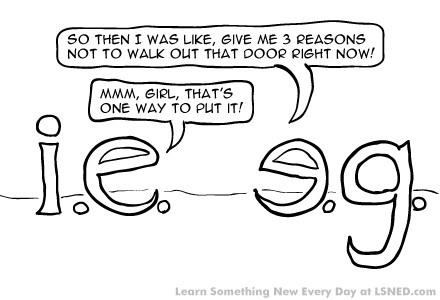
Every once in a while we post something for those of us who are teaching (and learning) how to write.  This is one of those times.

Get it!  Because you use “i.e.” to mean “what I mean to say is” and you use “e.g.” to mean “for example.”  Cute.

From Learn Something New Every Day.

Lisa Wade, PhD is an Associate Professor at Tulane University. She is the author of American Hookup, a book about college sexual culture; a textbook about gender; and a forthcoming introductory text: Terrible Magnificent Sociology. You can follow her on Twitter and Instagram.

A crazy character named Andrew Hales, a student at Utah Valley University, has put up a series of You Tube videos in which he — knowingly or not — does a classic Sociology 101 experiment called “norm breaching”: break a simple social rule and see how people react to you.  I’ll put my favorite first, but they’re all worth a chuckle:

Holding the door open for people that are (too) far away:

Walk (too) close to people and get in their way:

Staring at people:

Some of his transgressions are more out there than others, but these experiments show how uncomfortable others can be made by even mild norm breaking.

Lisa Wade, PhD is an Associate Professor at Tulane University. She is the author of American Hookup, a book about college sexual culture; a textbook about gender; and a forthcoming introductory text: Terrible Magnificent Sociology. You can follow her on Twitter and Instagram.