Cross-posted at Family Inequality.

Lots of buzz over a New York Times article about men moving into female-dominated occupations, which reported that “more and more men are starting to see the many benefits of jobs long-dominated by women.”
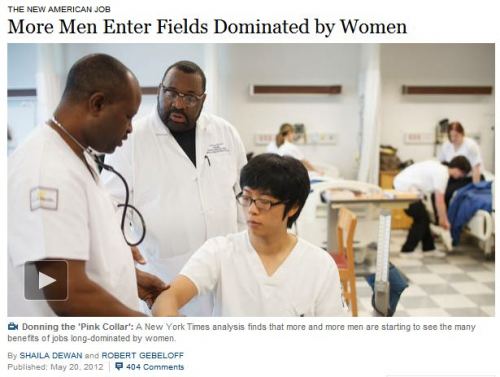
The Times produced this table, which shows the fastest growing occupations for (for some reason) college-educated White men, ages 25-39:
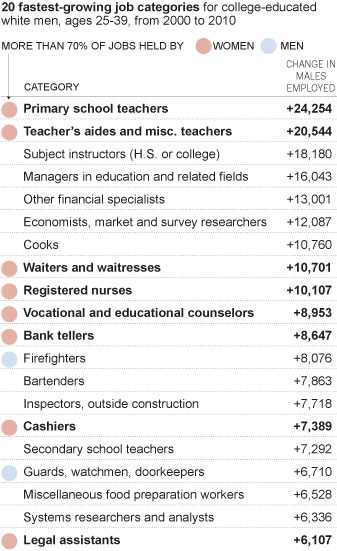
The ones with the pink dots are 70% female or more. The increase of young college educated White men in these occupations over 10 years appears striking, but the numbers are small. For example, compare that increase of (round numbers) 10,000 young White male registered nurses to the 1,900,000 full-time year-round nurses there were in 2010.

Moreover, consider that increase of 10,000 nurses in light of the overall growth of registered nurses from 2000 to 2010: about 500,000. Overall, the representation of men among full-time year-round registered nurses increased from 9.4% to 10.3% during the decade.

The Times article attempts to describe a broad trend of men moving into “pink-collar” jobs:

The trend began well before the crash, and appears to be driven by a variety of factors, including financial concerns, quality-of-life issues and a gradual erosion of gender stereotypes. An analysis of census data by The New York Times shows that from 2000 to 2010, occupations that are more than 70 percent female accounted for almost a third of all job growth for men, double the share of the previous decade.

Bold claims. But check the next sentence: “That does not mean that men are displacing women — those same occupations accounted for almost two-thirds of women’s job growth.” So, lots more men are in these jobs, but even more women are? How does that reflect an “erosion of gender stereotypes”? It seems like it reflects an increase in the size of female-dominated occupations.

In fact, as I reported briefly before, occupational gender segregation dropped barely a hair in the 2000s, from 51 to 50 on a scale of 0 to 100, compared with drops of 5 or 6 points in the decades before 1990. That is a lost decade for integration.

And if you look specifically at the category the Times chose — occupations that are 70% female or more — the percentage of men in those occupations increased, but only from 5.0% to 6.1%. And nurses? In 2010, 0.4% of all full-time year-round working men were nurses, up from 0.3% in 2000. Women are still 11-times more likely to be nurses than men.

Now that’s what you call a “gradual erosion of gender stereotypes.”

Sources: U.S. Census tables for 2000 and 2010 (table B24121).
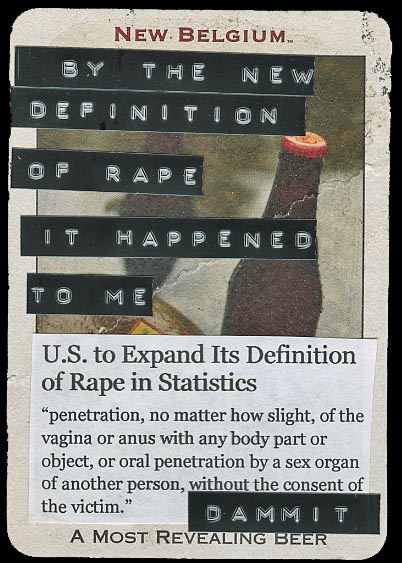
In January the U.S. government announced a new definition of “forcible rape” to include male victims and oral or anal penetration in addition to vaginal. This has legal implications, of course, but also symbolic ones.  Language shapes how we experience the world, potentially changing how we feel about an event in our lives.  This happened to at least one person, prompting them to send in a postcard to Post Secret:

The more inclusive definition is a net good, I believe.  Legally, it’s best that we have the tools to prosecute these crimes and, for some people, being able to use this word to describe something terrible that happened to them will be validating and empowering.  For others, however, it may heighten the trauma. “Rape” is a powerful word and many Americans imagine it to be among the most harmful of crimes.  Like child abuse, but unlike even very violent non-sexual physical assaults, rape is often believed to be a long-lasting harm, maybe even one that you can never truly recover from.

Perhaps the word “dammit” in the card is meant to convey exactly this sentiment.  It was easier, perhaps, to think it was a bad night.  Now, though nothing has changed except for the language, the victim has to contend with having been raped.

Lisa Wade, PhD is an Associate Professor at Tulane University. She is the author of American Hookup, a book about college sexual culture; a textbook about gender; and a forthcoming introductory text: Terrible Magnificent Sociology. You can follow her on Twitter and Instagram.

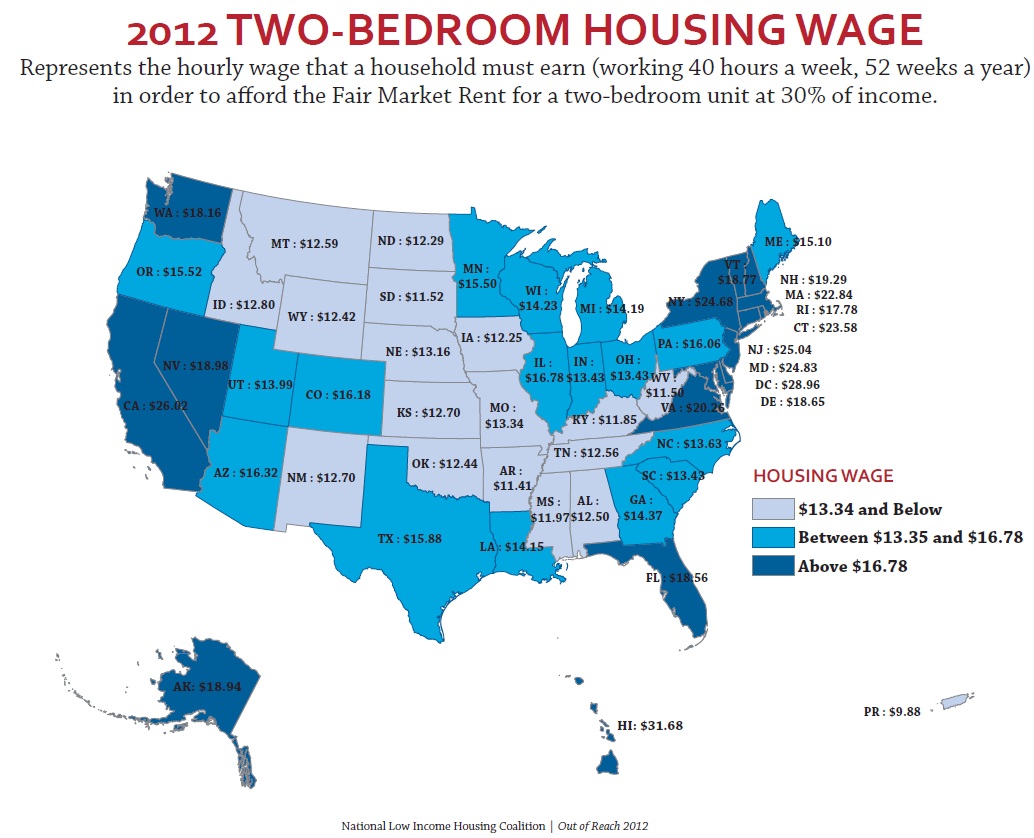
Each year the Department of Housing and Urban Development (HUD) calculates the fair market rents for apartments throughout the U.S. in order to set standards for housing assistance payments and vouchers for Section 8. Using data from the Census and the American Community Surveys, HUD figures out the average cost for various sizes of apartments. You can easily look up data for fiscal year 2012 here.

The generally-accepted standard for affordable, sustainable housing costs is that they should be about a third of a household’s income. The National Low Income Housing Coalition recently released a report on the mismatch between minimum wage — currently set at $7.25 nationally, with some states and municipalities having higher minimum wages within their boundaries — and the standard of living. The NLIHC report included this map showing the hourly wage that would be required for the HUD-calculated fair market rent to be about 30% of a full-time worker’s income:

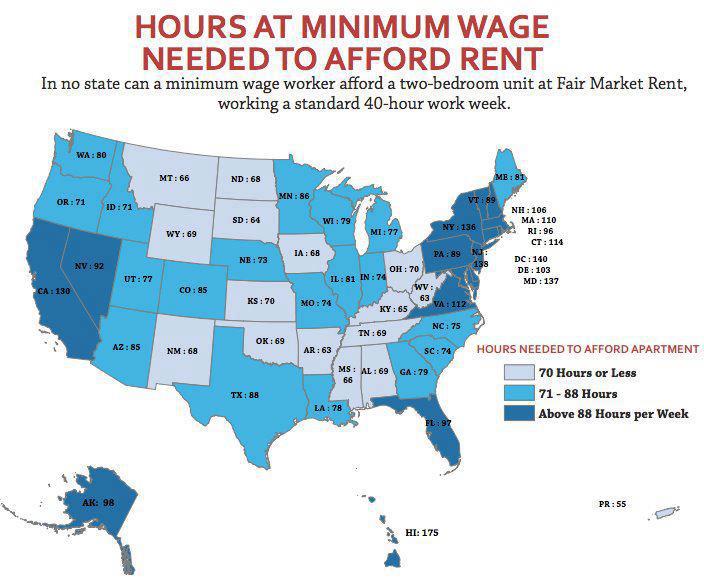
In no state does the minimum wage pay enough to hit the 30%-of-income standard of affordable housing costs. How many hours would a minimum-wage worker need to work per week to make enough that the fair market rent would be about a third of their income? A lot, from a low of 63 hours a week in West Virginia to a high of 175 in Hawaii:

Thanks to Dmitriy T.M. for the tip!

Cross-posted at Reports from the Economic Front.

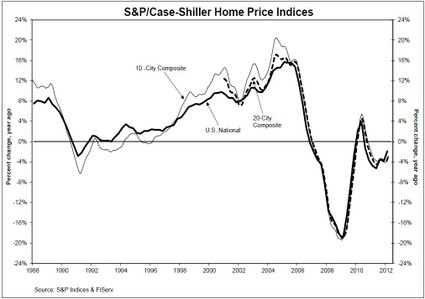
Economic recoveries often depend on the state of the housing market.  While an April increase in housing prices has led many analysts to talk of a housing recovery, U.S. home values still remain depressed.  According to a Zillow real estate research report, they are still some 25% below their 2007 peak.

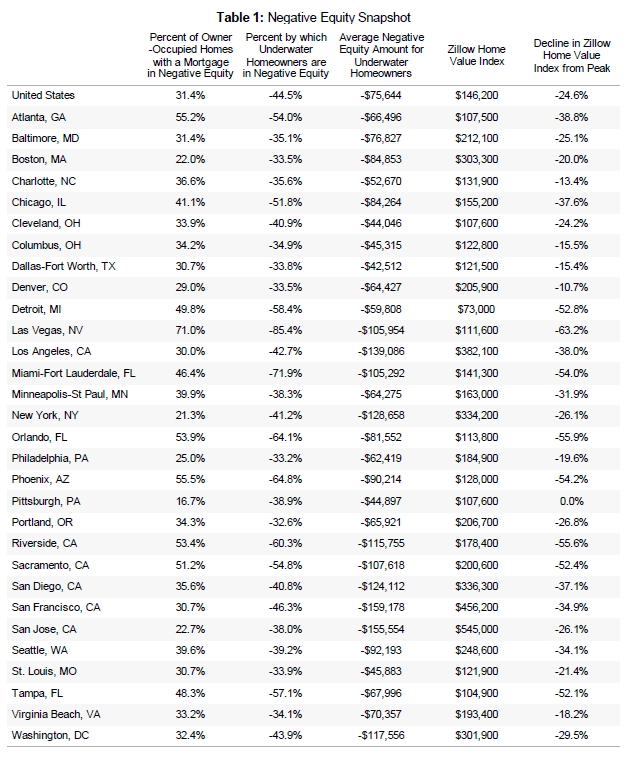
Perhaps the most telling indicator of the state of the housing market is that, as of the first quarter 2012, 31% of all owner-occupied homeowners with a mortgage were “underwater,” which means they had a mortgage greater than the market value of their home. As the table below shows, these homeowners owed, on average, $75,644 more than what their home was worth.

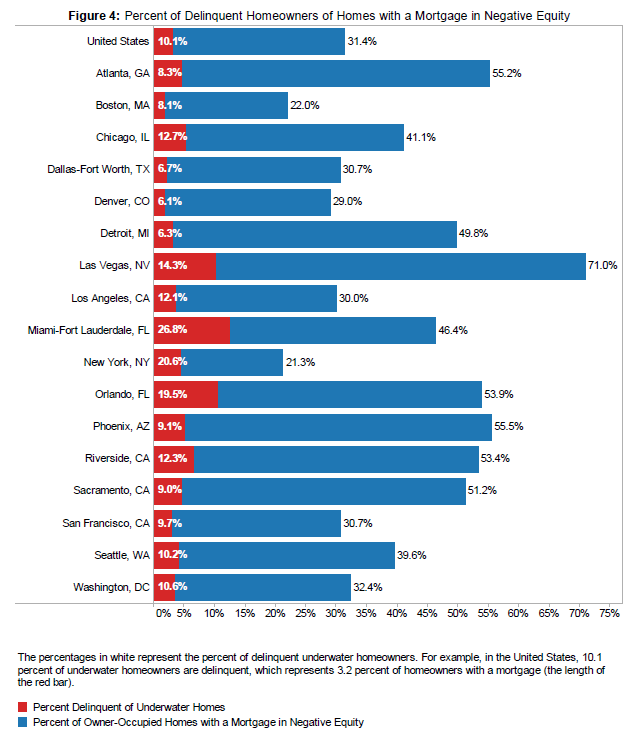
To this point, the high percentage of underwater homeowners represents, in the words of Zillow, only “a potential danger.”  That is because “the majority of underwater homeowners continue to make regular payments on their mortgage, with only 10% percent of the 31% nationwide being delinquent.”  The following figure highlights the percent of delinquent/underwater homeowners in the largest metropolitan areas.

At the same time, as Zillow notes:

With nearly a third of the nation’s mortgaged homeowners in negative equity and the average underwater homeowner having a home value that is 31 percent lower than their mortgage balance, negative equity will prove both to be difficult to fully eradicate near-term and to have pernicious effects longer term as some households continue to encounter short-term financial trouble even with a slowly improving broader economy. Should economic growth slow, more homeowners will not be able to make timely mortgage payments, thereby increasing delinquency rates and eventually foreclosures.

In other words, if the economy slows, or interest rates rise, two very likely possibilities, the housing market could deteriorate quickly, intensifying economic problems.  In short, we are a long way from recovery.

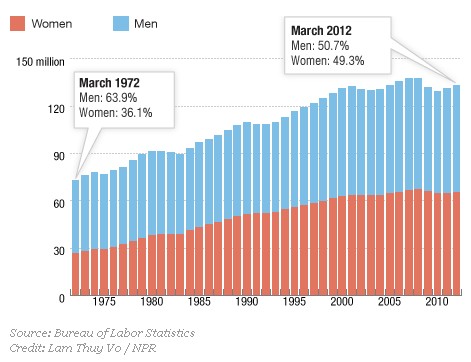
NPR’s Planet Money asks an interesting question.  If there are more women in the workforce now than there were forty years ago (and there are), where did all the additional jobs come from?

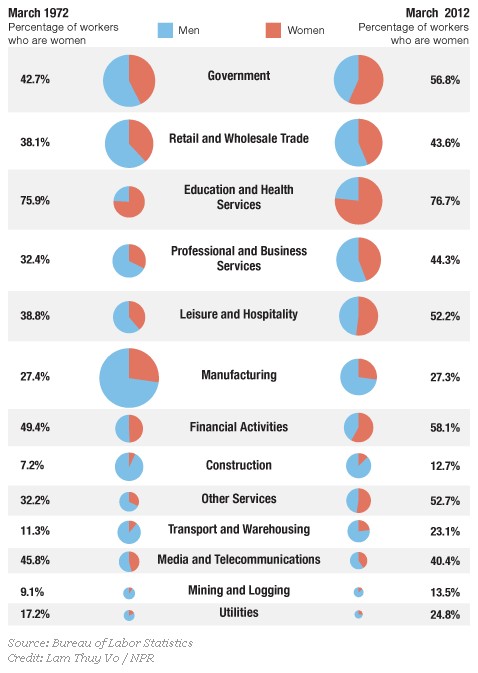
The pie charts below tell some of the story.  On the left are charts representing the percentage of women in various occupations in 1972.  The size of the circle corresponds to the size of the sector: larger is equivalent to more total jobs; on the right are the same charts for 2012.

Notice two trends: first,  in almost all categories today women are a larger percentage of the workers than they were in 1972 and, second, many of the occupational sectors that have high percentages of women have grown (e.g., education and health), whereas many in which men dominate have shrunk (e.g., manufacturing, media/telecommunications).

So, as women have joined the workforce, they’ve contributed to the overall growth of the American workforce and, specifically, filled the demand for employees in growing occupations.

Lisa Wade, PhD is an Associate Professor at Tulane University. She is the author of American Hookup, a book about college sexual culture; a textbook about gender; and a forthcoming introductory text: Terrible Magnificent Sociology. You can follow her on Twitter and Instagram.

The prisoner’s dilemma is a concept used to help explain situations in which individual actors may pursue their own self-interest even in situations where they would all be better off if they cooperated and acted for the good of the group. In this short video posted at Scientific American, Michael Moyer explains the prisoner’s dilemma puzzle and how it helps explain situations such as the global nuclear arms race:

See also: Game Theory and the Prisoner’s Dilemma.

SocImages Updates:

The University of Cinncinati’s J.A. Carter has put together a fabulous resource: a Course Guide for Sociology of Sport classes.

Gwen has put together a new Pinterest page.  This is our 16th and it covers various attempts by marketers to Masculinize Femininized Products in order to sell them to men.

An article tracing the history and philosophy of SocImages is now in pre-publication.  Feel free to email socimages@thesocietypages.org for a copy if you’d like one.

In the News:

Peggy Orenstein, author of Cinderella Ate My Daughter and other books, offered a blush-inducing review of SocImages at her website.

Peg Streep discussed Lisa’s research on hook up culture in Psychology TodayFinding Anastasia Steele and Looking for Christian Grey.

Matt Cornell’s fantastic post on his “man-boobs” was featured, in French, at Rue89.

Our fabulous four-part series on LEGO’s history of marketing (and not marketing) to girls, by David Pickett, was featured at Boing BoingNeatorama, and HuffPo Parents.

Finally, this month we enjoyed being linked from sites the likes of CrackedKotakuUtne ReaderTVTropes, GoodGamasutra, AdWeek, and Business Insider.

Most Popular in May:

Social Media ‘n’ Stuff:

Finally, this is your monthly reminder that SocImages is on TwitterFacebookGoogle+, and Pinterest.  Lisa is on Facebook and most of the team is on Twitter: @lisadwade@gwensharpnv@familyunequal@carolineheldman@jaylivingston, and @wendyphd.

If your campus is like mine, the syllabi and/or student handbook contain a statement along the lines of “For every hour of course instruction, students should expect to spend 2 to 3 hours per week in study and preparation outside of class.” So for a 3-credit course, that would be 6 to 9 hours per week spent on the class — doing the reading, studying the material, and completing assignments. And if you’re like me, you periodically bemoan the fact that this message does not seem to have reached its target audience.

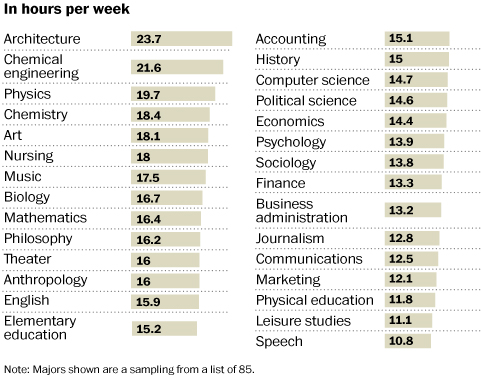
So how much are students studying? Well, not as much as we tell them they’re supposed to, it appears. Peter N. sent in an image from the Washington Post, summarizing the number of hours students from a range of majors report studying per week. At 23.7 hours per week, architecture students are studying enough to almost meet the study expectations for 4 classes a week, at the lower end of the standard 6-9 hours/week range. Speech students averaged 10.8 hours a week — less than the minimum for two courses:

The data is based on self-reports from the National Survey of Student Engagement (NSSE). Critics express concerns with self-reports of studying; students may not have an accurate sense of how much time they spend preparing for class each week, especially as requirements fluctuate throughout the semester. NSSE, of course, defends their data. And the effects of self-reports seem unclear; would they lead to overestimates or underestimates?