A few years back we featured a series of Playboy drawings from the 1960s and ’70s that trivialized the social movements of the time: feminism, the anti-war movement, native rights, and the civil rights movement.  You should really go take a look; they’re something else.

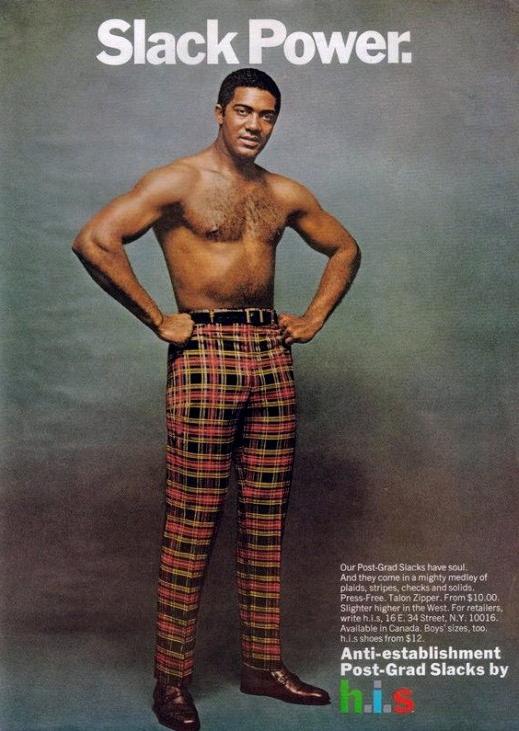
In any case, Peter from Denmark sent in another example from the same time period.  A 1970s JC Penney ad for pants; “slack power” is a reference to “Black power” and it’s no coincidence that an African American man is modeling.  Notice, too, that it calls the pants “anti-establishment” in the bottom right.

While companies like Komen are getting a lot of critical attention these days for turning cancer awareness into consumption, this strategy has been around a long time.

For examples of appropriation of feminism, see these framing consumption of clothesmake-upjewelry, cigarettesmagazines, and cosmetic procedures as expression of freedoms.

Lisa Wade, PhD is an Associate Professor at Tulane University. She is the author of American Hookup, a book about college sexual culture; a textbook about gender; and a forthcoming introductory text: Terrible Magnificent Sociology. You can follow her on Twitter and Instagram.

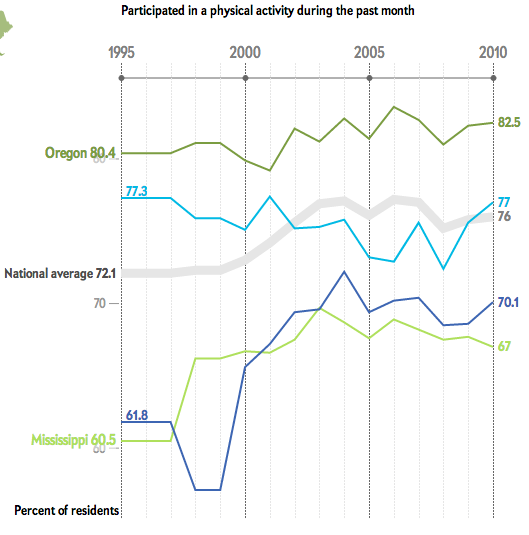
Mark Fischetti has posted an interactive graphic at Scientific American that lets you look at the prevalence of several behaviors or characteristics measured on the Centers for Disease Control and Prevention’s survey on risk factors. The graphic includes data on exercise, tobacco use, heavy drinking, binge drinking, and obesity. Commenters on the post suggested it’s unnecessarily snarky about obesity; that said, it provides a quick snapshot of several behaviors demographers often use to judge general trends in health. For each topic, a graph shows the state where it is highest and lowest; you can also select up to 3 additional states to compare.

For instance, the percent of people who took part in a physical activity in the last month is highest in Oregon and lowest in Mississippi; I added my home state of Oklahoma (dark blue) and current residence of Nevada (light blue) too:

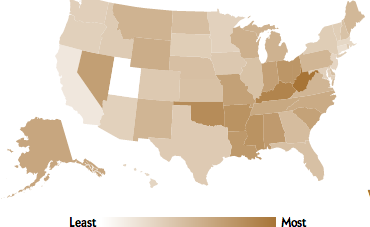
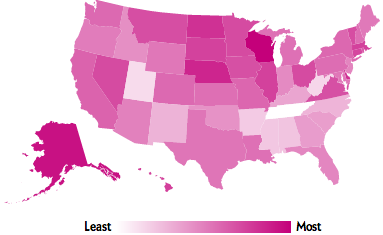
You also get a map for each topic that shows where it’s most or least common. Here’s the map for smoking:

Sconnies, you may not be surprised to know that Wisconsin leads the nation in binge drinking:

I can’t embed the graphic, so you’ll have to go to Scientific American’s post to play around and compare your own state.

***TRIGGER WARNING for racism and enslavement***

During a dark period of world history, intellectuals pondered where to draw the line between human and animal.  They arrayed humans hierarchically, from the lightest to the darkest skin.  Believing that Africans were ape-like, they weren’t sure whether to include apes as human, or Africans as apes.

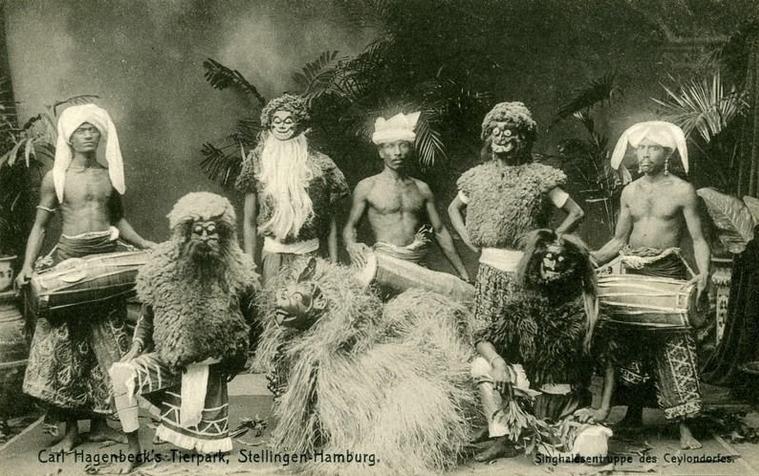
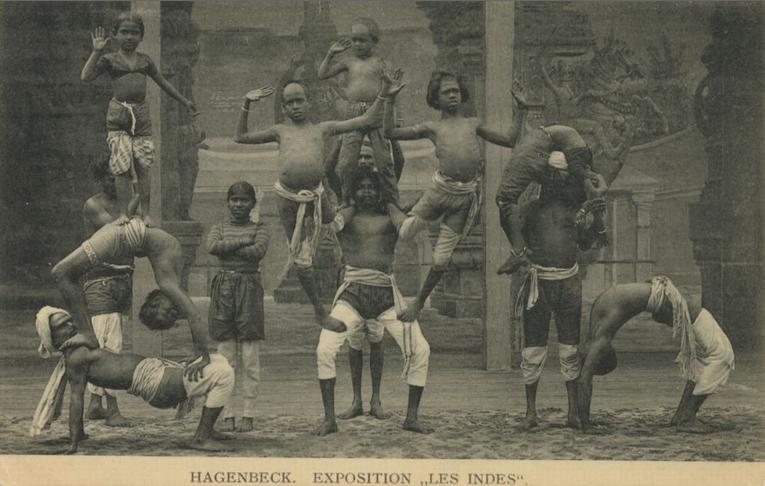
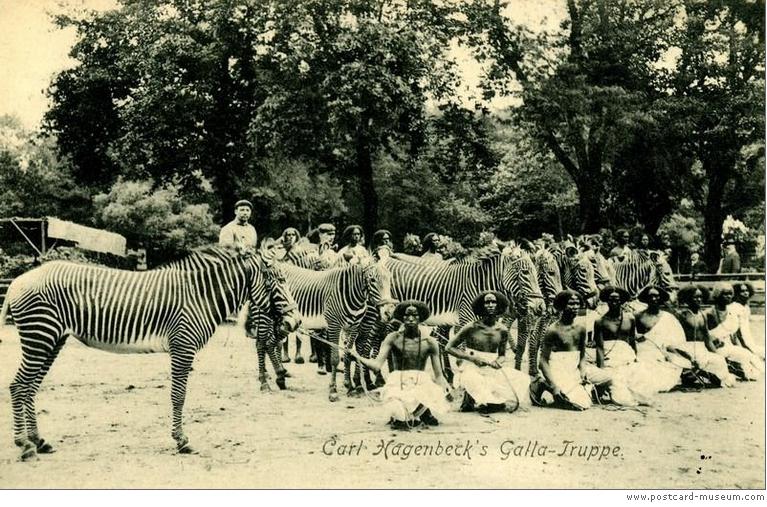
One artifact of this thinking was the “human zoo.”  Kidnapped from their homes at the end of the 19th century and into the next, hundreds of indigenous people were put on display for white Westerners to view.  “Often they were displayed in villages built in zoos specifically for the show,” according to a Spiegel Online sent in by Katrin, “but they were also made to perform on stage for the amusement of a paying public.”  Many died quickly, being exposed to diseases foreign to them.

This group of captives is from Sri Lanka (called  Ceylon at the time):

This photograph commemorates a show called “Les Indes,” featuring captives from India:

These captives are from Oromo in Ethiopia:

A German named Carl Hagenbeck was among the more famous men involved in human zoos.  He would go on expeditions in foreign countries and bring back both animals and people for European collections.  In his memoirs, he spoke of his involvement with pride, writing: “it was my privilege to be the first in the civilized world to present these shows of different races.”

The zoo in Hamburg still bears his name.

Lisa Wade, PhD is an Associate Professor at Tulane University. She is the author of American Hookup, a book about college sexual culture; a textbook about gender; and a forthcoming introductory text: Terrible Magnificent Sociology. You can follow her on Twitter and Instagram.

Cross-posted at Montclair SocioBlog.

Back in June, Mitt Romney said:

I want to make sure that we keep America a place of opportunity, where everyone… get[s] as much education as they can afford

After all, Mitt got as much education as he (his parents, really) could afford, so he thought it best if everyone had that same opportunity.

Opportunity – How much is that in American money?

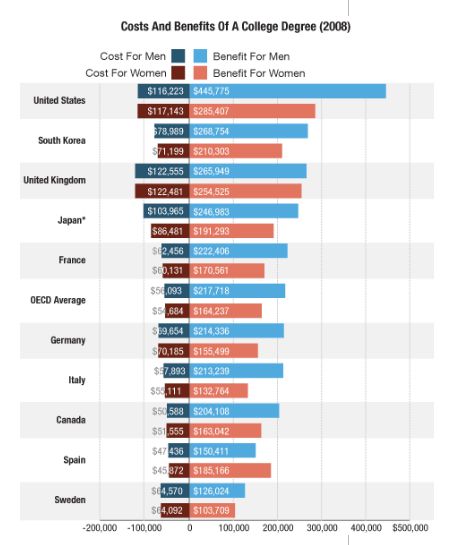
Yesterday, Planet Money  posted this graph showing the costs and benefits of a college education in several countries.

The title of the post summarizes the interpretation of the college-educated folks at Planet Money:

“College Costs More In America, But The Payoff Is Bigger”

But what if you look at the data from the other side?  Here’s the half-empty-glass title:

“College in the US Costs a Lot, and If You Can’t Afford It, You’re Really Screwed”

…or words to that effect.

What the chart seems to show is inequality — specifically, the inequality between the college educated and everyone else.  In advanced economies, like the those of the countries in the chart, education is important. But some of those countries, like the Scandinavian countries, have reduced the income sacrificed by non-college people relative to the college educated. Other countries favor a more unequal distribution of income.

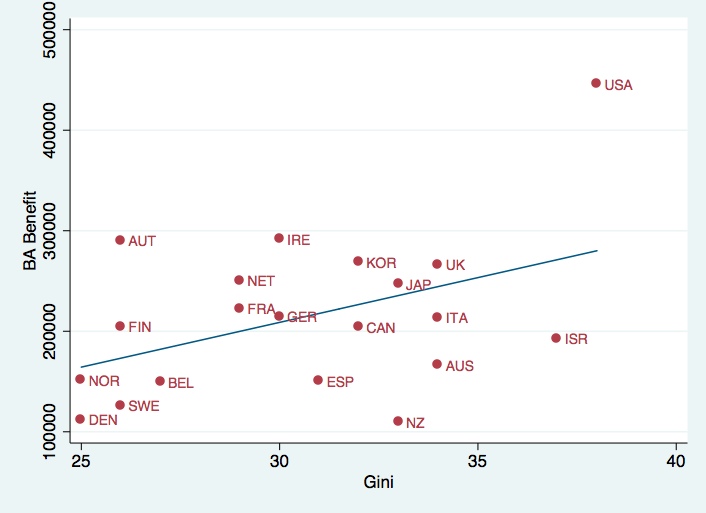
To look a little closer, I looked at the relationship between the payoff of a BA degree for men and a country’s Gini coefficient, a measure of inequality.  I used the ten countries in the Planet Money chart and added another ten OECD countries.

The correlation is 0.44.  The US is the clear outlier.  In the land of opportunity, if you’re a male, either you pay the considerable price of going to college, or you pay the price for not going to college.

With this inequality come the kinds of social consequences that Charles Murray elaborates in his latest book about non-educated Whites — disability, divorce, demoralization, death.

—————————

Jay Livingston is the chair of the Sociology Department at Montclair State University.  You can follow him at Montclair SocioBlog or on Twitter.

New York City’s stop-and-frisk policy has gotten intensified scrutiny recently. A stop and frisk refers to police officers stopping and searching individuals who are out in public. These stops don’t require a warrant; the police officer has to have reasonable cause to believe the person is engaged in criminal activity.

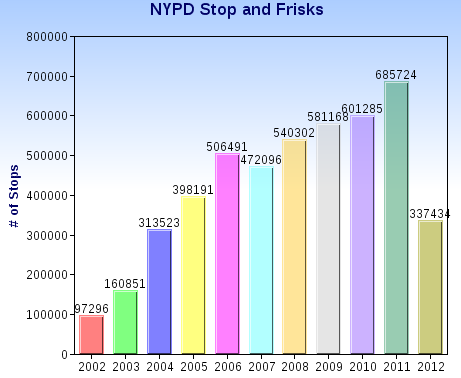
Critics point out that these stops are incredibly inefficient, and that relying on cops’ evaluations of who is suspicious opens the door to widespread racial profiling. The New York Civil Liberties Union analyzed the NYPD’s own data, which they are required to record about all stops. Over the past decade, literally millions of people have been the targets of stop-and-frisks, with steady growth in the use of the program. I made a chart of the data from 2002 through the first 6 months of 2012:

Yet all these stops have led to little discovery of actual crime. Overall, about 87-89% of stops lead to no evidence of wrong-doing.

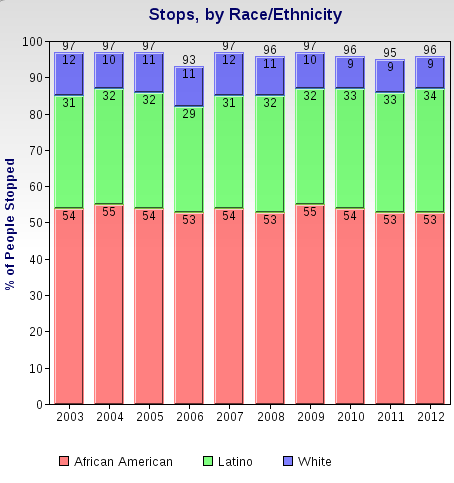
These stops have also disproportionately affected minorities. Here’s a breakdown by race/ethnicity, based on the NYPD data:

You can read more about the data on stop-and-frisks at the NYCLU website.

The Nation recently posted a video that discusses the impacts of stop-and-frisk on the lives of those targeted and on perceptions of the police, as well as police officers discussing the pressure to complete stop-and-frisks. The clip includes an audio recording that a 17-year-old made when he was being targeted for a stop-and-frisk after having just been stopped a couple of blocks earlier. As the video makes clear, these stops are about more than an inconvenience in citizens’ lives; they involve real harassment and fear of violence for those who find themselves the target of police suspicions:

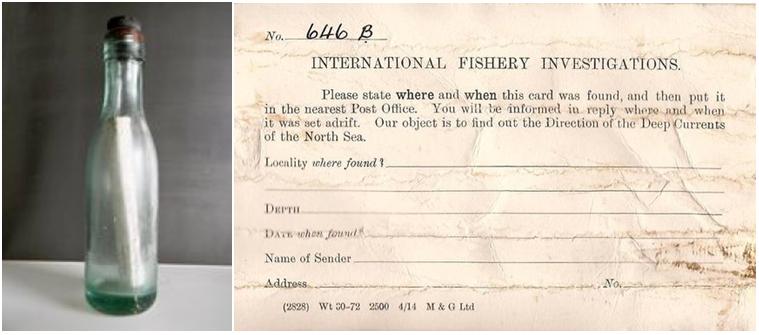
A message written in 1914 and curled into a corked bottle was scooped out of the North Atlantic last month (NatGeo).  Not a love note, but a research instrument.The Glasgow School of Navigation sent 1,890 such bottles adrift, hoping to map deep ocean currents.  They were weighted to float just above the ocean floor.  The message inspires me to contemplate just how far our research methods have come in the last 98 years.

Via BoingBoing.

Lisa Wade, PhD is an Associate Professor at Tulane University. She is the author of American Hookup, a book about college sexual culture; a textbook about gender; and a forthcoming introductory text: Terrible Magnificent Sociology. You can follow her on Twitter and Instagram.

Well, first, they’re not baby carrots.  The two-inch carrots marketed as juveniles are actually pieces of regular sized carrots that are cut off and shaved into a “baby carrot” shape.  So, there’s no reason to expect the babies to be fresher, more tender, or sweeter. (Sorry, baby carrot lovers.)

But revealing how baby carrots are made is only Part I of the answer to the question of where they come from.  Who had the idea to make “baby carrots” and for what reason?

It turns out the idea came from a grower named Mike Yurosek.  According to Douglas McGray at Fast Company, it was grocery stores that pushed Yurosek to invent the baby carrot.  McGray writes:

…Yurosek had become frustrated with all the waste in the carrot business. Supermarkets expected carrots to be a particular size, shape, and color. Anything else had to be sold for juice or processing or animal feed, or just thrown away. Yurosek wondered what would happen if he peeled the skin off the gnarly carrots, cut them into pieces, and sold them in bags.

He whipped up two prototypes: the baby carrot with which we’re all familiar and “bunny balls,” 1-inch round carrot bites.  Somehow the latter didn’t catch on.  The rest is history.

Thanks to Annie C. for sending in the link!

Lisa Wade, PhD is an Associate Professor at Tulane University. She is the author of American Hookup, a book about college sexual culture; a textbook about gender; and a forthcoming introductory text: Terrible Magnificent Sociology. You can follow her on Twitter and Instagram.

Tricia Mc.T. sent in a video that illustrates the tendency to associate non-White women’s bodies with curves. Fruit of the Loom’s “Flawless” commercial celebrates women’s bodies, offering the message that they’re flawless at any size. But as Tricia points out, though there is variety in the bodies of the women in the commercial, “women of color are the only ones with ‘curves’,” and the woman whose body is farthest from the thinness ideal is an African American woman:

It’s a small example of a larger pattern in which non-White women are associated with curviness and we’re comfortable depicting women of color as larger — think of all the TV shows you’ve seen where the only plump female character is the African American woman.

For more on this pattern, see our post on who has curves in a Levi’s ad, an ad for shapewear to get “Latino curves,” Vogue emphasizes Beyonce’s body, fetishizing African American women’s butts, and conflating “ethnic” with “curvy.