Chilling video taken at a high school party in Steubenville, Ohio in which attendees laugh and joke about an unconscious 16-year-old allegedly raped and sodomized by members of the football team, propelled the case into the national spotlight earlier this winter.

The deeply disturbing video focuses on Steubenville High School alum Michael Nodianos as he holds court with a grim comedy show, cracking up to quips such as, “They raped her quicker than Mike Tyson!” and “They raped her more than the Duke lacrosse team!” Those with the stomach to endure the entire 12-minute video hear the victim repeatedly referred to as “dead,” offering ugly details including, “They peed on her! That’s how you know she’s dead because someone pissed on her.” The death motif is so amusing to those involved that it leads to a litany of references to her being “deader than” everyone from Caylee Anthony to Trayvon Martin.

Trigger warning:

The video combined with other digital remains of the attack mined from Twitter and Instagram stirred public outrage at the accused perpetrators, at the bystanders who failed to intervene, and at adults — coaches, police, prosecutor, and parents — perceived as having been complicit in covering up the assault, preferring to sweep the violence under the rug to protect the football team and the young men on it. Protests sprouted around the courthouse and are expected to resume on Wednesday as the trial begins.

This video and other digital souvenirs of violence, such as the photos taken and circulated of Savannah Deitrich while she was sexually assaulted, may or may not have significant legal consequences. Yet their cultural legacy — the opportunity they have to undermine our most resilient rape myths — has the potential to be even weightier.

Read the rest of this article at WBUR’s Cognoscenti.

Last week many media outlets were busy celebrating the Dow Jones record high, suggesting that it was indicative of the United States’ recovery from the greatest economic downturn since The Great Depression.  The graph below comes from a New York Times story with the headline “As Fears Recede, Dow Industrial Hits a Milestone.”

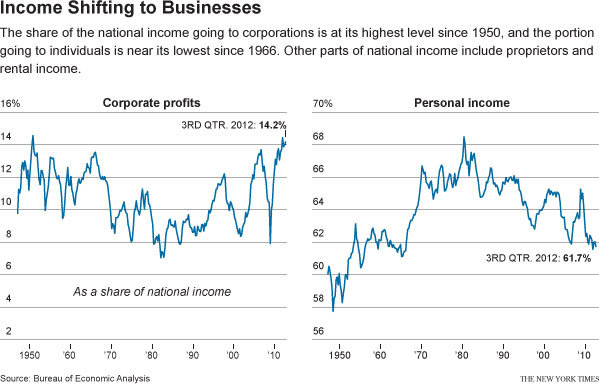
However, another story buried in the Business section of the New York Times, titled “Recovery in U.S. Is Lifting Profits, but Not Adding Jobs,” contains a graph illustrating how the supposed economic recovery is bitter-sweet at best:

2

The second graph uses data from the Bureau of Economic Analysis to highlight the fact that corporate profits and stock prices are at record highs, but the share of profits workers have taken home has steadily dropped since the early 1980s.  Some of the steepest declines have come during the last few years, or during the supposed “recovery.”

These two graphs illustrate that while ”The Market” is probably considered the go-to indicator of economic well-being, stock indexes are not always indicative of the economic reality experienced by non-investors.  If businesses and corporations were increasing their stock value by investing to expand productivity, thereby creating good-paying jobs and opportunities for workers, rising markets would be a sign good of economic times for all.  But this data suggests that is not what is happening; instead, as the twin charts show, rising corporate profits are at least partly the result of wage suppression.

Jason Eastman is an Assistant Professor of Sociology at Coastal Carolina University who researches how culture and identity influence social inequalities.

In case you’ve ever wondered, “Is there anything we won’t pointlessly gender?”, Katrin sent in evidence that there really, really isn’t:

bibles

Via Marginal Christianity.

Gwen Sharp is an associate professor of sociology at Nevada State College. You can follow her on Twitter at @gwensharpnv.

The ’60s is often held up as a time of dramatic upheaval in American life.  It brought us civil rights victories, the sexual revolution, the women’s movement, the gay liberation movement, and anti-war activism.  It was, in short, antiestablishmentarian.

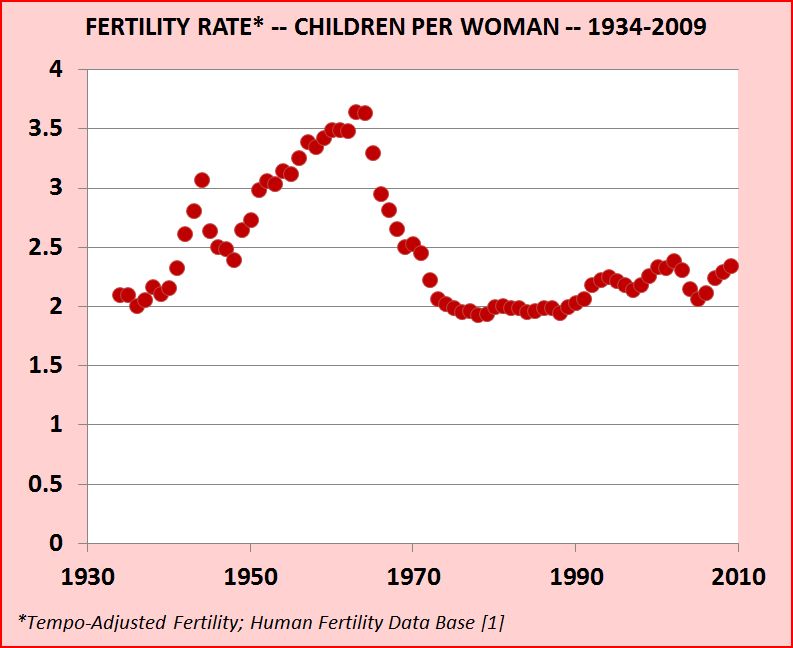
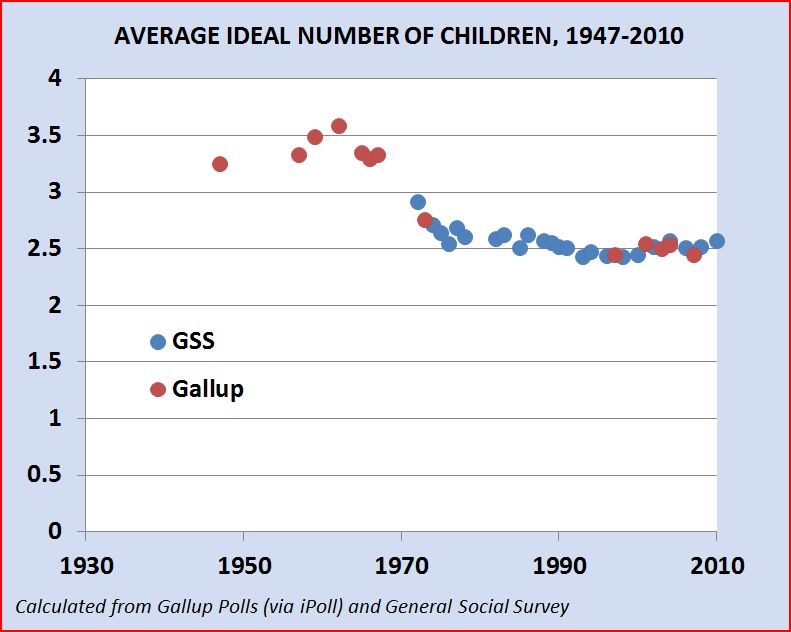
What were the concrete impacts of these changes?  One is the birth rate, as illustrated in a post by Made in America‘s Claude S. Fischer. Far from introducing a new normal, the ’60s reversed what was a relatively recent a rise in the ideal number of children and actual fertility rate.

While data not shown suggest that the ideal number of children in the ’30s was under three, the ideal had risen to 3.6 by 1962.  This dropped quickly across the rest of the decade.

2

Likewise, the actual number of children born to the average woman in the 1930s was about two, but this started shooting up in the late ’30s and ’40s.  Then, just as quickly as it had risen, it plummeted again:

1

This data reminds us of how unusual the ’50s really was.  It was an especially pro-natal family-centered time.  As historian Stephanie Coontz puts it:

At the end of the 1940s, all the trends characterizing the rest of the twentieth century suddenly reversed themselves. For the first time in more than one hundred years, the age for marriage and motherhood fell, fertility increased, divorce rates declined, and women’s degree of educational parity with men dropped sharply.  In a period of less than ten years, the proportion of never-married persons declined by as much as it had during the entire previous half century.

So, while in some ways the 1960s dramatically changed American culture, in other ways it simply put us back on track.

Lisa Wade, PhD is an Associate Professor at Tulane University. She is the author of American Hookup, a book about college sexual culture; a textbook about gender; and a forthcoming introductory text: Terrible Magnificent Sociology. You can follow her on Twitter and Instagram.

Originally posted in 2010. Re-posted in honor of Women’s History Month.

When I teach gender I always talk about the ways in which societies actively construct ideas that men and women have very different bodies, capable of different things. In the U.S., our gender ideology includes the belief that female bodies are weaker than male ones, more fragile. Particularly in the Victorian Era, this belief led doctors to discourage physical activity by women. Among a range of other concerns, doctors argued that physical exertion in women might cause their organs (particularly the reproductive organs) to become dislodged and wander around the body, causing all types of problems. I know I’d certainly be distressed if my uterus migrated and I ended up pregnant and carrying a fetus in, say, my elbow.

A result of this, of course, is that (White) women were discouraged from being physically active and taking part in sports. This, combined with heavy clothing and corsets that actually did shove organs around, led to the condition that the medical community claimed already existed: women’s bodies were less capable of physical exertion than men’s and they were more likely to faint (corsets often making it difficult to breathe adequately). It’s a self-fulfilling prophecy: if you believe women’s bodies are weaker than men’s and thus discourage or even prohibit women from being physically active, you create differences in physical capability and fitness that you can then claim prove you were right all along.

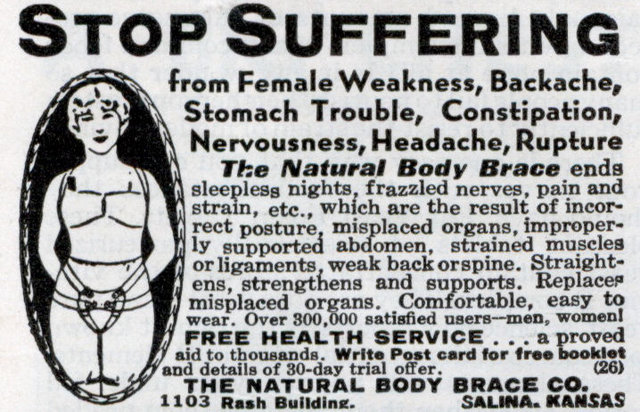
James T. found this awesome ad for a product that, among other amazing things, ends “misplaced organs” and will even move them back where they belong (from Modern Mechanix). The ad (from 1934) says that satisfied users include both men and women, but concerns about misplaced organs were a concern applied predominantly to women:

Medical practitioners weren’t just worried about physical exertion. They believed mental activity could be harmful to women as well; perhaps all that thinking meant the brain would take blood away from the reproductive organs and lead to infertility. A common diagnosis for women was “hysteria,” a general term that could be applied to almost any woman. A common “cure” for hysteria was bed rest, preventing both physical and mental activity. The diagnosis of hysteria served as a justification for severely limiting women’s activities, drawing on the ideology of the fragile female body. Charlotte Perkins Gilman wrote the classic short story “The Yellow Wallpaper” after her own experience of being forced to stay in bed with no mental stimulation, not even books.

Hysteria was also often associated with sexual problems, including a lack of interest in sex. The cure for this was “vaginal massage,” which was exactly what you think it was. This was done manually in doctors’ offices, but eventually mechanical vibrators became widely available, allowing women to treat their hysteria more cheaply and at home, and reducing the time it took to produce a “paroxysm”.

I find it fascinating that the construction of (middle/upper class White) women as “hysterical” and often sexually repressed and frigid made it acceptable for them to purchase a product that allowed them to sexually satisfy themselves at a time when masturbation was still widely vilified, and excuse it on the grounds that it was medically prescribed.

Gwen Sharp is an associate professor of sociology at Nevada State College. You can follow her on Twitter at @gwensharpnv.
Cross-posted at Racialicious.

I featured the two-page ad below in one of the first posts I ever wrote for SocImages (it was October of 2007 and we’d written less than 100 posts; today we’re approaching 5,000, but I digress…).  It’s still one of my very favorite images.

I use it in Sociology 101 when I argue that race, class, and gender are, among other things, performances. Activities, items, and behaviors carry class, race, and gender meanings. In order to tell stories about ourselves, we strategically combine these things with the meanings we carry on our bodies (a gendered shape, skin color and hair texture etc., and signs of economic wealth or deprivation).

The ad for PhatFarm deftly balances Blackness (the body), upper-class Whiteness (the sailboat), and femininity (the pink sweater).  In strategically using culturally-resonant signifiers, he challenges popular representations of the Black body.

1

This happens in real life too.  Journalist Brent Staples powerfully discusses how he adds a signifier of upper-class Whiteness to his large Black body in order to avoid the discomfort of frightening people on the streets of New York.

…I employ what has proved to be an excellent tension-reducing measure: I whistle melodies from Beethoven and Vivaldi and the more popular classical composers. Even steely New Yorkers hunching toward nighttime destinations seem to relax and occasionally they even join in the tune. Virtually everybody seems to sense that a mugger wouldn’t be warbling bright, sunny selections from Vivaldi’s Four Seasons.

“It is my equivalent to the cowbell that hikers wear when they know they are in bear country,” Staples adds, referring to the fact that being perceived as dangerous can itself be dangerous, as we know from the example of Trayvon Martin and Rodrigo Diaz, who was shot in the head in January when he accidentally pulled into the wrong driveway thinking it belonged to a friend.

Thinking of class, race, and gender as performances gives us credit for being agents.  We don’t have control over what the signifiers are, nor how people read our bodies, but we can actively try to manage those meanings.  Of course, some people have to do more “damage control” than others.

Lisa Wade, PhD is an Associate Professor at Tulane University. She is the author of American Hookup, a book about college sexual culture; a textbook about gender; and a forthcoming introductory text: Terrible Magnificent Sociology. You can follow her on Twitter and Instagram.

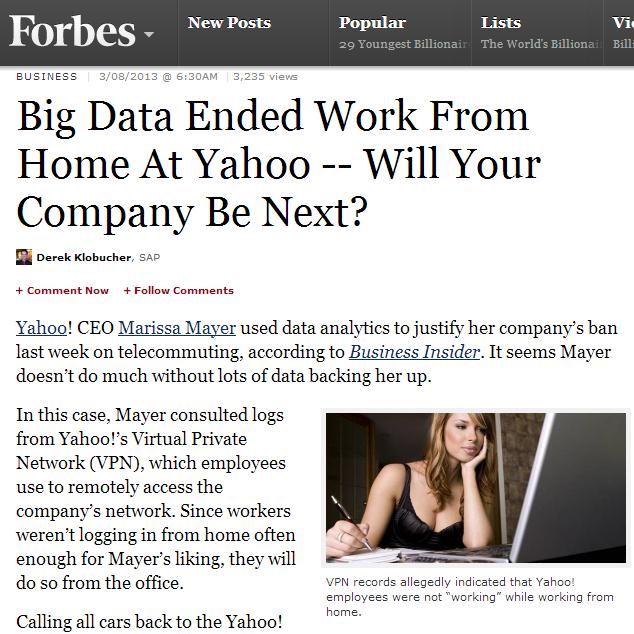
Todd Schoepflin, @CreateSociology, thought we should remark on the photo Forbes used to illustrate their story on Yahoo’s new no-work-from-home policy.  What do you think?  Totally realistic right?

1

Also, that hand is photoshop disaster worthy.

Lisa Wade, PhD is an Associate Professor at Tulane University. She is the author of American Hookup, a book about college sexual culture; a textbook about gender; and a forthcoming introductory text: Terrible Magnificent Sociology. You can follow her on Twitter and Instagram.

Originally posted in 2009. Re-posted in honor of Women’s History Month.

I still remember when the female characters on the sitcom Friends started the trend of visible nipples:

680f6_celebrity-pictures-jennifer-anniston-nipples-friends

As long as I’d been alive and paying attention, hard nipples were embarrassing. Then, suddenly, they weren’t. I even remember hearing that women could get the all-hard-all-the-time look by buying those tiny rubber bands (that I only associate with the plastic bags aquarium fish come in) and fitting them tightly around your nipples. Nipples are still big, if measured by mannequins (Wicked Anomie noticed too).

It turns out this comes in fits and starts.  This vintage ad (no date on the source), for example, features a bra with built-in hard nipples! (Apparently it had been a trend before I’d been alive and paying attention.)

0_2806c_528ae45_l

In the comments, Dmitriy T.C. added a link to the patent for this device. I can’t resist adding this particular paragraph explaining why a bra with fake nipples is important:

…simulated nipples for a brassiere would offer an acceptable compromise for ladies who do not wish to go without a brassiere and a welcome release from the subconscious effects of the suppression brought on by wearing brassieres of the types variously available, which obliterate the nipple.

LOL.

Anyhow, Tracey at Unapologetically Female wondered about wearing such a bra:

Didn’t anyone ever start to wonder why these women’s nipples were ALWAYS hard? And what if their real nipples (realistically probably located somewhere a bit lower than the bra’s) ever poked through, creating a quadruple effect?! Horrifying.

I find this whole thing especially funny, since, while shopping recently, Katie and I were making fun of these bras with built-in “modesty panels” that provide extra padding so that the nipple will never make an appearance. Times sure have changed.

Except times haven’t changed in the sense that women’s bodies still aren’t allowed to just be. Their nipples either must show, or must not show, or they should show in some contexts, or are allowed to show, but in other contexts they better not show.  (Remember the outcry over Hilary Clinton’s “cleavage”?  Can you imagine if she’d shown some nip!?)

So apparently we’re supposed to have nipple bras, bras with “modesty panels,” and a couple rubber bands in our pockets just in case. The one thing that is clearly less than ideal in all this: actual nipples doing what they do.

Lisa Wade, PhD is an Associate Professor at Tulane University. She is the author of American Hookup, a book about college sexual culture; a textbook about gender; and a forthcoming introductory text: Terrible Magnificent Sociology. You can follow her on Twitter and Instagram.