Originally posted in 2009. Re-posted in honor of Women’s History Month; cross-posted at Mental Floss.

Several factors were in play in the 1920s for the emergence of what came to be known as flappers, teenagers and young women who flaunted convention and spent their time pursuing fun instead of settling down to raise children in the prime of their lives. Many entered college or the workforce and felt entitled to make their own decisions about how to live their lives.

4502flappers

A lot of young men did not return home from World War I, which left an entire cohort of women without enough husbands to go around. The horror of the war (and the Spanish flu pandemic of 1918) also impressed young people with the knowledge that life is short and could end at any moment. Instead of staying home preparing to marry a man who might never come, young women wanted to spend what time they had enjoying all that life had to offer.

450thomasbrooks

Movies popularized the image of the fun-loving and free-thinking woman throughout the US and Europe. The 1920 movie The Flapper introduced the term in the United States. The title character, Ginger, was a wayward girl who flouted the rules of society. Played by Olive Thomas, a former Ziegfeld Girl (left), Ginger had so much fun that a generation of lonely young women wanted to be like her. Another role model was stage and screen actress Louise Brooks (right), who also modeled for artists and fashion designers. She was the inspiration for the flapper comic strip Dixie Dugan.


450clarabow

Clara Bow wasn’t the first flapper on screen, but she was certainly a role model for young women of the era. She didn’t play by the rules, and was tabloid fodder for years for her sexual escapades with the biggest movie stars of the time. Bow’s first film was in 1922 and her career peaked in 1927 with the film It. “It” was defined as the sexual allure some girls have and others don’t. Bow’s fans wanted “it”, so they copied her look and behavior.

450twentiescar

The rise of the automobile was another factor in the rise of flapper culture. Cars meant a woman could come and go as she pleased, travel to speakeasys and other entertainment venues, and use the large vehicles of the day for heavy petting or even sex.

450flappertoon

These young women had plenty of opportunities for fun. Although Prohibition drove alcohol underground, that only added to its allure. Postwar prosperity allowed for leisure time and the means to spend that time drinking, dancing, and hanging out with free thinkers.

425flapperfashion

Being a flapper wasn’t all about fashion. It was about rebellion. In this article from 1922, a would-be flapper (but still a “nice girl”) explains her lifestyle choices to her parents. Flappers did what society did not expect from young women. They danced to Jazz Age music, they smoked, they wore makeup, they spoke their own language, and they lived for the moment. Flapper fashion followed the lifestyle. Skirts became shorter to make dancing easier. Corsets were discarded in favor of brassieres that bound their breasts, again to make dancing easier. The straight shapeless dresses were easy to make and blurred the line between the rich and everyone else. The look became fashionable because of the lifestyle. The short hair? That was pure rebellion against the older generation’s veneration of long feminine locks.

450loneflapper

The party stopped when the economy crashed and the Great Depression curtailed the night life. Although the flapper lifestyle died along with the Roaring Twenties, the freedoms women tasted in that era weren’t easily given up. They may have gone back to marriage and long hours of toil for little pay, but hemlines stayed above the ankle, and the corset never went back to everyday status. And we’ve been driving cars ever since.

Miss Cellania is a newlywed mother of four, full-time blogger, former radio announcer, and worst of all, a Baby Boomer. In addition to mental_floss, she posts at Neatorama, YesButNoButYes, Geeks Are Sexy, and Miss Cellania. Miss C considers herself an expert on no particular subject at all.

Cross-posted at Montclair SocioBlog.

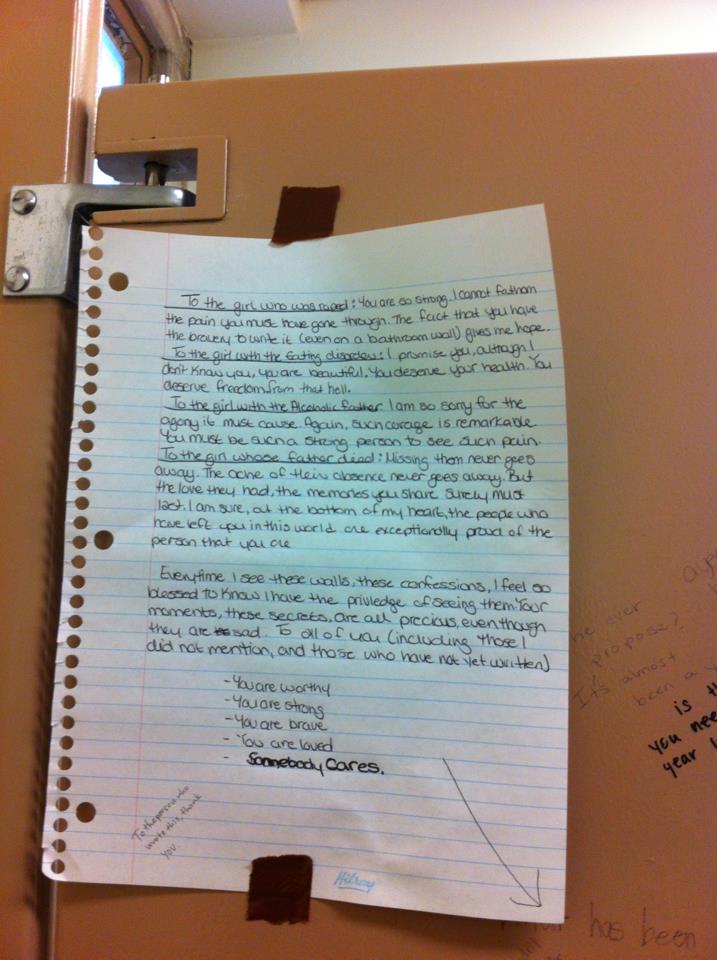
In the third stall at a women’s room at the University of Western Ontario, someone had written, “What was the worst day of your life?”

A few responses were humorous, but most were serious.

  • Every day, struggling with an eating disorder.
  • The day I found out my father was an alcoholic.
  • The day I was raped.

One student who saw these took a piece of notebook paper, wrote a sympathetic response to each, and taped it on the wall of the stall (transcript follows):

1

Transcript (borrowed from The Huffington Post):

To the girl who was raped: You are so strong. I cannot fathom the pain you must have gone through. The fact that you have the bravery to write it (even on a bathroom wall) gives me hope.

To the girl with eating disorders: I promise you, although I don’t know you, you are beautiful, you deserve your health. You deserve freedom from that hell.

To the girl with the alcoholic father: I am so sorry for the agony it must cause. Again, such courage is remarkable you must be such a strong person to see such pain.

To the girl whose father died: Missing them never goes away. The ache of their absence never goes away. But the love they had, the memories you share surely must last. I am sure, out of the bottom of my heart, the people who have left you in this world are exceptionally proud of the person you are.

Everytime(sic) I see these walls, these confessions, I feel so blessed to know I have the priviledge(sic) of seeing them. Your moments, these secrets, are all precious even though they are sad. To all of you (including those I did not mention, and those who have not yet written)

-You are worthy.
-You are strong.
-You are brave.
-You are loved.
-Somebody cares.

It  went viral.  Reddit picked it up, and the story has been in Canadian newspapers.  But this example is not so unusual.  A study of bathroom graffiti at a New Zealand university (unfortunately behind a paywall) found similar themes:

…inscriptions in the women’s toilets were talking about love and romance, soliciting personal advice on health issues and relationships, and discussing what exact act constitutes rape. Women also tried to placate more heated discussions (e.g., “Stop this. There is no reason to say these things. Why so much in-fighting?”).

The men wrote about politics and money (especially taxes and tuition).  Men also posted insults that were far more numerous and aggressive than those in the women’s room.  Only the men wrote racist graffiti.

Drier’s note, then, is a nice example of a documented trend: anonymous women being nice to each other in their bathrooms.

Jay Livingston is the chair of the Sociology Department at Montclair State University. You can follow him at Montclair SocioBlog or on Twitter.

Re-posted to add to the discussion about sexual assault in the aftermath of the Steubenville rape trial, the Senate hearing on rape and harassment in the military, and the controversy at Occidental College.

1On the heels of our recent post about an anti-rape ad that did the unusual — target men and tell then not to rape — comes this Scottish ad, sent along by Sociologist Michael Kimmel, that does a fantastic job of mocking the idea that some women are “asking for it”:

Lisa Wade, PhD is an Associate Professor at Tulane University. She is the author of American Hookup, a book about college sexual culture; a textbook about gender; and a forthcoming introductory text: Terrible Magnificent Sociology. You can follow her on Twitter and Instagram.

Re-posted to add to the discussion about sexual assault in the aftermath of the Steubenville rape trial, the Senate hearing on rape and harassment in the military, and the controversy at Occidental College.

Toban B. sent us two pairs of photographs showing feminist activism and backlash (images found here) at the University of Western Ontario.  These posters, and their defacement, nicely demonstrate how resistance to oppression is met with counter-resistance.  Until inequality is challenged, things often seem to be just fine; when groups stand up and demand equality, we suddenly see how fiercely people will defend their privilege.

Images after the jump (includes language about sexual violence):

more...

Re-posted to add to the discussion about sexual assault in the aftermath of the Steubenville rape trial, the Senate hearing on rape and harassment in the military, and the controversy at Occidental College.
1The other day I came upon a post by Margaret Lyons at Vulture pointing out the frequent use of rape jokes in sitcoms this season. A number of sitcoms, especially Two Broke Girls, Whitney, and Work It included scenes where rape served as a punchline. Lyons explains what particularly bothers her about this is that references to rape are being used simply as a “shorthand for outrageousness,” a way to cue the audience that they’re watching a show that is bold and daring, that will say anything!

The post includes a video of clips of a lot of these rape-joke scenes from this season, showing how frequently and casually they’re included. Clearly, these could be particularly upsetting for some readers:

I’ve been thinking about posting the video for a couple of days, but then Jeremiah J. sent in a link to a post that captures what I find problematic about how rape is used in TV and movies so much better than I ever could. Film critic and screenwriter Drew McWeeny posted a lengthy article at HitFix about reaching the breaking point in his ability to watch gratuitous rape scenes in movies. McWeeny explains,

It seems to me that somewhere along the way, it was decided that the easiest way to make an audience uncomfortable was to have someone rape a character onscreen.  I must see 30 films a year where somebody needs to have “something bad” happen, and the go-to impulse in almost every case is rape. It is guaranteed to cause a visceral reaction, even when the scenes are badly staged and lazy, which most of them are.

…the point has been more than made on film that rape is a terrible thing, and at this point, if you’re not contributing some new idea to the conversation, then you are literally just using it as a button, something you push to get a response, and that unnerves me.

I think McWeeny’s points are relevant to a discussion of sitcoms’ use of rape jokes as well, because in both cases rape is often being used as a “button,” a lazy, predictable way to get a reaction from an audience and mark the show or movie as one that’s audacious and pushes boundaries. You really must read McWeeny’s full original post, as he eloquently explains why this matters.

Gwen Sharp is an associate professor of sociology at Nevada State College. You can follow her on Twitter at @gwensharpnv.

Re-posted to add to the discussion about sexual assault and rape culture in the aftermath of the Steubenville verdict.

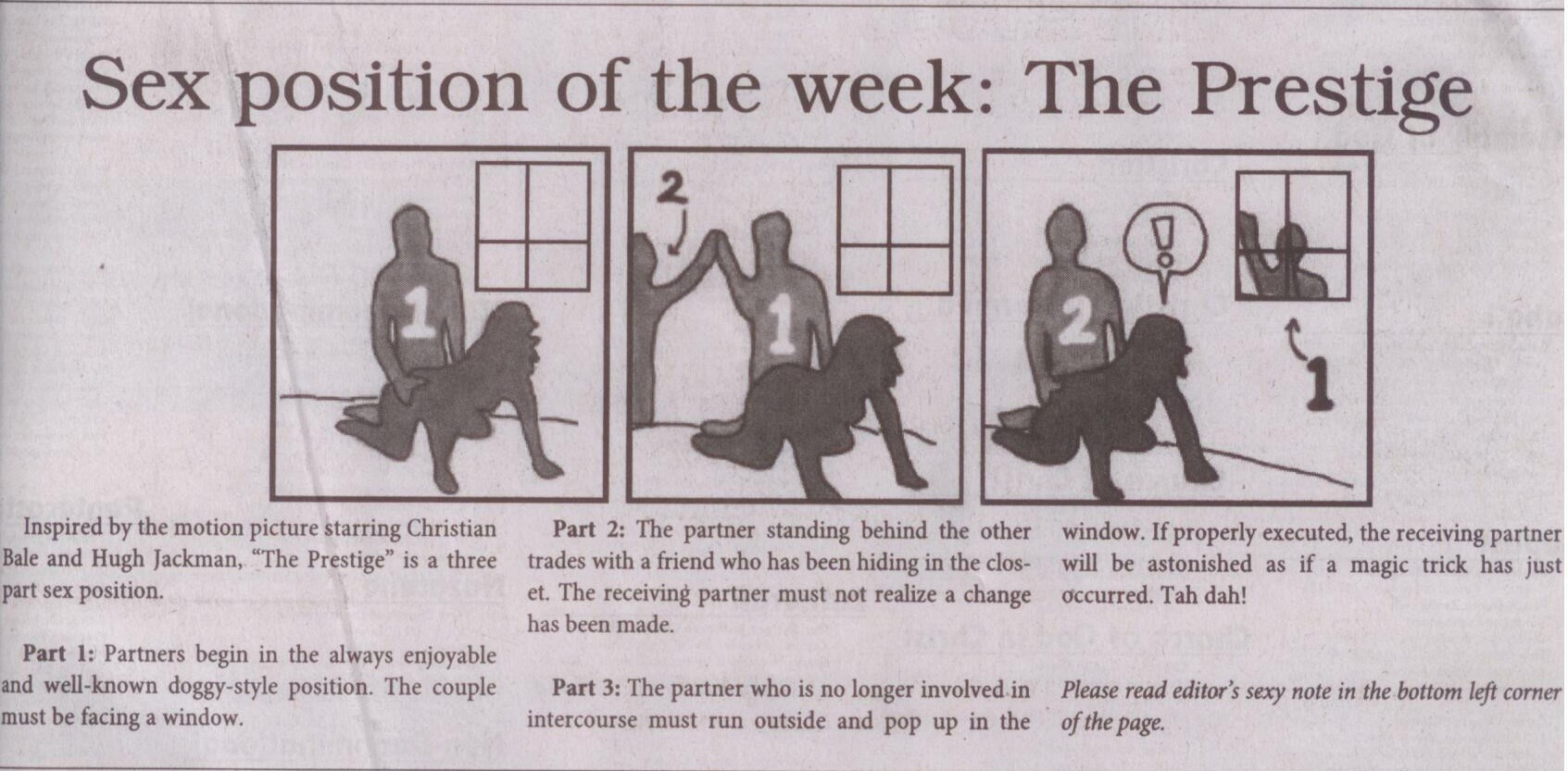
On the heels of yesterday’s cartoon making light of lynching published in Eastern Michigan University’s newspaper, Michaela N. submitted an intended-to-be-humorous visual making light of rape in The Purdue Exponent, the Purdue University student newspaper.  Part of a “sex position of the week” series, this one suggests that one man should pass a female partner off to another man without her knowledge.

This is another piece of evidence that suggests that we live in a rape culture: a society that, at best, trivializes and, at worst endorses, sexual assault.

UPDATE: Zoe Hayes, editor-in-chief of The Purdue Exponent, sent along a note asking that we link to their apology.  To their credit, unlike the non-apology issues in the case of the lynching cartoon linked to above, they express genuine empathy, remorse, and responsiveness.

For more indications that we live in a rape culture, see our posts on media coverage of a rape video game and the George Sodini murders, rapists as hyperconformists to ideal masculinity, the rape scene in Observe and Report, and t-shirts endorsing sex with “drunk girls”.

Lisa Wade, PhD is an Associate Professor at Tulane University. She is the author of American Hookup, a book about college sexual culture; a textbook about gender; and a forthcoming introductory text: Terrible Magnificent Sociology. You can follow her on Twitter and Instagram.

Re-posted to add to the discussion about sexual assault in the aftermath of the Steubenville rape trial, the Senate hearing on rape and harassment in the military, and the controversy at Occidental College.

This screenshot of the front page of The Sun is an excellent example of the eroticization of violence against women and our insistent denial of it:

capture1

The article is a condemnation of a video game in which the goal is to rape a mother and her two daughters (and force them to have abortions if they get pregnant).   They call the game “sick” and “shocking,” but also include a huge picture of the virtual rape victim sexily stripping down to her underwear.  Twisty, at I Blame the Patriarchy, observes that “…in terms of screen real estate, titillating images take up more space on the Sun’s web page than actual copy…”

Notice, also, the “related story” about a girl murdered who had reported rape threats and then, to the right of that, a dating advertisement featuring a couple of girls making bedroom eyes at the viewer.

This is what rape culture looks like: a story about a video game that encourages players to rape and otherwise torture women and girls, alongside titillating images from that very game; a story about a “girl” who had actually been murdered, alongside a photo of her looking invitingly into the camera; and a dating website.  With this material like this, we learn that sex, violence, and women aren’t separate concepts.  Instead of learning to think about sex, violence, and women, we learn to think about, and fantasize about, sexviolencewomen.

Lisa Wade, PhD is an Associate Professor at Tulane University. She is the author of American Hookup, a book about college sexual culture; a textbook about gender; and a forthcoming introductory text: Terrible Magnificent Sociology. You can follow her on Twitter and Instagram.

Re-posted to add to the discussion about sexual assault in the aftermath of the Steubenville rape trial, the Senate hearing on rape and harassment in the military, and the controversy at Occidental College.

Nizam A. sent in a rather stunning two-minute, 15-second clip put together by Media Matters.  It is a montage of the use of rape as a metaphor by right wing pundits (trigger warning).  To be fair, I don’t know if a similar video could be made using left wing pundits, so it may be best in comments to stick to a conversation about the metaphor itself.

Why it this such a popular way of talking about the world?

How does it work?  Does the metaphor, given that we think of rape as a crime that men do to women, feminize and masculinize?   Or is it about a gendering of the very notion of violation and vulnerability?  So are these pundits trying to transfer listener’s beliefs about protecting women and girls to other categories (e.g., the rich and the people of New York)?

Does using it as a metaphor give more power to, or trivialize and make invisible, actual rape?

Is there not some irony in how frequently we use it to describe something horribly violating, given the high rates of rape in the U.S., the frequency of non-reporting, our dismal treatment of victims, and the wildly low incidence of trials and convictions?

See also our post on violent metaphors, including rape.

Lisa Wade, PhD is an Associate Professor at Tulane University. She is the author of American Hookup, a book about college sexual culture; a textbook about gender; and a forthcoming introductory text: Terrible Magnificent Sociology. You can follow her on Twitter and Instagram.