Screenshot_1While the flight attendant might be a quintessentially feminized occupation today, the first “stewardess” was, in fact, a “steward.” Pan American had an all-male steward workforce — and a ban on hiring women — for 16 years.  It was forced to integrate during the male labor shortage of World War II, when female flight attendants were considered as revolutionary as “Rosie” riveters and welders.  By 1958, their ban on hiring women would be reversed. There was now a ban on hiring men.  This is just some of the fascinating history in Phil Tiemeyer‘s new book, Plane Queer, a history of the male flight attendant.

By the 1950s women dominated the aisles in the sky.  Airlines accepted this.  Women (1) were cheaper to employ, (2) domesticated the cabin, making commercial travel seem suitable for women and children, and (3) sexualized the experience for the business men who still made up the bulk of travelers.

By the time Celio Diaz Jr. invoked the 1964 Civil Rights Act and sued Pan Am on the basis of gender discrimination, white male flight attendants were seen as downright queer.  Servile behavior — the cooking, serving, nurturing, and aiding behavior characteristic of the job at the time — was both gendered and racialized.  When black men or white women performed domestic duties, it was seen as natural.  (The gender dimension might seem obvious but, from slavery to the early 1900s, black men were also concentrated in domestic occupations: coachmen, waiters, footmen, butlers, valets  etc.)

So, when white men served others — but not black men or white women — it challenged the supposedly natural order on which both hierarchies were founded.  This is why male flight attendants caused such a stir. The airlines wouldn’t hire black men or women, so they hired white men and women. The men, as a result, were suspected of being not-quite-heterosexual from the get-go and have suffered the ups and downs of homophobia ever since.

The double-definition of servile behavior as simultaneously racialized and gendered absolutely leapt out at me when I saw a commercial for Virgin Atlantic, sent in by Grace P.  It captures both the race and gender dimension of a segregated workforce. The two women and single black man play the role of service worker, while the two white men are a pilot and an engineer.  Each is framed as being literally born to do these jobs, thus the insistent and troubling naturalization of these hierarchical roles.

Lisa Wade, PhD is an Associate Professor at Tulane University. She is the author of American Hookup, a book about college sexual culture; a textbook about gender; and a forthcoming introductory text: Terrible Magnificent Sociology. You can follow her on Twitter and Instagram.
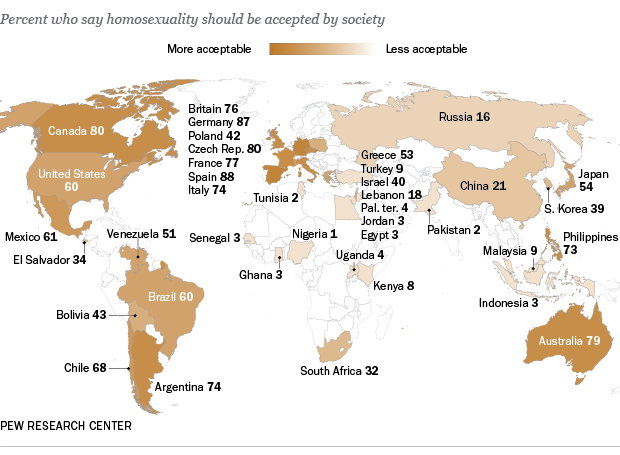
The Pew Research Global Attitudes Project recently released data on attitudes about homosexuality in 39 countries. Generally, those living in the Middle East and Africa were the least accepting, while those in the Americas, Europe, and parts of Asia (the Philippines, Australia, and to a lesser extent Japan) were most accepting:

PG_13.06.04_HomosexualityAccept_620

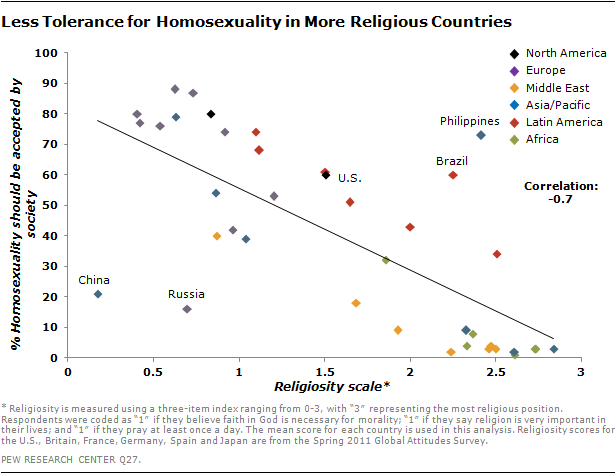
Generally, the more religious a country, the less accepting its citizens are of homosexuality:

2013-Homosexuality-03

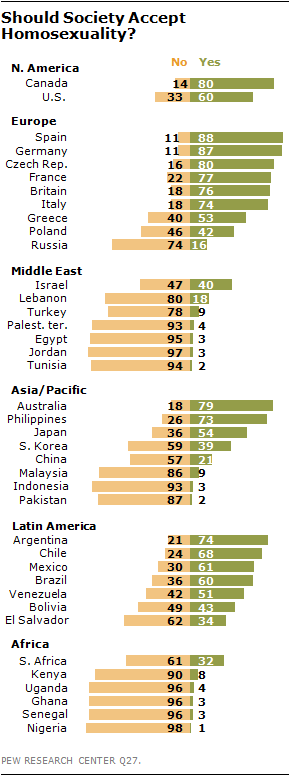
The proportion of people who support social acceptance of gays and lesbians ranged from a high of 88% in Spain to a low of 1% in Nigeria:

2013-Homosexuality-05

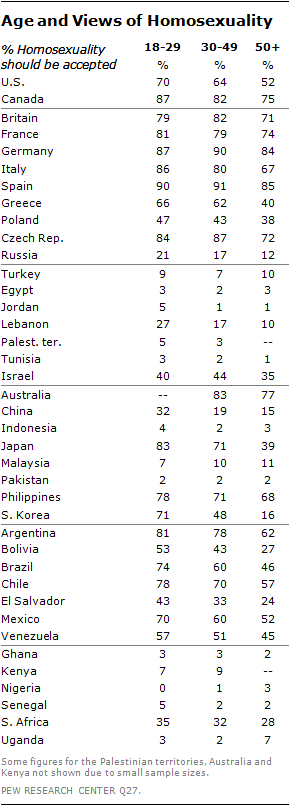
Attitudes about homosexuality vary widely by age. There is a pretty consistent global pattern of more positive attitudes among younger people, with a few exceptions:

2013-Homosexuality-01

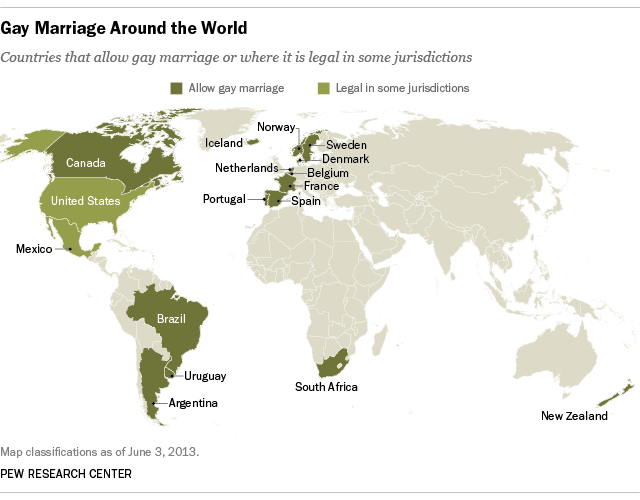
Thus far, legalization of same-sex marriage has been largely confined to the Americas and Europe; New Zealand and South Africa are the two outliers:

FT_13.05.31_gayMarriageMap

The Pew Center points out that of the 15 nations that have fully extended marriage rights to same-sex couples, 8 have done so just since 2010. In the U.S., we’re currently awaiting a Supreme Court’s decision, which should arrive shortly, to know if we’ll be joining the list sooner rather than later.

Thanks to Peter Nardi at Pitzer College for the link!

Gwen Sharp is an associate professor of sociology at Nevada State College. You can follow her on Twitter at @gwensharpnv.

Screenshot_2As our society becomes increasingly technological, I love stories that remind us of the value of simpler ways to solve problems, like a faux bus stop to catch escapee nursing home residents or dogs that are trained to sniff out cancer (both stories here).

This weekend we were treated to another such story, this time by Google. The company has announced a plan to bring internet to the whole world… with balloons.  The very first launch of a gas balloon was in 1783.  Two hundred and thirty years later, the company aims to deliver what is arguably the defining feature of our age — the internet — with helium-filled balloons.  That technology will then bring almost countless other technologies, such as medical advances and agricultural information, to people who are largely excluded from them now.  A fantastical plan.

Here’s how it’ll work:

Lisa Wade, PhD is an Associate Professor at Tulane University. She is the author of American Hookup, a book about college sexual culture; a textbook about gender; and a forthcoming introductory text: Terrible Magnificent Sociology. You can follow her on Twitter and Instagram.
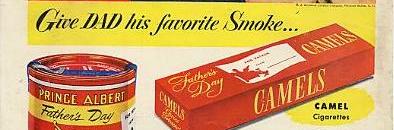
Please enjoy these posts from Father’s Days past:

Stereotyping Men on Dad’s Day

Also…

@plouie01 snapped these two pics of the suggested gifts for Mother’s and Father’s Day at Chapter’s Bookstore in Vancouver. You might notice an interesting difference:

1
Yep, that’s right. Men get books, interesting books even!  And women get… pink stuff.  Mostly paper products, but without words and ideas on them, and also candles and soap..  You know, pretty good-smelling things meant to please the daft. Forgive me, perhaps I’m being overly harsh towards stationary. All I’m saying is, not a single book for ladies at the book store? Alas.

Lisa Wade, PhD is an Associate Professor at Tulane University. She is the author of American Hookup, a book about college sexual culture; a textbook about gender; and a forthcoming introductory text: Terrible Magnificent Sociology. You can follow her on Twitter and Instagram.
A new symbol to represent people with disabilities is being introduced in New York City. The symbol, designed by a team at Gordon College, looks like this:

1

We’ve posted previously about the politics of the symbol and its history. The notable changes here are the moving of the arms to the wheels of the chair, suggesting that the person is pushing themselves, and the forward-leaning angle, suggesting active motion.  It tells a story about independence and ability, instead of dependence and disability.  A very nice change.

Lisa Wade, PhD is an Associate Professor at Tulane University. She is the author of American Hookup, a book about college sexual culture; a textbook about gender; and a forthcoming introductory text: Terrible Magnificent Sociology. You can follow her on Twitter and Instagram.
Teen pregnancy, like obesity, is often framed as an “epidemic.”  As such, both the “epidemic” of teen pregnancy and the “epidemic” of obesity can be understood through the lens of what sociologist Stanley Cohen popularized as a “moral panic.” In Cohen’s words, moral panics are “condensed political struggles to control the means of cultural reproduction”; additionally “successful moral panics owe their appeal to their ability to find points of resonance with wider anxieties.”

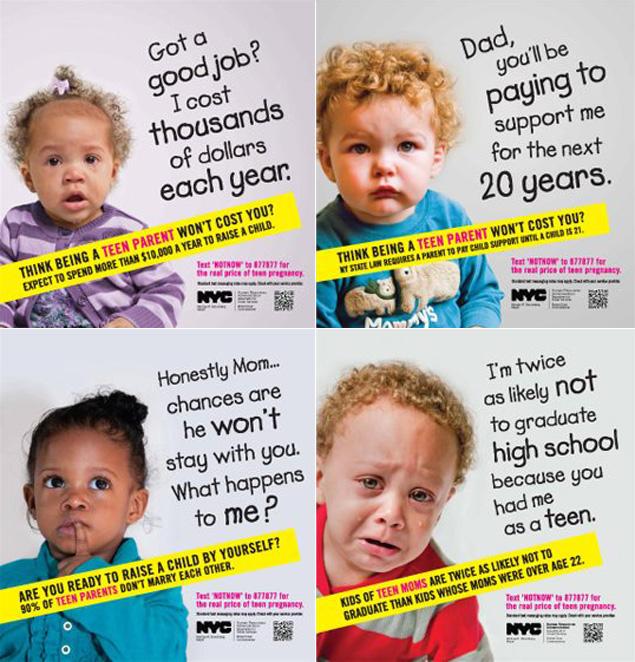
“The Real Cost of Teen Pregnancy” — a public health information campaign launched by the Mayor and Human Resources Administration of New York City in March 2013 — features babies and toddlers, primarily children of color, chastising their teenage mothers. Launched at a time when teen pregnancies have actually declined, primarily due to the availability of safe and affordable reproductive health care, the accusatory “shame and blame” narrative of these images is not only out of proportion to the “problem” it seeks to address, but is weighed down by its obvious cultural narratives about teens of color, poverty, gender and sexuality.

teen4n-web
Having a pensive toddler of color next to the slogan “Honestly Mom… chances are he won’t stay with you. What happens to me?” and a weeping boy of color next to the words “I’m twice as likely not to graduate high school because you had me as a teen,” serves to re-stigmatize single teen mothers, encouraging wider social senses of moral outrage, hostility and volatility toward young, predominantly impoverished girls of color. Not unlike cultural narratives about “welfare queens,” the campaign plays into racist and classist fears about sexually active girls of color and teenage mothers who use social services. The message just under the surface here is about the need for social control of “unruly bodies.”

These 4,000 posters, put up in buses and subways, cost a reported $10,000 per year for the city, and have already drawn harsh critique from many. Haydee Morales, vice president for education and training at Planned Parenthood of New York City, for instance, has reportedly suggested the campaign has got it backward. In her words, “It’s not teen pregnancies that cause poverty, but poverty that causes teen pregnancy.”

According to Samantha Levine, a spokesperson for New York’s Mayor Bloomberg, “it’s well past the time when anyone can afford to be value neutral when it comes to teen pregnancy.” Public health campaigns are never value neutral. They communicate social beliefs about normalcy, productivity, desirability, and cultural worth.

An additional cost of the unexamined acceptance of this new teen pregnancy campaign is accepting yet another narrative about individual choice over systemic change. Placing responsibility on the shoulders of the individual, such campaigns silence more complex conversations about accessible and affordable reproductive health care, anti-poverty campaigns, and gender and social justice work. Instead of buying into the “moral panic” of teen pregnancy, perhaps the mayor’s office might look into more long lasting and less stigmatizing possibilities of structural change to improve the lives of young women in New York City.

“Shame and blame” has rarely gotten public health anywhere. In the words of researcher and speaker Brené Brown, “Shame diminishes our capacity for empathy. Shame corrodes the very part of us that believes we are capable of change.”

Sayantani DasGupta is a faculty member in Narrative Medicine at Columbia University. She is the editor of Stories of Illness and Healing: Women Write their Bodies,  co-authored The Demon Slayers and Other Stories: Bengali Folktales, and authored Her Own Medicine: A Woman’s Journey from Student to Doctor.

Screenshot_1Earlier on SocImages, Lisa Wade drew attention to the tourism industry’s commodification of Polynesian women and their dancing. She mentioned, briefly, how the hula was made more tourist-friendly (what most tourists see when they attend one of the many hotel-based luaus throughout the islands is not traditional hula).  In this post, I want to offer more details on the history and the differences between the tourist and the traditional hula.

First, Wade states that, while female dancers take center stage for tourists, the traditional hula was “mostly” a men’s dance.  While it has not been determined for certain if women were ever proscribed from performing the hula during the time of the Ali’i (chiefs), it seems unlikely that women would have been prevented from performing the hula when the deity associated with the hula is Pele, a goddess. Furthermore, there is evidence that women were performing the dance at the time of Captain James Cook’s arrival in Hawai’i.

Second, while the traditional dances were not necessarily sexualized, they were very sensual.  The movement of hips and legs that are seen as sexual by some visitors, and showcased as such by the tourism industry, certainly existed in early practices.

In fact, the supposedly lascivious and blasphemous nature of the hula prompted missionaries to censure the public practice of hula, and in 1830 Queen Ka’ahumanu enacted a law prohibiting the public performance of the hula. This law was highly ineffective, however, and when King Kalakaua ascended the throne he actively encouraged public hula performances and other expressions of Native Hawaiian culture, earning him the moniker “Merrie Monarch.”

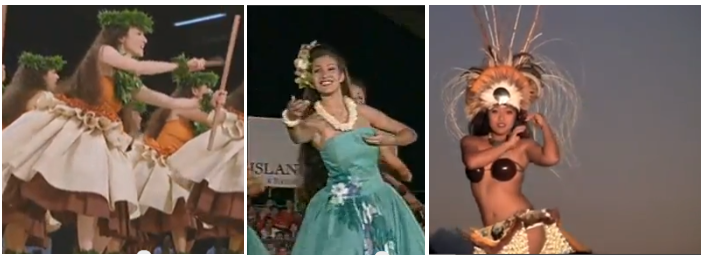
Eventually, a modernized dance emerged that did not incorporate much religiosity and employed modern music rather than chants. This is closer to what you would find at a hotel luau, but differs drastically in costuming and lacks the uncomfortable cloud of objectification associated with hotel-style hula (that is, the focus is on the dance rather than the dancers).  Below are some examples of the evolution.

Hula (men’s dance, traditional):

Hula (contemporary):

These examples of hula, and other Polynesian dances, are vastly different from what one finds in a hotel’s “Polynesian Revue” luau.

Hula (hotel):

In conclusion, it is true that the hula dances, and other dances of Polynesia, have been usurped by the tourism industry and commodified.  The culturally authentic forms, however, still thrive. Native dances are impressive enough without the ridiculous costuming and disrespectful bending of the islands’ histories seen at hotel luaus; unfortunately, it is difficult to find any culturally sensitive displays of Polynesian culture due to the huge influence of tourism over these locations.

*The information in this post was gleaned from various courses I’ve taken at the University of Hawai’i at Manoa. For more information on hula and the commodification of the Hawaiian culture, see Haunani-Kay Trask’s From A Native Daughter.

Sarah Neal is currently working on obtaining her M.A. in English at North Carolina State University.