Ten women marched in defiance of the stigma against women smoking cigarettes as part of the New York Easter Day Parade in 1929.  The interesting thing was, however, it was all a sham. The tobacco industry had set the whole thing up with the help of public relations mastermind, Edward Bernays.  American Tobacco Company President George Hill  knew cigarette sales would skyrocket if more U.S. women smoked, a behavior reserved for men in the 1920s that had closed off the female market.

Within one year of Bernay’s stint, women were smoking.

Today, similarly, Japanese fast-food has found a way to bypass the cultural stigmas that impede their profits. One food chain noticed many women would not buy their biggest-sized burgers.  The culprit was ochobo, a Japanese custom that prevents women from opening their mouth widely in public.  Small mouths are considered beautiful and opening them widely is considered “ugly” and “rude.”  The restaurant concluded that it would get into the business of “freeing women from the spell of ‘ochobo.’”

1

The burger chain invented a wrapper that would allow women to open their mouths larger, but not be seen: the liberation wrapper. It is a profitable tactic touted as a cultural solution.

2

You can watch them introduce the wrapper in this short video:

The liberation wrapper was welcomed in Japanese media and social networks, spreading its popularity.  Similarly, Bernay’s public relation’s stint in 1929 garnered much of its success from the media hype that ensued then.

The approach has produced results. Sales of the Japanese chain’s biggest burgers jumped 213% after the wrappers were made because they allowed the burgers to become “socially available” to women.

Of course, the irony is that the burger chain’s “solution” isn’t actually liberating women.  By hiding the deviation behind a paper mask, it is actually reinforcing Ochobo. After all, the social reality remains — it is not acceptable for Japanese women to display an open mouth in public.

Michael Lozano is a graduate of CSULB’s Sociology Honors program and frequent contributor to NewAmericaMedia.org and VoiceWaves.org, a hyper-local news site based in Long Beach, CA.
“What is it that I want?”

Jane Van Galen asked herself this question after reading a gushing profile of an “island cabin” in The Seattle Times.   It begins: “Lots of folks have lots of reasons for wanting their own piece of land out of town” and quotes one of the new cabin’s owners who, when pregnant, came to realize: “I can’t raise a child just in the city … I wanted woods, salamanders and pileated woodpeckers.”

So, she and her husband “went right out,” bought nine acres on an island, and built this a stunning “cabin.” Writing at her site, Education and Class, Van Galen processed her reaction to this article. She added up the costs, figuring that the owners spent close to a million dollars.  “I knew that my unease,” she wrote, “was not just straightforward jealously.”  So, what did she want?

She knew what she did not want:

Narratives in which the wealthy are held up as model parents who upon hearing of the dangers of the modern world, “go right out” to provide acres of weekend woods for their children; narratives that invite us to admire their paint colors and beautiful windows and solid black granite bathtub without asking too many questions about how it is that relatively young parents can ensure that their child has access to acres of his own private salamanders, and especially not to ask too many questions about how all children might have room to grow and thrive...

She wanted, “for once,” to hear wealthy people just admit they’re rich — for whatever reason — instead of framing their decision to build a vacation home as simply what any good parent would do.

“I love having this for my son,” the owner is quoted.  But Van Galen wants to know: What about everyone else’s children?

Cross-posted at Global Policy TV.

Lisa Wade, PhD is an Associate Professor at Tulane University. She is the author of American Hookup, a book about college sexual culture; a textbook about gender; and a forthcoming introductory text: Terrible Magnificent Sociology. You can follow her on Twitter and Instagram.

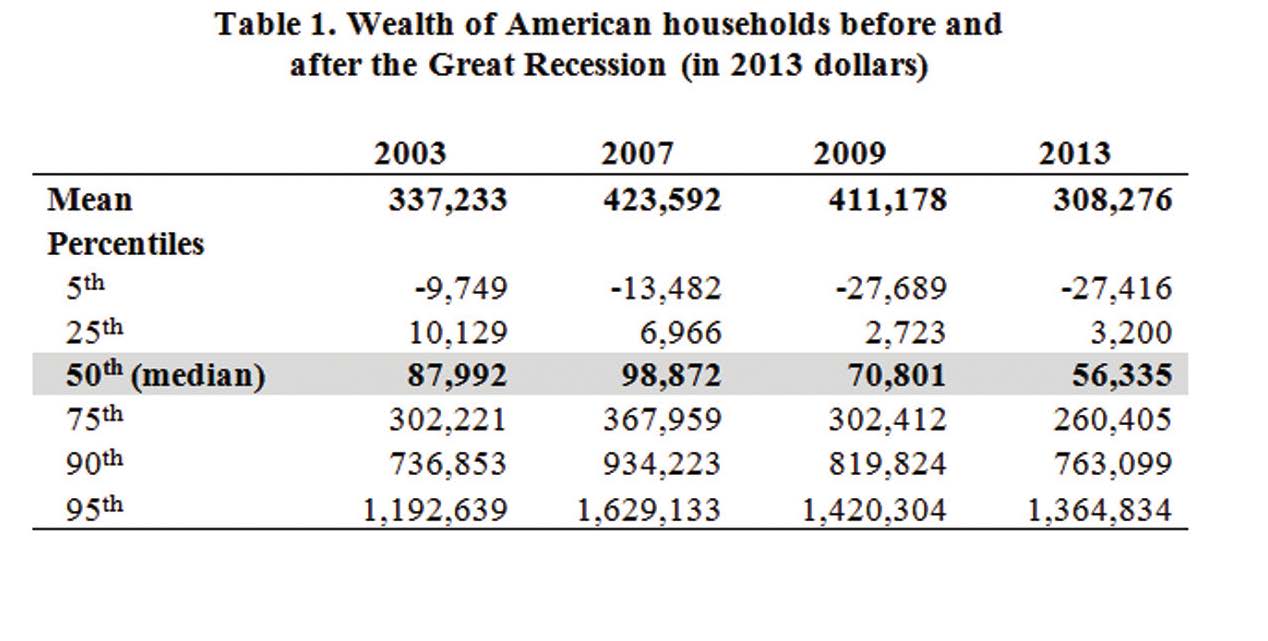
According to a June 2014 Russell Sage Foundation report, the average U.S. household experienced a real wealth decline of more than one-third over the 10 years ending in 2013.

Table 1 shows that the net worth of the median household fell from $87,992 in 2003 to $56,335 in 2013, for a decline of 36%.  In fact, the last ten years were hard on the overwhelming majority of American households.  Only the top 2 groups enjoyed wealth gains over the period.  Also noteworthy is the tiny net worth of households below the median.

1

Figure 1 provides a longer term perspective on wealth movements.  We can see that most households enjoyed growing wealth from 1984 to the 2007 crisis, with wealth falling across the board since.  However, the median household is now significantly poorer than it was in 1984.  Only the richer households managed to maintain most of their earlier gains in wealth.

2

These trends highlight the fact that we have a growing inequality of wealth, as well as of income, and they are not likely to reverse on their own.

Martin Hart-Landsberg is a professor of economics at Lewis and Clark College. You can follow him at Reports from the Economic Front.

Flashback Friday.

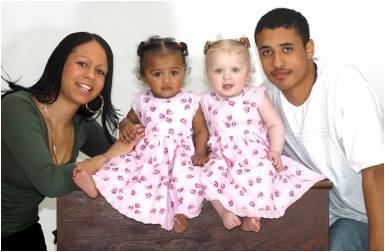
This remarkable newspaper article illustrates how skin color (which is real) gets translated into categorical racial categories (which are not).  The children in the images below — Kian and Remee Hodgson — are fraternal twins born to two bi-racial parents:

1

The story attempts to explain the biology:

Skin colour is believed to be determined by up to seven different genes working together. If a woman is of mixed race, her eggs will usually contain a mixture of genes coding for both black and white skin. Similarly, a man of mixed race will have a variety of different genes in his sperm. When these eggs and sperm come together, they will create a baby of mixed race.  But, very occasionally, the egg or sperm might contain genes coding for one skin colour. If both the egg and sperm contain all white genes, the baby will be white. And if both contain just the versions necessary for black skin, the baby will be black.

Fair enough.

But then the journalist makes a logical leap from biological determinants of skin color to racial categories. Referring now to genes for skin color as “black” and “white” genes, she writes: “Baby Kian must have inherited the black genes from both sides of the family, whilst Remee inherited the white ones.”  And, of course, while both children are, technically, mixed race*, the headline to the story, “Black and White Twins,” presents them as separate races.

We’re so committed to racial differences that the mother actually speaks about their similarities as if it is surprising that twins of different “races” could possibly have anything in common.  She says:

There are some similarities between them. They both love apples and grapes, and their favourite television programme is Teletubbies.”

This is also a nice example of a U.S.-specific racial logic. This might not have been a story in Brazil at all, where racial categories are determined more by color alone and less by who your parents are.  It is not uncommon there to have siblings of various racial designations.

The twins, by the way, are seven now.

* Of course, identifying them as mixed race also re-inscribes racial categories in that you must believe in two or more racial categories to believe that it is possible to mix them.

Originally posted in 2008.

Lisa Wade, PhD is an Associate Professor at Tulane University. She is the author of American Hookup, a book about college sexual culture; a textbook about gender; and a forthcoming introductory text: Terrible Magnificent Sociology. You can follow her on Twitter and Instagram.

Call for Papers:

  • I’m looking for recommendations for fantastic blog posts addressing gender and its intersections for a book project.   Self-nominations are welcome!  Please send ideas to lwade@oxy.edu.

SocImages News:

Elsewhere on the Web:

You like!  Here are our most appreciated posts this month:

Thanks everybody!

Editor’s Pick!

Social Media ‘n’ Stuff:

Finally, this is your monthly reminder that SocImages is on Twitter, Facebook, Tumblr, Google+, and Pinterest.  I’m on Facebook and most of the team is on Twitter: @lisawade, @gwensharpnv, @familyunequal, and @jaylivingston.

Lisa Wade, PhD is an Associate Professor at Tulane University. She is the author of American Hookup, a book about college sexual culture; a textbook about gender; and a forthcoming introductory text: Terrible Magnificent Sociology. You can follow her on Twitter and Instagram.

Every spring, my daughter receives an invitation to participate in a local Girls on the Run (GOTR) program. Every spring, I hesitate saying, “yes.”

Girls on the Run (GOTR) is a non-profit organization with about 200 councils across the U.S. and Canada. Over 10 to 12 weeks, councils help organize teams of girls in 3rd through 8th grades to train for and complete a 5K run.

Volunteer coaches lead their team through the program’s pre-packaged curriculum, consisting of lessons that “encourage positive emotional, social, mental and physical development.” Among other things they discuss self-esteem, confidence, team work, healthy relationships, and “challenges girls face.” Boys are not allowed to participate in the program. The 5K is described by GOTR as the ending “moment in time that beautifully reflects the very essence of the program goals.”

The starting line has the atmosphere of a party. Music is played over loud speakers, pumping teen pop (with lyrics laden with sexual innuendo and “crushes” on boys) and oldies that carry an affirmative “you can do it” message like Gaynor’s, “I Will Survive.”

Vendors (local businesses and organizations) bring tables to engage the girls and their parents in products/services they have available. This is not the only form of capitalistic opportunism affiliated with GOTR. The international organization’s official sponsors include Lego Friends – a line of Legos that emphasize single-sexed socialization (not building!) and Secret’s campaign “Mean Stinks” (featuring another pop glam star, Demi Lovato) that emphasizes painting fingernails blue, among other frivolous things, to address girl-on-girl bullying.

The run is an odd scene. Though boys have been banned from participation, older male relatives, friends, and teachers are encouraged to run with girls as their sponsors. It has become a unique trademark of GOTR that these men, and many of the women and girls, dress “hyper-feminine” (e.g., in skirts, tutus, big bows, bold patterned knee-high socks, tiaras, etc.), apply make-up or face paint, and spray color their hair. The idea is to “girl it up.”

Over the years, I’ve become increasingly uncomfortable with this event for a couple of reasons.

First, encouraging girls to “girl it up”—or I prefer, “glam it up,” so that we don’t appropriate these behaviors just for girls—can be fun, an opportunity to step out and beyond what is practiced in everyday life. But there’s no corresponding encouragement to “butch it up” if they desire, or do some combination of both.  In the end, then, this simply serves to reproduce gender stereotypes and the old-fashioned and false notion that gender is binary.

Second, by bombarding girls with “positive” messages about themselves meant to counteract negative ones, the program implicitly gives credence to the idea that girls aren’t considered equal to boys. What messages are girls really getting when special programs are aimed at trying to make them feel good about themselves as girls?

Although I have always given in to my daughter’s requests, at some point I am going to say “no.” Instead of reinforcing the box she’s put into, and decorating it with a pretty bow, we’ll have to start unpacking mainstream girl culture together.

Scott Richardson is an assistant professor of educational foundations and affiliate of women’s studies at Millersville University of Pennsylvania. You can follow him on Twitter.

Great comic by David Malki at Wondermark.  H/t to @annettecboehm.

Lisa Wade, PhD is an Associate Professor at Tulane University. She is the author of American Hookup, a book about college sexual culture; a textbook about gender; and a forthcoming introductory text: Terrible Magnificent Sociology. You can follow her on Twitter and Instagram.

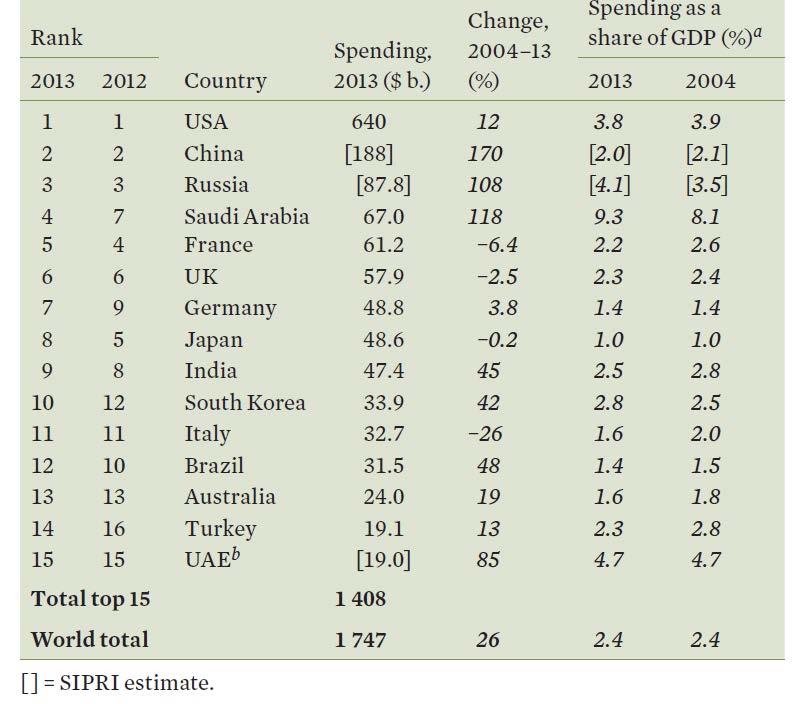
According to the Stockholm International Peace Institute, the United States remains the world’s top military spender. In fact, U.S. military spending equals the combined military spending of the next ten countries.  And most of those are U.S. allies.

1 (2) - Copy

Although declining in real terms, the U.S. military budget remains substantial and a huge drain on our public resources.  As the following chart shows, military spending absorbs 57% of our federal discretionary budget.

1 (2)

 Notice that many so-called non-military discretionary budget categories also include military related spending. For example: Veteran’s Benefits, International Affairs, Energy and the Environment, and Science.   We certainly seem focused on a certain kind of security.

Martin Hart-Landsberg is a professor of economics at Lewis and Clark College. You can follow him at Reports from the Economic Front.