Archive: 2014

Sociologist Sangyoub Park forwarded us a fascinating account of Ikea’s business model… for China.  In the U.S., there are rather strict rules about what one can do in a retail store.  Primarily, one is supposed to shop, shop the whole time, and leave once one’s done shopping.  Special parts of the store might be designated for other activities, like eating or entertaining kids, but the main floors are activity-restricted.

Not in China.  Ikea has become a popular place to hang out.  People go there to read their morning newspaper, socialize with friends, snuggle with a loved one, or take a nap.  Older adults have turned it into a haunt for singles looking for love.  Some even see it as a great place for a wedding.

This is a great example of the social construction of spaces: what seems like appropriate behavior in a context is a matter of cultural agreement.  In the U.S., we’ve accepted the idea that the chairs in our local furniture store are not for socializing.  Some of us, depending on our privilege, could probably get ourselves arrested if we took a nap at our local Mattress King.  But this isn’t an inevitable truth.  If we all just collectively change our minds, the people with power included, then things could be different.

Cross-posted at Pacific Standard.

Lisa Wade, PhD is an Associate Professor at Tulane University. She is the author of American Hookup, a book about college sexual culture; a textbook about gender; and a forthcoming introductory text: Terrible Magnificent Sociology. You can follow her on Twitter and Instagram.

A new submission inspires me to re-post this great collection of public resistance to advertisements that objectify women.

Adding commentary to the ubiquitous images that surround us can help us to notice, even if just temporarily, that our environment is toxic to our ability to think of all people as full and complete humans.  Here are some inspiring examples.

1.  An unknown artist pastes the photoshop toolbar on H&M posters in Germany (thanks Dmitriy T.C. and Alison M.).

2.  Toban B. (a prolific SocImages contributor, by the way) sent us a set of photographs.  These were snapped in Seattle, Washington by Jonathan McIntosh:

3.  Commentary on a Special K. ad in Dublin, sent in by Tara C. (Broadsheet).

Text:

Hey there Special-K Lady.

I know you think I should diet
So I can be slim just like you.
thing is, I think I look pretty fabulous
Just the way I am
Also, Special-K tastes like cardboard

so piss off

4.  This one was written on by a teenage girl in Rotterdam, the Netherlands.  It reads:  “I’m sick of sexually tinted images.”

2293892526_399004a285

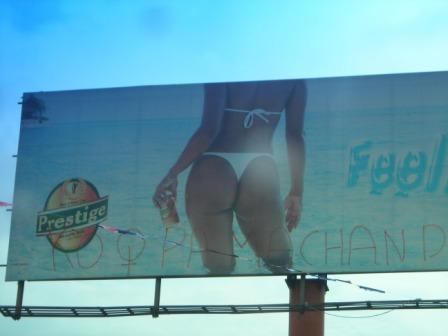
5.  Tricia V. sent us an example of this kind of resistance in Haiti.  The billboard below is in for a brand of beer called Prestige.  Tricia writes:  “The writing [along the bottom of] the billboard says “Ko O+ pa machandiz”  which translates as ‘Women’s bodies are not merchandise.'”  She was impressed at the effort exerted to climb up and write across a full-sized billboard.

haiti-may-2007-031

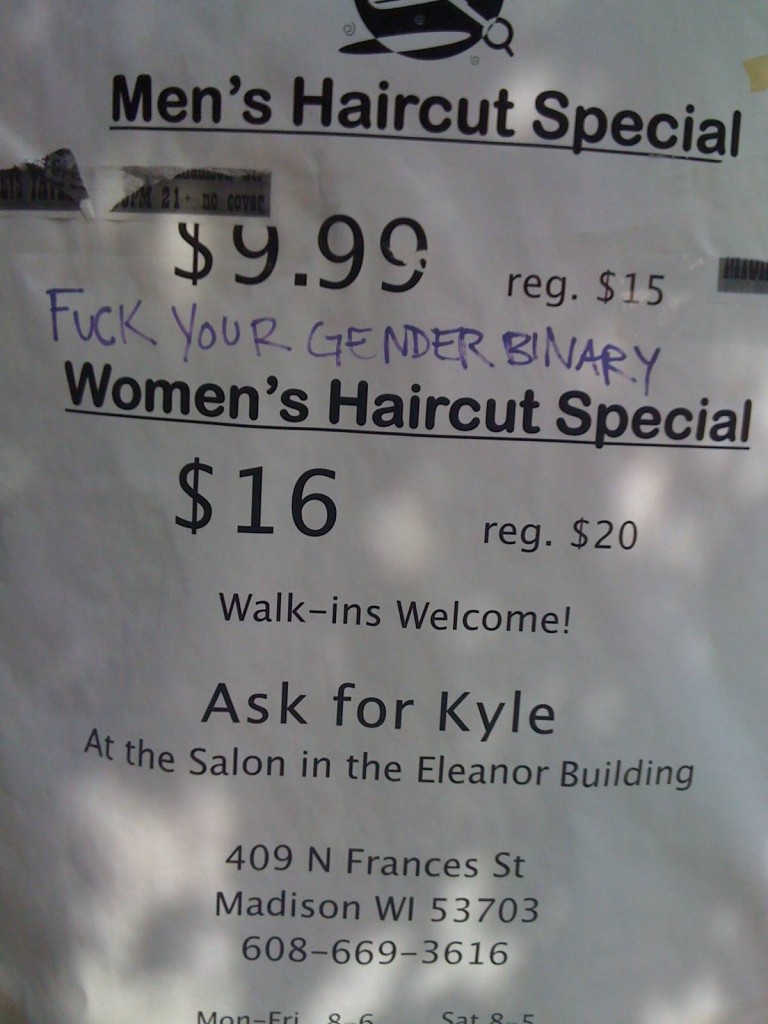
6.  Ang B. snapped this photo in Madison, Wisconsin:

7. Sasha Albert saw this comment written on a “please excuse our construction” sign at her gym. Someone else had already written: “WEIRD retouching. Give us a real, healthy, normal woman!” Read more at About Face.

2

See also: my mom has a phd in math.   For a classic example, see “If it were a lady, it’d get its bottom pinched.”  For an example of backlash to public anti-sexist messages, see this post on defending privilege (trigger warning).

Cross-posted at Ms.  Sources:  herehere, and here.

Lisa Wade, PhD is an Associate Professor at Tulane University. She is the author of American Hookup, a book about college sexual culture; a textbook about gender; and a forthcoming introductory text: Terrible Magnificent Sociology. You can follow her on Twitter and Instagram.
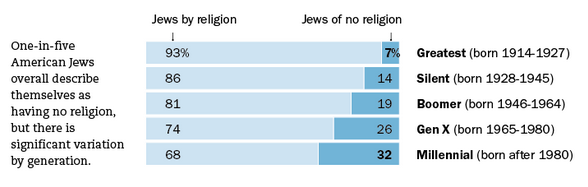
The Pew Research Center has released the data from new survey of religious and non-religious Jews.  They find that almost a quarter of Jews (22%) describe themselves as being “atheist,” “agnostic,” or “nothing in particular.”  The percentage of Jews of no religion correlates with age, such that younger generations are much more likely to be unaffiliated.  Nearly a third of Millennials with Jewish ancestry say they have no religion (32%), compared to 19% of Boomers and 7% of the Greatest Generation.

Screenshot (34)

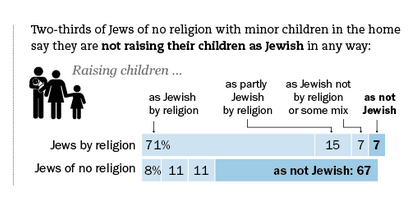
A majority of Jews with no religion marry non-Jews (79%); 67% have decided against raising their children with the religion.
Screenshot (33)As a result of intermarriage, the percent of all Jews who have only one Jewish parent is rising.  While 92% of people born between 1914 and 1927 had two Jewish parents, Millennials are as likely as not to have just had one.

Cross-posted at Pacific Standard.

Lisa Wade, PhD is an Associate Professor at Tulane University. She is the author of American Hookup, a book about college sexual culture; a textbook about gender; and a forthcoming introductory text: Terrible Magnificent Sociology. You can follow her on Twitter and Instagram.
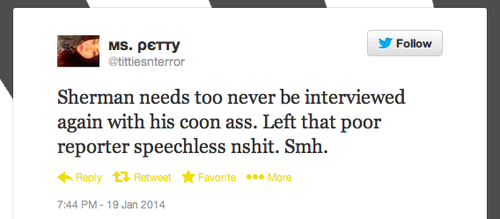
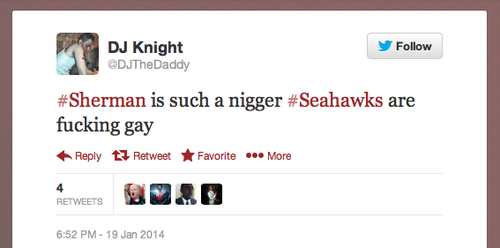
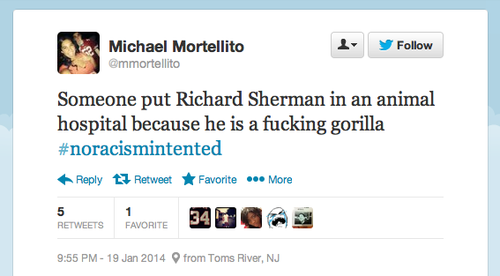
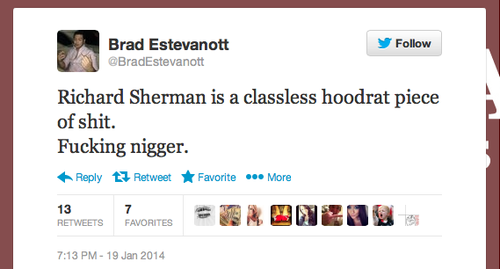
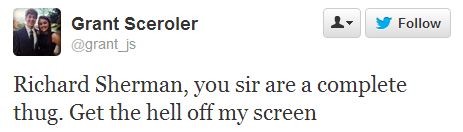
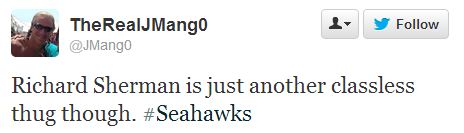
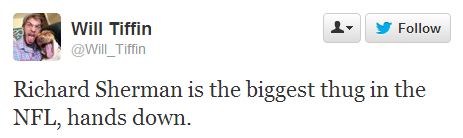
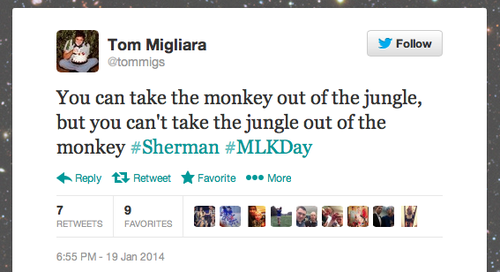
Immediately after the Seattle Seahawks beat the San Francisco 49ers on Sunday, Richard Sherman gave an intense, boastful post-game interview.  This triggered the always-present racism, as illustrated by many tweets that followed.  Here is just a sample from Public Shaming:

13 4 57

These are obviously cruel and full of hate, but the ones in which he was called a “thug” got somewhat less attention:

2 3 4 5

In interviews about the racist response, Sherman made some really nice points about what this means about the state of America and the specifically racial insults.  In a press conference, for example, asked about being called a “thug,” he argued that it’s just “the accepted way of calling someone the n-word these days.”  He points out that, in no way was what he was doing thug-like:

Maybe I’m talking loudly, and doing something… talking like I’m not supposed to, but I’m not… there’s a hockey game where they didn’t even play hockey, they just threw the puck aside and started fighting.  I saw that and I said, “Aw man, I’m the thug? What!? What’s going on here?”

[youtube]https://www.youtube.com/watch?v=wPSiOCC8nvc[/youtube]

In another video, he expands on this point, saying: “I’m not out there beating on people, or committing crimes, or getting arrested, or doing anything; I’m playing a football game at a high level and I got excited.”

Sherman’s making two points.  First, that there was nothing thug-like about his behavior.  Thugs are violent criminals.  He’s just playing a game.  And, second, the term is decidedly racial, applied to him largely because of the color of his skin.  Meanwhile, hockey players, who are overwhelmingly white, as well as other white athletes, don’t as often get these sorts of labels even if they are physically violent in ways that exceed the demands of their sport.

Lisa Wade, PhD is an Associate Professor at Tulane University. She is the author of American Hookup, a book about college sexual culture; a textbook about gender; and a forthcoming introductory text: Terrible Magnificent Sociology. You can follow her on Twitter and Instagram.

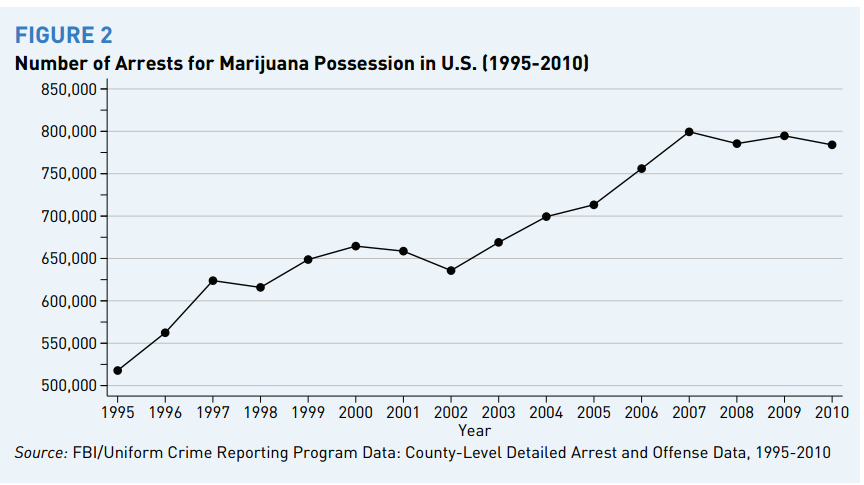
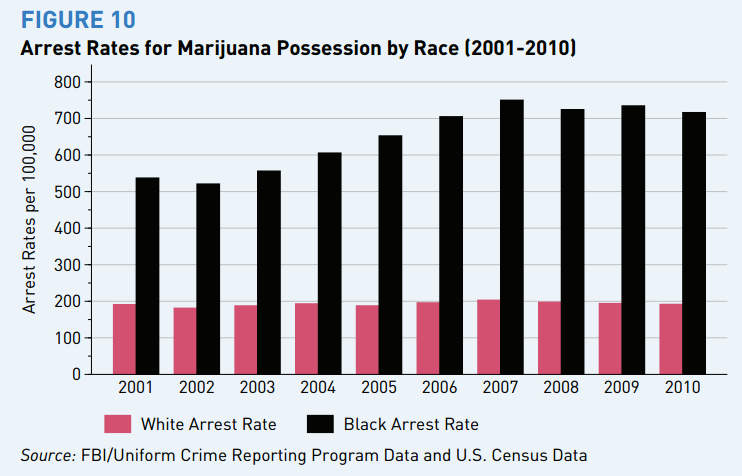
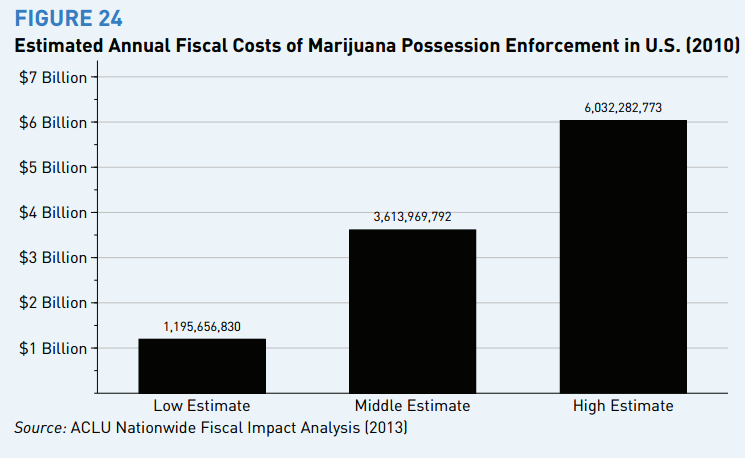
Young black adults are less likely than whites to use marijuana, but extraordinarily more likely to be arrested for its use, according to a new report by the ACLU.  This is old news, but the data never fails to stun.

First, notice that arrests for marijuana possession have grown over the past 15 years, even relative to arrests for other types of drugs.  The first chart is total marijuana possession arrests, the second is the percent of all drug arrests that were for marijuana (note that in neither chart does the vertical axis start at zero and truncated axes tend to make data look more dramatic, as if that were necessary here).

Screenshot (11) Screenshot (12)This rise in arrests has disproportionately affected African Americans.  The arrest rate for blacks has consistently been substantially higher than that of whites, but it increased, even so, over the 2000s.
Screenshot (14)

According to the report:

…in every state the Black arrest rate is disproportionate to Blacks’ percentage of the population.  In fact, in 42 states the Black percentage of marijuana possession arrests is more than double the Black percentage of the population, while in 18 states Blacks account for more than three times the percentage of marijuana possession arrests than they do of the population.  In four states, the difference is a factor of at least four.

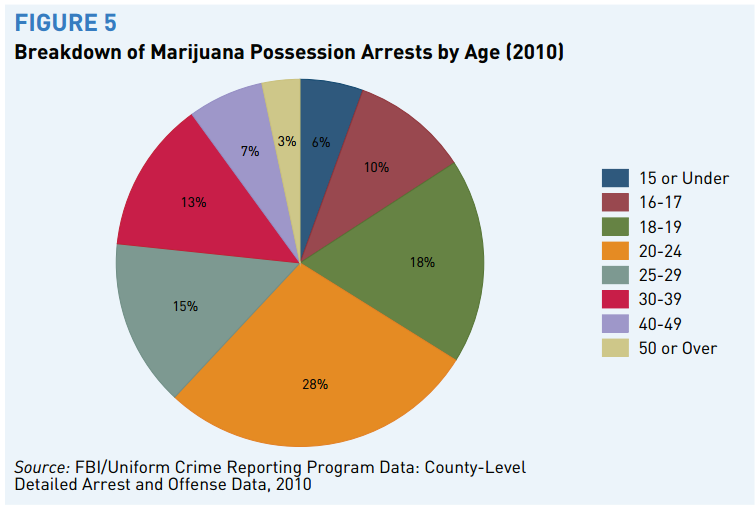
Most of these arrests are of young people.  Almost half (46%) involve 18 to 24 year olds:

Screenshot (17)

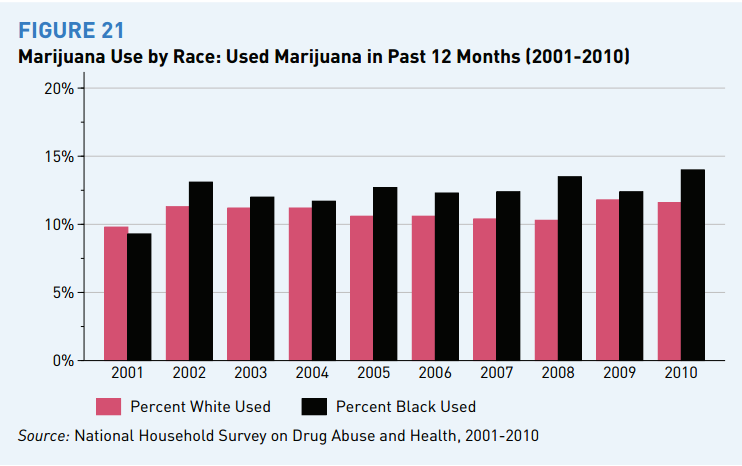
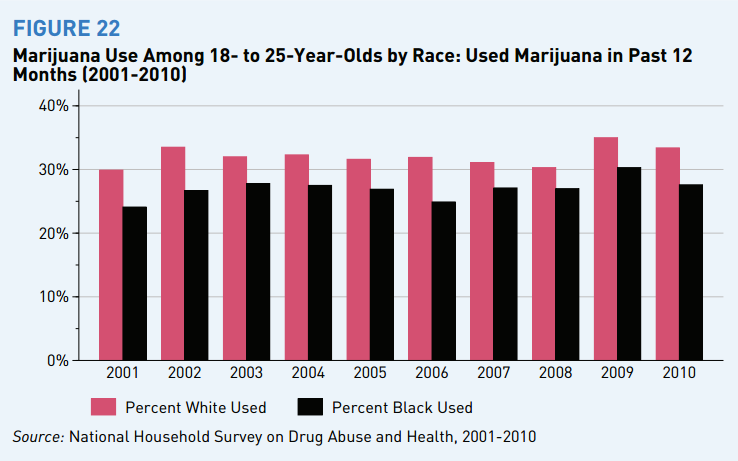
The black arrest rate cannot be attributed to different rates of use.  Overall, blacks and whites have very similar rates of marijuana use (the first figure below), but among 18 to 25 year olds — the population being arrested the most — whites have slightly higher rates than blacks (second figure):
Screenshot (15) Screenshot (16)This is a long-standing, well-documented Civil Rights issue.  The war on drugs is a war on black people.  These practices are harmful to individuals, their families, and their communities.  It functions to further the disadvantage faced by black Americans in a society rife with institutions already stacked against them.

More than half of Americans would like to see marijuana legalized.  Legalizing or decriminalizing marijuana would relieve this egregious attack on black communities and save states billions of dollars.  There is little downside.  Relative to other substances, it’s a minor problem.

Screenshot (19)Cross-posted at Pacific Standard.


Lisa Wade, PhD is an Associate Professor at Tulane University. She is the author of American Hookup, a book about college sexual culture; a textbook about gender; and a forthcoming introductory text: Terrible Magnificent Sociology. You can follow her on Twitter and Instagram.
3Thanks to a tip from Jay Livingston, I came across this quote from The Pursuit of  Loneliness by sociologist Philip Slater.  It’s long, but wow:

[I]t can’t be denied that the female ideal in America is nonaggressive and nonthreatening, to the point of caricature.  Take for example the film personality of the much-idolized Marilyn Monroe: docile, accommodating, brainless, defenseless, totally uncentered, incapable of taking up for herself or knowing what she wants or needs. A sexual encounter with such a woman in real life would border on rape – the idea of “consenting adults” wouldn’t even apply.  The term “perversion” seems more appropriate for this kind of yearning than for homosexuality or bestiality, since it isn’t directed toward a complete being.  The Marilyn Monroe image was the ideal sex object for the sexually crippled and anxious male: a bland erotic pudding that would never upset his delicate stomach.

It’s important to realize that this Playboy ideal is a sign of low, rather than high, sexual energy.  It suggests that the sexual flame is so faint and wavering that a whole person would overwhelm and extinguish it.  Only a vapid, compliant ninny-fantasy can keep it alive. It’s designed for men who don’t really like sex but need it for tension-release – men whose libido is wrapped up in achievement or dreams of glory.

Slater wrote this passage in 1970, hence the reference to Marilyn Monroe.  I would have to think hard about whether I think it still applies broadly, but I think it’s fair to say that the “bland erotic pudding” is still part of the repertoire of essentially every female celebrity who is successful in part because of her appearance.  I did a search for some of the most high-profile female actresses and singers today, looking specifically for images that might fit Slater’s description.  I invite your thoughts.

1

Lisa Wade, PhD is an Associate Professor at Tulane University. She is the author of American Hookup, a book about college sexual culture; a textbook about gender; and a forthcoming introductory text: Terrible Magnificent Sociology. You can follow her on Twitter and Instagram.
B.A. in Sociology, Morehouse College, Class of 1948. 

Image at HBCU.

Lisa Wade, PhD is an Associate Professor at Tulane University. She is the author of American Hookup, a book about college sexual culture; a textbook about gender; and a forthcoming introductory text: Terrible Magnificent Sociology. You can follow her on Twitter and Instagram.
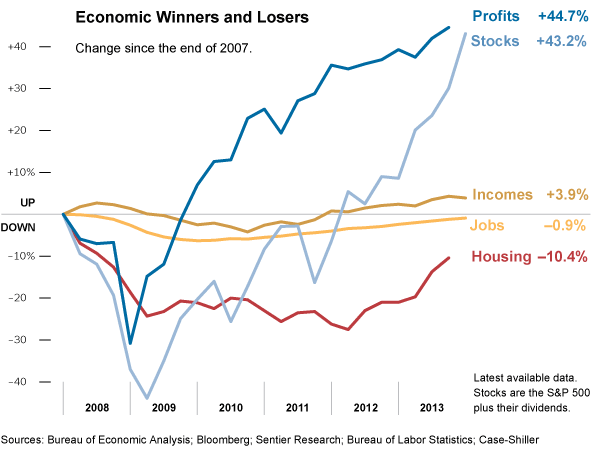
Officially our most recent recession began December 2007 and ended June 2009.  The following chart provides an important perspective on the recovery period.

1

Stocks and profits have enjoyed a remarkable recovery.  While income is slightly up over the period, it is critical to remember that this is average income and the increase largely reflects gains for those at the very top of the income distribution.  Jobs and housing have yet to recover.

So, with returns to capital booming, it is easy to understand why business leaders are relatively content with current policies and, by extension, political leaders are reluctant to rock the boat.

Unfortunately, current policies are unlikely to do much to improve the job prospects or income of most workers.  In fact, the rise in business profits owes much to our depressed labor conditions.  Unless something dramatic happens, we can expect the next few years to look very much like the past few years.

Cross-posted at Reports from the Economic Front and Pacific Standard.

Martin Hart-Landsberg is a professor of economics at Lewis and Clark College. You can follow him at Reports from the Economic Front.