Archive: 2010

In this video, sent in by Martha, Lindsay Ellis asks why it is that female characters in general-audience cartoons, if present at all, are always plot points for the male characters. Her point is clearly sound, but damn does she marshal the evidence!  She appears to have really done her homework… but I have no doubt that those of you who are experts in My Little Pony, Transformers, Scooby Do, and She-Ra will have something to add.

Here’s another video on the same topic:

For more on the phenomenon in which women are women and men are people, see our analysis of the “Human” Bodies exhibit, girls as an afterthought, dinosaurs are for boys (and girls), traffic lights with female figures, stick figures and stick figures who parent, and default avatars.

Lisa Wade, PhD is an Associate Professor at Tulane University. She is the author of American Hookup, a book about college sexual culture; a textbook about gender; and a forthcoming introductory text: Terrible Magnificent Sociology. You can follow her on Twitter and Instagram.
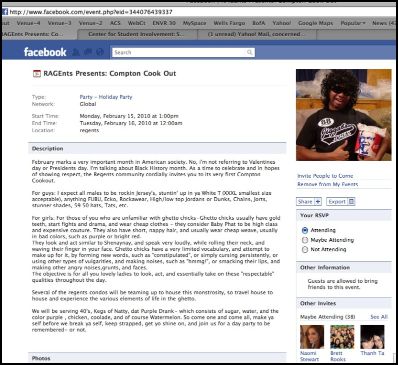
Members of PIKE fraternity at the University of California, San Diego came under fire this month for hosting a party, called” The Compton Cookout,” designed to mock black Americans and Black history month (less than 2% of UCSD students are black).  People are shocked and horrified, and rightly so, though it’s just one in what seems to be a constant stream of such parties.  Becca C. asked us to post about it.

Its Facebook page shown below (which, interestingly, is part of what made the party visible enough to protest) explicitly describes how people are to dress and act (trigger warning; it’s quite upsetting):

February marks a very important month in American society. No, i’m not referring to Valentines day or Presidents day. I’m talking about Black History month. As a time to celebrate and in hopes of showing respect, the Regents community cordially invites you to its very first Compton Cookout.

For guys: I expect all males to be rockin Jersey’s, stuntin’ up in ya White T (XXXL smallest size acceptable), anything FUBU, Ecko, Rockawear, High/low top Jordans or Dunks, Chains, Jorts, stunner shades, 59 50 hats, Tats, etc.

For girls: For those of you who are unfamiliar with ghetto chicks-Ghetto chicks usually have gold teeth, start fights and drama, and wear cheap clothes – they consider Baby Phat to be high class and expensive couture. They also have short, nappy hair, and usually wear cheap weave, usually in bad colors, such as purple or bright red. They look and act similar to Shenaynay, and speak very loudly, while rolling their neck, and waving their finger in your face. Ghetto chicks have a very limited vocabulary, and attempt to make up for it, by forming new words, such as “constipulated”, or simply cursing persistently, or using other types of vulgarities, and making noises, such as “hmmg!”, or smacking their lips, and making other angry noises, grunts, and faces. The objective is for all you lovely ladies to look, act, and essentially take on these “respectable” qualities throughout the day (transcription borrowed from Threadbared).

The page:

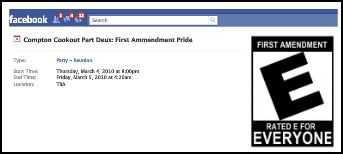
When the first Facebook page was taken down, a student put up a second page in objection (Compton Cookout Part Deux: First Amendment Pride):

A diverse group of students, with the support of many faculty, protested the administration’s slow response to the event (chronicled at Stop Racism UCSD). But the vocal resistance to the overt prejudice and hateful stereotyping created a counter-resistance.  A student-run TV station defended the party with racial epithets and, then, a student hung a noose in the library:

UPDATE (Mar. ’10): This was followed by a KKK hood, made from a pillow case, found on a campus statue’s head (hap tip to Becca).

This is sociologically interesting because it illustrates the backlash phenomenon.  Backlash is a common response to any effort to point out or undermine prejudice, discrimination, and inequality.  We’ve posted about it in response to racist products (Mr. Wasabi, the Black “Lil’ Monkey” doll, and the Obama sock monkey) as well as anti-rape campaigns.  As I wrote in a previous post:

…resistance to oppression is met with counter-resistance.  Until inequality is challenged, things often seem to be just fine; when groups stand up and demand equality, we suddenly see how fiercely people will defend their privilege.

Remember, the Klu Klux Klan emerged only after slaves had been emancipated; whites didn’t need to put black people in their place when they were in their place.  Those who are protesting the Compton Cookout, by not standing by and letting the (largely white) administration address (or fail to address) the party as it pleases, are refusing to stay in their place.  The backlash is proof that they are actually perceived to be a threat.

NOTE: A commenter claims that the party was organized by the PIKE, SIGMA CHI and SIGMA NU fraternities, not just the PIKE fraternity.  I read in a news report that it was PIKE, but it could be wrong.

Lisa Wade, PhD is an Associate Professor at Tulane University. She is the author of American Hookup, a book about college sexual culture; a textbook about gender; and a forthcoming introductory text: Terrible Magnificent Sociology. You can follow her on Twitter and Instagram.
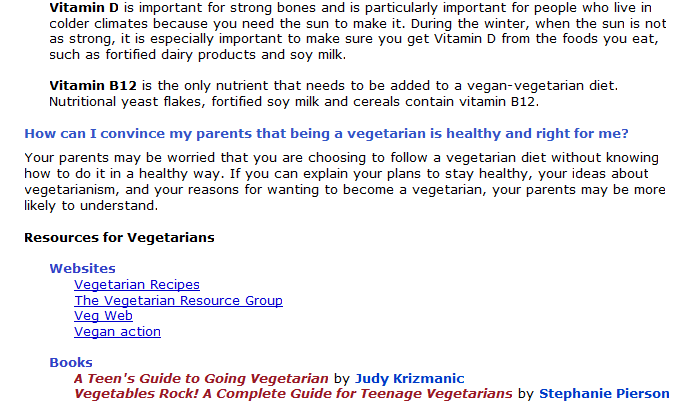
Christopher R. noticed that the sibling sites www.youngwomenshealth.org and www.youngmenshealthsite.org had nearly identical advice for being vegetarian or vegan, except for one small detail.  He writes:

Both pages are generally the same (pretty much word for word), except for the last section on convincing parents to let you be vegetarian. The female version includes the suggestion “read vegetarian cookbooks or nutritional information with your parents and offer to help with the shopping and cooking,” as well as an extra article titled “What are some healthy meals that I can prepare?” I guess the difference between male and female vegetarians is their ability to cook and shop.

Screen shot of the male version:

Screen shot of the female version:

Also, pink and blue!  Of course!

Lisa Wade, PhD is an Associate Professor at Tulane University. She is the author of American Hookup, a book about college sexual culture; a textbook about gender; and a forthcoming introductory text: Terrible Magnificent Sociology. You can follow her on Twitter and Instagram.

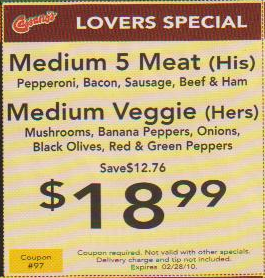
Lynne S. clipped this coupon for a “lovers special” at Cassano’s Pizza.  Notice it both presumes heterosexuality and genders meat as masculine and veggies as feminine.

We saw the same gendering of food in the Brick House Tavern Menu, TV dinner categories, and a vintage Campbell’s soup ad.

Lisa Wade, PhD is an Associate Professor at Tulane University. She is the author of American Hookup, a book about college sexual culture; a textbook about gender; and a forthcoming introductory text: Terrible Magnificent Sociology. You can follow her on Twitter and Instagram.
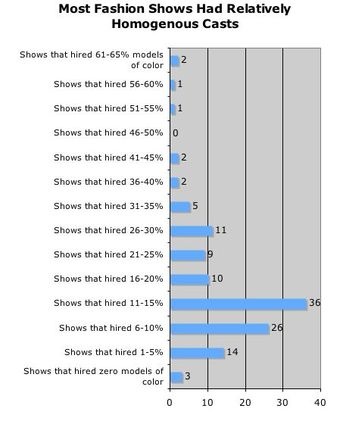
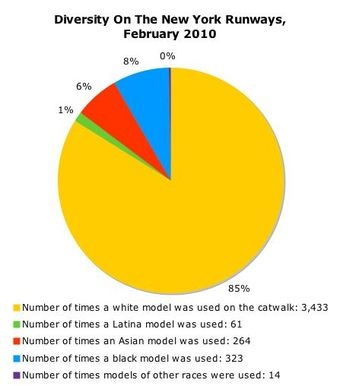
Dmitriy T.M. sent us a link to Jezebel’s analysis of the inclusion of models of color at New York fashion weeks.  The post author, Jenna, begins:

…in the fall of 2007 that fully one-third of shows in New York had 100% white casts. Two years later, we calculated that 18% of spots in show lineups were booked by models of color — a real improvement in the representation of black, Latina, and Asian faces in the crucible where the beauty standard is forged.

This season, fashion took a step back.

Of 4,095 turns on the runway, only 662 went to models who weren’t white. That’s barely 16%.

More:

Most of the shows that took place used some models of color — just three designers, A Détacher, Alice + Olivia (full disclosure: an old client of mine), and Preen, chose exclusively white casts — but many used very few. Well over 60% of the shows, in fact, used casts that were 85% white, or more.

Most of the shows that took place used some models of color — just three designers, A Détacher, Alice + Olivia (full disclosure: an old client of mine), and Preen, chose exclusively white casts — but many used very few. Well over 60% of the shows, in fact, used casts that were 85% white, or more.

More details on the data, and the models, at Jezebel.

Lisa Wade, PhD is an Associate Professor at Tulane University. She is the author of American Hookup, a book about college sexual culture; a textbook about gender; and a forthcoming introductory text: Terrible Magnificent Sociology. You can follow her on Twitter and Instagram.

Mihai L. sent in a Romanian commercial for wafers that suggests that women have been slowing down progress and re-writing history since the cavewoman days!

With subtitles:

Lisa Wade, PhD is an Associate Professor at Tulane University. She is the author of American Hookup, a book about college sexual culture; a textbook about gender; and a forthcoming introductory text: Terrible Magnificent Sociology. You can follow her on Twitter and Instagram.
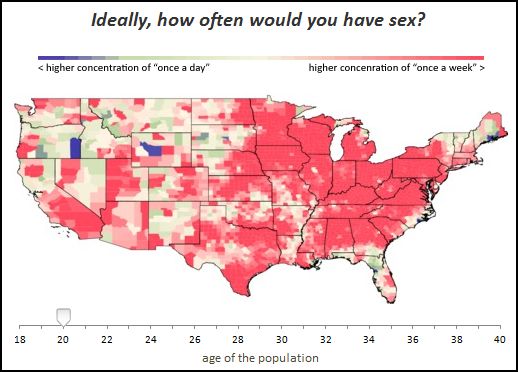
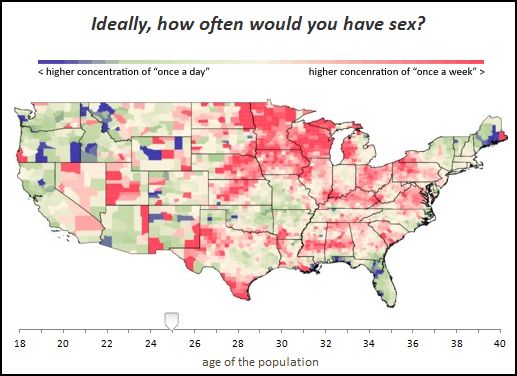
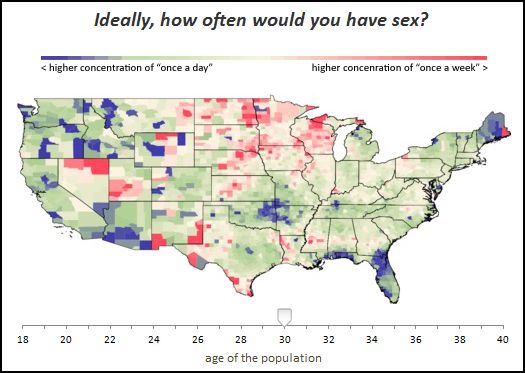
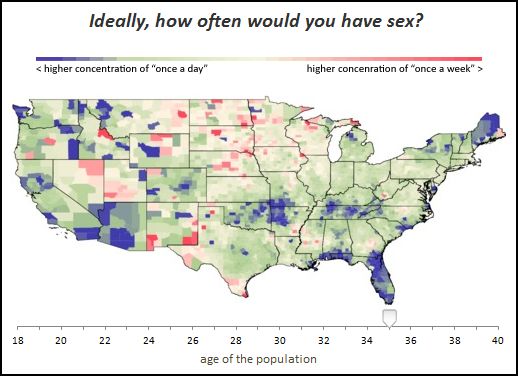
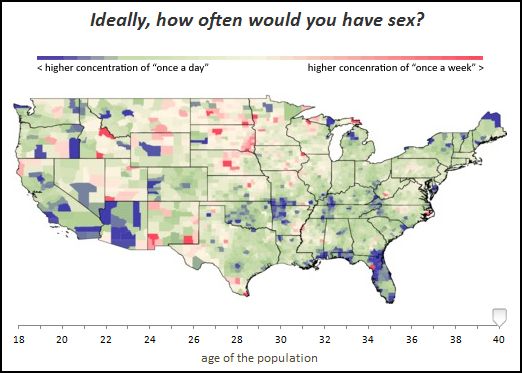
Claire P. and Jessica Sherwood, of the Sociologists for Women in Society, sent in a link to some data, from OK Cupid, on women’s preferences for frequency of sex by county.  The uptake: Women’s preferences for the incidence of sex goes up as they age.  You can check out the interactive map, or just check out my screen shots below.

Preferences at age 20 (red = higher preference for once a week; blue = higher preference for once a day; white = in the middle):

Preferences at age 25:

Preferences at age 30:

Preferences at age 35:

Preferences at age 40:

Also from OK Cupid: the racial politics of dating, what women want, and men’s preference for younger women.

Lisa Wade, PhD is an Associate Professor at Tulane University. She is the author of American Hookup, a book about college sexual culture; a textbook about gender; and a forthcoming introductory text: Terrible Magnificent Sociology. You can follow her on Twitter and Instagram.
Dmitriy T.M. reminded me of this classic performance of the song “America” from a classic American musical, West Side Story (1961; it won 10 Academy Awards, including Best Picture).  The song features white New Yorkers and Puerto Rican immigrants debating about the benefits of living in America.  The “streets paved with gold” mythology is articulated by the women at the same time that the white men remind them that they face racism and poverty.

Also, Rita Moreno is awesome:

UPDATE: Commenter Jesse W. says,

…as a theater nerd, I wanted to point out it’s not a debate between white New Yorkers and Puerto Ricans, I think you just get that impression from the bad casting. They’re all supposed to be Puerto Rican; it’s more of a battle of the sexes between the men who wanted to stay in the old country and the women who wanted to come to America.

And Laura says,

…the women are arguing with the men that America is great, and they prefer it to Puerto Rico, and the men are arguing that America is racist and oppressive.

Lisa Wade, PhD is an Associate Professor at Tulane University. She is the author of American Hookup, a book about college sexual culture; a textbook about gender; and a forthcoming introductory text: Terrible Magnificent Sociology. You can follow her on Twitter and Instagram.