Archive: 2010

Boy, you can’t open the paper these days without seeing something about how irrevocably fucked California’s finances are. With a budget deficit approaching a staggering $40 billion dollars, it’s worth noting that not only is their deficit the biggest in the country in absolute terms but also as a proportion of state GDP. That’s pretty impressive given that California’s economy is bigger than all but a handful of countries.

In my line of work, “Raiding the UCs” is a very real phenomenon. Faculty have seen salaries slashed by 20% (with talk of more cuts to come) while students have experienced dramatic tuition hikes – although it’s fair to note that in-state tuition before the hikes was far lower than in most states. The recent cuts come on the tail end of a 15 year trend that has seen the university system’s share of the state budget halved. With too many obligations and not enough money, it would make sense that cuts to a vital sector like education would be indicative of cuts across the board.

Oh.

Lost in the budget debate is the fact that California spends nearly 10% of its annual budget on the Department of Corrections. Eight billion dollars. Let’s see that with the zeroes: $8,000,000,000. This is, of course, in addition to other money spent on law enforcement and the criminal justice system. Such figures look reasonable only in comparison to a trainwreck like Michigan, where a mind-blowing 22% of the state budget is spent on warehousing the poor in prisons.

We can re-hash all the usual, obvious, and valid culprits – “guideline” sentencing, mandatory minimums, three strikes, a vast social underclass deriving minimal benefit from the state’s aggregate wealth – but we’d say nothing new. The more important questions is how prison systems, and California’s in particular, can absorb the coming increase in crime concomitant with an extended period of double digit unemployment. At a time when every agency needs to get cheaper, the CDC must continue to get bigger (and inevitably costlier) to provide a convenient dumping ground for society’s expendables.

This problem is fascinating because like the Federal budget there is no reasonable move that doesn’t make the situation worse. California can start paroling more people. With no jobs available even for Californians with clean criminal backgrounds, we can imagine how few ex-inmates will find an “honest” living and how high the rate of recidivism will be. It can adopt different sentencing guidelines, which is politically unlikely and will provide only gradual long-term relief. They can simply stop arresting and/or charging so many people, but that too is politically infeasible and may ultimately lead to increased crime levels. They can, as publications as mainstream as Time have noted, formally surrender in the War on Drugs and legalize weed. I will believe that when I see it (although I don’t entirely discount it as the budget situation gets progressively more desperate). They could simply slash the budget, which may not be realistic given the high fixed costs of the system and the current levels of overcrowding/understaffing.

Spending twice as much on prisons as higher education should prompt some soul searching. I won’t hold my breath; in all likelihood the status quo will be maintained and the share of the budget devoted to corrections will continue to increase. Devoting one of every ten tax dollars to locking up the poor is understood as the cost of doing business in a state and society that choose to solve the problem of a persistent underclass the same way it deals with trash; that is, by collecting it in cities and shipping it out to the middle of nowhere to be buried under a mountain of other garbage, never to be seen or thought of again.

—————————–

Ed is a Political Scientist who claims to finds “the spatial and geographic context of political behavior — partisanship, turnout, and public opinion” — particularly thrilling.  You can learn more, vaguely inappropriate, things about Ed here.  In the meantime, we’re thrilled to feature his post questioning California’s questionable budget priorities. He blogs at Gin and Tacos.

If you would like to write a post for Sociological Images, please see our Guidelines for Guest Bloggers.
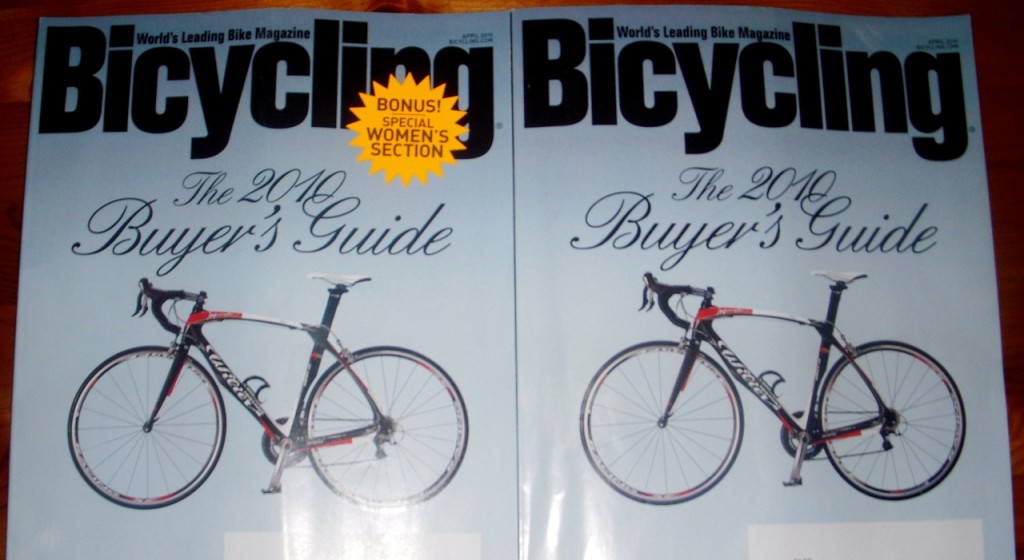
Reader Clifford McC. and his (female) partner both receive Bicycling magazine (which, he explains, is more of a free advertisement that they get whether they want to or not).  In any case, this month’s issue was the 2010 Buyer’s Guide and, though the issues each received were identical, the one addressed to his partner was stickered:

The sticker read, “BONUS! SPECIAL WOMEN’S SECTION.”

Perhaps they were trying to be inclusive, but a sticker advertising a special women’s section just goes to show that the magazine is, first-and-foremost, for men.

For the same phenomenon elsewhere, see our posts featuring websites selling dinosaur toys and Legos(see “exhibit three”), each with a special section for girls.

Lisa Wade, PhD is an Associate Professor at Tulane University. She is the author of American Hookup, a book about college sexual culture; a textbook about gender; and a forthcoming introductory text: Terrible Magnificent Sociology. You can follow her on Twitter and Instagram.

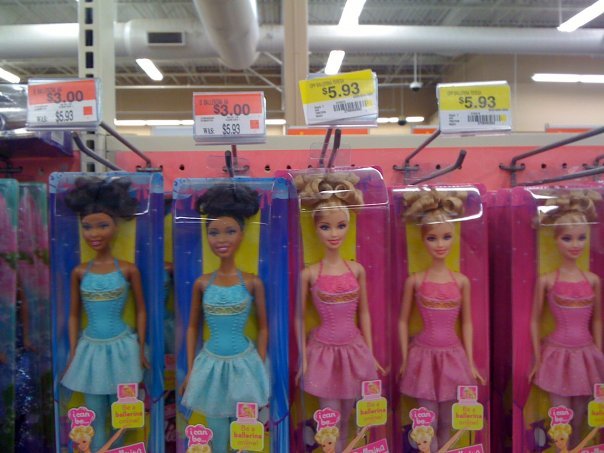
db, Lindsey B., and ABC News asked us to talk about the recent scandal over Walmart pricing a darker-skinned version of the Ballerina Theresa doll less than its white counterpart.  The evidence (from FunnyJunk):

Walmart claimed that the doll was priced less because they were trying to move inventory (ABC News).  It’s possible that the doll wasn’t selling (low demand) or they had ordered more than they could sell (high supply) and so the doll went on sale.  In fact, we know that people of all colors tend to absorb a color hierarchy in which whiteness is nicer, more beautiful, and more valuable (test your unconscious preferences here), so maybe the white doll WAS outselling the non-white doll because both white and non-white people were buying it, but not the darker-skinned doll.  Walmart, in this case, would only be following the market so as to maximize profits.

Walmart, however, could have chosen, in this case, to opt out of profit maximization.  The market isn’t physics; a company doesn’t have to follow its laws.  Walmart could have said, “You know, putting the dark-skinned doll on sale symbolically values whiteness higher than blackness.  Perpetuating that stereotype isn’t worth the money.”  That is, they could have decided that anti-racism trumped profits.

But they didn’t.

It’s important to say that I know of no study showing that, as a rule, white dolls are priced higher or are less likely to go on sale than other dolls.  It may be true that, if we were paying attention, we’d see all kinds of disparate pricing and it wouldn’t pattern itself on race.  Even in this case, I still think that companies need to be cognizant of the context in which they price their products.  In fact, I will go so far as to say that I think it is perfectly fine to discount white dolls while other dolls are left undiscounted, but not vice versa.  Why?  Because we live in a world where discounting dark-skinned dolls resonates with a discourse the symbolically devalues dark-skinned human beings.  Discounting white dolls simply does not carry the same problematic message.

Costco faced this kind of problem when it’s black Lil’ Monkey doll was pulled from shelves.  It turned out that the Lil’ Monkey doll came in three different races, but the black doll carried connotations that the others did not because black people have been compared to primates for centuries in an effort to dehumanize them.  A black Lil’ Monkey is wholly inappropriate in a way that a white Lil’ Monkey is not.

Companies make and sell products in a context.  Following market demands is not opting out; often, it reproduces the status quo.

NEW (Mar. ’10)! Sarah G., after seeing a different post on a multicultural cast of Barbies, looked them up on Target only to discover that the light-skinned Barbies were all priced at $19.99 and the dark-skinned Barbies were all priced at $19.95.  Here are all of the Barbies:

I don’t know, people.  I just don’t know.

See another example here.

NEW! (July ’10): Christine B. sent in images from Target that show Black Baby Alive dolls (two different types) on clearance (down from $19.29 to $13.50) while the White versions aren’t; the Black dolls are clearly marked on the shelf and with individual stickers:

Lisa Wade, PhD is an Associate Professor at Tulane University. She is the author of American Hookup, a book about college sexual culture; a textbook about gender; and a forthcoming introductory text: Terrible Magnificent Sociology. You can follow her on Twitter and Instagram.

Prolific sender-inner Dmitriy T.M. sent in some maps found at F.A.D. that illustrate where various agricultural items are produced. This one shows the population density of cows (pink), pigs (yellow), sheep/goats (turquoise), chickens (blue), and turkeys (green); the darker the shade of each color, the higher the density. Note that the data is broken down at the county level:

You can see a larger image here, where it’s easier to read the info at the bottom about the highest population density for each animal, per square mile: Cows = 700, pigs = 2,800, sheep/goats = 85, chickens = 75,000, turkeys = 5,500. I suspect the highest density for cattle is based on a county with a lot of feedlots, which put many more cattle in a small space than you’d see on grazing lands.

Notice the high levels of production of chickens throughout the southeast. This is a relatively new occurrence; poultry producers moved into the region due to lower wages and fewer environmental regulations compared to other areas, making it less likely their huge containment facilities would lead to a lot of opposition.

The low densities of sheep/goats are due to a few things. Most obviously, there isn’t nearly as much of a market for sheep or goat meat in the U.S. as for other meats, so they aren’t produced in large numbers. Beyond that, they’re more likely to be raised by people with a small amount of land, or even in a back yard, because they don’t need a lot of space, so you don’t have to have a lot of grazing land devoted just to them the way you do with cattle (though in the western states there certainly are very large herds).

Random bit of info: in the U.S., wool production is just a by-product of sheep meat production in most cases. I worked on a sheep ranch for a few months; they sheared their sheep just to reduce the weight the sheep had to carry around and the chance of overheating. The amount they got for the fleeces just barely covered the cost of hiring a shearing crew. The real profit was in selling the lambs for meat.

Also: you think lambs are super cute, with the jumping and baa-ing and all, but when you have to bottle-feed 40 of them twice a day, they quickly lose their allure. [Note: since commenters are already getting worked up about this being my way of justifying my brutality toward animals, I’ll just state that I’m a vegetarian, so that line of reasoning isn’t going to get you far. That is entirely irrelevant to how exhausting it got to feed lambs.]

Here we have % of land in each county devoted to corn (gold), wheat (green), soybeans (pink), cotton (blue), hay (yellow), and fruits/nuts/veggies (red):

Larger version here.

Dmitriy also sent in an image from GOOD that shows where the various elements that go into a taco in the U.S. come from, and how far they travel on average. I can’t get it large enough here to read the info on the various ingredients, but there’s a larger version here.

From the article on GOOD:

The various spices in the Adobo seasoning, for instance, had traveled a combined 15,000 miles. The avocados had traveled from Chile, home of the world’s largest avocado grower (a company that was said to produce 300 million fruit per year). The rice was imported from Thailand, despite an abundance of California-grown rice, and was packaged under an array of brand names.

Related posts: feeding a city, Unilever encourages local eating, and the global distribution of Starbucks and McDonald’s, ownership of organic brands.

Dmitriy T.M., Christina W., Kelly V., and George asked us to comment on Vajazzling. Dmitriy, who sent in the video link, said he was too frightened to press play, but I am very brave and now I know what vajazzling really is! It’s hard to know because the term “vajayjay” is, um, who knows what that word means… and the term “vagina” (which actually refers to what is otherwise known as the birth canal) is now used to mean the vulva and, apparently, anything within 12 inches of it.

In any case, the video below, in which a woman documents the vajazzling of her “vagina,” reveals that the term refers to the placing of a field of tiny crystals where your public hair would be. So, you essentially replace your pubic hair with shiny objects.

So, brave souls who pressed play, sociologically analyze away.

Lisa Wade, PhD is an Associate Professor at Tulane University. She is the author of American Hookup, a book about college sexual culture; a textbook about gender; and a forthcoming introductory text: Terrible Magnificent Sociology. You can follow her on Twitter and Instagram.

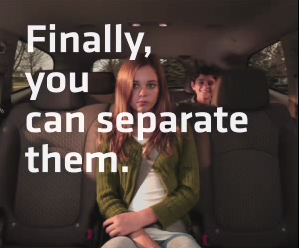
E. W. sent in a three-page internet ad for the 2010 Chevy Traverse.  The Traverse seats eight, but the ad campaign suggests that it is perfect for just four.  E.W. offers the play-by-play:

The first image of the ad shows a young boy and girl in the first row of seats in an SUV.  They are separated by at least a foot of space.  The young boy is poking the girl (presumably his sister) in the shoulder.

The following images show the two kids in various seating arrangements where they are always separated by the seating rows (one in front and one in back).

The end tag (car-two) states “Finally, you can separate them.”

“To summarize the ad in my words,” said E.W., “Buy a car that can seat 6 kids because you can’t control your 2.”

Or, in my words, in the face of an economic crisis peppered with sky-high fuel prices, we are desperate for another way to try to convince Americans that they need giant cars.

Lisa Wade, PhD is an Associate Professor at Tulane University. She is the author of American Hookup, a book about college sexual culture; a textbook about gender; and a forthcoming introductory text: Terrible Magnificent Sociology. You can follow her on Twitter and Instagram.

If you’re interested, I wrote a piece for The Daily Mirror about my recent trip to the LAPD’s “Behind the Scenes” exhibit here in Vegas (which got a lot of media attention when the Kennedy family protested the inclusion of bloody clothing from Robert Kennedy’s shooting). My friend Larry was interested in the politics involved–whose personal tragedy gets put on public display? Were the displays as sensationalistic as he suspected they would be? He was particularly interested in how the case of the Black Dahlia (aka Elizabeth Short) would be presented, and what the LAPD would think was appropriate to display for public consumption.

So I agreed to go take a look. And I was horrified in so many ways. Absolutely stunned. You can find the piece here.

This is the second post using material borrowed from the essay, “Facts and Fictions About an Aging America.”  Our online host, Contexts magazine, is offering some free content, including this essay, now through March 15th.  See yesterday’s post here.

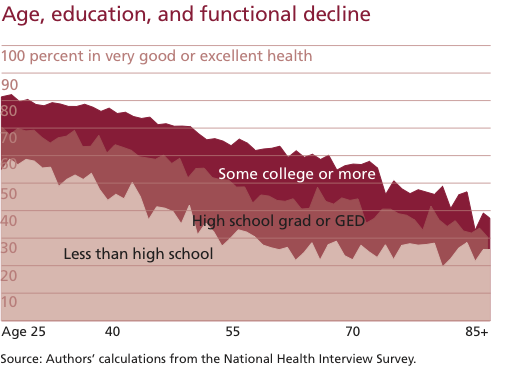
While people in industrialized countries live longer and healthier lives than ever, more educated people enjoy even less morbidity than less educated people.  The figure below illustrates the decline in mental and physical function over time for people with a college degree, a high school degree, and no degree at all:

The figure shows that more educated people experience “excellent health” than less educated at every age, except perhaps 85 and above.  Why might this be?

Well, higher educated people may come from wealthier families who were able to provide their children with health care, good nutrition, and exercise.  Having degrees may also correlate with jobs that are less harmful to the body and offer both health insurance and more free time to exercise.  Lower educational attainment is likely correlated with economic insecurity; a lifetime of struggling to make ends meet could create the kind of bad stress that interferes with both mental and physical health.

Other theories?  Thoughts on these?

Lisa Wade, PhD is an Associate Professor at Tulane University. She is the author of American Hookup, a book about college sexual culture; a textbook about gender; and a forthcoming introductory text: Terrible Magnificent Sociology. You can follow her on Twitter and Instagram.