Archive: 2010

Dan S. alerted us to an image, purportedly of an article from the May 13, 1955, episode of Housekeeping Monthly. In it there is a photo of a woman bending over an oven with a list of tips for being a good wife, such as “a good wife always knows her place.” We’ve gotten this image before and never posted on it, much like the list on “How to Be a Good Wife,” attributed around the web to a “1950s home economics textbook.”

So why haven’t we posted the image before? Because it’s a fake. According to Snopes, the list was circulating widely on its own long before it suddenly appeared with the damning image…which is a completely unrelated image from a cover of John Bull magazine (not Housekeeping Monthly) that appeared in 1957, not 1955. Notice the text along the upper right corner of the image–it says “Advertising Archives.” According to Snopes, no one has ever turned up the economics textbook the “How to Be a Good Wife” list supposedly comes from, either.

So what gives? Why do these hoax 1950s-era images/lists keep appearing? I think Snopes makes an interesting case:

It has become fashionable to portray outdated societal behaviors and attitudes — ones we now consider desperately wrongheaded — to be worse than they really were as a way of making a point about how much we’ve improved. When we despair over the human condition and feel the need for a little pat on the back, a few startling comparisons between us modern enlightened folks and those terrible neanderthals of yesteryear give us that. We go away from such readings a bit proud of how we’ve pulled ourselves up by our bootstraps and with our halos a bit more brightly burnished.

The juxtaposition of wonderful modernity with a tawdry past also serves to reinforce the ‘rightness’ of current societal stances by  making any other positions appear ludicrous. It reminds folks of the importance of holding on to these newer ways of thinking and to caution them against falling back into older patterns which may be more comfortable but less socially desirable. Such reinforcement works on the principle that if you won’t do a good thing just for its own sake, you’ll surely do it to avoid being laughed at and looked down upon by your peers.

A typical vessel for this sort of comparison is the fabricated or misrepresented bit of text from the “olden days,” some document that purportedly demonstrates how our ancestors endured difficult lives amidst people who once held truly despicable beliefs.

Of course, as the Snopes article goes on to discuss, all kinds of very sexist stuff existed in the ’50s, and there were home-ec textbooks, magazines, etc., that included suggestions along the lines of those listed above.

Given that, it’s not shocking that when we see images of this sort, they immediately seem authentic, and get re-posted around the web despite the sketchy aspects of their origin stories. It’s not like we’ve never posted anything on Soc Images that we later figured out was a hoax (we also get things that we hope, desperately, are hoaxes but turn out to be real).

So there’s a truth behind the general gist of these types of lists, but many of the images themselves are fakes, created to make fun of our hopelessly, and hilariously, sexist past. And given how many real examples of sexist propaganda you could find from the 1950s, it’s worth pondering we find so many fake ones, and how, for some people, they may function to delegitimate concerns about gender inequality or sexism today, because come on, ladies — look how much better we have it than our grandmas did!

Gwen Sharp is an associate professor of sociology at Nevada State College. You can follow her on Twitter at @gwensharpnv.

We’ve posted many times on the way that cleaning is gendered feminine in a way that makes women ultimately responsible for housework.  The Today segment embedded below, however, does not suggest that cleaning is a feminine task. Instead, it turns the tables by arguing that men are better at cleaning and that women need to learn how to “Clean Like a Man.”  Ah-mazing.  The second cleaning is framed as masculine, it becomes a story about men’s superiority over women.

And, of course, for men cleaning is a war (“Gather the troops,” “Establish a plan of attack,” “Plan the victory party”) and women reward themselves by drinking white wine, playing music, and watching a chick flick.

For examples of how women are responsible for the home, see help cleaning, Olympic laundry, this KFC advertisement offering moms a night off, this a commercial montage, Italian dye ad with a twist, women love to clean, homes of the future, what’s for dinner, honey?, who buys for the familyliberation through quick meals, “give it to your wife,” so easy a mom can do itmen are useless, and my husband’s an ass.

See also our historical examples of the social construction of housework: husbands “help” wives by buying machines, gadgets replace slaves, feminism by whirlpool.

Hat tip to Jezebel.

Lisa Wade, PhD is an Associate Professor at Tulane University. She is the author of American Hookup, a book about college sexual culture; a textbook about gender; and a forthcoming introductory text: Terrible Magnificent Sociology. You can follow her on Twitter and Instagram.

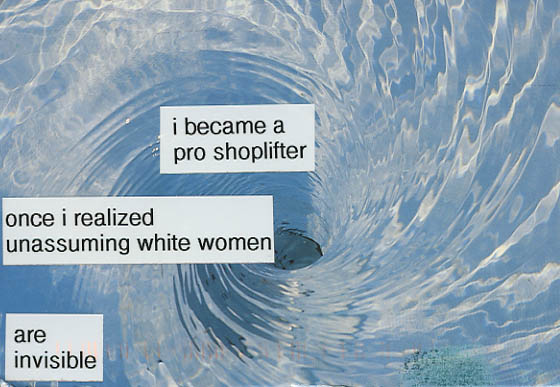
Heather J. sent along a nice illustration of white privilege, courtesy of PostSecret.  PostSecret features anonymous confessions on postcards and, in this confession, a person confesses that being white and female facilitates her shoplifting: The card is a great example of the flip side of racial profiling: those who do not carry the stigmatized features aren’t simply treated fairly, they’re given a benefit of the doubt that allows them to get away with the very thing that others are suspected of doing.

Lisa Wade, PhD is an Associate Professor at Tulane University. She is the author of American Hookup, a book about college sexual culture; a textbook about gender; and a forthcoming introductory text: Terrible Magnificent Sociology. You can follow her on Twitter and Instagram.

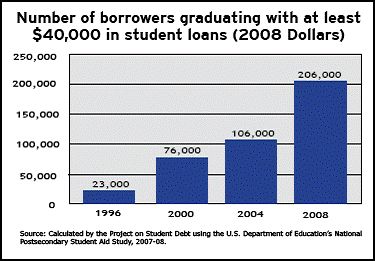
Data from The Institute for College Access and Success shows that the number of students who graduate with at least $40,000 in student loans increased nine-fold between 1996 and 2008.

Sally Raskoff at Everyday Sociologyoffers some explanations for the data:  (1)  College has been getting more expensive; among other reasons, states cut education budgets.  (2)  For-profit colleges have also become a larger proportion of all colleges and students in these colleges are more likely to take out loans.   (3)  Given a bad economy, students are less likely to have jobs while in school.  Other explanations?  Stories?

Lisa Wade, PhD is an Associate Professor at Tulane University. She is the author of American Hookup, a book about college sexual culture; a textbook about gender; and a forthcoming introductory text: Terrible Magnificent Sociology. You can follow her on Twitter and Instagram.

Amanda B. sent in this screencap of the teaser for a story on the Shape magazine website:

That is the image we’re presented as a woman who isn’t “skinny.” This photoshopped picture is, apparently, what counts as being curvy in Shape: a perfectly hour-glass figure with large breasts (that have been contour shaded/highlighted to emphasize their size and roundness).

Just to be sure you don’t think Shape is arguing that you, yourself, should accept your body the way it is, the article includes a link to Kim’s workout routine so you can “get her body.”

It’s another example of articles that pretend to be presenting an alternative to beauty standards/Hollywood ideals (be confident! Even stars have cellulite! So what?!?) but ultimately reinforce them, both by presenting images in which the featured women’s bodies differ little from those seen in the rest of the magazine and by making sure you know how to diet and exercise in order to get  your body to conform.

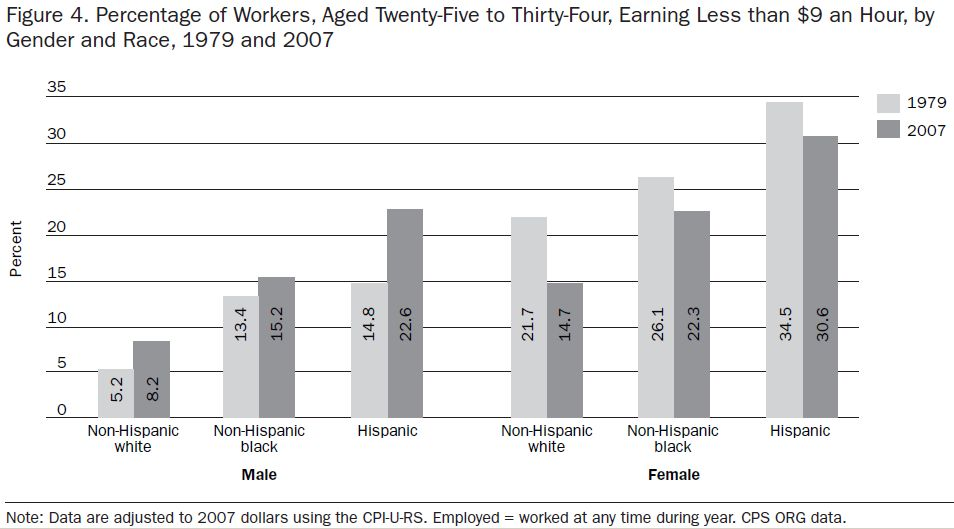
A full-time worker making nine dollars an hour cannot raise a family above the poverty line.  A paper by Sheldon Danziger and David Ratner demonstrates that fewer women survive on less than $9 an hour today than (its adjusted equivalent) in 1979.  The same cannot be said for men: The authors write:

…changes in the labor market over the past thirty-five years, such as labor-saving technological changes, increased globalization, declining unionization, and the failure of the minimum wage to keep up with inflation, have made it more difficult for young adults to attain the economic stability and self-sufficiency that are important markers of the transition to adulthood.

This is just more evidence of the shrinking of the middle class; solid working class jobs that will allow you to buy a modest home are disappearing. Hat tip to Family Inequality and Karl Bakeman’s blog.

Lisa Wade, PhD is an Associate Professor at Tulane University. She is the author of American Hookup, a book about college sexual culture; a textbook about gender; and a forthcoming introductory text: Terrible Magnificent Sociology. You can follow her on Twitter and Instagram.

Crossposted at Jezebel.

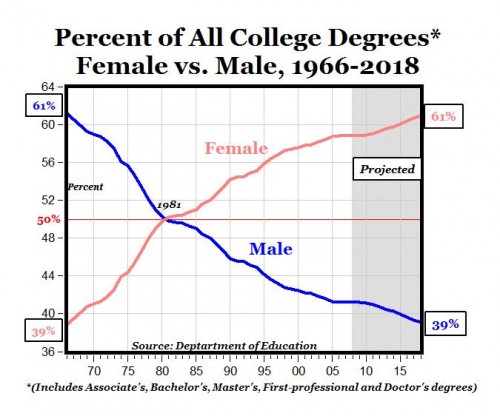
Andrea sent us a link to a post at Carpe Diem about the growing sex gap in college degrees. Current Department of Education estimates have women earning over 60% of all college degrees within 8 years:

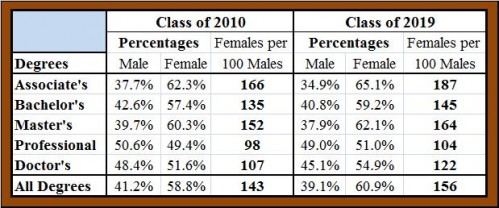
A breakdown by type of college degree:

Nothing new there, in that scholars have been aware of this pattern for a while now. The author of the post on Carpe Diem uses this data to thus argue that women’s centers are no longer needed on campuses. He also asks,

Didn’t the “journey toward equity” that is mentioned in the book [he discussed] end back in 1981 when women started earning a greater share of college degrees than men?

This comes down to a question of what equality would mean. Does equality mean simply that men and women make up about half of those in any given institution? What about the continuing differences in the types of majors men and women choose, with women particularly underrepresented in engineering and the natural sciences? Or that female college graduates still make less than male college graduates? Even among men, attendance rates vary greatly by race and class.

This isn’t to say that we shouldn’t be concerned that the gap is increasing, or that it doesn’t matter if men aren’t going to college at the same rates women are. But a bean-counting attitude toward issues of equity — that if there are equal or greater numbers of one group in an institution, they have automatically overcome any and all inequality — obscures a lot of information. For instance, a workplace could have very similar percentages of male and female employees…one group working as the lower-paid secretaries and assistants to the other.

My courses are overwhelmingly female. From that perspective, any inequity is in the direction of hurting men. On the other hand, my male students very rarely miss class because they had a sick child they had to stay home to care for or their childcare plans fell through. Issues such as sexual violence on campus, which affect female students more than male ones, might also indicate that paying attention to women’s issues on campus might not be obsolete quite yet.

Anyway, I think it’s an interesting case for starting us thinking about what sex and gender equality on campus would look like. Among other things…would men’s and women’s centers have to be mutually exclusive? Couldn’t we address the needs of male students without seeing it as a zero-sum game in which to do so we have to take away services provided to female students?

This was originally posted at Jezebel by Lindsay Robertson. Thanks to Chloe A. at Feministing for drawing our attention to it as a possible cross-post!

————————————

Last night, ABC used hidden cameras and actors to see what regular people would do if they saw an obviously abused woman being harassed by her boyfriend. A lot of regular people failed the test.

The highly-successful 20/20 spinoff What Would You Do? brings social experiments to television, using variables to test how ordinary people react to situations such as seeing someone steal a bike in a park, or witnessing a deli clerk give a blind man incorrect change. Lately, the show has been raising the stakes, and last night reporter John Quiñones showed us what restaurant diners do when they see a very obviously bruised woman getting picked on by her boyfriend at a nearby table.

As they often do, the producers used different variables to see if they changed the outcome, staging the scene with both white and African American actor “couples” to see if race affected bystanders’ willingness to step in. In both cases, the actresses were helped by fellow diners (though fewer men got involved with the African American couple):

Would You Help A Battered Woman If She Was Dressed "Provocatively"?

But then they tried a different variable: the women’s clothing. When the same actresses dressed “provocatively,” and we’re talking clothing that’s pretty average for a Saturday night, not Julia Roberts’ blue-and-white monokini-thing in Pretty Woman, nobody came to their rescue. Diners complained to the staff that the couple were “upsetting customers” and one man told the abusive boyfriend actor that the two were “embarrassing themselves as a couple,” but nothing like what happened when the women were dressed conservatively occurred in this case, and in fact, two middle-aged female witnesses joked with each other about the beaten-up woman being a prostitute.

While obviously the show is highly unscientific (notice that in the second video, the white actor is inexplicably dressed up in a suit) and meant for entertainment, it can’t be a bad thing to force viewers to think about issues such as racism or domestic violence. Maybe the next time they see someone being abused, they’ll be more likely to step up. (After all, they might be on TV!)

What Would You Do? [ABC]

Send an email to Lindsay Robertson, the author of this post, at lindsay@lindsayism.com.