empowerment

10:15 a.m. Ten minutes before my first class of the semester. It was January and Connecticut was buried under several feet of snow. Damn. There was no point trying to run over to one of my friend’s offices to find an accomplice for my exercise. I’d never make it back in time. Who could I grab for this experiment so last minute? As I pulled out my phone to check the time, I mentally smacked myself on my head. Of course!

But I should back up a bit before I go on. Every year in my Introduction to Sociology class, I like to start the first class with an experiment. This is often an exercise that introduces my students to basic sociological concepts, such as norms, cultural values, roles, and legitimate authority (since all of these are very central to what I teach in my course). In the past, my experiments have included asking students to follow me around the building without explanation and then returning to the classroom and resuming the lesson; asking them to jump around the room; asking them to switch their seats in a given pattern (first two rows move to the last two rows, the middle rows switch left and right). But this year, I wanted to do something more. Something that was blatantly wrong. My original plan was to ask a faculty colleague of mine to stand outside the classroom with me and chat past the time that class was supposed to start. But now, just minutes before my class, my friend had told me she couldn’t make it. So here I was, considering my options. And now as the solution dawned on me while I stared at my phone, I muttered, “Who needs humans in the flesh when you have a phone at your disposal.” I went over the plan in my head. “Don’t give in in less than 10 minutes… you have to make it last.” I said to myself as I took a deep breath and walked into class.

From my position behind the podium, I watched the students shuffle in without greeting them. When they were all seated I announced, “This is Introduction to Sociology. Please put all cell phones away.” I then pulled out my own cell phone, walked behind the desk, sat down and started scrolling through my email on my phone. The students sat patiently. A couple of minutes went by and no one said a word. I was getting nervous at this point myself. I giggled as if I had read something funny. Clearly, it was not an emergency that was forcing me to stay on the phone. The students started to shift in their seats a little. I looked up and glanced around the room. They looked at each other. I went back to my phone.Using smart phone

Five minutes passed, although it seemed much longer. Not being one who uses her phone very much, I was really struggling to keep busy with my phone, plus I was nervous. I made a point to look at the clock. 10:32 a.m. Seven minutes had passed since the start of class. I heard a couple of students laugh uncomfortably but no one spoke to each other. I went back to my phone and pretended to scroll through news. “Just a few more minutes,” I thought to myself. “You need to go past the ten minute mark at least.”

At 10:37 a.m., exactly 12 minutes since class was supposed to start, I put my phone away, picked up the syllabus and started class as if nothing unusual had just transpired. After going through my office hours, assignments for the semester, policy on late assignments etc. I looked around and asked, “So, what questions do you have for me?” I encouraged them to deviate from the syllabus, “Ask me anything,” I prodded, “If appropriate, I’ll answer it.” They asked me all kinds of questions . . . but not the one I was waiting for. After a while, I looked around and said, “ Is there ANYTHING else you think you should ask me about?”

The students shook their heads.
At this point my experiment was complete and it was time to let them in on it.
“Why are you here?” I asked.
Uncomfortable silence.
“No really, why are you here?”
“To learn”, a student in the front row said after a while.
“Then why didn’t you ask me to stop using my phone and teach?”
The students gave me range of obvious answers, from they don’t know what I would do in return, to they don’t want to question the professor.
“What if I told you, you are also here to un-learn?” I countered.
Uncomfortable laughter.

From here on, we had a lively discussion about the lessons learned and un-learned from this exercise. To briefly summarize:

1) The first lesson of this exercise is to understand that social norms – how we are expected to behave in a given situation—are always working on us whether we know it or not. For my students, it was their socialization in schools, the expectation that they do not question their teachers that encouraged them to not challenge my inappropriate behavior. Students could probably excuse a professor coming in late by a couple of minutes, or taking a couple of minutes to get themselves together. But I had made certain that the experiment lasted longer than ten minutes – an arbitrary choice by me, but one I felt made the experiment long enough to make the situation absurd and unreasonable.

2) This experiment also exposed the power of the “path of least resistance”, (as Allan Johnson discusses in his book, The Forest and the Trees) for my students: nobody else was questioning me, so why should they? It’s much easier to do what everyone else is doing in a given situation. This lesson is one of the most valuable one perhaps, especially as we cover the by-stander effect later on in the semester when discussing hazing in fraternities, or military abuse of prisoners for example.

3) Relatedly, it also revealed the nature of legitimate authority and obedience to authority: my students obeyed my instructions (putting cell phones away) and did not question my behavior, not because they knew who I was as an individual, but because of the authority vested in me by the title of “professor”. In our society, we see professors and teachers as generally moral, intelligent, and ethical. The authority of a professor is further emphasized by the physical structure of the classroom with the professor at the front of the room, and by the “material culture” of a classroom: desk, podium, chalkboard, and smart-board for professors. The students on the other hand, sit in chairs, physically looking up to the professor.

These are all sociological lessons that my students learn on the first day through this experiment. But implicit in this experiment is the hope that they will “un-learn” some of the behavior that they’ve been socialized into, whether it’s being a passive student or a passive by-stander. It is only through learning about and critically analyzing our social world that we are actually able to “un-learn” or challenge the many lessons we’ve been taught.

As a critical, feminist sociologist, that is the most important lesson that I can teach my students—sociology is not a collection of facts and theories, it is a perspective, a way of seeing. And as the writer Arundhati Roy says “once you see, you can’t unsee.” To this I would add: truly seeing, that is, seeing the world through a sociological lens, is the first step towards unlearning. Welcome to Introduction to Sociology.

Works Cited:

Johnson, Allan. 2014. The Forest and the Trees. Philadelphia, PA: Temple University Press.

Roy, Arundhati. 2001. “The Ladies Have Feelings, So . . . Shall We Leave it to the Experts?” In Power Politics. Cambridge, MA: South End Press.

____________________

Jafar-2015Afshan Jafar  is in the sociology department at Connecticut College. She studies globalization, gender, and the body.

In 2010, PinkRibbon.org did a “quick poll” to ask “whether commercialization of the pink ribbon adds to the cause.” They reported that 71 percent of respondents said “YES” – pink ribbon commercialization adds value. Well, there we have it! But is it true? As I wrote in the new introduction to Pink Ribbon Blues,

Breast cancer is indeed one of the most popular and profitable social causes of our time. The pink ribbon not only signifies a good and moral cause but also functions as a proxy for awareness and support. Countless promotions and publicity materials are carefully crafted to capture the hearts, minds, and wallets of eager, well-meaning consumers as imperative language echoes across the pink cultural landscape: hope, fight, win, celebrate, give – now, today, forever. The formula morphs into any number of fun-filled activities from pub crawls and fashion shows to the now commonplace runs and walks “for the cure.” While these actions offer symbolic support and raise money, they sometimes do little to help the diagnosed, promote real awareness, or impact the epidemic at large.

Public attention to breast cancer and the pink ribbon have grown over the past thirty years entwined with a medical system at once the hope and bane of the disease, situated within communities of advocacy and support that help as much as hinder, and popularized to the degree that pink consumption has become more of a trendy lifestyle choice than a rallying call for social change.

Hidden beneath the highly publicized pink ribbon celebration, the push-pull of breast cancer advocacy gave way to those with the largest megaphones, political influence, and marketing potential. As pink ribbon promotions increasingly exploited the cause for public relations purposes and to keep revenues and profit streams flowing, tenacious groups continued to work on the margins to affect the epidemic and support the diagnosed in meaningful and healthful ways.

A persistent reticence persists amid the halo of sound bites, survivorship mantras, product placements, and inattention to strategies and actions that may be more useful. These individuals and organizations go beyond fundraising and self-promotion to consider issues of bioethics, evidence-based medicine, health communication, social justice, conflicts of interest, neglected areas of research, and the limits of consumption-based advocacy. Though they diverge in the problems they tackle and the methods they use, these groups share a critical stance that fosters new thinking about breast cancer and how to address it.

In recent years members of the public have joined their voices to a chorus of serious and uncomfortable questions about breast cancer:

• Are we any closer to knowing what causes breast cancer, how to prevent it, how to keep it from coming back, and how to keep people from dying from it?

• Why are the“slash, burn, and poison” approaches to treatment still the norm?

• Are pink ribbon products outpacing efforts to provide meaningful support to the diagnosed and to influence the epidemic?

• Where does the money go, and who/what does it help?

Not long ago, outside of trusted circles, such questions would have been uttered in hushed tones. Many, including those treated for breast cancer, felt guilty for doubting a cause that was commonly accepted as overwhelmingly good. As the inner workings of pink culture and industry become more visible, largely through the misconduct of breast cancer charities and profit-driven industries, growing numbers are calling for transparency, accountability, and alternatives.


This year for breast cancer awareness month, let’s get behind those calling for change. Let’s move beyond the pink pendulum of fear mongering and feel-good, consumption.

Let’s look at the messaging for what it is.

Simple. Emotional. Symbolic. Advertising.

Breast cancer exists.

Ch4 SunSoy Image 164

Be afraid.

CheckYourself Before Its Too Late

All women are at risk.

Daughter-Sister-Mother-Friend IMG120

Have hope.

HopeIsBeautiful

Show courage.

024 CourageNightImage 20.1

Cop a feel.

ProjectBoobies

Get a mammogram.

Mammogram Billboard

Have a biopsy.

BandaidImage 283

Think Pink.

64__420x340_029-paulathinkingpink

Shoot Pink.

OLYMPUS DIGITAL CAMERA

Cheer Pink.

Atlanta Falcons cheerleaders

Jeer Pink.

Go Pink or Go HOme

Fight Pink.

226__420x340_020-ch-5-arimidex

Win Pink.

Triumphant

Walk Pink.

231__420x340_025-avonwalkad

Drive Pink.

FrenchieTruck

Eat Pink.

mmsForTheCure EgglandsBestPinkRibbonEggs

Drink Pink.

0197 Sip, Swirl, Support Wine

Porn Pink.

Porn Hub

Pee Pink.

0159 Pink Potty

Shop Pink.

102__420x340_066-shoppink-save

Spritz Pink.

Promise Me Perfume

Debit Pink.

Drill Pink.

pinkdrill

Live Pink.

Live-Laugh-Love Pink

Die Pink.

Die Pink

Women and men with, and at risk for, breast cancer deserve better. #rethinkpink

It’s different for women to collect tattoos than men. Back in the 1970s when tattooing was just starting to become an interesting, edgy way for people to express themselves, tattoo shops even had a special section of art dubbed, “for the ladies.” Little hearts and cute animals were something for women to hide away on a breast, hip, or shoulder.

Image Source: http://www.pcs.org/blog/item/janis-joplin-tattoo-trailblazer/
Image Source: PCS Blog,  http://www.pcs.org/blog/item/janis-joplin-tattoo-trailblazer/

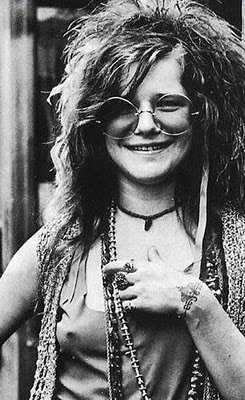
Janis Joplin popularized the small tattoo style for women after she got a  delicate Florentine bracelet tattoo on her wrist from famed tattoo artist, Lyle Tuttle at his shop in San Francisco. He went on to put the Joplin bracelet on hundreds of women. After awhile, having one or two “small, cute and hidden” tattoos became “gender appropriate,” and if the tattoos were visible, like the Joplin bracelet, small and mild was still the norm for years.

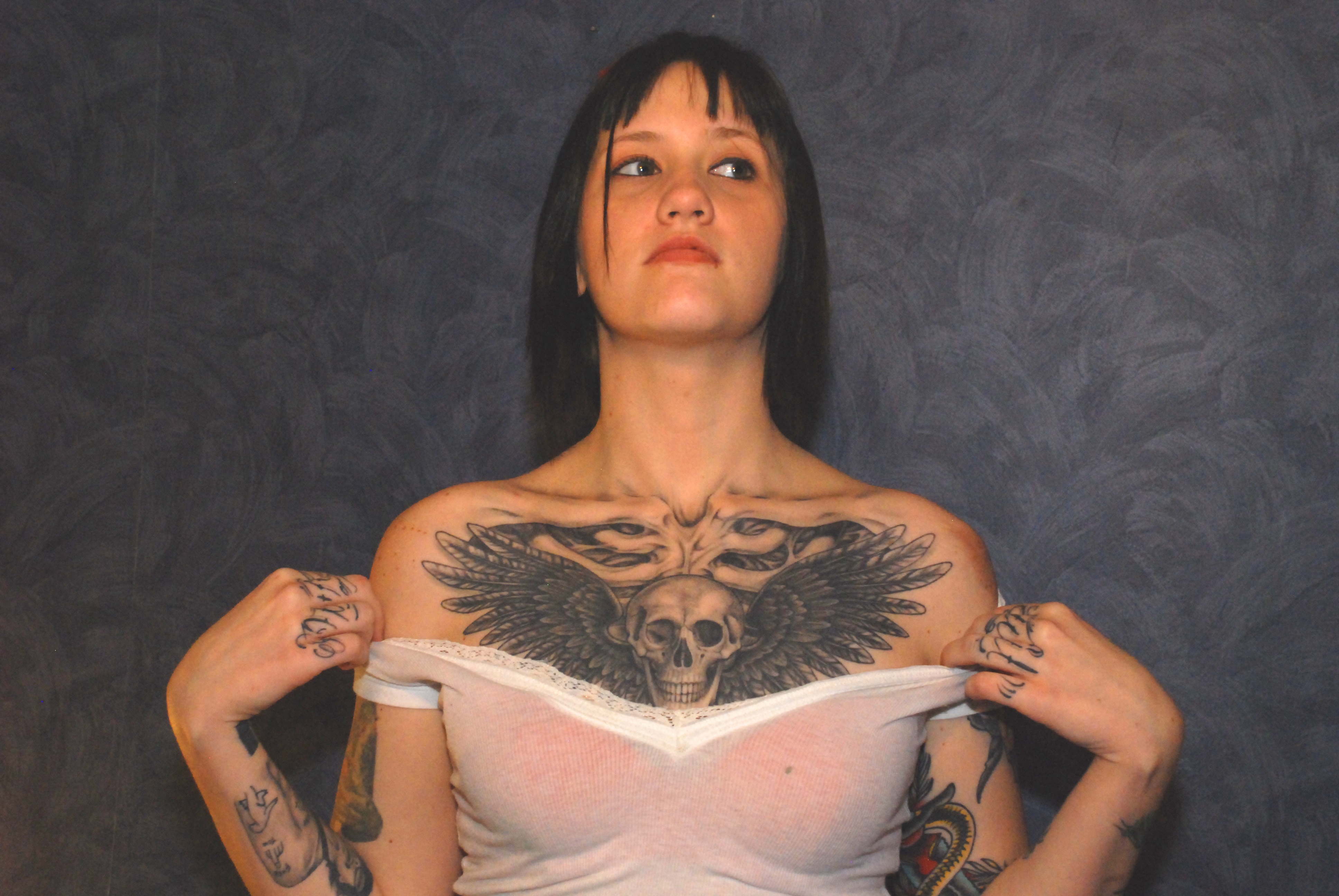
Over the last few decades, women’s ink started to creep out from under their shirts to cover their bodies in earnest, with images that are not so meek or mild. In fact, for the first time in recent U.S. history, women are beginning to outnumber men as tattoo collectors, and they are also becoming “heavily tattooed.” But if women are supposed to strive for beauty, then collecting large, visible, and not-so-cute imagery such as snakes or skulls crosses a socially appropriate gender line. It is not uncommon for heavily tattooed women to be sexually harassed with public comments, like: “You’re such a pretty girl, why would you do something like that to yourself?” In other words, why would you “make yourself ugly?” Women should be objects of beauty.

Kristen Wall
Kristen Wall, a student in Texas.

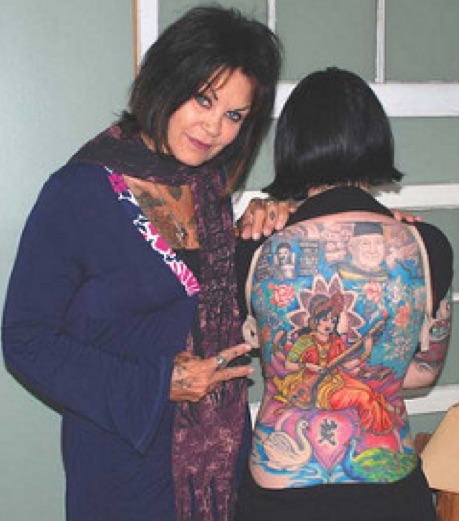
Embodied gender transgression is the topic of my recently published book, Covered in Ink: Tattoos, Women, and the Politics of the Body (NYU Press, 2015). While other tattoo ethnographies study people with one or more tattoos, Covered in Ink exclusively focuses on “heavily tattooed” women or those who violated that traditional mandate to keep their ink small, cute, and hidden.

I started this research as a heavily tattooed woman who herself wondered if her experience was representative of other women who chose to cover their bodies in ink. Did other women hide their tattoos from their fathers, or carry around a sweater in their car for last minute tattoo hiding, as they went about their day? Did strangers approach them and to touch their skin without permission? Was it common for them to worry about losing their jobs, in the chance that a tattoo might pop out from under their sleeve?

tampaTattooFest_contest
Tampa Tattoo Fest 2007 hosted a tattooed women beauty contest.

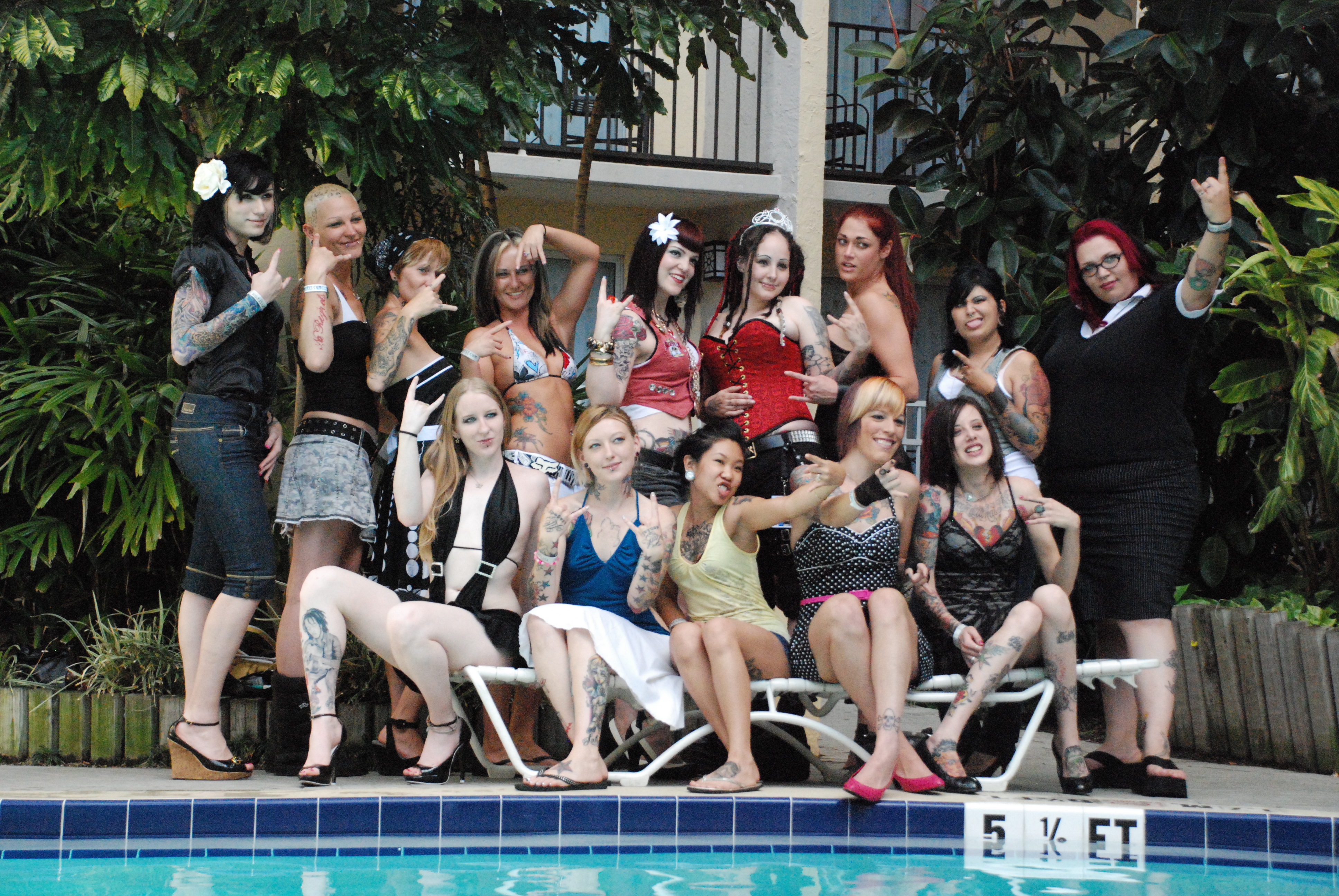
From 2007 when I attended my first Marked for Life all-female tattoo convention held annually in Orlando in January until 2010, I traveled to tattoo studios, conventions, and the homes of seventy women tattoo artists and collectors.

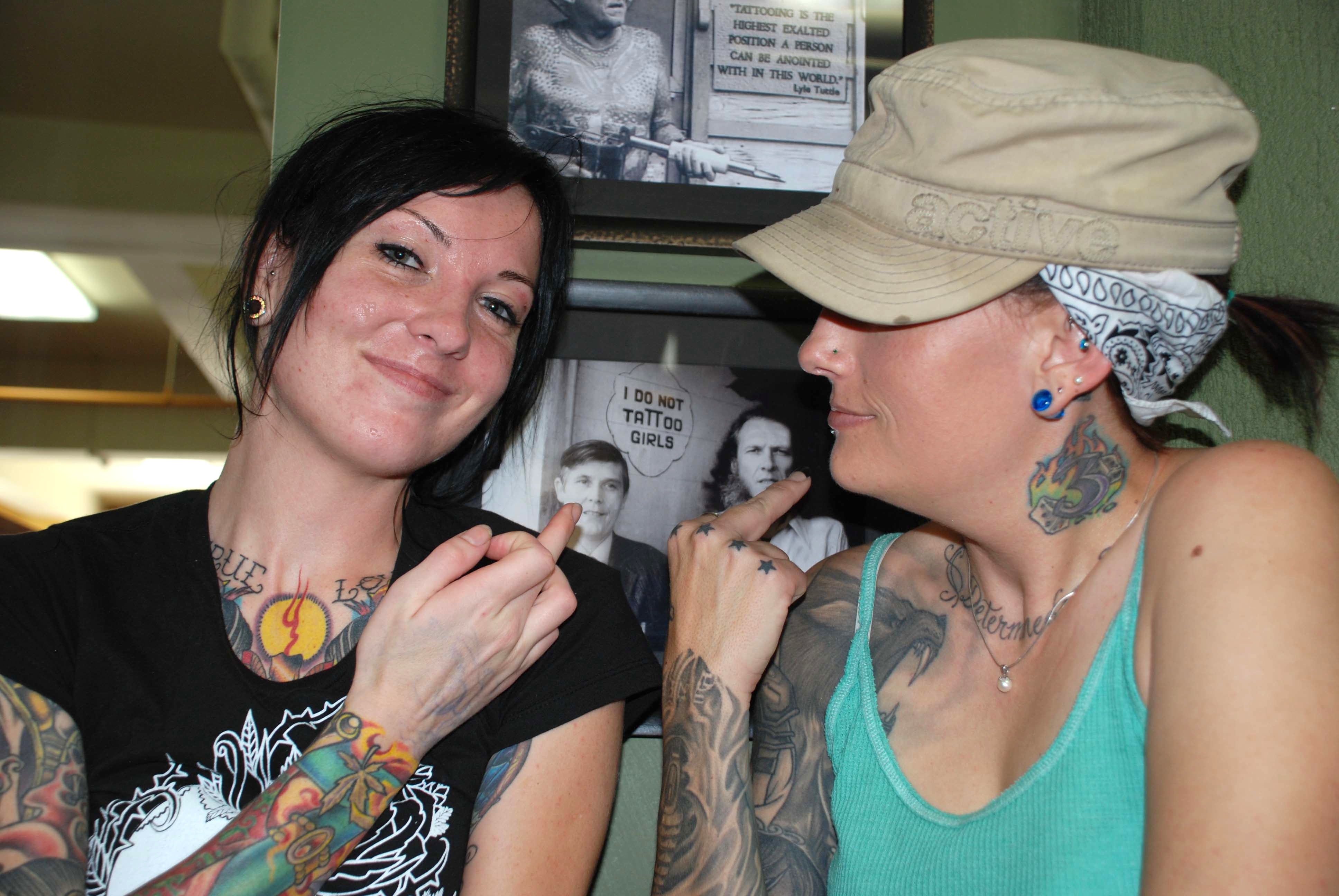
Shorty and Kody Kushman are tattoo artists at Outer Limits Tattoo in California
Shorty and Kody Kushman are tattoo artists at Outer Limits Tattoo in California. They are sitting in font of a picture of Lyle Tuttle and Burt Grimm, famous tattoo artists who spoke out against women working in the profession in the early days. The women are giving the middle finger to these old timers views on women.

These beautifully tattooed women were an inspiration to me, and their stories did overlap with my own in many ways. I share their experiences in this book and also a documentary film, Covered. [https://vimeo.com/94019352]

Each chapter of the book opens with a personal story of my own before sharing the similarities and differences across women’s experiences in the varied contexts of their lives — the family, the workplace, and the larger societal beauty culture within which women define themselves. It wasn’t surprising for me to learn for example that for other women, too, there is a world of difference between having a small, safe tattoo and sporting something like a large skull on your forearm, especially in terms of the negative social sanctions we receive.

“What does that say on your arm?” A man asked me as I sat in a coffee shop, deeply immersed in a textbook, studying for an exam, when I was eighteen years old.

“Feminist.” I replied, looking up at him, cringing as I awaited his response.

“Oh? Does that mean you hate men?” He asked with a frown, shaking his head.

“Something like that,” I replied.

The lettering this man was so interested in evaluating was my second tattoo, a stylistic, cursive script that stood alone on my arm until I collected more tattoos around it, making it harder to discern. It always leads to questions. And whenever I clarify that it says “feminist,” well, you might imagine the interactions that follow, with men attempting to define the word and me offering up sassy answers, growing more insolent depending on how bold I feel at the moment. The chapter “Tattoos Are Not for Touching” shares this story and the voices of other women who have been reprimanded for their tattoo collection, including the stares, comments, and touches that sociologist Erving Goffman demonstrated in his research on public self presentation.

Beverly Back ArtDuring my fieldwork I found an amazing artist who spent five years giving me a back piece tattoo, in her own beautiful style, that represented my academic journey.

Since Covered in Ink has been published I’ve been hearing more women’s stories of their artwork and the social struggles, both positive and negative, that accompany them.

What’s yours?
________________________

Listen to Beverly Yuen Thompson’s interview on KERA’s Think with host Krys Boyd.


Beverly with her book Covered in Ink

Beverly Yuen Thompson is an Associate Professor and Chair of Sociology at Siena College, Loudonville, New York. She earned a PhD and MA in Sociology from the New School for Social Research in New York, a Master’s Degree in Women’s Studies from San Diego State University, and a Bachelor’s Degree in Political Science from Eastern Washington University. Her first book, Covered in Ink: Women, Tattoos, and the Politics of the Body, was published by NYU Press in 2015. Her research interests include subcultures, visual culture, and gender.

As sociologists and feminists we are quick to critique, which does have merit. We tend to look structurally and think individuals are for the psychologists. While we can offer needed critiques on society, it seems our limitation is in proposing solutions that look at both structure and agency, including an understanding of the daily lives of people, especially those who are marginalized in society and have less agency.

I started thinking of this post this the summer when numerous articles posted on the internet reported how a teen with Down Syndrome started modeling. While the articles were positive, I happened to see a comment on Facebook on a feminist group about this young woman modeling. Again, while most of the comments were positive, one person stated how this teen with Down Syndrome should not be modeling or aspiring to be a model because in so many words it reinforced gender subordination. It made me stop and think.

MODELING INDUSTRYYes, the modeling industry is not always an ideal industry. Airbrushed images have pushed women (and men) into eating disorders and unrealistic expectations of body image. Yet, do we critique the industry or the teen? A teen who has lived her life with Down Syndrome in a society that is not always friendly to different abilities? Can we change our lens to see this as someone changing the face or nature of the industry? The comment in ways could be read as critiquing the person, not the industry. How can we critique structures while also remembering how people may have limited options or want to feel included or normal. Can we think of how agency can change the structure? disability inclusion

While we study social problems and issues from a structural view and advocate what we think changes should be, we cannot forget the people who we as a society have not given agency to, such as those with differing abilities. Can we have a focus of inclusion, which sees these individuals as having agency as something that does change the structure for the better?

The first model with Down Syndrome

We can say “embrace your differences” all day long or “normal is boring”, yet it seems part of human nature to want to be included and to feel normal. Or at the least, not just treated with only sympathy and woe, but seen as a person who has something to contribute to society. This does not mean that structural change does not need to happen.

For the teen with Down Syndrome who is modeling, I say go for it! In alignment with a New York Post piece on these issues, http://nypost.com/2015/07/16/this-model-with-down-syndrome-is-changing-the-face-of-fashion/, you are changing the industry, how we view (dis)abilities, and are a role model to others!  Here are some fabulous pictures of this inspiring teen!

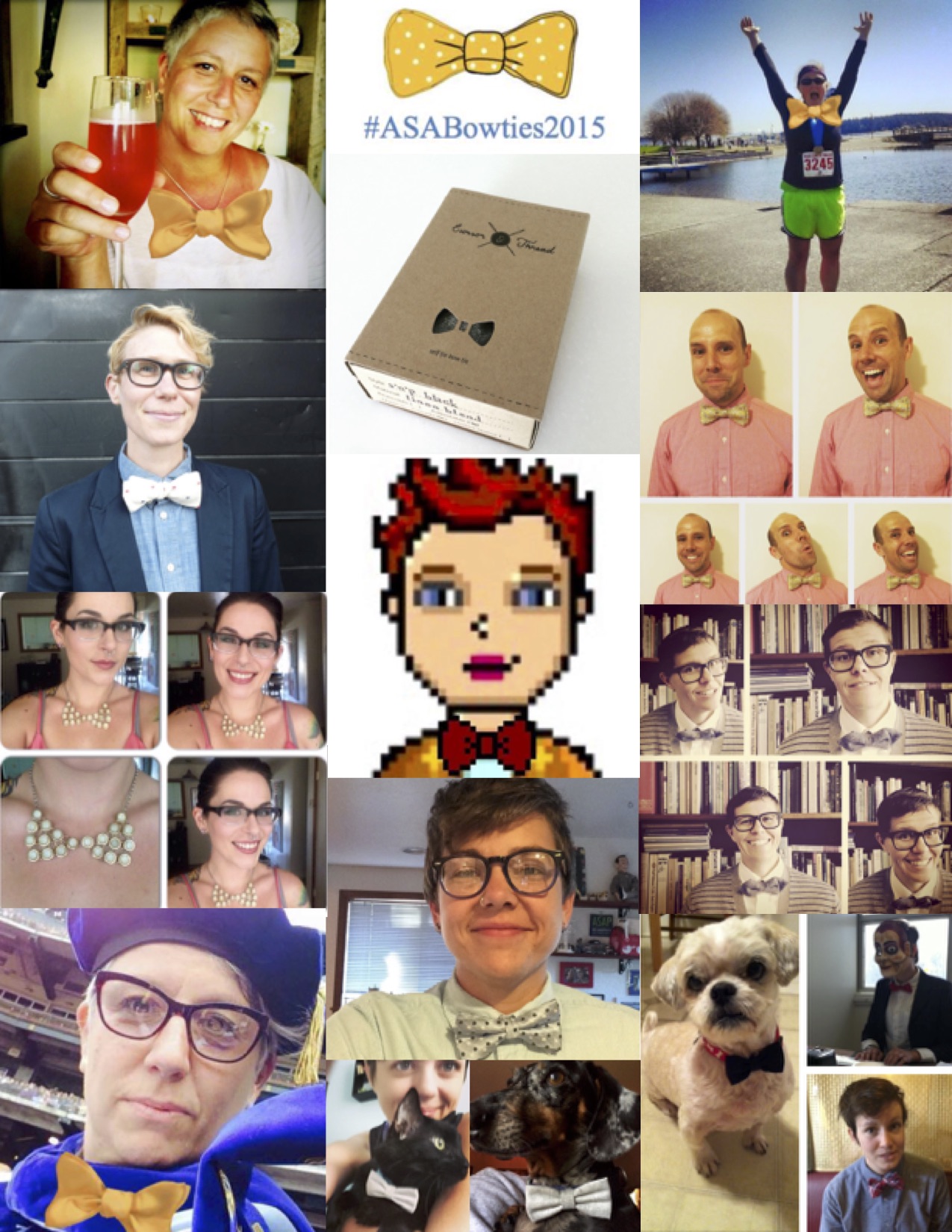
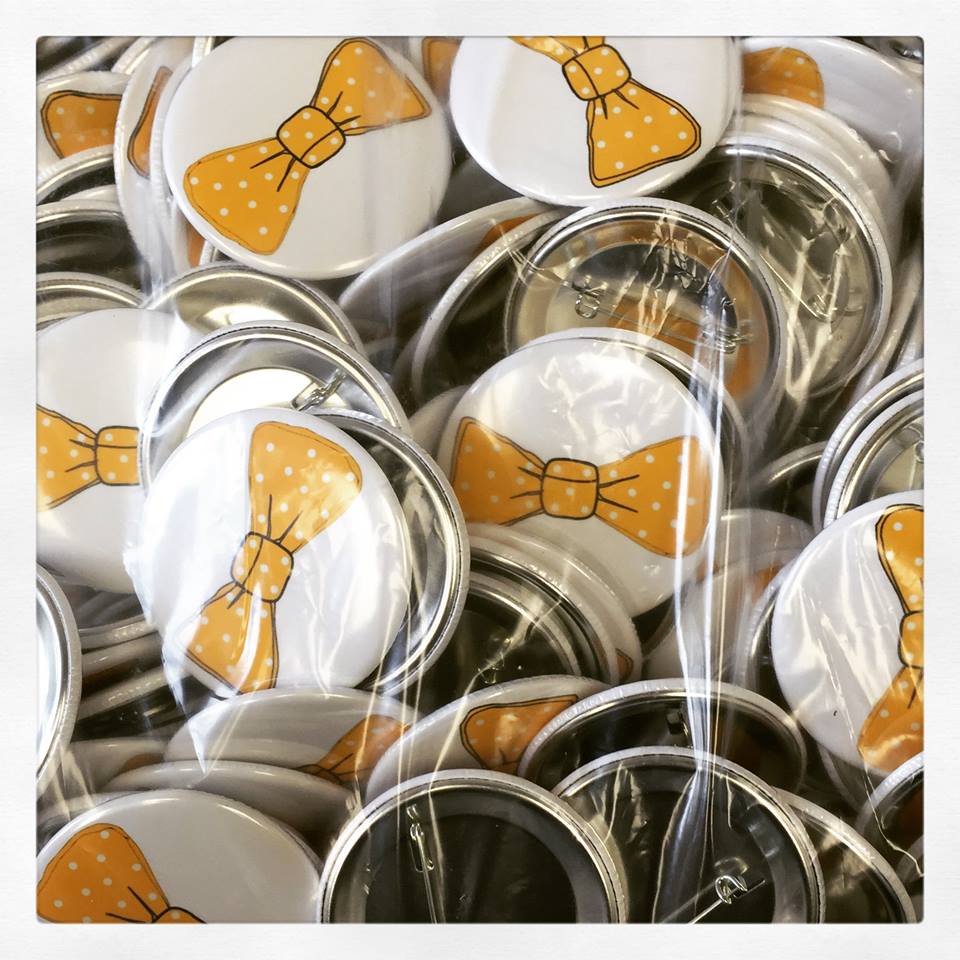
ASA Bowties 2015 jpegSpot a bow tie, meet a sex and gender scholar (or someone lucky enough to have donned a bow tie on our day)! The Sex & Gender Section of the American Sociological Association will celebrate its members, increase the visibility of sex and gender researchers at the summer meeting, and support conversation and networking with a “wear-a-bow tie” campaign. The Section’s Membership Committee encourages all members to wear a bow tie on Saturday, August 22nd, Sex & Gender’s designated section day.

Members can wear their own bow ties, pick up one of the free 500 bow tie pins at the Section Business Meeting on Saturday (from 9:30-10:10am), or get creative with jewelry, broaches, bow tie print apparel and other displays. The bow tie is fun way to boost our Section visibility with a trendy gendered style accessory. You can find bow ties clip art and designs in all sorts of places including on phone cases, mugs, socks, various forms of jewelry, emoji, photo editing apps, and, or course, actual bow ties. I personally watch the same YouTube video each time I’ve tied one. And, if you choose to brave one you need to tie yourself, I’ll just highlight the most important piece of information distilled in this How-To video: “Remember, there’s no such thing as a perfect bow tie.”

To discuss the campaign in more detail, I asked Kristen Schilt, chair of the Sex and Gender Membership Committee, and section member D’Lane Compton to join us in a brief digital interview.

Tristan: How was the bow tie decided upon for the campaign?

Kristen: Sex & Gender is one of the largest sections at ASA – in fact, this year, we surpassed all of the other sections with over 1200 members! With such a big section, however, it can be difficult for newer members to find a way in and to meet people. Our idea with this visibility campaign was to come up with a common symbol for all members to display on “sex and gender” day at ASA. Our hope was for it to be an ice-breaker for newer members and a way to show the general ASA what an important part of the discipline the field of sex and gender has become. We asked for suggestions for possible images and the bow tie came out as the winner among the section council. We felt that it was visible – seeing a large group of ASA members in bow ties would raise conversation. The bow tie also has a history of gender transgression in fashion, from Marlene Dietrich to butch subcultures in the 1950s. We recognized that not all members would be excited about the bow tie, but, we also felt no symbol would have full consensus in such a large and diverse section. We decided to move forward with this visibility campaign so we would be taking action on increasing the sense of community among newer and more established members. We imagine that if this campaign is a success that the Sex & Gender section will solicit member suggestions for a new symbol. We look forward to seeing what people come up with!

Tristan: What if members don’t want to wear a bow tie but do want to participate?

11011222_785267271571761_4706088863506098956_nKristen: Sex & Gender has commissioned 500 bow tie buttons that members without bow ties can wear on Saturday, August 22nd. We will give out these buttons at the Sex & Gender business meeting at 9:30 am. Any remaining buttons will be available at Sex & Gender sessions throughout the day. Just look for Jessica Fields, chair of the section, Kristen Schilt, head of Membership, or members D’Lane Compton and Tristan Bridges, who helped promote the winning bow tie idea.

D’Lane: Beyond the free buttons the section will be handing out, there are other ways you can get creative. For example, while I will be sporting a bow tie on Saturday, I also plan to draw a bow tie on my coffee cups that day. I will likely have a sharpie on hand if folks want to borrow it. I have also heard of some folks who were talking about bow tie-themed socks and various pieces of jewelry including earrings, broaches, hair combs, and necklaces. I will also be playing “I spy…” looking for those folks.

Tristan: What do you like about the campaign?

D’Lane: Beyond the visibility and promotion of the section, what I like most about the campaign is that I am certain it will generate a great deal of interaction whether it be online or on the streets, so to speak. I think it will also offer up different avenues in which we can learn new things about our colleagues and friends and of course just be a simple icebreaker for making new connections. It also gives us something to talk about other than work and may allow some insights into our tastes, likes, and dislikes.

Maybe it’s in my roots growing up under the Friday night lights of Texas stadiums, but I love spirit and “spirit days”. Wearing mismatched clothes on Wacky Wednesday, Thursday was tie day, and of course school colors on Friday. I remember having tie day in high school and loving the fact I had an “appropriate” reason to wear a tie and wouldn’t catch slack for wearing menswear that day. For some wearing a bow tie may feel like drag for the first time, irrespective of sex. Could be professional drag, or dandy drag, some combination, or other types of drag.

Despite all critiques, spirit days made for increased engagement and social bonding. It gave us something new to try, a place to play with who we are; and it was fun. You could also be really annoyed by it and opt out…which still allowed you to engage with others and bond over how ridiculous joiners are or the particular activity was and how over it all you were. It is with this mind set I approach my enthusiasm over the campaign.

Tristan: How are you considering participating?

D’Lane: I plan to wear a bow tie, and, assuming they are down with it, I will take as many pictures as I can of other bow ties and bow tie representing folks to share online. I know people who will not be in attendance plan to show their support by wearing a bow tie Saturday and tweeting it. I have also already changed some of my profile pictures to represent the section. And maybe I will instigate a #ASABowTieScavengerHunt hashtag searching for a collection of the ingenuity of members finding clever ways to participate!

10432120_794886257276529_5923158181651371396_nTristan: Thanks so much for telling us more about it. It sounds like a fun event. The new logo for the section even found a bow tie for the event, thanks to logo designer Eli Alston-Stepnitz. (See the July newsletter for an essay by Eli, Tristan, and Jessica Fields on the process of producing the new logo.) I’ll be wearing a bow tie on Saturday to participate. I chose one from a “conversation starter” line online.

Make sure you participate using the #ASABowties2015 hashtag on social media. And tag @asanews in your posts. In addition to making a show of the size and enthusiasm of our section at ASA, we’re also hoping that this sparks us to make some digital noise this year.

We hope section members will help live tweet the sessions they attend. In addition to flagging posts with session numbers, consider using #ASAGender15 in your tweets during presentations. The Sex & Gender twitter account (@asasexandgender) promoted the hashtag. We are an extremely vibrant section on social media. I’m excited to see whether we can connect our social media energy with this suggestion.

Thanks to Kristen Schilt and D’Lane Compton for the campaign and the interview. We’re all excited to see everyone this weekend. See you soon and safe travels!

We’ve all had them, and maybe some of us are them! (No, not us!) As a sociologist who has spent many years studying workplaces, I am indebted to a number of bad bosses. Although some of them made my life miserable, they inspired me to understand why. So in the spirit of acknowledgment, I must first say thank you to the boss who told me I was destroying my life by leaving the job to pursue another direction. (Destroying whose life?) And thank you, too, to the psychotic boss who knew that I supported a particular political cause, and out of nowhere screamed at me, “Don’t ever let me see you on television with a sign in your hands supporting that Communist (crap).” Whoa! It hadn’t occurred to me, but now that you mention it…And thank you to the newly appointed manager who, in her first month on the job, falsely accused me of serious financial improprieties. (One month, and many sleepless nights later, I was vindicated.)

Given these experiences, it has been therapeutic to study the American workplace and to dissect some of the problems that contribute to “bad-bossism”. Despite having been “stung” by a few bad bosses, I still believe that people – including some bosses – are basically good!
So what is it that leads some people in management positions to “behave badly?” Well for a start, the workplace is a microcosm of our larger culture and society. Societal problems that exist outside the office are likely to surface within it as well, playing out via power dynamics between and among employees, based on their occupational status, their gender, and their racial and ethnic backgrounds.
Political economist and philosopher, Karl Marx, laid the groundwork for understanding the intrinsic tension between labor and management (or, as he would say, capital), in which a capitalist system favors profit over people. In this system, he argued, management would necessarily exploit workers with long hours and poor working conditions, in order to get more productivity out of workers, which in turn would maximize profit. With the advent of laws that limit working hours in manufacturing settings, and the regulation of working conditions, Marx’s critique and analysis continues to provide a useful framework, even though it’s probably more relevant to manufacturing work in Third World countries, where many multinational corporations have moved their operations in search of cheaper labor.

In the U.S., our current economy has increasingly shifted to knowledge-based work and services, and the lines that are drawn between workers and managers are often painted as more subtle. Nonetheless, stratification of the labor force ripples through multiple levels of professional and managerial workers. How do these dynamics affect the contemporary workplace?

Studies suggest that a number of factors shaping workplace environments contribute to the “bad boss” phenomenon:

1. Male model of the ideal worker
In this model, the “normal” trajectory of the worker is based on a “male model” of the ideal worker, a person who can work throughout his (her?) career in a continuous and uninterrupted manner, taking no time for non-work (e.g., personal, family) activities. Sociologist Erin Kelly, et al calls it a “masculinist work culture”, commenting,

“Working long hours is a sign that employees are readily available and eager to meet others’ needs; it further reinforces the ideal worker as someone – most often a man – who does not have, or does not attend to, other pressing commitments outside of work.”

With this model, work comes first. When managers perceive that’s not the case for one or more employees, it’s viewed as an affront to the company, a deviation from employee loyalty. Managers who “buy into” a “masculinist work culture” are likely to be critical of workers who challenge this norm. In a study I conducted on parental leave policy in a large financial services company, the norm was so powerful that men chose not to use the company’s generous parental leave policy, and women who used the policy took very short leaves, even though legally, all employees were entitled to longer leaves.

2. Structural issues that create a culture of competition
in our current American workplace, where the bottom line rules, there are economic pressures to produce. In line with the prevailing capitalist ethic, a culture of competition is viewed by many managers as necessary to foster productivity, with long hours as the norm. In order to sustain productivity, managers feel pressure from above to push employees to produce more, even when they realize that it’s not humanly possible. In a number of the workplace studies I’ve conducted, I’ve learned that being in a middle managerial position is often isolating. This makes these managers depressed and grumpy. Most have little support to figure out a better way, and they realize quickly that too much empathy for their “subordinates” takes too much time. Ergo, they may “act badly.”

3. Poor economic times makes managers even more grumpy
In our crisis economy, the financial pressure is even more intense, and some managers may exhibit more controlling behavior towards their employees. Managers are being more closely monitored on financial performance, and they may be even less likely to take the time to attend to employees’ feelings or needs under these conditions.4. “Deal with it; I did!”
Some managers worked hard to get where they are, and along the way, they experienced a lot of pain themselves. When they get to the top (or close to it), some pass on what is familiar. While many of the managers I’ve interviewed worked very hard to respond to the needs of those under their supervision, some were less than understanding.5. Lack of management training
Some managers who are good workers are rewarded by being moved up to management positions. While some organizations prepare their workers for this type of promotion, others fail to prepare them for the pressures they encounter once they are in charge. Without adequate management training, some bosses make mistakes, even lots of mistakes. Sometimes they find themselves in positions of power and it feels uncomfortable. They’re being asked to do things with and to workers that they wouldn’t have liked themselves. They know that. But they don’t know how to challenge or work with the system without jeopardizing their reputation or losing their jobs. This can make for frustration and grumpiness.

6. Personality problems
Some managers just shouldn’t be managing people. Their “management style” may look good to upper-level managers because it fits in with a culture of competition and drive. But they may be making the people who work for them miserable. Because of an “us” and “them” dichotomy, other managers may even side with them.

Perhaps we all have a story about the crazy or mean or incompetent boss. Are all managers bad bosses? No, of course not. But the problem is clearly pervasive: Google “bad boss” and you’ll find over 7 million citations, with countless workers publicly venting about their negative experiences, and experts offering advice on how to deal with that mean and disrespectful supervisor.

What is a good boss? There’s plenty written about good bosses as well. Google “good boss” and you’ll find over 14 million citations! Hopefully we’ve also had them (and maybe even are them!).

Here’s an excerpt (slightly tweaked) from a 10/10/10 article in the Chicago Tribute by Mary Schmich about what makes a “good boss.”
* A good boss understands that all power is fleeting and borrowed, and doesn’t take advantage of this moment.
* A good boss realizes that her/his real power comes not from those above him, but from the rank-and-file.
* A good boss listens, and can see a problem before it turns into a crisis. If it does turn into a crisis, the good boss works with an employee to resolve the situation.
* A good boss understands that your time is important too.
* A good boss is a good communicator, responding to your concerns and questions in person and via electronic communications.
* A good boss treats employees with respect. S/he does not treat people differently based on their occupational status, gender, race or sexual orientation.
* A good boss tries to make everyone feel special and included.
* A good boss is self-aware and tries to understand how his/her behavior affects others.
* A good boss has the courage to deal with problem employees, and does it professionally.
* A good boss tells you when you screwed up and forgives you.
* A good boss does not take credit for your ideas, nor does s/he demand credit when s/he gives you an idea.
* A good boss is not afraid of people as smart as s/he is.
* A good boss sees what you do best, matches your job to your talents, and gives you room to bloom.
* A good boss remembers how s/he felt about bosses before s/he was one.
* A good boss reveals just enough about her/his personal life to remind you that bosses are people too.
* A good boss doesn’t take bonuses when the workers can’t get a raise.
* A good boss knows how to apologize and how to laugh, sometimes at him/herself.
* And a good boss understands how much we all yearn for a good boss.

Graphic arts engage readers in a way text cannot. Told with sequences of pictures, along with narration and dialogue (often in the form of speech bubbles), graphic arts have become increasingly popular media for education and communication as well as social commentary. From disaster preparedness to questioning high-tech medical advancements, comics and other forms of graphic art are effective in sharing information and insight. For some, they are a more accessible format as they encourage readers to develop critical thinking, cultural literacy, and a motivation to engage in individual and social change.

Communication and Education

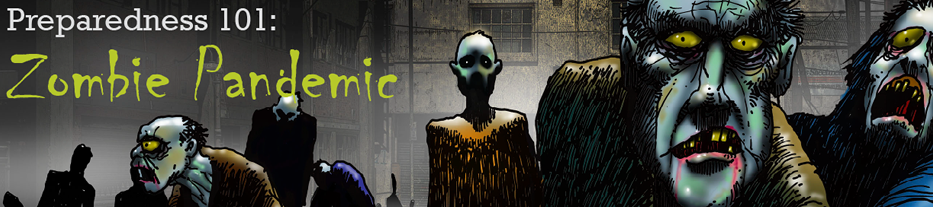
In 2011, the Centers for Disease Control and Prevention (CDC) developed a free downloadable comic book, Preparedness 101: Zombie Pandemic, as a way to help prepare the public for general emergencies.

http://www.cdc.gov/phpr/zombies_novella.htm

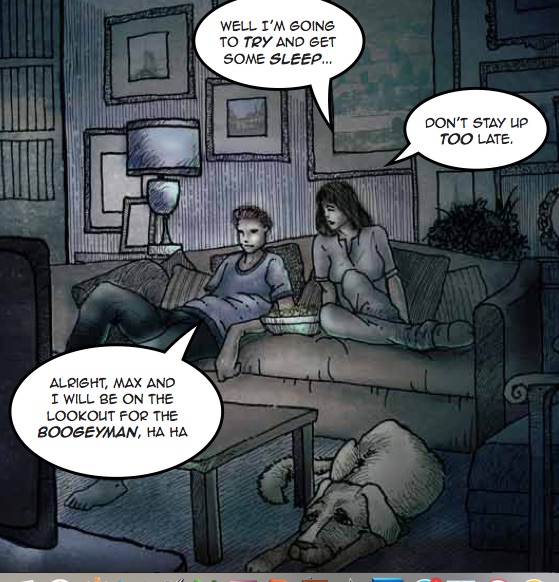
zombie SlideThe 40-page graphic novella tells the story of a young couple and their dog during an escalating zombie apocalypse who manage to stay safe with the help of the CDC’s disaster preparedness instructions. The vivid images focus the reader’s attention, and the story line is clear and compelling.

As the impending disaster approaches the characters receive frightening information from official channels. Julie hears a voice on the radio:

“Stay in your homes. Do not go outside. If you or your family begin showing symptoms such as slowed movement, slurred speech, or violent behaviors, quarantine them to a secure area of the house. Stay tuned for more information on where to go…Stay in your…”

The images and text are geared toward a range of literacy levels and cognitive abilities and together promote recognition and recall. Yes, we’ll stay right here and wait for instructions! The graphic tale conveys this specific information as it creates an emotional connection with readers to motivate behavior.

The CDC’s story is likely to be nonthreatening to most people (unless they believe in zombies), thereby encouraging open-mindedness toward the message. Man scratches chin and says:

“I’ve been thinking…we should really make an emergency kit in case something happened. What if we were stuck in the house or had to evacuate? We need to have a plan!”… “Ok, but I’m serious…I think we need to make an emergency kit.”

“I hear ya!”
Message sent, and received. People learn in different ways and for some, visualizing a message is more compelling than seeing words on a page.

Comics for Social Commentary

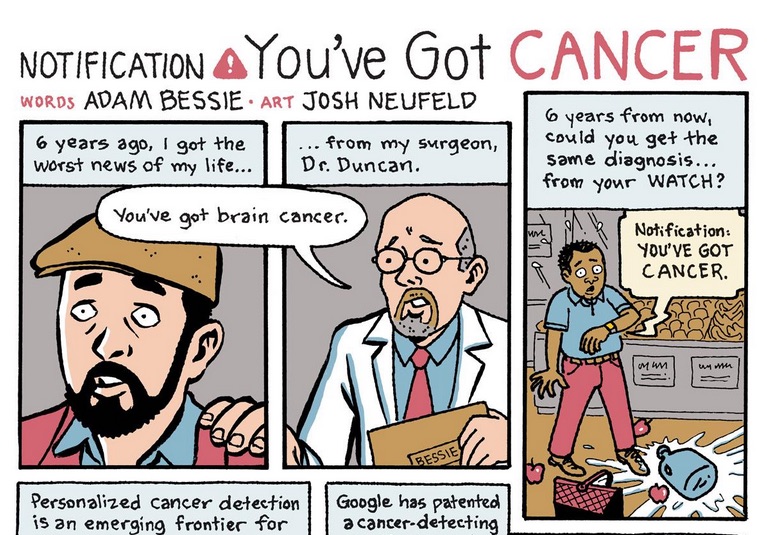
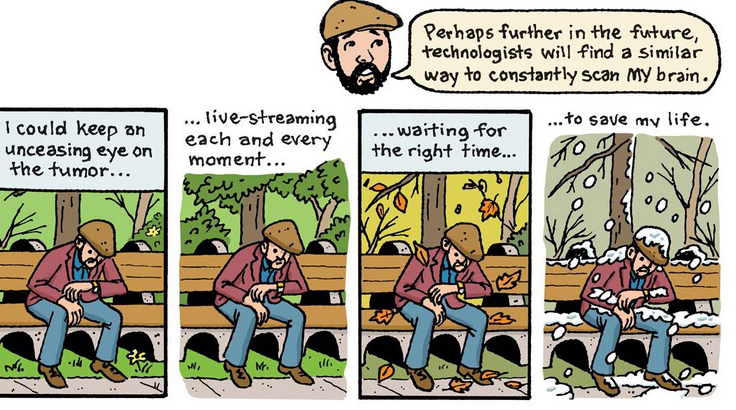
In a culture bombarded by images, we are increasingly conditioned to learn through visual entertainment. Graphic arts take the form of this “entertainment” to inform and engage, and to incite action. “Notification! You’ve Got Cancer” is a comic strip by Adam Bessie and Josh Neufeld that provokes critical inquiry into an important social issue, the rise in medical technology and biomedical surveillance.

The short comic strip suggests that advances in high-tech cancer detection might get so invasive that someone could potentially receive a text message about some new diagnosis via smart device. The narrative does not go into detail about the practical or emotional implications of such advancements. It merely suggests that biomedical surveillance has become so increasingly routine, with patents on new technologies emerging at record speed, that the technology of cancer detection is likely here to stay whether we’re prepared for it or not.

Bessie-You've Got cancer


Adam received his brain cancer diagnosis from a doctor. Imagine getting news of your cancer diagnosis on your watch while shopping for fruit! This take on technology’s reach is not far fetched. The comic strip makes mention of recent developments such as GOOGLE’s newly patented cancer detecting pill and the iT bra that supposedly detects breast cancer using a smart phone and cloud-based analysis.

A flippant sequence featuring the author moves the reader’s attention beyond the shock of impersonal, inopportune diagnosis toward another serious flaw: personalized detection technology outpaces successful treatment.

Bessie2-You've Got cancer


In pointing out this problem, Notification! raises a crucial question about the technological imperative, or the inevitability and necessity of new technologies. Namely, is it necessarily for the greater good?

The authors suggest that there may be little to gain in live-streaming one’s tumor and waiting to be saved. What’s more, the matter illuminates the uncertainty that inherently exists in technology and biomedicine.

Biomedical uncertainty refers to the ways in which knowledge is limited about how to prevent, diagnose, and treat a varied range of diseases and conditions. This shouldn’t be news. Talcott Parsons argued in 1951 in The Social System that the incessant advancement of science and medicine increases biomedical uncertainty as doctors rely more fully on scientific advancements and specialized technology to consult with patients and construct diagnostic and treatment protocols. Yet technological advancements march along while indeterminate diagnostics, controversial medical evidence, and ambiguous treatment outcomes are often a stark and surprising reality for the diagnosed.

As the biomedical enterprise colonizes greater expanses of health and illness domains, it must move ethical and practical considerations such as those discussed in this comic strip to the heart of its research and development. Otherwise Adam’s future stressed out descendants might find themselves live-streaming their tumors on their fit bits while recording their gradual demise on their Snapchat Spectacles.

I’ve been researching and writing about breast cancer for so many years that I’ve accumulated a plethora of pink-ribbon-themed items. I’m finished with the baggage. Taking control of my surroundings has been very freeing!

–Gayle Sulik, on Psychology Today

I’m not a hoarder. But I’ve been known, on occasion, to keep things long after they outlived their usefulness or meaning. Like that colorful, Italian bowl with the chipped edge that would be perfect for a huge pasta salad but never sees the light of day. At least I don’t hate it.

Other keepsakes, I despise. Those finely carved mahogany sculptures I bought 20 years ago are still scattered around my house or in the back of a closet. I have nothing against them really, but tastes change. Those books from graduate school, taking up prime real estate on my shelf, are out of date. Unlike my old, yellowed copy of Natalie Goldberg’s Writing Down the Bones, ever reminding me that I am a writer, these objects no longer contribute to my well-being.

I usually realize when I’ve been surreptitiously loathing my stuff. I come to my senses and the purging begins, sometimes immediately. It wasn’t so easy to come to grips with all of the pink ribbon paraphernalia I’ve collected over the years.

I’ve been researching and writing about breast cancer for so long that I’ve accumulated a plethora of pink-ribbon-themed items: awareness magazines, newspapers, advertisements, jewelry, cleaning supplies, teddy bears, M&M bags (contents consumed), and more. Some of these items were gifts to inspire me to keep going with my research. Many of them were gifted to others then bequeathed to me because they didn’t want reminders of their cancer around, or because they too hated the idea of pink ribbon commercialization.

IMG_7557
Part of the Pink Ribbon Collection. Photo by Gayle Sulik.

My collection grew large enough that I considered creating an exhibit on the pink ribbon industry. In addition to my own items and others that would be donated, I imagined a 10-foot in diameter gumball machine filled with pink “I heart boobies” bracelets and a life size replica of “Miss Pink Elegance” from the Thomas Kinkade collection.Pink Lady We’d have posters calculating the profit margins of fundraising campaigns juxtaposed against pie charts of budget allocations from charities, themes in awareness campaigns, and the state of misinformation surrounding the disease. It was a good idea.

But since then, bloggers have taken it upon themselves to reveal, quickly and skillfully, the hypocrisy of the pink ribbon marketplace. Journalists have sunk their teeth into investigative reports about fundraising and other controversies. The Canadian documentary Pink Ribbons Inc. gave audiences the visual and narrative content to illustrate key themes within pink ribbon culture and the industry that surrounds it. Breast cancer organizations that have been resisting the status quo for years gained new traction. Even some of the most contentious scientific controversies entered public discussion with renewed vigor and solid evidence. Pink Ribbon Blues served its purpose.

There remains much to be done with the topic of breast cancer, and I’m glad to do it. But I’m finished with the pink ribbon baggage. It will no longer take up valuable space in my closets, on my shelves, or in my life. I feel lighter already. Taking control of your surroundings can be very freeing!
Pink Elegance - Tennis Ball
What’s left of the Pink Ribbon Collection. Photo by Gayle Sulik.

There are two pinked items I’m keeping though. My very own Miss Pink Elegance, given to me by my dear friend Rachel Cheetham Moro, stands proudly above a pink tennis ball signed by sociologists Phil Brown, Kathy Charmaz, Barbara Katz Rothman, and Heather Laube to honor my book’s “Author Meets Critics” session at the American Sociological Association in 2012. These items represent a different kind of breast cancer awareness to me, along with a sense of connection to those who have supported me in this research all along. That’s enough.


Originally published on Psychology Today »

Endings & Beginnings

May is full of beginnings and endings — graduations from high school and college propel students on to new endeavors.diplma and cap

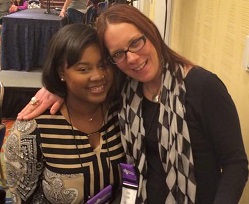
Chasity is a student who will always hold a special place in my heart. She’s talented, passionate, and hard working, and while I’m sad that we’ll no longer be part of each other’s day-to-day, I’m excited to see what the future holds for her.

It has been an exciting year, and I’ve enjoyed watching Chasity grow. She has worked with me as a research assistant; we traveled together to a conference where she received a national award. Chasity received our department’s Undergraduate Sociology Student Research Award, served as president of our Sociology Club, and won another award from our university’s Multicultural Center.

On Saturday she’ll walk across the stage and receive her diploma, marking the commencement of her undergraduate studies; she’ll move away with her fiancé and her new chapter will begin.

Working with Chasity as a student has been an honor and I’m incredibly proud of her. At the same time, it’s bittersweet. As teachers, we’re expected to teach and guide our students. But as I reflect on the past year, I’m also reminded of how much our students teach us. Chasity has been my student. She’s been my mentor as well. I’ve learned so much from her about social justice, activism, and staying the course. Teaching in the Deep South has been an adjustment for this Northern transplant, and students like Chasity remind me why I push through.

 Mentoring & Recognizing Our Students

Mentoring relationships are often seen as one way, but I see them as reciprocal. Naturally, there are appropriate professional boundaries, but this does not mean our students do not impact or mentor us. They come to us from different parts of the world; they share their stories. When we are open, we learn.

This post serves as a thank you and a tribute to Chasity, as well as a testament to the importance of mentoring, with emphasis placed on what our students give us. While our job is to help students learn, learning is not just a give and take relationship. We are human. We teach sociology, where many concepts are personal for our students and ourselves. Emotions can not be removed from the learning process. We build relationships with our students, and we care about them.

I want to write this post within a framework of feminist mentoring, but today words fail me. This post is from the heart. At times, I think as faculty we are negligent in recognizing the talents and humanity of our undergraduate students. We may not take the time to tell them how they’ve changed us, taught us, and pushed us to be our best. We all need positive reinforcement and this is especially true of our students.

 “I Just Do It”- Social Justice to Unitechas and me cropped

Each year, SWS requests nominations for the Undergraduate Student Activism Award and Chasity was an obvious choice. Her work on campus speaks for itself. She’s served as a diversity peer educator, worked with the Gay Straight Alliance, engaged in research on racism, women, and mental health. She’s worked tirelessly with the Sociology Club and the Multicultural Student Center, volunteering and mentoring numerous students. She’s part of Model UN, and these are only the things I can remember. She does all this in addition to being an exceptional student.

For Chasity’s nomination for this award, I received letters of support from faculty and staff across campus. As I wrote in my letter,

“Chasity is dedicated to social justice, and is able to use a sociological lens to frame her inquiries. But most importantly, it is not just her experiences that fuel her activism, but her desire to build bridges among diverse groups, to relate to and understand people, and she does so in a professional, reflective way, serving as a role model to others who strive for equality.”

As the letters of support attest, Chasity takes a lead role in advocating for social justice and equality, and she does so with professionalism, empathy, and self-reflection.

Chasity is humble and her work is never self-serving or simply for fame. She does it because she cares deeply for others. She is passionate about social justice. This was beyond evident when we were working on her resume. I asked about her work and she responded, “I just do it; I don’t think about writing it down.”

The world needs more people like Chasity. Chasity is about action, authenticity and living her values. Students like Chasity inspire me to be better — a better person, as well as a teacher and scholar.
Mentoring Our Undergraduates

Chasity has helped me become a better person, but also teacher and scholar. She can tell you what I have helped her with, but this post is not about that. It’s about showing our own humanity and appreciation for students, particularly undergraduate students, who often get left out of the conversation about mentoring and positive relationships. I’m grateful to have been able to work with so many wonderful students in my teaching career. Mentoring undergraduates does not have to take away from our research or teaching. Seeing the humanity and positive attributes of our students can do wonders for their development and by actually listening to them, we can grow professionally and personally.

I encourage you to reach out to students who’ve made a difference in your life. I’ve learned so much from many of my students this year, but today is about Chasity. Join me in congratulating her as she walks across the stage on Saturday and begins an exciting new chapter.

For Chasity

A poet, I may not be, but this is the best way I can tell you and the fabulous folks who read this blog about you.  Here goes…

You have my support and I am forever grateful.

After intense teaching days, you were there.

With a smile, words of wisdom, reminding me how much you learned.

You were the voice of reason when I was ready to run.

You listened and reminded me why I do this important work.

You were the calm during a long day of travel, despite your lack of sleep.

You even didn’t poke me when I snored!

You made me proud; you made me laugh; I cried when you won your award.

You made quite the impression with your authenticity, professionalism, and knowledge.

You worked hard collecting, coding, and analyzing data.

Your awards were numerous,

And you deserve every one!

You have made an impact.

On me,

On your peers,

On your mentors,

On our department,

On campus.

As you move forward, I will miss you,

Yet you will forever be in my heart,

Guiding me, reminding me to build bridges and advocate for justice.

I’ll hear your words to me — you’re worth it!

Never forget how wonderful you are.

You’ve made a difference.

Life is not always easy,

New chapters bring new challenges.

But you are ready.

You are strong and intelligent,

Resourceful and creative,

Empathetic and caring.

You will be okay.

But always remember,

As you care for others, you’ll need support.

Don’t be afraid to ask for it.

Your family, friends, colleagues, and peers,

Will be here for you.

Be brave and take care of yourself.

Chase your dreams!

Congratulations, Graduate!

baloons

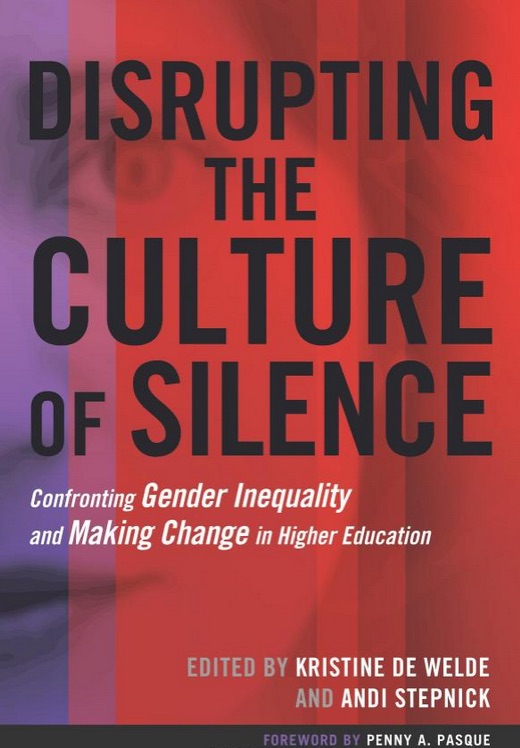
Book CoverKris De Welde and Andi Stepnick’s new co-edited book, Disrupting the Culture of Silence: Confronting Gender Inequality and Making Change in Higher Education, is an engaging, evidence-based toolkit for building gender equity in higher education. I just got my copy of the book two weeks ago, and I haven’t been able to put it down.

The first four parts of the book emphasize challenges facing U.S. women faculty (structural, cultural, interpersonal). Each part opens with an introduction that intersperses narratives from the data the editors collected for the book, and ends with a case study to give readers a sense of the difficulties and costs women academics face as a result of inequitable workplaces. It then offers action steps as starting points for other academics in similar situations (and those who support them) to use.

The chapters in Part 5, “Tools for Changing the Academy,” illustrate how broad, complementary approaches must work with smaller, progressive steps that both evaluate and correct equity issues on campus. This part concludes with real examples of recent, successful change initiatives from universities across the U.S.

With its “tool-kit” approach, Disrupting the Culture of Silence has a comprehensive list of resources compiled for faculty, administrators, and practitioner-researchers seeking to create a more inclusive academy. These resources are not only meant for women. De Welde and Stepnick write:

Though we focus on women faculty, these issues are not “women’s issues”; they are relevant to the academy, its members and constituents, and beyond. West and Curtis (2006) argue:

“The barriers for women in higher education not only raise questions of basic fairness, but place serious limitations on the success of educational institutions themselves.”

The academy reflects societal biases and hostilities. Yet, it could direct social change too. Our biographies, experiences, and training in feminist scholarship compel us to disrupt complacency among those who might claim that things are “better” or “good enough.”

The Back Story

What I also love about this book is the story behind it. Seven years in the making, Disrupting the Culture of Silence was borne from Kris De Welde and Andi Stepnick’s earlier work and a series of thematic workshops and sessions held at national conferences. After hearing about so many instances of hostile, vindictive, intimidating, and demoralizing situations among women faculty, these women decided to commit their scholarship and activism to working out concrete and meaningful strategies for helping them/us to persist, thrive, leave, or transform the very institutional environments that give rise to injustice. It makes me shudder.

The first step was a fact finding mission. They created Disrupting the Silence sessions to be held at key academic conferences that focused on the experiences and challenges of faculty women. Prior to each meeting, they issued a “call for experiences” that exemplified ‘difficult’ workplaces. They removed identifying information and  edited several of narratives into digestible stories to share at the sessions. After participants read them, they gathered into small groups to brainstorm about how to manage the situations and/or take actions that would have impact at multiple levels — individual, interpersonal, institutional, and even beyond the institution.

Faculty members who served as panelists and facilitators invited the participants to share their own experiences and the strategies they used to overcome challenges. From unequal policies, to coping with a hostile department or problematic pathways to tenure, to many other topics, those in attendance discovered that many of their challenges were common across campuses. They were not alone. After the groups reported back, their responses were documented. De Welde and Stepnick wrote up the results and shared them in other outlets read by women faculty.

The idea caught on, and women faculty flocked to these sessions every time they were held.

Next, the “Disrupting the Silence” sessions morphed into other workshops focused not only on coping with effects of gender inequality (crucial in its own right) but on Building Gender Progressive and Multicultural Departments. What could gender progressive, multicultural workplaces, departments, organizations, and institutions look like? What would be involved in creating them? What kinds of strategies are people already using to make progress?

Since all of these sessions were held over the years at multiple conferences, starting with Sociologists for Women in Society and then branching out to the American Sociological Association and the National Women’s Studies Association, there was a broad cross section of women faculty across the country who shared their stories and provided input. The book that grew out of these informative, supportive, and constructive sessions and workshops necessarily combines these real-life experiences and case studies with contemporary research, concrete strategies, resources, and tools.

Disrupting the Culture of Silence is an essential read. More than that, it is a resource that faculty members and administrators will want to re-read, and reference, and use “to make change on their own campuses and in their professional and personal lives.” Be sure to get a copy or two for your libraries and teaching centers.

Related:


Disrupting the Culture of Silence: Confronting Gender Inequality and Making Change in Higher Education is available from Stylus Publishing. Discount Code: DTCS15 saves you 20 percent.