empowerment

FR LogoContributing editors and guest contributors of Feminist Reflections will be attending the 2015 Sociologists for Women in Society (SWS) Winter Meeting in Washington, D.C. (Feb. 19-22) to discuss our work.

Our Panel: “Feminist Reflections: A Space for Feminist Public Sociology”

Abstract:

How do we carve a space for feminist public sociology? Can feminist public sociology include not only highlights of important research in the media, but an understanding of the feminist sociological perspective, particularly applied to everyday life? How did a diverse group of gender scholars with varying research interests, places and positions within sociology, collaborate to create such a space? Feminist Reflections (FR) hosted by The Society Pages, is an example of this niche in feminist public sociology. The founders and contributing editors of FR include SWS members: Gayle Sulik, Tristan Bridges, Amy Blackstone, Meika Loe, and Trina Smith.

The panel will focus on the collective process of creating FR, the impact of this work, and our reflections on the first year. Panelists will address how FR is a form of feminist public sociology, the impact of this feminist space, and how blogging for FR has not only affects our research and teaching, but us personally. Panelists include the contributing editors and two feminist bloggers, Mindy Fried and C.J. Pascoe, who have contributed guest posts to FR and/or collaborated with the contributing editors. In addition, the panel serves as a way to build enthusiasm and support for this form of feminist public sociology by building a network of guest bloggers for FR.
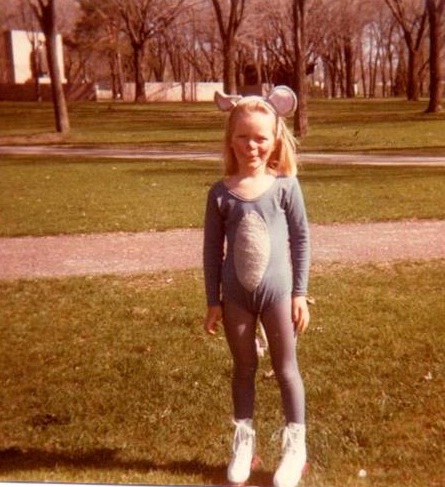
 

I spent a good portion of the ‘70’s curled up around my parents’ record player, listening to Jim Croce croon about the Roller Derby Queen he’d fallen in love with – a woman whose fans called her Tuffy and friends called her Spike. Tuffy/Spike raised eyebrows, she was a woman loved for her strength, one “built like a ‘fridgerator” who “knew how to scuffle and fight.” As a girl I never wanted to be a princess. But this roller derby queen thing? This was the sort of royalty I wanted to become one day.

Figure skating - another of my failed attempts at finding my passion.
Figure skating – another of my failed attempts at finding my passion.

Because roller derby was an option only in my dreams, I tried other outlets that might fulfill my penchant for pushing myself, for raising eyebrows, and for playing to a crowd. My career as a ballerina was cut short after my mother heard one too many complaints about my itchy tutu. My dreams of becoming the next Ian Anderson were dashed when my flute teacher told me I’d have to give up having friends or a life if I really wanted to be a professional musician. In college I tried my hand at broomball and rugby but I hadn’t yet developed the courage needed to leave it all on the rink or field. And though I ran a few marathons in my 30s, I’m skeptical of anyone who claims to really enjoy distance running. I mean, come on. Runner’s trots and bloody nipples? How are these things fun?

Roller derby re-entered my life just as I was wrapping up my 39th year and staring down the barrel of the big 4-0. As much as it pains me to fess up to something so trite, I suppose I was facing the proverbial midlife crisis. I’d gained weight. New gray hairs had sprouted. I worried that I’d given too much to my job and not enough to the people I loved or to myself.

I’d received tenure a few years before and was feeling restless, not sure what to do now that the chase of the thing I’d been chasing since what felt like forever had come to an end. Sure, there was the next promotion but I longed for something other than work to fill my time and to occupy my mind.

Yet I had no real passions. No hobbies. Other people I knew loved reading voraciously, building furniture, knitting sweaters, climbing rock walls, running marathons (or so they said). I wanted to have something I loved, something that was mine but that wasn’t the next paper or presentation or promotion. Something that harkened back to my life-long desire to raise eyebrows and to try scary, challenging things.

An invitation from a former student who had become part of a growing movement of women looking to bring flat track roller derby to my area led me to find myself covered in protective gear and hugging the wall at my local roller rink. I had laced up a pair of skates and was going to give it my best shot. As luck would have it, I fell. Hard. I got back up. I fell. Again.

Skating as Wined Up, #13abv

For the next few years, I continued to fall and continued to get back up. More than 30 years since Jim Croce first sang to me about the adventures of his Roller Derby Queen in my parents’ basement, I’ve taken a great many spins round and around the track myself. I became my own version of Croce’s “meanest hunk of woman” I’d ever seen. And, just as Croce described, I learned how to scuffle. I reveled in the realization that being “built like a ‘fridgerator” was a good thing, a royal thing even.

To become this sort of royalty requires determination, a willingness to scuffle, and grander-than-princess aspirations. It requires an interest in what, in my humble opinion, is one of the coolest darn things some of the coolest darn women in the world give their heart and their soul to in order to be a part of something bigger than themselves, something that challenges them to be their best selves.

Popularized in the 1960’s, the derby of 50 years ago was typically run by male business owners for a largely male spectator audience. Today, roller derby is run by and for women. As a feminist sociologist of gender, I love the diversity of gender expressions that are allowed and encouraged in derby. I love how derby simultaneously embraces and challenges normative expressions of gender. I love the contrariness of it all, the eyebrow raising-ness of it all.

Most of the sociological research on roller derby comes from fellow gender scholars who are interested in how roller derby challenges what we think about gender, how we think about gender, and how we “do” gender. As sociologist Jennifer Carlson put it in her 2010 article in the Sociology of Sport Journal, “Roller derby provides an aggressive, high-contact environment in which to interrogate femininity.”

Carlson, like other sociologists who study derby, is especially interested in the balance that derby members strike between their athleticism and the sport’s theatrical edge. It is perhaps because of the theatrical liberties allowed by the sport that derby players are so successful at both calling our attention to our cultural biases when it comes to representations of gender and forcing us to question those biases.

Travis Beaver, who wrote about derby in the Journal of Sport & Social Issues, argues that the “do-it-yourself” philosophy of today’s roller derby is a crucial value of derby’s revival. Doing it themselves ensures that the skaters – the women athletes – retain control over their training, their organizations, and the future of the sport.

While derby players may have grander-than-princess aspirations in common, one clear finding to emerge from the sociological research on derby is that players are by no means a homogenous group. Kylie Parrotta, a sociologist at Delaware State University, wrote her dissertation on tensions between sub-groups of derby participants based on differential investments in the identities “rollergirl” versus “athlete.” She also explores how skaters balance work and family obligations with their commitments to the sport – not an easy task! Parrotta says that skaters’ athletic careers may be shaped by other aspects of their identities that are linked to gender, such as motherhood.

While the sociological research raises questions about the extent to which roller derby is or can be transformative in terms of gender, I think sociologist Adele Pavlidis put it best when she wrote, “Roller derby smashes through dichotomous thinking that ranks and privileges men over women, but only if we let it. Right now there is an opportunity not to be missed, an opportunity for women to be watched and admired … on their own terms and with their own rules.”

On an individual level, roller derby has without a doubt been transformative for me. It has challenged my own too-often dichotomous thinking. It has pushed me to figure out my own terms and my own rules – and to live by them. It was my passion at a time when I very much needed one and it is an experience for which I will be eternally grateful.

Part 3 in a series

At a recent speak-out, I shared how Rodney King’s treatment by police 20 years ago helped me to find my voice as a social justice activist. And yet, despite our national attempts to stop traffic and speak back to injustice, I am horrified by how little progress we have made since then. Yet another generation is forced to confront these structural problems.

Following on Gayle Sulik’s recent post, Don’t Black Lives Matter?, many of us are involved in protests on our own campuses. This is the letter our feminist faculty at Colgate posted in solidarity with students on our campus. Now I want to share it widely with student activists across the nation. Students, we are here with you. We feel broken too. Let’s move forward together.
-Meika

Dearest Students:

We write this letter in the spirit of solidarity and love. And we begin this letter with one word, one potentially problematic idea: “to be broken.” And then to ask, “what does it mean to break, to be broken?” Certainly, the events of this last week, this last month, this last semester have left many of us with broken hearts and a more general sense of brokenness: a broken justice system that facilitates impunity and the abuse of power, a broken society where the humanity of the racialized and the poor is subject to daily assaults and being disappeared, a broken world all together where the cracks reveal far too many injustices. There is much that is broken. And we recognize that in this vulnerable moment things and persons nearest and dearest to us feel all the more fragile, easily broken, as we pause to also reflect on the histories and structures that render some lives, some bodies, more fragile, more easily broken, than others. It’s possible that many of you, as you read these (broken) words, are likely feeling that brokenness in your hearts. And that some of you are likely feeling that brokenness in your bodies and in your very spirits, the week’s/semester’s/year’s events leaving you feeling weary, broken-down, on the side of a shadowed road with your spirits deflated, while “hope,” that elusive winged-thing, speeds by, sees you for a moment, but can’t be bothered to stop to help with the repairs. Many of you know this brokenness far too well, so well in fact that it’s beginning to feel like a broken-in shoe. And you are tired.

As faculty, we write this letter to say that we know this brokenness too, and that we are living with that brokenness, albeit in ways both similar and different, alongside you. We write this letter in an effort to recognize and name that brokenness and to note that we are here, standing beside you amidst the fissures and the cracks that have been revealed. Without undermining or glossing over the very real pain that has resulted from so much breakage, we write this letter from a space of hope for what these heart-breaking moments of rupture might reveal and what lessons they might teach us about how we want to be and belong as a community here and beyond. Breaking offers opportunity for building anew. After all, “[a] writer’s heart, a poet’s heart, an artist’s heart, a musician’s heart is always breaking,” says Alice Walker. “[I]t is through that broken window that we see the world.” As we look, cautiously perhaps, through these broken windows in our midst, what can we now see? What connections and opportunities for new relationships and alliance-building does such breaking reveal?

The events of this last week (and prior) have served to illuminate the inherent brokenness of a system—a broken system that facilitates students feeling uncared for, unseen, unsafe. We write this letter to let you all know that we recognize this brokenness and that we take serious our responsibility to make sure those gaps in the system are addressed so as to trace the threats to their source(s). With all of that said, we thus hope that this letter will signal a different kind of break—the fracturing of a narrative that tells you are in this alone. You are not alone. This letter gestures towards the possibility inherent in what we recognize is a heart-breaking moment, but one that has also broke open the opportunity for us to share our stories of breaking and being-broken—stories that might bring us closer to recognizing the deeper bonds and commitments we need to have to one another during these heart-soul-body breaking times. We are here, with you.

In solidarity,

Your feminist faculty


Read the entire Black Lives Matter Series on Feminist Reflections


Part 2 in a series


Last Thursday night, I sat in Boston’s Hope Church with over 300 white people, not for a concert or for a sermon. But to respond to a call from local and national Black leadership asking white people to come together to talk about our role in the movement for racial justice. Like so many people, I had been seething about the targeting of young Black men by police, and the increasing militarization of the police in responding to legal protests in Ferguson and elsewhere.

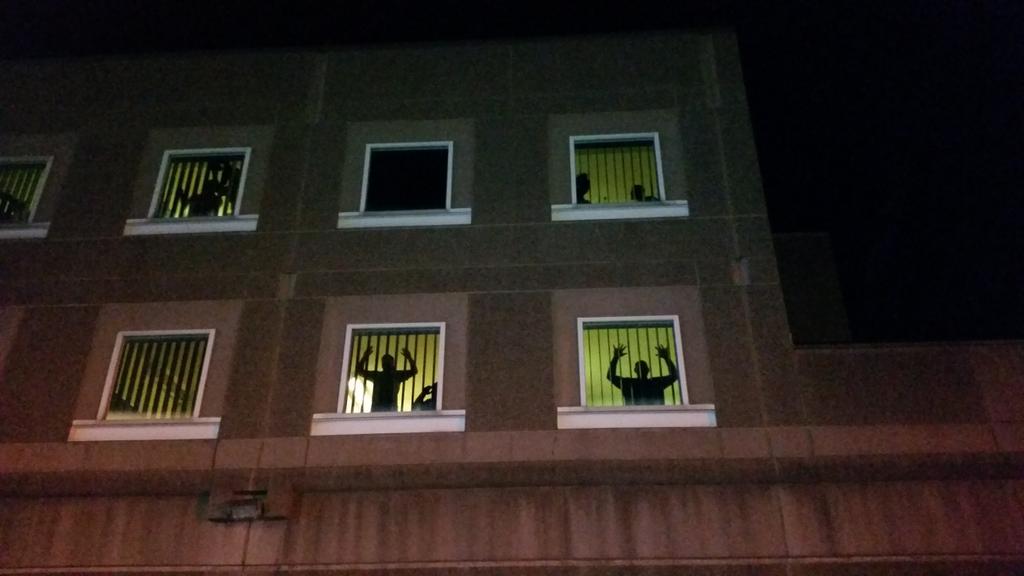
I had joined two of the rallies in Boston the week before, the first, following the non-indictment of Darren Wilson, who had killed Michael Brown, in which thousands of people took over the streets, chanting “No justice, no peace, no racist police.” We paused in front of the South Bay House of Correction, where inmates stood at the windows with their arms held up to communicate “Hands up, don’t shoot.”

BLM post_Inmate picUltimately, many of the marchers shut down a ramp leading to the interstate. In contrast to the media framing of this demonstration, a number of people I know personally were punched in the head or ribs, or trampled on by police. The other rally followed the non-indictment of Daniel Pantaleo, the police officer who killed Eric Garner, marching up to the city’s Christmas tree lighting and celebration. The message was that we cannot go on with business as usual, while Black people are being victimized.

image002In both of these rallies, I was struck by the power of Black women leadership, and discovered the organizers of these events were from a group called Black Lives Matter (BLM) Boston, affiliated with the national BLM.

BLM is a national organization with an action agenda. It started as a hashtag, created by three Black queer women organizers with a deep understanding of “intersectionality” (or, ways in which different oppressions – including gender, race, and sexual preference – intersect and co-produce one another). Queer is an umbrella term to refer to all LGBTIQ – lesbian, gay, bi-sexual, transgender, intersexual and questioning people – that reveals the fluidity of social categories such as sex and gender. As Black feminist and social activist, bell hooks, writes: “Every day of my life that I walk out of my house, I am a combination of race, gender, class, sexual preference and religion or what have you.”

To be in a huge throng of people demanding an end to racism, to chant Black Lives Matter, was nothing short of inspiring. Here is a short clip of activist Ife Franklin, who spontaneously led us in singing Bob Marley’s “Redemption Song.”

Video from Ferguson Rally (11.25.14)

But while marching, there were moments I felt confused. Should I, as a white woman, be chanting, “Hands up, don’t shoot?” or “We can’t breathe?” Do whites as a group face systematic victimization by the police? No. Can I breathe when I see a police officer when I walk down the street? Hell, yeah! They might even help me, if I’m in need, without presuming that I am guilty of some infraction. As a collectivity, white people are not incarcerated or murdered because of the color of our skin. It seemed wrong to use the language of people who are.

I wondered, more broadly: What is my role in this struggle for racial justice, as a white person?

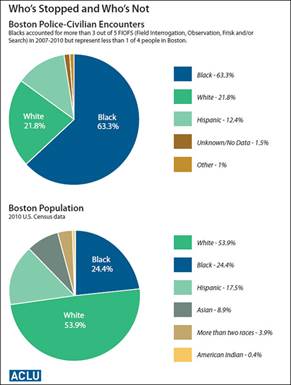
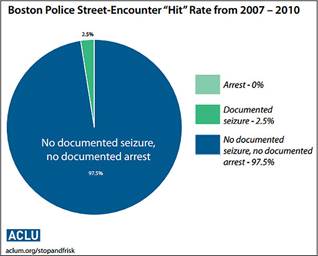
When I read about the local meeting to help white people figure out their role in the context of this organizing effort, I was compelled to go. Sitting in the pews of Hope Church, I listened to three young white organizers deftly walk us through a set of guidelines to frame how we can be allies – or “accomplices” – to this Black led movement “without replicating racist dynamics.” To set the stage, the trainers began by presenting findings from a study (conducted by scholars from Harvard and Rutgers for the ACLU) that confirmed the existence of racial discrimination within the Boston police force. The study concluded that Boston police officers disproportionately interrogated, observed, or searched Black residents during the period between 2007 and 2010.

image003
Courtesy of the ACLU Massachusetts

And despite these Boston “police-street encounters,” there was little evidence of probable cause. Researchers reported that the “hit” rate was incredibly low, with no documented seizure and no documented arrest in 97.5 percent of the cases. Black people were 8.8 percent more likely than whites to be stopped repeatedly by police, and 12 percent more likely than whites to be frisked or searched during a stop.

Courtesy of the ACLU Massachusetts


In defining our role as white people in supporting Black Lives Matter, the trainers acknowledged that we in the audience might be leaders in our own worlds and in many of our endeavors, but now we have an opportunity to “follow the leadership of this Black-led, women-led, and queer-led movement.” They challenged us to keep “Black lives at the center,” meaning that it is Black people who suffer the consequences of anti-Black racism, and they must be in charge of the movement to eradicate it.

White people need to critically assess what it means to be white in a society that systematically privileges whiteness. Peggy McIntosh, who writes extensively on white privilege, says,

“I have come to see white privilege as an invisible package of unearned assets which I can count on cashing in each day, but about which I was ‘meant’ to remain oblivious…White privilege is like an invisible weightless backpack of special provisions, maps, passports, codebooks, visas, clothes, tools and blank checks.” [She cites many examples of white privilege.]

“Whether (I use) checks, credit cards, or cash, I can count on my skin color not to work against the appearance of financial reliability. I can arrange to protect my children most of the time from people who might not like them. I can swear, or dress in second hand clothes, or not answer letters, without having people attribute these choices to the bad morals, poverty, or the illiteracy of my race…I can do well in a challenging situation without being called a credit to my race…I can take a job with an affirmative action employer without having co-workers on the job suspect that I got it because of race…I can choose public accommodation without fearing that people of my race cannot get in or will be mistreated in the places I have chosen.”

White people have a critical role to play, not only in supporting the efforts of Black people, but also in educating ourselves and other white people about the nature of structural economic and racial oppression.

How can white sociologists contribute to a Black-led movement for racial justice? What role can we play in combating racism?

We may say, “I am not a race scholar,” so what can I do? But sociologists specializing in any field are still human beings living in a racist society. We understand the social structures within society that reproduce inequities of all kinds. How can we bring this sociological eye to our work to address and help to eradicate racial oppression? I can think about a number of ways, and maybe you can think of others.

We can assess the critical role of law enforcement as the tool of a white dominant culture. We can question how police brutality against “racialized others” has historically been considered acceptable in our society. We can change our curriculum and incorporate other people’s experiences and narratives. We can include authors on our syllabi who tell stories about racial injustice, providing students with a better understanding of the systemic ways that discrimination is reproduced. We can create space in the classroom for dialogue about these issues. And for those of us who teach social movements, we can include this growing social movement as part of our curriculum, how small acts of coordinated resistance are important for engendering large-scale struggle. We can also incorporate a race lens into our research and writing. We can support social action among our students on campus.

The trainers emphasized that Black Lives Matter is not a pep rally or protest; It is an uprising, and the meeting at Hope Church was held in the hopes that white people in the room would join that resistance. The three energetic trainers asked us white people to understand the structural nature of racism and to find a way to talk – as white people – about the Black Lives Matter movement. They asked us to commit to the practice of talking with other white people about white supremacy, just as we were doing at this meeting. And they asked us to become activists, to mobilize anti-racist white people when we were called upon.

As white people, we have an opportunity to make a difference, just as hundreds and thousands of white people who have joined the struggle for racial justice over the decades. As social scientists, we have tools to support this movement – our teaching and research and our access to spaces to foster a new, constructive dialogue – where we can frame the conversation for our students, our colleagues, and our communities.

To paraphrase an oft-used phrase: If not us, who? If not now, when?


Lyrics, Redemption Song by Bob Marley

Emancipate yourselves from mental slavery;
None but ourselves can free our mind.
Wo! Have no fear for atomic energy,
‘Cause none of them-a can-a stop-a the time.
How long shall they kill our prophets,
While we stand aside and look?
Yes, some say it’s just a part of it:
We’ve got to fulfill the book.
Won’t you help to sing
These songs of freedom? –
‘Cause all I ever had:
Redemption songs –
All I ever had:
Redemption songs:
These songs of freedom,
Songs of freedom.


Read the entire Black Lives Matter Series on Feminist Reflections


Part 1 in a series

http://thefeministwire.com/wp-content/uploads/2014/10/BLM.jpg
Image from: TheFeministWire.Com

The online platform turned national organization project — Black Lives Matter — started as a call to action against anti-Black racism following the acquittal of George Zimmerman, the neighborhood watch volunteer who fatally shot unarmed black teenager Trayvon Martin.

According to The New York Times, the jury rejected the prosecution’s argument that Zimmerman deliberately pursued and started what became a lethal fight with Martin because he assumed he was a criminal. The verdict wasn’t a surprise, certainly not to black people who have experienced and/or witnessed similar outcomes over and over again. Alicia Garza, a co-creator of Black Lives Matter, explained in a Colorlines interview:

A lot of what we were seeing on Facebook and in our conversations was, “I knew they would never convict [Zimmerman]. He would never go to jail.” For us, it wasn’t actually about using the criminal justice system to solve our issues. For us, it’s really about asking, “Do black lives matter in our society?” and what do we need to do to make that happen. We know that someone going to jail is not going to make black lives matter. What’s going to make those lives matter is working hard for an end to state violence in black communities, knowing that that’s going to benefit all communities.

The hashtag #BlackLivesMatter soon became a rallying call. Within days of tweeting it out, Garza teamed up with Patrisse Cullors, executive director of the Coalition to End Police Violence in L.A. Jails, and Opal Tometi, who runs the Black Alliance for Just Immigration. Together, these women started a dialogue about what it means to be black in this country, to be the target of a system of anti-Black racism.

The persistent, strained relationship between law enforcement and African Americans that has led to a string of police-related incidents and fatalities is part of that system. The fatal shooting of yet another unarmed, black teenager in Ferguson, Missouri, followed by yet another grand jury decision not to indict the white police officer who shot him, begs the question again: Don’t black lives matter?

Recurring incidents like these across the country shine a dim light on the everyday biases and racial, political, and socio-economic structures that uphold racial inequalities and privilege whiteness. But Black Lives Matter is not just about racism; it’s about anti-Black racism.

At this critical time, we, as social scientists, have an opportunity not only to support those seeking transparency, accountability, and safety in their communities, we can examine ourselves, and be proactive in our own work.

What biases do we hold? How do we help to perpetuate racism in our institutions, and specifically anti-Black racism? How might we engage in critical dialogue in ways that will transform our institutions to make black lives matter? What actions can we take to support this growing movement, not only through our classroom teaching, but also informally in our work with students, in our research and how we use that research, in our public sociology, and for some, in direct action?

We’ll be reflecting on these questions here. Please share yours. And we will continue the discussion in the next few blog posts.


Read the entire Black Lives Matter Series on Feminist Reflections


More Information:

On the movement:

Related:

Reflections from The Society Pages:

How white people can fight racism:

On Protesting:

logo-300x135

When we had a baby girl, her super hip grandmother asked “Is there an Internet site where we can buy books that feature strong girls?”

At the time there wasn’t. But lo and behold, it has arrived. And it is a sensation. We have to thank the feminist blogosphere for helping us to get here. more...