crime

Since 9/11, Arab Americans have experienced various forms of harassment and repression in the U.S., including deportations, FBI questioning, citizen surveillance, and harassment as well as insults, threats, and physical attacks we might now categorize as hate crimes. Sociologists Wayne Santoro and Marian Azab are interested in how these experiences impact Arab Americans’ political activism, with a particular focus on protests.

Using Michigan as their case study, Santoro and Azab focus on two main questions. First, to what extent are documented levels of repression associated with increases in public demonstrations and meetings between Detroit-area Arab Americans and authorities about ethnic-based grievances? And second, which Arab Americans are more likely to be involved in activism and civic engagement?

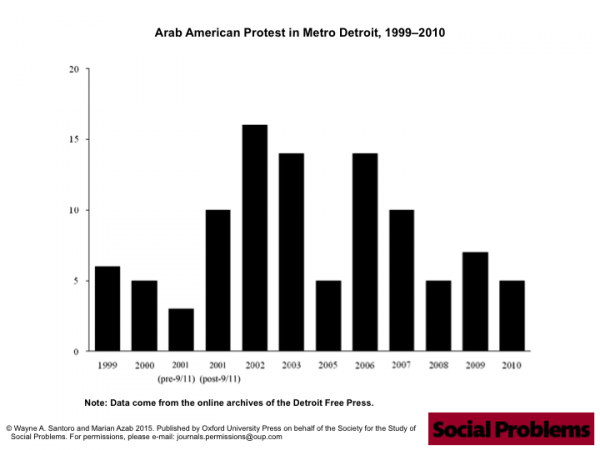
To answer the first, Santoro and Azab examined archives of the Detroit Free Press from 1999-2010. They found a clear temporal relationship between increases in repressive treatment against Arab Americans and patterns of protest and organizing in the community. Such activism peaked in the year after 9/11, with a general increase in protest in the following years.
© Wayne A. Santoro and Marian Azab. 2015.

If the fact that protests peaked post-9/11 within the Arab-American community is unsurprising, the second question—who participated in these protests—provides new information. To examine the effects of repression on an individual level, Santoro and Azab used the Detroit Arab American Study (DAAS) to look at a sample of 1,016 people of Arab or Chaldean descent living in the Detroit area in 2003. They examined the impact of experiencing repression due to race, ethnicity, or religion on the respondent’s participation in a protest, march, or demonstration about any social or political issue within the last twelve months. The results indicated that individuals who identify weakly with their Arab identity are more likely to protest after experiencing repression.

The results indicate that repression does not just mobilize those who are already activists. Rather, repression mobilizes individuals with low levels of identity who are especially shocked by their experiences with oppression.

Andy McLemore//Flickr CC. Click for original.

Stories of domestic violence and child abuse committed by athletes like Ray Rice and Adrian Peterson prompt public belief that violent crimes are a widespread epidemic in American professional football, thus inspiring the nickname “National Felon League.” In fact, a national survey indicates 69% of Americans believe domestic violence is a serious problem in the league. NFL officials have responded by developing policies to address domestic violence and sexual assault. Despite numerous news articles highlighting these crimes, however, few researchers have actually researched whether NFL players are more likely to commit crimes than people in the general population.

Wanda Leal, Marc Gertz, and Alex Piquero contrast the arrest rates of NFL players with those of the general public from 2000 to 2013. Using data compiled by the San Diego Union – Tribune and USA Today, the authors looked at the arrest rates of 1,952 NFL players to the national arrest rates for males between the ages of 20 and 39 as reported in the FBI’s Uniform Crime Reports (UCR). They found that NFL players had significantly lower rates of property, public order, and total arrests than other young men, but higher rates of violent arrests (a statistically significant phenomenon in 6 of the 14 years they measured, particularly from 2004 to 2008).

Leal, Gertz, and Piquero’s preliminary study does not appear to support the theory that NFL players are especially likely to be arrested, as the general population had higher arrest rates in three of the four measured crime indices. Nevertheless, the study also provides some support for those concerned about violence crime committed by professional football players.

Image by Shannon Golden for The Society Pages.
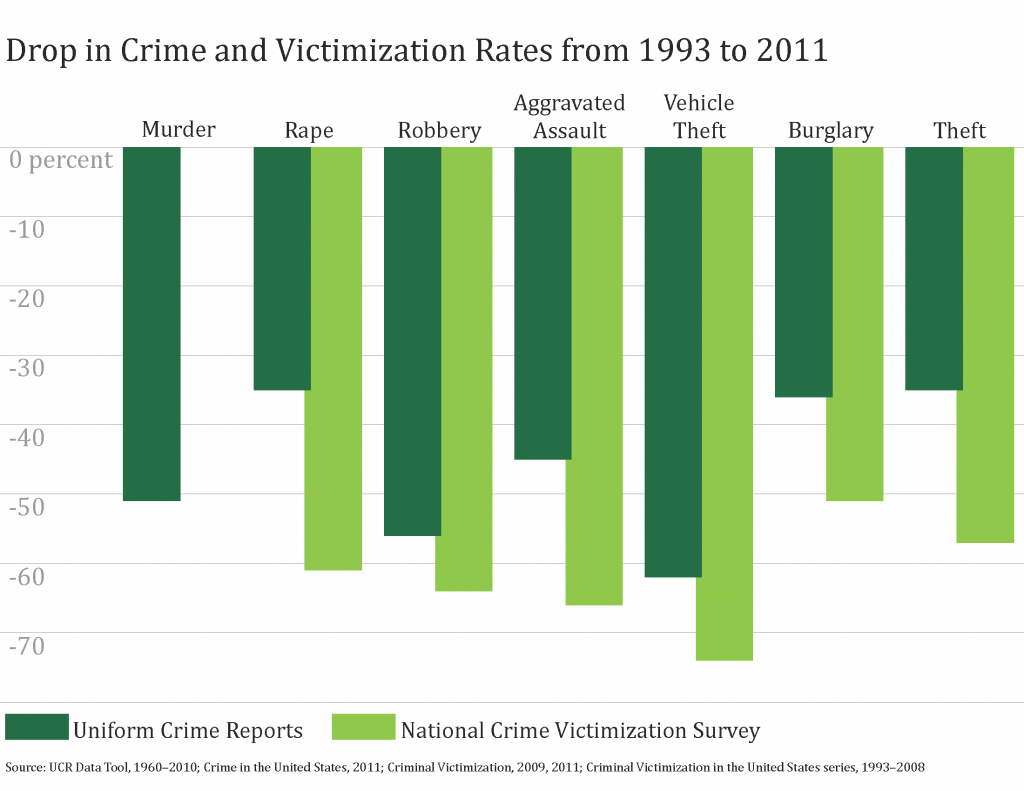
Image by Shannon Golden for The Society Pages. U.S. data as indicated.


The homicide rate has been steadily, albeit slowly, declining in the United States and Western Europe for several decades. Researchers have pointed to various social and economic factors that account for variations in the homicide trends, including “decommodification”: the extent to which individuals are protected from market forces. In particular, Robert Merton’s strain/anomie theory predicts that the murder rate is dependent on the extent to which cultural expectation and social structure are in balance. Here, a society in which social life is heavily dictated by economic pressures would likely have a higher prevalence of criminal activity.

Following this theory, social welfare support, an attempt to buffer individuals from the economic turmoil of the market, could function to decrease the prevalence of crime. Patricia L. McCall and Jonathan R. Brauer empirically examine this possibility using homicide (one of the most reliable measures of criminal activity—underreporting is a less pressing issue than in other types of crime) and economic data from 29 European countries from 1994 to 2009.

McCall and Brauer find that levels of welfare support within a country (measured by an index that incorporates total welfare expenditure per capita, health care, and unemployment support) is associated with a decrease in the homicide rate, controlling for numerous other economic indicators and the age structure of the country. Further, the researchers find that the effects of these changes are not apparent right away. The effect of increased social welfare support has a 2-3 year lag, meaning that an increase in welfare spending in 1990 would not be reflected in lower homicide rates until 1992-1993.  

McCall and Brauer’s analysis suggests that protecting individuals from the forces of the market via robust a robust social welfare net may not only decrease the extent of inequality in a nation, but also the prevalence of homicide. This finding highlights how the anti-austerity measures many European nations have implemented have not only changed economic conditions, but also the social conditions of many citizens. While McCall and Brauer caution that welfare spending is not a solution to a nation’s homicide problem, increased social support won’t hurt.

A photo for World Suicide Prevention Day. Ashley Rose, Flickr CC.

Suicidal behavior has been found to cluster in and around certain areas and groups. For example, the nine western states that make up the “suicide belt” in the United States, including Arizona, Oregon, and Wyoming, consistently report higher suicide rates than the rest of the country. Research also finds that suicidal behavior can “spread” between individuals; when someone experiences a friend or loved one’s suicide, he is much more likely to attempt his own suicide. If suicide is contagious, how and why does it spread?

In their analysis of suicide contagion among young adults, Anna Mueller and Seth Abrutyn use network data from a national survey of adolescents to analyze how the disclosed and undisclosed suicide attempts of one adolescent affects the suicide attempts and ideation of that adolescent’s friends one year later. They find that when an adolescent knows about their friend’s suicide attempts, they are more likely to think about and attempt suicide themselves. However, they find that undisclosed suicide attempts and ideations do not result in suicidal attempts or ideation among their friends.

Mueller and Abrutyn conclude that when an individual shares their suicide attempts with their friends, it “transforms the distant idea of suicide—as something that other people do—into something that people like them use to cope with distress, sorrow, or alienation.” They argue that suicide spreads when it becomes a “cultural script” for coping with emotional distress; the more someone is exposed to suicidal behavior among their peers, the more likely the generalized idea of suicide will become an acceptable option for how that individual deals with her own distress. When suicide becomes prevalent enough in a peer group or culture to qualify as an option, it is much more likely to spread.

Protestors in Oakland, CA. Photo by Annette Bernhardt, Flickr Creative Commons.

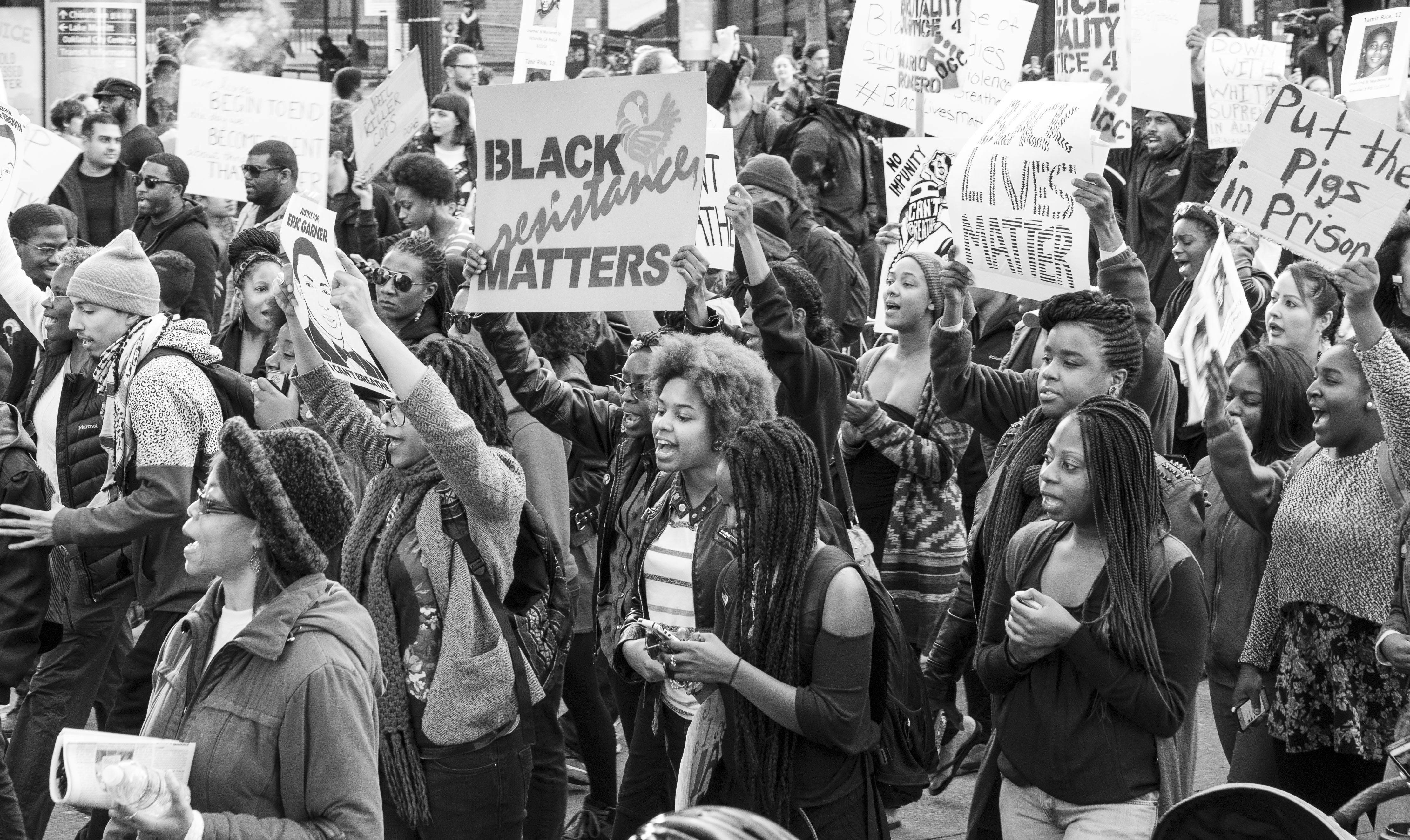
Stories like those out of Ferguson and Baltimore show a double bind for the Black Lives Matter movement. On the one hand, large scale protests draw national attention to important matters of racial injustice and structural police violence. However, media attention to riots leads commentators to criticize “violence” among protestors and discredit their mobilization. One response to these critiques is the argument that violence is political—it is sometimes the only possible way to resist injustice when the traditional political system fails. New research gives us another perspective to chew on: tangible political power for citizens of color may actually reduce the link between race and violence that the media is so quick to criticize.

Research on neighborhood violence often finds a relationship between racial composition and rates of violence—communities with a higher percentage of black residents tend of have higher rates of violence even after we control for structural problems like economic inequality. Vélez, Lyons, and Santoro argue that neighborhood context matters a great deal and can challenge this conclusion. In particular, political opportunities for community members of color offer policy benefits and increased trust in local institutions, and these factors in turn may reduce or even eliminate the relationship between race and violence in a neighborhood.

Using data from the National Neighborhood Crime Study and the 2000 Census, the authors measured violent crime (homicides and robberies) in 8,931 census tract neighborhoods in 87 cities. They also measured black political opportunities in terms of elected representatives, workers in civil service positions, civilian police review boards, and liberal voting bases, and black political mobilization through the presence of citywide minority advocacy organizations and histories of riots and nonviolent protests. Finally, they controlled for city-level factors like the number of manufacturing jobs, racial segregation, and residential mobility.

With a method called hierarchical generalized linear modeling, the authors test the relationship between neighborhood racial composition and neighborhood violence across census tracts clustered in cities. When they introduce the controls for city-level disadvantage, the relationship between race and violence drops substantially, suggesting that it does not hold true across different locations. Finally, they find that in cities with more black political opportunities and more past mobilization through protests and riots the relationship between race and violence disappears.

This last finding is especially important for two reasons. First, it is a myth buster; the authors argue “these results challenge pervasive cultural stereotypes that trace black neighborhoods inevitably to violence” (110). Second, the finding shows us the benefits of political engagement and symbolic inclusion in neighborhood life—when communities have opportunities to organize, mobilize, protest, and ultimately secure power, certain social forces that may increase neighborhood violence disappear.

Ted Chiricos, Elizabeth K. Stupi, Brian J. Stults, Marc Gertz, “Undocumented Immigrant Threat and Support for Social Controls,” Social Problems, 2014
Photo by Paolo Cuttitta via Flickr.


Immigration, particularly undocumented immigration, is a hot-button political issue. Polls consistently show Americans are concerned about the flow, control, and punishment of undocumented immigrants. Previous sociological inquiry has highlighted how, when people think minority groups pose a threat to their interests, they are more likely to support anti-immigration stances.

Ted Chiricos and colleagues use a national survey of non-Latino respondents to investigate the role of context in attitudes supporting stronger border control (such as increased manpower at boundaries) and internal controls (such as not allowing undocumented immigrants to receive welfare). They find their respondents’ personal characteristics, such as education level and non-white race, are associated with lower levels of support for both types of immigration control, whereas characteristics such as a conservative political persuasion and living in a border state increase support for controls.

The researchers also look at how perceived threats affect individuals’ stances on immigration control. Dynamic changes in the unemployment rate (an economic threat) and the ratio of Latinos to non-Latinos (a cultural threat) both increase support for internal immigration regulation, but not border controls. Such changes in demographic context may be more noticeable to individuals than static observations. Chiricos and colleagues also show that people’s perception of the threat of immigration mediates many personal and contextual factors in forming their opinions. That is, it’s the sense of threat, rather than the existence of one, that drives attitudes toward immigration policy.

Community changes can sway immigration attitudes when the changes are perceived as legitimate cultural or economic threats. Thus, when citizens, pundits, and politicians label social changes as “threats,” they can shift popular opinion toward closed (and closely guarded) borders.

Certification programs have become a common way to assess corporate social and environmental responsibility, but do these third-party rating programs actually change business practices?

Amanda Sharkey and Patricia Bromley investigated how involvement in an environmental evaluation program, the quality of a firms’ rating, and the ratings of peer firms are associated with actual pollution levels. They found that ratings programs affect the individual companies involved as well as their wider network of peer companies. Just as there are social pressures and norms to be environmentally friendly in communities and friend groups, firms also seem to bow to peer pressure.

Sharkey and Bromley collected data on thousands of public companies using KLD Research and Analytics, Inc. (an influential leader in socially responsible investing) evaluations and EPA data on toxic pollution emissions. They found that corporations with more “rated” peer companies are more likely to reduce their own emissions and that the impact depends on the degree of competition and regulatory oversight in the industry. The ratings numbers also mattered, as firms with higher positive peer ratings had greater emissions reductions.

In short, private third-party rating programs can tangibly improve environmental and social outcomes, so long as organizations anticipate the ratings will impact their competitive edge, profit margins, and corporate culture. While Sharkey and Bromley caution that monitoring and rating can’t replace laws and regulation, the ratings may still play an important role in bringing about social and environmental change.

Photo by Matthew G//Flickr CC

A lot of ink has been spilled investigating “mass incarceration,” the massive expansion in the scope of punishment and its subsequent social consequences. However, the largest arrest categories are for crimes below a felony level, which do not elicit a prison sentence. These “lower-level” criminal justice encounters involve misdemeanors or infractions of noncriminal codes. Issa Kohler-Hausmann, using over 2 years of field work in a New York City criminal court, investigates how “misdemeanor justice” – the criminal justice processing of lower level offenses – represents a form of social control, even though the majority of these sub-felony cases do not result in either a finding of guilt or a formal punishment.

Kohler-Hausmann argues that the criminal justice system extends its net of control through misdemeanor level cases through three techniques: marking, procedural hassle, and performance. The first procedure, marking, is an official mark on the defendant, most often in the form of a temporary rap sheet (which can be dismissed after a period of time). The mark allows the authorities to keep temporary “tabs” on the defendant, and restricts the defendant’s travel and immigration. Further, all open criminal matters in New York are accessible to the public through an online database. This can increase the stigmatizing reach of the criminal mark, as employers and landlords can access this data.

The second form of misdemeanor control, procedural hassle, involves the institutional “hurdles” necessary to obtain the dismissal of the mark. Defendants have to conform to the institutional demands of the court, for example, a mandatory court appearance (or a number of them) is accompanied by stress, lost work, child care costs, and often the neglect of other opportunities in order to comply with court dates. Additionally, the time from arrest to dismissal is defined by numerous encounters with state authority, which demand a level conformity and obedience.

The final penal technique offered by Kohler-Hausmann is performance. The threat of a lasting criminal mark and the demands of criminal justice procedures require the defendants to comply with the demands placed on them. For example, the performance of community service is a common prerequisite for a case dismissal. Overall, these techniques allow the criminal justice system to track and discipline alleged low-level offenders without the formal punishment of parole, prison, or jail, widening the system’s net of control.

The United States has seen a steady increase in the policing and mass incarceration of its citizens in the last few decades. The increased surveillance and imprisonment, primarily of poor and minority populations, has been called by social scientists a “culture of control.” This culture of control harms not only the individual, but also their community, since highly policed communities have worse health outcomes and less economic stability than their less-policed counterparts. In their study of the effects of out-of-school suspension on academic achievement, Brea Perry and Edward Morris find that the cultural mindset of control—and its consequences— has now found its way into the halls of America’s schools.

Using three years of data from over 15,000 students in a public school district in Kentucky, Perry and Morris report that higher levels of “exclusionary discipline” (out-of-school suspension rates) lead to lower math and science test scores even among non-suspended students. The increased use of suspension as a punishment for individuals, that is, reduces academic achievement outcomes for the student body as a whole.

To test for reverse causation—the possibility that the effects are working in the opposite way—the authors looked at test scores over three years and used suspensions at the beginning of a given semester to predict test scores at the end of that semester. Their analyses confirm that increased suspension leads to lower test scores, rather than lower test scores leading to more suspensions.

Like the destabilizing consequences of mass incarceration for communities, exclusionary discipline in public schools ultimately undermines rather than supports academic performance. Schools with highly punitive environments create anxiety and distrust, heightening tensions for both students and teachers.

The authors emphasize that their findings are presented as an addition to existing critiques of the overuse of exclusion as a means of social control. They conclude, “Punishment is not a discrete response to certain transgressions, but a system of social order that produces wider meanings and consequences.”

Racial and ethnic minorities are more likely to be incarcerated and are given longer sentences relative to majority groups. However, to what extent are non citizens punished differently than citizens? Michael Light, Michael Massoglia, and Ryan King, using federal court data from the United States Sentencing Commission, find that some of the incarceration disparity attributed to ethnicity/race is due to citizenship status.

Controlling for numerous factors, such as criminal history and offense type, the researchers find that “noncitizen offenders are over four times more likely to be incarcerated,” and that noncitizens receive roughly an additional 3.5 months of additional prison time.  Further, the effect of citizenship on incarceration is larger than other factors such as race, offense type, and gender. The researchers also find that while the odds of incarceration for both documented and undocumented immigrants are raised, it is the undocumented individuals who are at a higher odds of being imprisoned relative to documented immigrants. The effect of citizenship on incarceration has in fact increased steadily from 1992-2008, which was a time of heavy immigration into the United States.

So noncitizens are more likely to be incarcerated and for longer periods when they are indeed convicted. But why? The authors suggest a few reasons – First, legal officials often have limited time and imperfect knowledge surrounding a case, and may resort to factors such as citizenship  to aid in their decision making process. Second, less integrated groups, like immigrants, have less knowledge and power when it comes to navigating America’s social structures and are more prone to disparate treatment by institutions. Finally, the dominant group (legal citizens) may perceive minority groups (immigrants) as a threat to their superior social position, and incarceration is used as a strategy to keep immigrants in a powerless position. Overall, the research here highlights how citizenship proves to be an important factor in incarceration decisions, above and beyond the usual suspects of race and ethnicity.