Archive: 2011

As many of you already know, the Cyborgology editors decided to throw a conference called Theorizing the Web. The conference will be in College Park, MD (just outside of Washington, D.C.) on April 9th. Today we are excited to announce the program for the conference and attach a flier that we hope you all can distribute to those who you think might be interested.

As you will see, the response was terrific. We built 14 panels out of the 56 papers we accepted (from the over 100 submissions). There will be three invited panels (on feminist activism, race, and methods). There will be two symposia (one on the role of social media in the Arab uprisings and another on social media and street art). There will be two plenaries (one by Saskia Sassen and another by George Ritzer). And we are excited to have danah boyd deliver our keynote.

If that was not enough, we have plenty of art-related surprises in store for those who attend. We have invited artists of all types to display and perform art specifically tailored to the themes of the conference. This will be one busy carnivalesque day for those who love technology and/or theory!

The program is found here: http://www.cyborgology.org/theorizingtheweb/program.html

Last, a flier for the conference [.pdf here]. Please distribute widely!

TtW2011 Flyer


Twitter users, likely from outside of China itself, are calling for people to “stroll” in Chinese public areas. The strolling protestors are not to carry signs or yell slogans, but instead to blend in with regular foot traffic. Chinese officials will not be able to identify protestors who themselves can safely blend in anonymity. [Edit for clarity: the idea is that foot traffic will increase in the announced area, but officials won’t know which are the protesters.]

This tactic is reminiscent of those French Situationist strategies of May ’68 to create chaos and disorder (note that strolling is akin to, but not exactly the same as, DeBord’s practice of “the derive“). The calls to “stroll” have had impact in China with the government shutting down public spaces and popular hangouts. Even a busy McDonald’s was closed. These gatherings announced over Twitter have been highly attended by many officials, police and media, but, importantly, not by many protestors themselves.

This is slacktivism at its best. If this slacker activism is often defined by more...

One of the few things more interesting than Anonymous, are the internal sub-groups that have begun to develop.  Libcom is currently running a story about the Anonymous Anarchist Action hacktivist group.  This group seeks to specialize in capitalist targets and (in true anarchist fashion) constructing a horizontally organized coalition of people with a wide variety of expertise (not just programming or web science).

by Space Invaders

Last week, fellow editor Nathan Jurgenson made a post entitled “Digital Dualism versus Augmented Reality” with a call for more concept work surrounding this topic.  I hope to make a contribution to that effort by discussion three competing theoretical paradigms of Internet research.  These three distinct perspectives perceive the Internet as either virtual reality, mediated reality, or augmented reality.  I argue (in the spirit of Saussure) that these three perspectives are only fully comprehensible defined in relation to one another.

Let’s start with the definition of “augmented reality” found in Wikipedia, society’s great font of prosumptive wisdom:

Augmented reality (AR) is a term for a live direct or a [sic… I fixed it] indirect view of a physical, real-world environment whose elements are augmented by computer-generated sensory input, such as sound or graphics. It is related to a more general concept called mediated reality, in which a view of reality is modified (possibly even diminished rather than augmented) by a computer. As a result, the technology functions by enhancing one’s current perception of reality. By contrast, virtual reality replaces the real-world with a simulated one.

This is an unsatisfying definition.  While it does contrast augment reality and mediated reality to virtual reality (mediated and augmented reality describe relationships between the online and offline worlds, while virtual reality describes their separation), it (self-admittedly) fails to distinguish between mediated and augmented reality.  As presented in this definition, mediated and augmented reality are basically synonyms.

more...

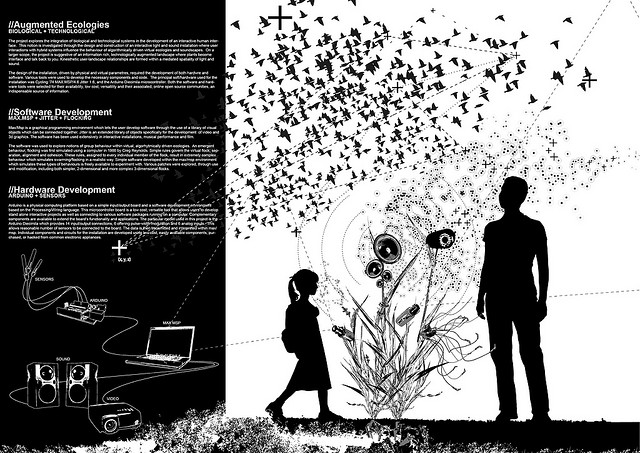
The integration of biological and technological systems in the design of an interactive human interface is explored through an installation where plants rigged up with sensors provide a kinesthetic user experience based on movement, touch, sound and light. Human interaction with the system affects an algorithmic projection and soundscape.
More images after the jump. more...

Visualizing the immaterial landscape of Wi-Fi networks reveals a layer of our augmented reality.

This post was originally published March 2, 2011 by Racism Review and is reproduced with permission. This work is part or an ongoing series by Jessie Daniels on race and social media.

facebook
(CC photo credit: ERNESTO LAGO)

I’ve been doing a series about what academic research on race and racism on the Internet.    The series continues today with a look at what researchers are finding about one the most talked about aspects of the popular Internet: Social Networking Sites.

Social networking sites (SNS), such as Facebook and MySpace, are phenomenally popular and important to the field of Internet studies, (Boyd and Ellison, “Social Network Sites: Definition, History, and Scholarship,” JCMC, 2007, Vol.13(1):210-230).    According to a recent report, the top SNS is currently Facebook, with over 65 million unique visitors per month.  Facebook has displaced the former leader in the field, MySpace, which still currently gets about 58 million unique visitors per month.  These are staggeringly high numbers of people participating in these sites.    But what does this phenomenon have to do with race and racism? more...

Protesters charge their mobile phones in Tahrir Square in Cairo.

In my previous post on “Digital Dualism Versus Augmented Reality,” I lay out two competing views for conceptualizing digital and material realities. Some view the physical and digital as (1) separate, akin to the film The Matrix, or (2) as an augmented reality where atoms and bits are increasingly imploding into each other.

I prefer the latter, and want to apply this augmented paradigm to the revolutions occurring in the Arab world that have been taking place this winter as well as the subsequent debate over the causes. I, like many others, am equally frustrated by those who give either all or none of the credit for these uprisings to social media tools and argue instead that what is occuring is an augmented revolution.

On one side there are those that promoted the phrase “Twitter revolution” during more...

Cool tool that uses Google’s Street View to allow users to tag street art from around the globe. Check it out.

Expect more on street art and social media right here on Cyborgology in the near future.

New Millimeter-scale computer. Photo Credit: Greg Chen

I have terrible eyesight. Correctable medium myopia, with a heavy dose of astigmatism, keeps glasses on my head for 90% of my waking hours. (The remaining 10% is split between showers and punctuating dramatic one-liners.) My first eye doctor made a point to remind me of, upon each visit,how hard it is to repair a damaged eye. Thus, fueled by a fear of losing my eyesight, I always get excited about new technology for the eyeballs.

Researchers at The University of Michigan have successfully developed one of the first millimeter-scale computer systems. They aim to use the technology to monitor eye pressure in glaucoma patients, by inserting this tiny computer near the eye. Their overall goal for the technology however, has much broader implications. Dr. David Blaauw explains:

“The next big challenge is to achieve millimeter-scale systems, which have a host of new applications for monitoring our bodies, our environment and our buildings. Because they’re so small, you could manufacture hundreds of thousands on one wafer. There could be 10s to 100s of them per person and it’s this per capita increase that fuels the semiconductor industry’s growth.”

more...