
health

The aqueducts in Segovia were one solution to Spain's need for water. But they're not the only one. Photo by Paulo Guerra via Flickr.
The aqueducts in Segovia were one solution to Spain’s need for water. But they’re not the only one. Photo by Paulo Guerra via Flickr.

Spain has always gone to great lengths to meet its high demand for water, but when faced with a shortage, the town of Zaragoza took a different approach. When severe droughts in the early 1990s caused reservoirs to dry up, forest fires to rage, and crops to wither, it became clear that the inland city would not be able to meet their high demand. Víctor Viñuales, the director and co-founder of the Spanish NGO Fundación Ecología y Desarrollo (Ecology and Development Foundation), used his understanding of sociology to devise an innovative solution. He tells The Guardian:

“Trained as a sociologist, Viñuales wondered what would happen if municipalities focused less on making sure residents had access to all the water they wanted and more on reducing demand. From that thought began a 15-year experiment in Zaragoza that has revolutionised how many in Spain – from locals to public officials – think about water management.”

Viñuales lead an ambitious project that began with a challenge to the city’s citizens to save 1 billion liters of water in a year. He used a widespread media and social outreach campaign, offered free audits to help find water saving opportunities, gave discounts on water saving products, and even changed the city’s water bills so citizens could track their changes in usage. Zaragoza stepped up to the challenge.

“Today Viñuales rattles off statistic after statistic to show how this city of 700,000 has transformed itself. Between 1997 and 2012, per capita use of water in Zaragoza dropped from 150 litres/day to 99 litres/day. The drop even sustained an increase in population; between 1997 and 2008, the city’s population grew by 12% but daily water use dropped by 27%.”

Viñuales was able to use both social and economic factors to effect the lives of the people of Zaragoza and make a huge stride forward in sustainability. While he acknowledges the success he has seen, he reminds us that “To achieve profound change – whether it be environmental, social or cultural – you have to be prepared to take it on for the long haul. Here in Zaragoza we’ve had that profound change. The population grew, but we use fewer resources than before. It’s really what needs to be achieved on a global level.”

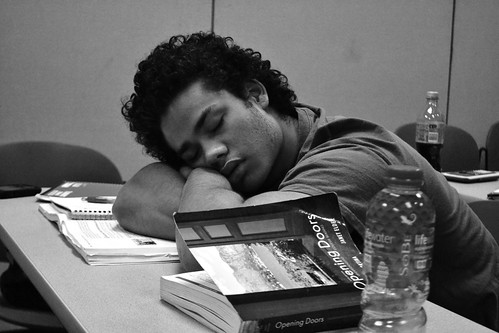


Photo by maxime delrue via Flickr.
Women may “catch” pregnancy from their friends. Photo by maxime delrue via Flickr.

A study coauthored by Bocconi University’s Nicolleta Balbo and University of Groningen’s Nicola Barban has unearthed a potential new contagion: babies.

The Chicago Tribune reports on the study of women’s friendships and potential child birthing saying,

…After one of the women in each friendship pair had a baby, the likelihood that her friend would also have her first baby went up for about two years, and then declined.

Balbo and Barban focus on high school friends, analyzing 1,170 women in a longitudinal study beginning in the 1990s. During the study, 820 of the participants became parents, having their first child at an average age of 27.

Balbo identifies three mechanisms that might contribute to the seemingly significant amount of influence between friends. First, she discusses social influence. This hinges on the idea that we constantly compare ourselves to people around us, including friends, and may be pressured to conform to their behavior. The second mechanism Balbo proposes is social learning. Watching a friend go through parenthood may arm prospective parents with knowledge and make them more comfortable fulfilling the parent role themselves. The third mechanism focuses on cost-sharing dynamics. Being in a similar life circumstance with friends can help reduce both costs and stress.

The study has been critiqued for not incorporating larger social networks and assuming that friendships can be studied in dyads.  Either way, I’ll think twice the next time I find a baby shower invitation in my mailbox!

first step to success
Photo by CJ via Flickr CC.

College students are tired of sleeping, according to a BBC interview with Catherine M. Coveney. She’s a British sociologist who recently explored the sleeping practices and subjective sleep experiences of two notoriously sleep-deprived groups: shift workers and college students. After conducting 25 semi-structured interviews with individuals dispossessed of rest, she concludes that our social context impacts how we understand the meaning of sleep and how we manage our sleeping schedules as a result.

The hospital-based doctors, nurses, police officers, call center employees, and other shift workers Coveney interviewed describe actively managing their sleep schedules around work patterns, finding childcare, and spending time with their partner. It is something that is constantly at the back of their mind. To illustrate why they view “broken sleep” as part and parcel of the job, Coveney explains how sleeplessness is built-in to the work structure:

There are some occupations where nothing is sanctioned…. The two nurses that I spoke to, they had to work waking nights. So even on their break, they weren’t allowed to go to sleep during the night. That’s not to say it didn’t occasionally happen, but that it was not a sanctioned practice. That was something that was seen as going against the rules of their profession.

On the surface, the sleep patterns of the college students look identical to the shift workers: “They did describe a kind of similar pattern; they did describe taking naps during the day, having a shorter sleep at night, having a two hour nap the next day.” Yet because they see sleep as an  “expendable luxury,” they don’t view their own erratic sleep as “broken.” According to Coveney, for the college students,

…it was more flexible, it was more their choice, so in a sense they were customizing their sleep patterns to fit around their social activities…. I suppose it was seen as disposable in a sense, they could cut back on sleep if they chose to, they could indulge in sleep if they chose to.

Although both groups thought of sleep in functional terms—the necessary amount determined by what was needed to get them through what they had to do the next day—Coveney reports, “None of the students I spoke to said they would prioritize a night in bed because they thought they hadn’t had enough sleep. If there was something else they wanted to do, they‘d do that. And they’d catch up later, they’d sleep longer the next day, they’d take a nap…. Some of them did go as far as to say if they could get rid of their need for sleep, it would give them much more time to do other things.” Even the value of sleep depends on supply and demand.

To learn who else is getting more sleep than you are, check out these TSP classics on the gender sleep gap and on segmented sleep.

m_350_oc_1sht_V1.inddThe comedy Obvious Child hit theaters last Friday, and it’s been praised as “the most honest” abortion movie Slate‘s Amanda Hess has ever seen. Honest, in that the film’s protagonist Jenny Slate decides to have an abortion and goes through with it. Her relationship does not implode, she does not suffer crippling guilt, and she survives. Her life goes on. It turns out that this kind of straightforward portrayal is a rarity in American film and television, though millions of women have abortions every year (the Guttmacher Institute pegs the number of worldwide procedures at about 42 million per year). In a recent Contraception article, a pair of sociologists report that pre-Roe v. Wade era plotlines disproportionately featured the death of women characters who even thought about abortion. After abortion’s legalization, portrayals came to suffer from a different distortion: “These movies tell us that it was wrong [before Roe] for laws to dictate what a woman ought to do with her body, but now that she has the choice, she should choose to give birth except under the most extenuating of circumstances,” Hess writes. Obvious Child rejects, well, the obvious.

Watch the trailer for the film here.

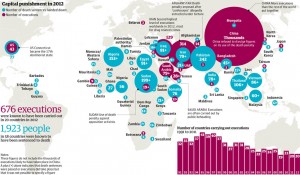
A Guardian UK graphic from 2011 draws on execution data from Amnesty International.

In societies that allow for the death penalty in criminal punishment, there has been a shift toward ever more “humane” methods of execution. The rhetoric surrounding these changes generally involves not violating the rights of the prisoner by applying a cruel or unusual punishment—that is, just death, not torture.

In an interview with The Voice of Russia, University of Colorado professor Michael Radelet explains that the real motivations for a turn toward the medicalized execution may have more to do with minimizing the suffering of the audience than the condemned. When asked if there was a humane way to kill someone, Radelet points out that shooting and guillotining have no history of failure, unlike generally bloodless lethal injection (recently pegged at 7% in the U.S. by Amherst College’s Austin D. Sarat).

“Most state authorities in the US couldn’t care less whether or not the inmate suffers, what they care about is the suffering by the audience. This all has to do with the spectators.” Apparently, modern sorts want their vengeance deadly, but not grisly.

Radelet says that the death penalty is mainly political, allowing the public to be convinced their society is tough on crime. If the obvious question in the death penalty debate is: Do you support the death penalty? Data Radelet cites points to a more thorough question: Do you support the death penalty, given the alternative of life without parole? When the question is rephrased, support for the death penalty actually goes up a bit. It seems that, when the respondents consider a lifetime of suffering against death, their views on the suffering of others shift yet again.

Picturing the War on Drugs in Pittsburgh. Photo by Christopher "Rice" via flickr CC.
Picturing the War on Drugs in Pittsburgh. Photo by Christopher “Rice” via flickr CC.

As far as the London School of Economics is concerned, it is time to end the global War on Drugs. According to LSE’s new report, the “War” is a “billion-dollar failure.” The report was signed by five Nobel-Prize winning economists (Kenneth Arrow, Christopher Pissarides, Thomas Schelling, Vernon Smith, and Oliver Williamson), as well as former U.S. Secretary of State George Schultz, British Prime Minister Nick Clegg, and former NATO and EU foreign policy chief Javier Solana. Al Jazeera explains:

“The pursuit of a militarised and enforcement-led global ‘war on drugs’ strategy has produced enormous negative outcomes and collateral damage.” Citing mass drug-related incarceration in the US, corruption and violence in developing countries and an HIV epidemic in Russia, the group urged the UN to drop its “repressive, one-size-fits-all approach” to tackling drugs, which, according to the report, has created a $300bn black market.”

The LSE report urges a shift toward evidence-based approaches to illicit drug use: the tremendous resources devoted to the drug war could be diverted to more rigorous analysis and effective policy with “a focus on public health, minimising the impact of the illegal drug trade.”

Photo by J.K. Califf via Flickr.com

In this era of social media, increasingly, our lives are being lived on the internet. Advertisers are taking note and mining our status updates and internet searches for information about our personal lives, targeting online advertising to our interests and identities.

Janet Vertesi, an assistant sociology professor at Princeton, has attempted the impossible: she tried to hide her pregnancy from the internet. It’s a lot harder than it sounds. Jezebel.com details her attempt to keep information out of the hands of advertisers while also explaining how this phenomenon is affecting women.

The tiniest bits of information, an Amazon order or an internet search, contribute to the web of data that companies are buying to target individuals. Data about pregnant women is fifteen times more valuable to companies than information about the average person, as parenting has increasingly become a consumer market. (See previous Citings about the economic investments of parenting and the luxury market for baby goods.)

In order to keep her pregnancy a secret, Vertesi and her husband paid for everything in cash or gift cards, asked their friends and family to keep all news off social media, and even searched for baby products using private browsing. The steps they took to avoid discovery could be seen as ‘suspicious.’ They even ended up paying cash for gift cards to spend online, a strategy that can trigger alarms when the prices get higher.

Jezebel.com discusses her experience saying, “In short, if you want to hide your pregnancy from big data, you’ve got to operate like a drug dealer.”

One concerning factor is what this means for pregnant women. Pregnancy status can be very personal and women can choose not to divulge their pregnancy for a wide range of reasons. If pregnancy is no longer private, what is?

Photo by woodleywonderworks via Flickr Creative Commons.

According to the New York Times, research from everyone from the Department of Health and Human Services to the CDCP, National Survey of Family Growth, the Tinina Q. Cade Foundation, and black women themselves shows that, despite centuries’ old stereotypes and even fears that black women are particularly fertile, well, they’re not. In fact, married black women have twice the odds of infertility than white married women, but it’s rarely talked about.

Regina Townsend of thebrokenbrownegg.org tells the Times:

“With women of color, specifically Hispanic and African-American women, the stigma attached to us is that it’s not hard to have kids, and that we have a lot of kids,” she said. “And when you’re the one that can’t, you feel like, ‘I’ve failed.’”

Some of the disparity in seeking treatment for infertility comes from differing health networks (see our recent piece with Brian Southwell for more on that) and some from differing financial positions (see decades upon decades of research on the wealth gap between black and white U.S. citizens). That is, black women seem less likely to talk to other women, their gynecologists, and their faith communities about fertility (or a lack thereof), and they’re less likely to have the resources—financial, medical, and network-wise—to seek infertility treatment.

Part of the problem, said Arthur L. Greil, a sociologist at Alfred University in western New York who has studied infertility and women of color, is that middle-class white women tend to have the confidence and connections to navigate the health care system better than less affluent minority women.

Even further, since fibroids (benign tumors that can significantly affect fertility) are more prevalent among black women and black women take longer to reach out for fertility advice, problems are compounded by time. Fertility drops naturally over the years, of course, but Dr. David B. Seifer said:

…fibroids [are] just one of various “cultural issues, biological issues and social issues” black women face that can affect their fertility. He said black women often waited longer to seek a diagnosis of or treatment for infertility, which “gives all of these other biological factors more time to become more severe.”

As Cariesha Tate Singleton told the article’s author, she knows she’s up against a stereotype that women like her are naturally “baby-producing machines.” Groups like Fertility for Colored Girls are working to change that notion.

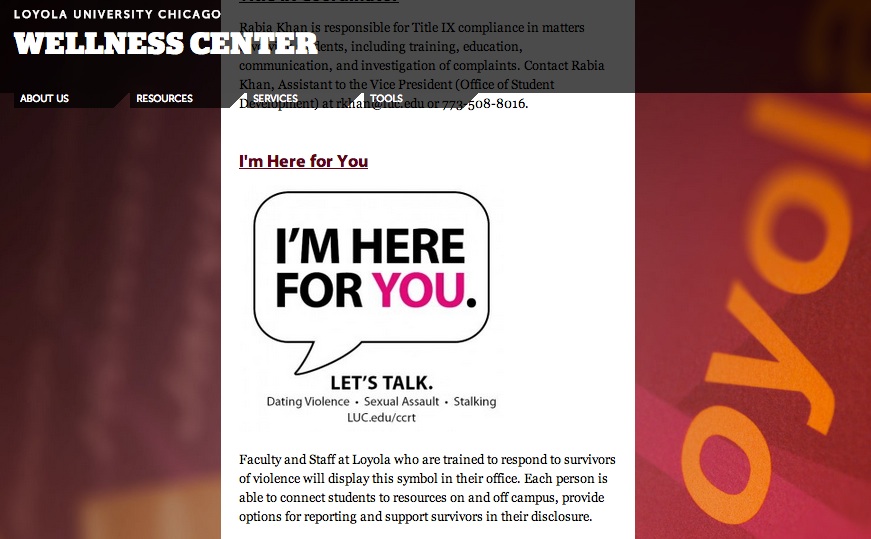
"I'm Here for You" at Loyola University Chicago offers support to victims of dating violence, sexual assault, and stalking.
“I’m Here for You” at Loyola University Chicago offers support to victims of dating violence, sexual assault, and stalking.

Good sociological research illuminates how individuals in society interact with social institutions and with one another. Sometimes, this research can uncover some of the feel-good aspects of social life. Other times, it can leave you despairing for humanity and raging against social structures.

A new report by Marquette University sociologist Heather Hlavka evokes the latter feelings. Analyzing over 100 interviews with girls aged 3 to 17 who may have been sexually assaulted, Hlavka found that the majority of these young women didn’t see themselves as victims because they considered sexual harassment a “normal” part of everyday life and male behavior.

For years, politicians, pundits, academics, and community advocates have been troubled by the staggering statistic that 60% of sexual assault and harassment goes unreported. Hlavka’s research speaks to some of the reasons behind this figure. Beyond the normalization of sexual harassment and assault, she finds that assaults go unreported out of shame, fear of retribution, and mistrust of authority. This mistrust extends to male authority figures, including police officers, to whom many of these women and girls would report an assault.

Hlavka sees her study as a call to action. Changing the way we think about sexual assault and sexual harassment might be a big step toward stopping it.

You can watch Hlavka discuss her research on the Melissa Harris-Perry Show.

Photo by Yoko via flickr.com

A recent study on school bullying offers more than just a look into the Mean Girls-style warfare taking place between high school cliques. It highlights the difficulty of social mobility and the risks that come with disrupting the status quo.

With data from over 8,000 North Carolina high school students, Robert Faris and Diane Felmlee created “a social map” of 19 North Carolina schools, documenting cases of bullying. They found that girls are victimized more often than boys, and most instances of school violence are due to a student’s perceived weakness, appearance, or sexual orientation.

Sociologists understand schools to be a space where social norms are learned and reinforced, and bullying is often a way to assert status and punish non-conformity. However, Faris and Felmlee’s research also shows that students use violence to organize and maintain social hierarchies. The study found that when students from the lower “rungs” began to move up the social ladder, their chances of being bullied increased by 25 percent.

“As kids get closer [to the top],” Faris says, “they become more involved in social combat.”

But the “luxury” of hierarchies, Faris claims, is that once students reach the top, they no longer engage in violence. With nowhere left to climb, the top 4 percent have no incentive to bully other students and their elite status protects them from being bullied.

Films tend to reduce bullying to a cliquey “nerds v. jocks” fact of adolescence, but Faris and Felmlee show that school violence doesn’t just affect unpopular students, it affects anyone who might disrupt the balance of power.