
health

swedish flag
Photo by Nicolas Raymond via flickr.com

Nordic countries boast some of the highest rates of equality, economic security, and social wellbeing. Though sociologist Lane Kenworthy isn’t necessarily suggesting that the United States regulates its industries or redistributes wealth, he thinks that America should take a page or two from Sweden’s book. In an interview with The Washington Post, Kenworthy calls for a restructured welfare system and an entirely new conversation about social policy. He argues that implementing more “public insurance programs” would allow the U.S. government to help citizens cope with the economic booms and busts that come with capitalism.

Different countries have tried different things, and a lot of what I suggest we do is based on previous experiences. Paid parental leave, for example, has existed for more than a generation in some European countries, as have universal child care and preschool.

Along with universal childcare and paid leave for new parents, plenty of developed nations have adopted other social insurance policies—like universal health care and protection against lowered wages. And although Americans tend to be pretty divided when it comes to expanding federal welfare, there are domestic examples of these types of federal programs bringing, and keeping, people out of poverty.

While most conversations about lowering American inequality tend to focus on strengthening the labor movement, placing hefty taxes on the rich, or regulating corporations, Kenworthy is “pessimistic” about these solutions.

I look at what’s happened in Western European countries, and I see union density declining nearly everywhere…Nordic countries rely very heavily on public insurance and less heavily on regulation than many American progressives believe, and…it’s not as though they sock it to the rich more than we do. Their tax systems are slightly less progressive.

According to Kenworthy, solutions to inequality should focus on policies that boost “economic security, opportunity, and shared prosperity.”


Picture 2


Photo by @Saigon via flickr.com

In the age-old struggle to “have it all,” many of us try to squeeze extra hours out of each day in order to accommodate all of our work and family responsibilities. In the past this discussion has revolved around female workers, those who juggle full-time work, parental duties, and the domestic chores of the “second shift.” However, as the nature of work changes – becoming more precarious at the same time more demanding – this struggle for work-life balance extends to workers of all genders, ages, and social classes.

In a recent Huffington Post blog, sociologists Erin Kelly and Phyllis Moen discuss this very challenge, asserting,

The root problem, of course, isn’t that employees have family or personal commitments. The root problem is the rigid conventions of work that assume work must occur at certain times and places and that mistakenly gauge productivity by the number of hours spent at work.

Kelly and Moen research flexible working policies that can dramatically shift the very nature of work in order for this balance to be more attainable. They have found that the most effective flexible policies are those that are available to all workers, rather than perhaps mothers or specific individuals and that are collectively implemented with both employees and managers sharing control.

To move beyond decades of discussing work-life balance to meaningful change, employers need to shift from one-off accommodations. It’s time to make working efficiently, creatively, sustainably and flexibly the new norm.

These policies, such as remote work and varied hours, benefit organizations as well as employees. With these flexible policies, employees are not only more healthy and less stressed but also are more likely to work hard to keep their jobs.

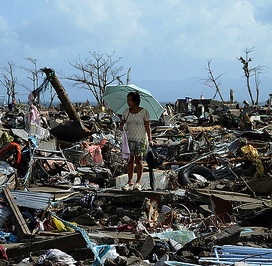
The aftermath of Typhoon Haiyan in the Philippines. Photo by Jordi Bernabeu
The aftermath of Typhoon Haiyan in the Philippines. Photo by Jordi Bernabeu via flickr.com

With death toll rising from the devastating typhoon in the Philippines this week, it seems that we’re constantly being reminded of the destruction of natural disasters, especially for rural and poor areas. Rural communities can be difficult to reach in times of environmental chaos, and poorer regions don’t always have the resources to cope with a crisis. When city services shut down or relief aid doesn’t come through immediately, community members band together to manage the aftermath of the disaster as best they can.

Sociologist Eric Klinenberg believes that community resources including “public places from libraries to mom-and-pop shops and coffee shops” can influence the outcomes of a crisis by providing the community the familiarity and support they need. In researching one such disaster, the 1995 Chicago heat wave, Klinenberg found that the residents of neighborhoods with more social infrastructure—like libraries and coffee shops—fared much better during the heat.

Those resources so dramatically improve the quality of our life on a regular day, but when there’s a heat wave or a hurricane or some other disaster, they can make the difference between life and death. In the Chicago heat wave, they did.

These types of social infrastructure benefit communities beyond times of crisis, according to Klinenberg who argues,

The nice thing about investing in climate security through social infrastructure is that the residual benefit is that we could dramatically improve the quality of life in these places all the time regardless of the weather. And it’s that kind of intelligent design that we desperately need at this moment.

Picture 2


Photo by Jeffrey Turner via flickr.com
Photo by Jefferey Turner via flickr.com

Reminiscent of The Proclaimers’ 1988 hit about walking 500 miles, William Helmreich, a sociologist at the City College of New York, has been taking it to the streets for the past four years. During that time he has walked all 120,000 city blocks across New York City’s five boroughs, and he is sharing the knowledge gained from his observations, experiences, and conversations in a new book called The New York Nobody Knows: Walking 6,000 Miles in the City.

His work illustrates the utility of ethnographic research as a means of public sociology. In addition to observing the social world around him, Helmreich engaged people he encountered on questions ranging from the best parks in the area to their opinions on social issues such as immigration and gentrification

Both the diversity of the terrain and the outspoken character of the people he encountered likely contributed to the depth of Helmreich’s research. A New Yorker, he says, “is gruff, fancies himself to be knowledgeable, and cannot resist a challenge of answering, on the spot, in a wisecracking type of way, a spontaneous question.”

Photo by JC i Núria via flickr.com

Cul-de-sacs, long the scourge of urban planners and often imagined as markers of suburbia, social isolation, and, well, bowling alone, may actually increase social cohesion among neighbors. That is the conclusion that Thomas Hochschild, a sociologist at Valdosta State University, draws from his research on 110 homes in demographically comparable Connecticut communities.

He conducted interviews with sets of homes around bulb cul-de-sacs, dead end cul-de-sacs, and through streets and found that people living around bulb cul-de-sacs are more likely to know their neighbors, spend time with them, and borrow or lend food or tools to them, even when controlling for such variables as income, number of children in a household, and the length of time that a family had lived there.

It may be that the features of cul-de-sacs which so aggravate civil engineers – the decreased walkability and the lack of efficient traffic circulation through neighborhoods – are just what promote neighborliness among the people living there. It’s just easier for people to gather outdoors or let their children play outside without cars whizzing past.

Hochschild suggests that, if designed with urban planning considerations in mind, cul-de-sacs will be a critical part of improving the livability of communities. “I’m concerned about the breakdown of community and of society… I wouldn’t claim that cul-de-sacs are a panacea, a cure-all for community problems we’re facing. However, I think that it’s a piece of the puzzle.”

Photo by Shardayyy via flickr.com

October is breast cancer awareness month in the U.S. Pink ribbons, 5k races, and educational events mark the campaign to educate the public about the disease and push for more research to find a cure. We hold fundraisers and portray survivors as heroes and positive role models. A number of sociologists and other academics have analyzed and critiqued the U.S. breast cancer industry, including Gayle Sulik, Sabrina McCormick, and Stefano Puntoni.

In other parts of the world however, breast cancer is silently killing women. For one, the disease still carries a stigma that keeps women from accessing treatment. New York Times blogger Denise Grady discusses this stigma towards the disease in developing nations, particularly African countries, as well as the many additional barriers to treatment. These barriers include scarce resources, shame surrounding the disease, corruption, and the real constraints of economic and family responsibilities, all of which make for a deadly combination. Grady states,

Survival rates vary considerably from country to country and even within countries. In the United States, about 20 percent of women who have breast cancer die from it, compared with 40 to 60 percent in poorer countries. The differences depend heavily on the status of women, their awareness of symptoms, and the availability of timely care.

Although it is not new knowledge that diseases disproportionately affect poorer countries and individuals, cancer treatment and education has been neglected in developing nations. It has been overshadowed by other diseases like malaria and AIDS, and due to a lack of public awareness on both the national and international scales, it has been underfunded by governments and foundations. Research from PRI indicates that “cancer kills more people in low- and middle-income countries than AIDS, malaria, and TB combined.”

Photo by Kris Mouser-Brown via flickr.com

In a recent article in The American Prospect, Monica Potts examines the mystery of what is killing poor white women. Research on longevity by Jay Olshanky from the University of Illinois in Chicago and a team of collaborators found that white women who dropped out of high school are dying on average five years earlier than the their equivalents in the generation before them. These results have researchers baffled – not since the fall of the Soviet Union, when life expectancy for men dropped by seven years, has there been such a dramatic change in longevity in a single generation.

Most Americans, including high-school dropouts of other races, are gaining life expectancy, just at different speeds. Absent a war, genocide, pandemic, or massive governmental collapse, drops in life expectancy are rare. “If you look at the history of longevity in the United States, there have been no dramatic negative or positive shocks,” Olshansky says. “With the exception of the 1918 influenza pandemic, everything has been relatively steady, slow changes. This is a five-year drop in an 18-year time period. That’s dramatic.”

Numerous researchers are investigating the root causes of this drastic shift. Jennifer Karas Montez from Harvard and Ann Zajacova from the University of Wyoming tested a number of potential factors, including employment, income, and health behaviors like smoking and drinking. White female high school dropouts are less likely than women with a high school education or more to work, and if they do work, it is often low wage, low skill jobs in the service sector. But certainly, many other demographic groups work minimum wage jobs. Indeed, black women who dropped out of high school have seen an increase in their life expectancy over this time.

Although women generally outlive men in the U.S., such a large decline in the average age of death, from almost 79 to a little more than 73, suggests that an increasing number of women are dying in their twenties, thirties, and forties. “We actually don’t know the exact reasons why it’s happened,” Olshansky says. “I wish we did.”


drugs $5
Dr. Hart was surprised that the subjects in his experiment often chose a $5 reward over a free high. Photo by David Hilowitz via flickr.com

Drugs are a necessary but not sufficient condition for addiction. Social scientists have long been interested in examining the social and environmental aspects of drug addiction.

A recent New York Times article discusses Columbia University Professor Carl Hart’s research on crack cocaine and methamphetamine addiction from his book “High Price.” When he started his research in the 1990s, Dr. Hart believed in the irresistibility of drugs, but findings from his experimental research to find a cure for drug dependency made him reevaluate his stance on addiction as purely a neurological phenomenon.

“Eighty to 90 percent of people who use crack and methamphetamine don’t get addicted,” said Dr. Hart, an associate professor of psychology. “And the small number who do become addicted are nothing like the popular caricatures.”

Both popular research and societal conceptions about drug addiction are missing a significant explanation for the cause of drug addiction. Dr. Nutt, a professor of neuropsychopharmacology at Imperial College London, supports Dr. Hart’s results:

Addiction always has a social element, and this is magnified in societies with little in the way of work or other ways to find fulfillment.

This “social element” could help explain why some people fall prey to drug addiction while others inexplicably escape its grasp. The idea of a social or structural element to addiction would cause a significant shift in the rhetoric of many substance abuse programs and wider societal discussions about drug use. The next step is to evaluate how large an effect environmental factors can have on addiction.

The reaction from other scientists has been mixed. No word yet on Dr. Hart’s next experiment, but I’m hoping it involves chocolate.

Photo by Gideon Tsang via flickr.com

After the recent shooting at the Washington Navy Yard, mass murders have once again occupied the attention of the American news media. From Aurora to Newtown to Washington, DC, one obvious trend among rampage shooters is that they are almost exclusively male. In a recent article for NPR, Linton Weeks asked members of the Homicide Research Working Group why women are so underrepresented among these shooters.

According to Lin Huff-Corzine of the University of Central Florida, women simply don’t kill as much as men. Examining FBI data, she and her colleagues found that:

Between 2001 and 2010, less than 8 percent of mass murder offenders in the U.S. were women, she says, adding that some of the women included in the statistics assisted in a crime but did not pull a trigger.

Candice Batton, the director of the School of Criminology and Criminal Justice at the University of Nebraska, Omaha explained that about 90-91% of homicide perpetrators were male. Men are more lethally violent than women in part due to their tendency to externalize blame for their personal problems, leading to “anger and hostility toward others.”

Batton says that women, on the other hand, “are more likely to develop negative attributions of blame that are internal in nature, that is: ‘The cause of my problems is some failing of my own: I didn’t try hard enough, I’m not good enough.’ And this, in turn, tends to translate into feelings of guilt and depression that are targeted toward oneself.”


Facebook Dislike photo via Flickr
Photo by zeevveez via Flickr.com

Social networks allow instant access to friends and family, and let you show the world what’s going on in your life. Maybe a bit narcissistic, but harmless. Studies, however, have been all over the place on the question of whether SNS (social networking systems) are “good” or “bad” for individuals and society. Are we more connected than ever or more disconnected than ever? A recent study by the Public Library of Science went with the bad news: it found that the more you use Facebook, the more miserable you’ll be.

A recent article in The Economist describes the work of Ethan Kross of the University of Michigan, and Philippe Verduyn of Leuven University in Belgium. In response to generally short-term, “cross-sectional” studies of SNS, their study was done over an extended period of time.  Subjects would answer surveys reporting their mental and emotional states multiple times a day. The more they were on Facebook, the more they reported being dissatisfied with life.

Others studies have associated the use of social networks like Facebook with depression, social tension, and envy. The article states:

Endlessly comparing themselves with peers who have doctored their photographs, amplified their achievements and plagiarised their bons mots can leave Facebook’s users more than a little green-eyed.

On a positive note, the same study found that the more in-person contact the subject had, the more satisfied they were. Digital dualism aside, a well-rounded life of on- and off-line interaction—that good old “moderation”—seemed to do the trick.