culture

Photo by mtume_soul via flickr.com

The Millenial Generation is coming of age in an era of low voter turnout, weak and waning labor union influence, and few civil protests compared to previous generations. Though this appears to paint a portrait of overall apathy, the young Millenials are not necessarily disengaged.

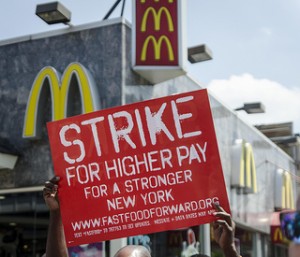
Last month, fast food workers, many of them young, in 60 cities and almost 1,000 restaurants across the country walked off their jobs in a demonstration for higher wages. In an article in the NYTimes, the workers involved in the walk-out received publicity for the “audacity of their demand,” a push to increase their hourly wages to $15. Currently, the majority of the 2.3 million fast food workers in America make no more than the federal minimum wage of $7.25, well below a living wage. The media depiction of the strikers as naïve and audacious in their demands calls to mind the Occupy Wall Street movement. Once again, corporations are claiming that raising workers’ wages would place a financial burden on consumers and hurt businesses.

But if we’ve learned anything from the backlash against these protests, it’s that the situation is not black and white. Tali Kristal’s recent research, “How the Decline of American Unions Has Boosted Corporate Profits and Reduced Worker Compensation,” argues that the consumer versus poverty-wage worker dichotomy is faulty. Not only has the federal minimum wage failed to rise with the cost of living, but the literal percentage of corporate profits going to the worker is declining—with more of the profits being pocketed by already-wealthy individuals. This is happening as labor unions, which have historically defended workers’ rights, decline in power and influence. Kristal advocates a need for increased collective action in the form of labor unions and a redirected attention to where profits are actually going.

Perhaps the fast food worker walk-out is an example of this much-needed change. University of Washington sociologist Jake Rosenfeld believes that the walk-outs mark a shift in the previous decline of labor unionism and collective action, arguing, “The strikes could elevate the union movement’s standing among younger workers who have grown up in an era when unions have steadily lost membership and power.” In a generation of waning civil engagement, declining labor unions, and an overall aura of apathy, such demonstrations mark a renewed form of collective action.
Image excerpt from the Washington Post, created by Christina Rivero. Click for full image.

When thinking about the typical U.S. family, you might imagine a classic sitcom like The Brady Bunch: stay-at-home mom Carol, architect husband Mike, and six lovely children. At the time the show aired, a “blended” family of remarried adults was a bit of a novelty, sure, but it still stuck to the married mother and father, father is the breadwinner trope. And that’s still how many often picture U.S. families.

The Washington Post reports the findings of Ohio State University’s Department of Sociology on the living arrangements of U.S. children from birth to 17 years old. The researchers found that the children’s living arrangements varied distinctly by race. Asian children were most likely to live with a married mother and father, with only the father working, but that set-up only counted for 24% of living arrangements among Asian children. It turns out that dual-income households are the strong majority among both white and Asian children, and that both are more likely to live in dual-income households than either black or Hispanic children. Higher percentages of black and Hispanic children are living with their grandparents. Another notable statistic among black children is their greater likelihood of living with a single, never-married mother (this is true for nearly a quarter of all black kids).

No word yet on all white, three-boy, three-girl families with maids.

Facebook Dislike photo via Flickr
Photo by zeevveez via Flickr.com

Social networks allow instant access to friends and family, and let you show the world what’s going on in your life. Maybe a bit narcissistic, but harmless. Studies, however, have been all over the place on the question of whether SNS (social networking systems) are “good” or “bad” for individuals and society. Are we more connected than ever or more disconnected than ever? A recent study by the Public Library of Science went with the bad news: it found that the more you use Facebook, the more miserable you’ll be.

A recent article in The Economist describes the work of Ethan Kross of the University of Michigan, and Philippe Verduyn of Leuven University in Belgium. In response to generally short-term, “cross-sectional” studies of SNS, their study was done over an extended period of time.  Subjects would answer surveys reporting their mental and emotional states multiple times a day. The more they were on Facebook, the more they reported being dissatisfied with life.

Others studies have associated the use of social networks like Facebook with depression, social tension, and envy. The article states:

Endlessly comparing themselves with peers who have doctored their photographs, amplified their achievements and plagiarised their bons mots can leave Facebook’s users more than a little green-eyed.

On a positive note, the same study found that the more in-person contact the subject had, the more satisfied they were. Digital dualism aside, a well-rounded life of on- and off-line interaction—that good old “moderation”—seemed to do the trick.

Photo by Kristine Lewis via flickr.com.

For many, the “American Dream” means owning a comfortable home in a nice neighborhood, and that idea brings a certain Mellencamp tune to mind.

The song nods to a deeper point: the history of American housing policy from the New Deal and the G.I. Bill onwards was often defined by who couldn’t get a little pink house. In fact, racial biases among policymakers and bureaucrats made it difficult or impossible for minorities to get support for housing in white neighborhoods (For a great account of this history, see Ira Katznelson’s book When Affirmative Action Was White, or his recent blog post over at The Scholars Strategy Network).

Today’s housing policies may be flipping the script on this story, but not necessarily in a good way.

The Atlantic Cities reports new research from NYU Sociologist Jacob Faber on the 2006 housing bubble that preceded the massive economic crash and kickoff to the U.S. “Great Recession” in 2008. It turns out that during this bubble, in addition to denying home loans to racial minority groups, banks were also targeting minority groups for lower quality loans. The article reports:

Black and Hispanic families making more than $200,000 a year were more likely on average to be given a subprime loan than a white family making less than $30,000 a year… blacks were 2.8 times more likely to be denied for a loan, and Latinos were two times more likely. When they were approved, blacks and Latinos were 2.4 times more likely to receive a subprime loan than white applicants.

Faber adds that the trend doesn’t just deny support to these minority groups, it actually ignores their financial successes.

…this data offers another illustration that middle-class blacks have often not been able to leverage their income status for the same benefits as middle-class whites.

Ain’t that America?

A 2012 Greek Orthodox Church gathering in Zimbabwe. Photo by The Alliance of Religions and Conservation via flickr.com.

On both the left and the right, discussions about the environment can often turn to religion to remind us of our responsibility to take care of the planet. Both Presidents Bush and Obama have reminded us to be “good stewards of the earth,” despite the disagreement on what that really means, and the activism of a range of religious groups on the issue has led pundits and scholars to conclude that Americans’ Christianity has been getting greener over the past few years.

A new report from Michigan State University, however, may challenge this verdant vision. Lansing’s Fox News affiliate station reports that a new study by John Clements, Aaron McCright, and Chenyang Xiao suggests a real divide between between what Christian leaders are saying and congregants are doing. Their work with an environmental attitudes section in the 2010 General Social Survey found that rank-and-file Christians have not shown “a significant increase in pro-environmental attitudes, beliefs, and behaviors.” In fact, nonreligious respondents in the survey were more likely to show concern about the environment and more willing to sacrifice to protect it.

The good news from the authors’ article in Organization & Environment is that, among Christians alone, those who were more religious were more likely to engage in “private environmental behaviors” like driving less and recycling. The real question, then, is not which religion gets to claim it cares more about the environment, but rather how to make these beliefs and behaviors more common for everyone.

Image via MNUnited.com, an organization formed to fight a proposed Constitutional amendment that would have banned gay marriage in MN, but repurposed to help make marriage equality the law in the state once the amendment was defeated.

Today marks the first day that gay couples can legally marry in the states of Rhode Island and Minnesota, the eleventh and thirteenth states respectively to legalize gay marriage. In the wake of  the recent Supreme Court decision on the Defense of Marriage Act (DOMA) and California’s Prop 8, many gay and lesbian individuals and allies around the country are celebrating advances in the rights and recognition extended to gay couples on a federal level.

However, in the midst of these celebrations, Rick Settersten points out in a recent LA Times article that same-sex couples, who do not reside in the thirteen states and the District of Columbia where gay marriage is legal, continue to be left out by the law. He states,

For those of us trapped elsewhere in the country—even in places we love—the verdict reinforces the fact that the security of our families and our futures rises or falls depending on where we live.

Highlighting the variation and inconsistency by state in legal rights extended to gay and lesbian partnerships, Settersten describes the reality of gay couples that migrate to states with more legal recognition. Settersten, his partner Dan, and their two children moved from Ohio in 2004 when the state banned recognition of any form of same-sex coupling (marriage, civil unions, or domestic partnerships). At the time, their new home state of Oregon enabled them to co-adopt children and register as a domestic partnership. Although they have been together for almost thirty years, their domestic partnership in Oregon will not be federally recognized under the DOMA decision, forcing them to move yet again if they want to benefit from federal recognition of their union.

At least it's not a favorite *kid*! Vintage ad via JBCurio, flickr.com.
At least it’s not a favorite *kid*! Vintage ad via JBCurio, flickr.com.

A new study from Purdue University lends weight to the idea that, emotionally, children do not always grow up in the “same” home. Research by Professor Jill Suitor and graduate student Megan Gilligan builds on this with a bit of sibling rivalry: siblings are likely to be more bothered by perceived favoritism from fathers than from mothers.

Other work has shown moms who picked “favorites” had caused sibling tension, but studying the influence of both parents was a novel approach. Revisiting 2008 interviews (from the Within-Family Difference Study) with “Baby Boomers” whose parents were still alive, the authors spotted the difference. Karl Pillemer of Cornell University, who has worked with Suitor and Gilligan on this data previously, commented in a HealthCanal article:

We often think of the family as a single unit, and this reminds us that individual parent and child relationships differ and each family is very complex. Favoritism from the father could mean something different than favoritism from the mother. We suggest that clinicians who work with families on later-life issues be aware of this complexity and look for such types of individual relationhsips as they advise families on care giving, legal, and financial issues.

Suitor also offered an explanation:

Mothers are often more open and affectionate with their children, whereas fathers have sometimes been found to be more critical, leading offspring to be more concerned when fathers favor some children over others.

From families to gender, culture, and the lifecourse, scholars are sure to take up this new angle on household dynamics.

Photo by Mathias Klang via flickr.com.

If you pack enough people and conversations in the right space—and add a hefty dose of coffee—they’re bound to start brewing creative energy for all kind of thinkers, artists, writers, and even sociologists. But in such lively groupings, what happens when the patrons all start talking about death?

In a recent op-ed for The Boston Globe, Alex Beam stops by a “Death Cafe”— a gathering pioneered by Swiss sociologist Bernard Crettaz. In these informal salons, people meet to share their thoughts about shuffling off the mortal coil. The Death Cafes aren’t about providing a support group, but letting attendees mull over just one topic we don’t often discuss. By sharing their perspectives, members break the social norms of small talk and get a fulfilling and genuine interaction in a public space.

Was the experience worthwhile? Absolutely. At least we weren’t talking about suburban real estate prices, Baby Boomers’ endless litany of health “concerns,” or who’s going to buy the Globe. Those subjects, it is fair to say, bore me to death.

With celebrity baby names like Apple, Blue Ivy, and now-old-fashioned northwest airlines calling cardMoon Unit, it is perhaps a little surprising that Kanye West and Kim Kardashian evoked an uproar by naming their child North West. The blogosphere erupted with jokes about the strange moniker, including many twitter users posting pictures of compasses and Northwest Airlines planes as the child’s first photo.

In a recent article in Vogue, sociologist Dalton Conley comes to the parents’ defense. With his own children named E and Yo Xing Heyno Augustus Eisner Alexander Weiser Knuckles (which you can sing to the tune of “John Jacob Jingleheimer Schmidt”), Conley argues that North West is just one in a long legacy of eccentric and often gender-neutral names. He also points to the historical rise in unique black names after the Civil Rights Movement, a trend examined by sociologists Stanley Lieberson and Kelly S. Mickelson.

Conley points out that these strange names often turn out to be less gender-neutral than they may first appear. In fact, many respondents in Lieberson and Mickelson’s study correctly guessed the gender of child in possession of the unique name, and Conley writes:

My own experience mirrors this. Nobody mistakes Yo for a girl’s name. Meanwhile, three other Es, who heard about my daughter’s name from my public musings, wrote me. (So much for unique…) Two of them were female, bringing the total percent female to 75. I only wish I had 25 other kids, so I could test the gender of every letter in the alphabet.

Later this year, Conley will be releasing a new book, Parentology: Everything you wanted to know about the science of kids but were too exhausted to ask.

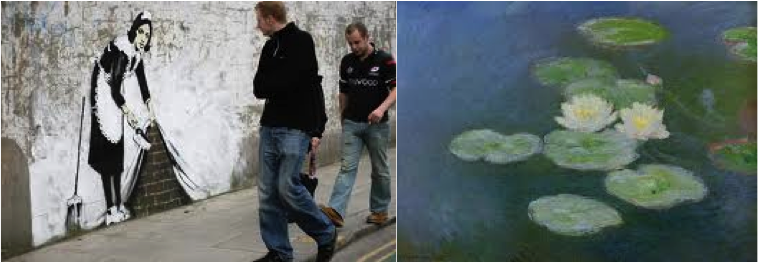
Banksy vs. Monet
Banksy vs. Monet

In Britain, it’s usually Banksy who’s associated with free-wheeling art in the streets. But now, sociologist and performer Tom Shakespeare is taking what might be an even more radical stance—not only should street art be outside the walls of the museum, museum art should go free, too.

“Couldn’t a gallery be more like a library and less like a temple?” Shakespeare asks in his Point of View piece for the BBC News Magazine. His idea is that a society is enriched by its art, and so, by locking up the great works of the world, we’re preventing the flourishing of society-level happiness. Hang a Monet in your house for a couple of weeks, and your whole worldview might change.

Maybe my modest proposal to break open the museum vaults will appear as fanciful as my support for the much-maligned Arts Council. In which case, let me finish by mentioning another way of democratising the visual arts – an experiment that is happening here and now and in the UK, no less.

Last week, the long list for Art Everywhere was published. This project, subtitled “A very, very big art show”, seeks to use hundreds of donated billboard sites to bring 50 of the best-loved works of British art into the public space for two weeks.

I think that Art Everywhere is an inspired idea. We are being asked to donate three pounds, and to choose which pictures from the long list will get this unprecedented exposure.

Just imagine: for two weeks, large scale artworks, in our streets. Not selling, not scaring, not “sloganising”, not titillating – just existing. Intervening silently in our lives with beauty and wonder and mystery.

More please.

For art lovers as well as scholars of utopias and happiness, this modest proposal might be a fantastic conversation starter—and we know that’s good for society.