culture

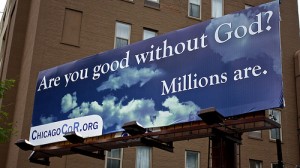
Here's hoping... Photo by Erik Ingram via flickr.com.
Here’s hoping… Photo by Erik Ingram via flickr.com.

This year’s hot trend in religion research is definitely the “spiritual but not religious” (SNBRs), a growing group of Americans who choose not to affiliate with any particular religious tradition, but don’t want to take the plunge into full-blown atheism. While a lot of scholars are still working through the concept, this new identity label is already cropping up in all kinds of research. How do SNBRs feel about religious practices like prayer, are they a stronger political force than conservative Christians, and—most recently—are they even more criminal than their religious peers?

A recent report from the science news website phys.org starts in on this latest question with research from Baylor sociologists Sung Joon Jang and Aaron Franzen.

Young adults who deem themselves “spiritual but not religious” are more likely to commit property crimes than those who identify themselves as either “religious and spiritual” or “religious but not spiritual”… a fourth category—who say they are neither spiritual nor religious—are less likely to commit property crimes than the “spiritual but not religious” individuals.

Franzen suggests that the SBNR identity reflects weaker ties to social networks that may prevent these crimes:

We were thinking that religious people would have an institutional and communal attachment and investment, while the spiritual people would have more of an independent identity.

Of course, this doesn’t quite explain why those who were neither spiritual nor religious were less likely to commit crimes than the SBNRs. The next question is whether strong ties to religion actually prevent crime, or just show up after criminals have been caught.

A child is fed in the South African refugee camp De Dooms. Photo by Courtney Brooks via flickr.com.

Amidst the uncertainty surrounding the health of Nelson Mandela, it’s an interesting time to reflect on the legacy of race and inequality in South Africa. Although the work of Mandela and others has extended human rights to black South Africans, a recent Al Jazeera article by Minnesota sociologist Cawo Abdi illustrates the continued violence and racism against Somali immigrants in South Africa, as highlighted by the recent gruesome murder of a young Somali refugee.

Relegated to informal housing settlements, many Somali refugees work as entrepreneurs in the informal economy. They open shops, called spazas, that provide goods and services to neglected, poor black neighborhoods. These neighborhoods themselves are rife with violence, both criminal and vigilante. Abdi writes:

Labeling violence against migrants as simply xenophobic diverts attention from the context of violence, the generalized criminality that is a daily reality for those in informal settlements. The brutality forces us to confront the limited access that many South Africans have to the social, economic, and political rights enshrined in the country’s progressive constitution.

Historically considered an issue of racial equality between black and white South Africans, Abdi demonstrates that issues of economic inequality and anti-immigrant sentiment are just as pervasive in the country.

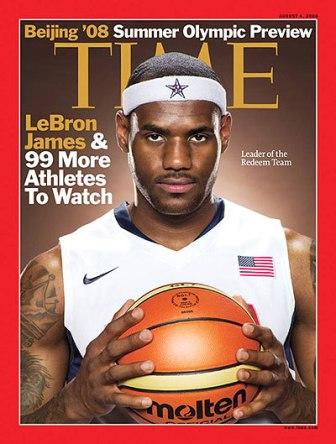
All eyes have been on LeBron James. Despite some predictions, he hasn't---yet---disappointed.
All eyes have been on LeBron James. Despite some predictions, he hasn’t—yet—disappointed.

When ESPN began broadcasting LeBron James’ high school games to a national audience some years ago, basketball fans asked, “Is he the next Michael Jordan?” Last week, James capped off the 2012-2013 NBA season with his fourth MVP award, leading the Miami Heat to a second consecutive championship (he really did “take his talents to South Beach”). It only cause more people to wonder if James could equal—or surpass—Jordan’s legacy.

Michael Eric Dyson, a sociologist at Georgetown University, made a guest appearance on ESPN’s “First Take” to offer his perspective on the similarities and differences between the two basketball greats, both on and off the court.

As Dyson explained, social movements and commercialization combined when Jordan was drafted by the Chicago Bulls in 1984. The Civil Rights Movement had passed; communication technology which could carry photos, highlights, and live games around the planet was improving; and the NBA’s new commissioner, David Stern, was intent on expanding the league’s global footprint. In Michael Jordan, Stern had found a charismatic ambassador for basketball. Dyson notes, “Jordan comes along at a time when people began to celebrate a tall, dark, handsome, physically lethal specimen who also has the ability to commodify… So when you have the marketplace joining the morality of social advance, that’s something that’s incomparable.”

While “King James” follows in Jordan’s footsteps commercially, Dyson argues that they’re different types of players on the court. Jordan was known for his legendary competitive drive and “killer instinct,” while LeBron, particularly since teaming up with fellow stars Dwyane Wade and Chris Bosh in Miami, has earned a reputation as a facilitator who works to involve his teammates as much as possible, perhaps even to a fault.

Like MJ before him, LeBron James is now the global face of the NBA—some love him, some hate him, and most basketball fans are fascinated by him. The marketing of and commentary about the two men’s talents, bodies, and identities provide a rich source of study for social scientists interested in race, media, sport, and culture over time.

Photo by Art$uper$tar via flickr.com.

When we get nostalgic, we tend to overlook bad times and focus on good memories. It’s like how Green Day’s “Good Riddance” ended up promoted under its subtitle, “Time of Your Life”… and then became the go-to ballad for every late 90s graduation, flashback, and farewell television episode.

In a recent op-ed for the New York Times, historian and Council on Contemporary Families co-chair Stephanie Coontz reminds us that a little personal nostalgia may be fine, but we should be wary when everyone starts longing for the “good old days”:

In personal life, the warm glow of nostalgia amplifies good memories and minimizes bad ones about experiences and relationships, encouraging us to revisit and renew our ties… In society at large, however, nostalgia can distort our understanding of the world in dangerous ways, making us needlessly negative about our current situation.

This nostalgia doesn’t just make the present look worse. It can make it harder to see some pretty spectacular screw-ups:

I have interviewed many white people who have fond memories of their lives in the 1950s and early 1960s. The ones who never cross-examined those memories to get at the complexities were the ones most hostile to the civil rights and the women’s movements, which they saw as destroying the harmonious world they remembered.

But others could see that their own good experiences were in some ways dependent on unjust social arrangements, or on bad experiences for others… These people didn’t repudiate, regret, or feel guilty about their good memories. But because they also dug for the exceptions and sacrifices that lurked behind their one-dimensional view of the past, they were able to adapt to change.

Trading in rose-colored glasses for 3D might let us accept a fuller version of the past and more possibilities for the future.

Photo by mahalie stackpole via flickr.com.

“Pomp and Circumstance” is no longer ringing in the rafters at college arenas across the country, and many members of the Class of 2013 are searching for their first post-graduation jobs. One wrinkle: though more than half of those graduates are female, according to a report by the American Association of University Women (AAUW), men working full-time one year after graduation will receive salaries that are 18% higher.

The study pushes back against notions that women’s wages are lower because of decisions now made later in the life course (such as leaving the corporate ladder to have children, for example). Researches found that approximately two-thirds of the pay gap just one year after graduation can be explained by field of study, grades, hours worked, and occupation, but the remaining portion is unexplained—that is, the only commonality is that the people getting the lower salaries are women.

The fact that so much of this pay gap escapes explanation poses a problem for rectifying the situation. Christianne Corbett, a senior researcher with the AAUW and one of the study’s authors, explains:

The pay gap cannot be solved by individual women alone. The bulk of the work has to be done by employers because it’s a systemic problem.

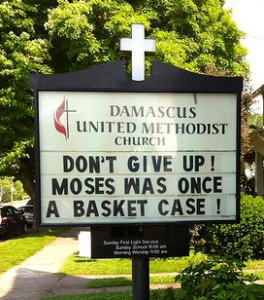
Learning is good, but doing will be better.

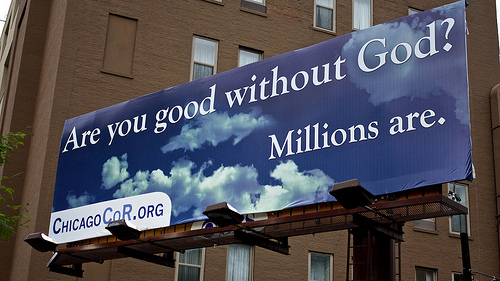
Photo by Erik Ingram via flickr.com.

Now that one in five Americans chooses not to affiliate with a religion, media outlets in both the sacred and secular worlds have taken a new interest in atheists—a small, yet dynamic subset of the growing religious “nones.” In a recent interview with UNT sociologist George Yancey about his new book with David A. Williamson, There is No God: Atheists in America, The Christian Post hits upon a key point: these identities are not static, but are actively shaped by social relationships.

CP: Atheism changes over time and is a reaction to the dominant religious beliefs of the time. Today’s atheism is, in part, a reaction to the political activism of conservative Christians, or the “Christian Right.”

Yancey: They don’t proselytize in the way that Christians tend to proselytize. Atheists tend to believe that people are religious because they are socialized to be that way.

The article also illustrates how media “makes” atheist identities while discussing them.

CP: You find that atheists are mostly highly educated, wealthy, old, white, men, and that was consistent with some random samples as well.

Yancey: …they tend to be men, educated, older. Although, there is some indication of some younger atheists coming up.

CP: So demographically, they look, more or less, like the U.S. Senate.

Yancey: [Laughs] I hadn’t thought about it that way, but, yeah, that’s a good way of looking at it.

CP: You’re basically talking about a privileged group—wealthy, old, white guys. You say it makes sense that atheists would come from a privileged group. Explain.

While atheists are more likely to be educated white males, they don’t really look like the U.S. Senate at all. In fact, open atheism may actually be a barrier to political participation. Currently, there is only one religiously-unaffiliated Congressional Representative. According to research from the 2003 American Mosaic Project, about 40% of Americans say that atheists “do not at all agree with my vision of society,” a higher level than the levels of distrust for any other racial, religious, or sexual minority group in the study. And a 2011 Pew Center for People and the Press report found that 61% of voting Americans were “less likely” to vote for a hypothetical presidential candidate who did not believe in God. Social interactions clearly shape atheists’ identities, but it’s also interesting to see how they shape others’ perceptions of atheist identities as well.

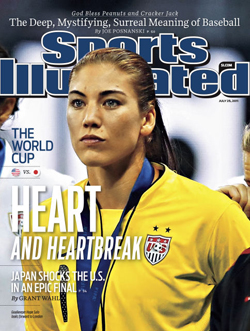
Soccer player Hope Solo covers Sports Illustrated in 2011

Title IX has had 40 years to flex its muscles in helping make sport a less gendered venue, and, indeed, more women are participating in and watching sports than ever before.  Oddly enough, the media representation of sports has not followed suit. A new study from sociologists Jonetta Weber and Robert Carini of the University of Louisville reconfirms a long line of research in media representations of athletes by looking at the covers of every issue of Sports Illustrated from the last decade. In an article for the website Jezebel, Madeleine Davies explains the scholars’ troubling results:

Researchers found that of the 716 SI issues published between 2000 and 2011, a mere 35 of them had covers featuring female athletes. That’s only 4.9%.

It’s extra bizarre since 12.6% of the covers from between 1954 and 1965 featured female athletes. And that’s not even the worst part. Only 18 of the recent covers actually had the female athlete as the primary image on the cover—that’s just 2.5%—and only 11 of the 35 issues showed non-white women on the cover. Despite a marked increase in women’s sport participation, one of the best-known sporting news outlets has been gradually phasing out female athletes and their accomplishments.

For more on SI’s troubled history of representing female athletes, check out The Atlantic’s 2011 piece “9 Ways Women Get on the Cover of ‘Sports Illustrated’.”

Photo by Chris Butterworth via flickr.com

When Tanya Marie Luhrmann, a Stanford anthropologist, studies religion, she’s not asking whether God is real. Rather, she wants to know how believing in a higher power affects the lifecourse. Writing in The New York Times, Luhrmann argues that the positive effects of church attendance go beyond simply increasing social capital through community interaction—it can be a psychiatric boon:

What I saw in church as an anthropological observer was that people were encouraged to listen to God in their minds, but only to pay attention to mental experiences that were in accord with what they took to be God’s character, which they took to be good. I saw that people were able to learn to experience God in this way, and that those who were able to experience a loving God vividly were healthier—at least, as judged by a standardized psychiatric scale.

Luhrmann’s work centers around “the way that ideas held in the mind come to seem externally real to people,” and she notes that belief in God is not always beneficial (for instance, some may feel only despair when they search for religious guidance). To that end, Luhrmann uses her essay to encourage more research into the relationships between mental illness and religion. Like many topics that interest social scientists, the challenge here is to move beyond, “Is this good or bad?” to explore, “When and for whom is this good or bad?”

Photo by DearPioneer via Flickr.com

Our society has a bad habit of making the most important jobs–and the workers that keeps us healthy, happy, and comfortable–the least visible. As a recent article in The Atlantic points out, while citing work from NYU anthropologist Robin Nagle, this invisibility hides some dire issues faced by one essential group of service workers: the folks who make your trash disappear.

Sanitation workers, it turns out, have twice the fatality rates of police officers, and nearly seven times the fatality rates of firefighters. And their work has similarly life-or-death consequences in the long term… “A study done in 1851,” Nagle writes, “concluded that fully a third of the city’s deaths that year could have been prevented if basic sanitary measures had been in place.”

However, these issues aren’t likely to hit the spotlight until the work itself grinds to a halt. After all, nobody notices the role of the garbageman until their trash fails to be collected and lingers sadly on the curb. While the rest of the working world attempts to balance their lives via telecommuting and flexible schedules, sanitation workers are on a strict schedule in order to service the community. Is the honor of being a staple in a functioning society enough?

One of the things that struck me very early on and that continues to puzzle me is the way in which some forms of knowledge are considered more valuable than others…If I stop working tomorrow, I’m not sure New York City will suffer. If the Department of Sanitation, for whatever reason, stops working tomorrow, the city will suffer immediately. So whose work is more important here?

Without a total work stoppage, it seems garbage collectors and the work they do will remain dangerously invisible.


—–

For another take on the invisibility of workers, you can check out an old guest post I wrote over at Sociological Images.

A Showtime ad for Gigolos.

Women watch porn and go to strip clubs. They also pay for sex. Sociologist Kassia Wosick from New Mexico State University says this reality is now becoming part of the television canon, making it more “real” for the rest of society. Shows like HBO’s Hung and Showtime’s Gigolos revolve around women as sexual consumers. In an interview with Las Cruces Sun, Wosick explains her motivation:

I wanted to do research like this as opposed to just going out and asking women about their experiences to see the way the media constructs this, because media is essentially supposed to be a reflection of our everyday lives….

Still, we might ask, is this what women want to watch or what they’re given to watch? Through content analysis and focus groups, Wosick has found that women do feel connections with the shows. The racy viewing might be exactly what they need to chip away at a taboo of sexual consumerism and enjoy some the same pleasures that men are allowed—in fact, the images might be empowering and support egalitarianism:

Women participating as sexual consumers challenges traditional notions of gender and sexuality, which I argue is key in equalizing gendered power dynamics within society.