
culture

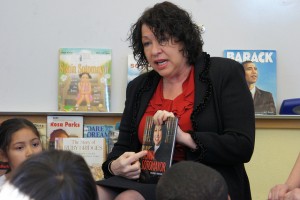
U.S. Supreme Court Justice Sonia Sotomayor shows students at the Berkeley Unified School District one model of Latina success: her own. Photo via flickr.com.

This short essay was part of a CCF series published in February 2013 in honor of the 50th Anniversary of Betty Friedan’s The Feminine Mystique.

Latinas are often described as being either too devoted to their cultural values or not sufficiently connected to them. They are often told that they must choose “one of way of being,” either Latina or American. This expectation not only implies that there is an “authentic” Latina femininity and American femininity, but that their success depends on enacting the “right” femininity.

A prevailing mystique facing Latinas is that their “culture” holds them back from success and fulfillment. More specifically, they are told that machismo and familismo, respectively referring to an exaggerated expression of masculinity among Latino men and sacrificing Latina femininity. There are certainly aspects of Latinas’ cultural backgrounds that privilege men, but this is not unique to Latinas/os. Yet, this is the persistent narrative about Latinas’ challenges. This powerful mystique conveys to Latinas that they must reject their “culture” to be successful.

But numerous Latinas have demonstrated that rejection of their culture is not a prerequisite for pursuing professional and personal ambitions. U.S. Latinas have consistently described themselves as being caught between two worlds, that of their particular communities and that of the dominant society. And it is precisely because of this that Latinas can challenge the idea of an “authentic” Latina or American femininity. Latinas that resist the dichotomies imposed upon them understand that “culture” is not fixed and that they can create new cultural meanings and practices. For instance, some Latinas do not interpret their professional goals and their family as mutually exclusive. Instead, they sometimes link them together as a strategy for success. This way, a desire to “give back” to their families and communities fuels their motivation to persist despite the structural barriers they encounter, such as racist-sexist workplace practices. more...

The Civil Rights Act of 1964 not only ushered in stronger federal protections for racial and ethnic minorities and women, but also for religious minorities. Antipathy toward Catholics and Jews in the US was a persistent and prevalent theme through much of American history. It was common for these groups to be labeled “un-American” and even categorized as “non-white.” Members of these religions were often discriminated against in hiring and in admission to institutions of higher learning (this was especially common for Jewish applicants) and excluded from many neighborhoods, clubs, and political positions. From the late 19th through the mid-20th century, organized hate groups, most notably the Ku Klux Klan, used the threat of violence to intimidate not only African-Americans but Jews and Catholics as well.

After World War II, these restrictions and prejudices eased somewhat. By 1955 the now-classic essay Protestant Catholic Jew could proclaim that although these three religions were the primary sources of identity in America, they were now “alternative ways of being an American” rather than two of them being seen as Un-American.

Still, anti-Semitism and anti-Catholicism persisted. In the 1960s, some commentators worried that President Kennedy, a Catholic, would take orders from the Pope. In the 1970s, President Richard Nixon was recorded making several anti-Semitic comments. And even today nativist hate groups continue to perpetuate centuries-old hostilities against Catholic and Jewish Americans. But the Civil Rights Act did give these minorities protection against outright exclusion and discrimination, and other religious minorities have also looked to it for security as the American religious landscape has diversified. more...

When I think back on the Feminine Mystique, I am reminded of my favorite childhood television show, “Bewitched,” which featured a beleaguered housewife and witch, Samantha Stevens. As partner in her husband Darrin’s “two-person career,” holding a job of her own was out of the question. She was on call to whip up fabulous meals for Darrin’s boss and his clients at a moment’s notice – yet she wasn’t even supposed to use her superpowers to add a tasty dessert. She spent her days cooking, cleaning and helping her husband’s career, all the while proudly avoiding magical shortcuts. She had the requisite two children, but they mostly sat in the background, being supervised by a witchy relative or their babysitter, Esmeralda. more...

Why do women earn less than men? Research points to a number of different explanations, but one of the central factors remains women’s caregiving responsibilities. The wages of childless men and women have been converging steadily over the last three decades – but mothers continue to earn significantly less, while fathers earn a bit more. These motherhood and fatherhood effects have been stable over time while childless women’s wages have been rising, even though mothers are increasingly likely to be employed.  more...

Has “hooking up” become the defining feature of college life? Does everyone do it? Does everyone want to? Most research on hooking up has examined college students who live on campus, or nearby, and hook up after alcohol-fueled parties. For example, the Online College Social Life Survey (OCSLS) of 21 colleges and universities shows that more than 70 percent of students, overall, hook up at some point in their college career. Even so, new research from the University of Illinois at Chicago, a diverse urban, public university with more commuters than on-campus residents, suggests that college sex is something quite different for the typical commuting student. (Go here to view this release online.)

In their study, “‘It Goes Hand in Hand with the Parties’: Race, Class, and Residence in College Student Negotiations of Hooking Up” (in February issue of Sociological Perspectives), Rachel Allison and CCF Senior Scholar Barbara Risman find that commuter students do not typically participate in hooking up culture—but they still believe it is a key feature of authentic college experience.

Allison and Risman explain, “The students we interviewed endorsed the media-driven belief that the ‘real’ college experience involves parties and hooking up. They explained, though, that it is simply unavailable to many of them.” Sociologists Allison and Risman found that only students who live on campus or in apartments away from their families have substantial opportunity to “hook up.” In particular, the authors found:

  • Less-wealthy students and most of the non-white students at this university who are working class participate in hookup culture far less than middle-class students.
  • Even when white working class and racial minority students live on or near campus, the tendency for students to hook up within racial and ethnic communities means that working class and racial minority students still feel excluded from what they see as “real” college experience.
  • Students who work for pay many hours per week also feel excluded from a party culture that takes both time and money.

What is hooking up? “Hooking up” typically means some sexual activity—ranging from kissing to intercourse—outside of a committed relationship. While much research focuses on residential college students and shows participation is common, those studies also demonstrate that hooking up leads to sexual intercourse less often than college students—and the general public—imagine. According to OCSLS data, 40 percent of students who have ever hooked up report intercourse during their most recent hookup.

Image from Mira John via Flickr Creative Commons

Is hooking up the “real” college experience? Allison and Risman’s study elaborated specifically on commuter students’ beliefs and experiences with hooking up. Allison and Risman explained, “Students from a range of class and ethnic backgrounds told us the ‘real’ college experience involves parties and hooking up, but white middle-class students believed they actually live the ‘real’ college experience.” One student (a Middle-Eastern woman) in the study explained about hooking up: “It goes hand in hand with the parties.”

Commuters and minority students talked wistfully about missing what they believe–often based on what they see in movies or television of campus life–is the “real” college experience. The researchers explained, “They feel they are getting a second rate experience.” The researchers added, “It’s not that the commuting students don’t tell us they sometimes have casual sex—they do. But they do not participate in the hooking up culture that most students see as part of college life.”

About the study. Allison and Risman analyzed 87 in-depth interviews with undergraduate students at the University of Illinois-Chicago for an article forthcoming in the February issue of Sociological Perspectives. Thirty-three percent lived on or near campus; 39 percent lived with their parents. The authors were especially struck by the extent to which students were convinced that the party and hookup scene was part of an authentic college experience. “On the one hand, our study demonstrates a lot more diversity in the way that students actually experience college—but on the other, it showed us that students don’t necessarily see the wide range of collegiate experiences as equally valid.” The authors reflected, “Could the real college experience be redefined as about learning? Of course, as college professors, we’d like to think it could.”

Rachel Allison and Barbara Risman’s February 2014 article, “It Goes Hand in Hand with the Parties”: Race, Class, and Residence in College Student Negotiations of Hooking Up in Sociological Perspectives.

Rachel Allison is in the department of sociology at Mississippi State University. She is the author of Race, Gender and Attitudes Toward War in Chicago: An Intersectional
Analysis
.

Barbara Risman is in the department of sociology at the University of Illinois at Chicago. She is the author of Gender Vertigo: American Families in Transition.

Fifty years ago, the United States adopted the Civil Rights Act, prohibiting discrimination on the basis of race, ethnic origin, religion, and gender. Women were a last-minute addition to the bill, and some legislators actually hoped that adding women would mobilize enough opposition to kill the entire act. But the court cases and public demonstrations that the Civil Rights Act enabled women to organize dramatically changed their status in the United States. We can assess the tremendous progress that has been made by comparing current figures to those collected the year before the passage of the act and published in the 1963 report of the President’s Commission on the Status of Women.

Leadership and occupations. In the 87th Congress, elected in 1960, women’s place was not in the House—or the Senate—but in the home. There were only two female senators and 17 female representatives, which meant that women constituted only two percent of the Senate and less than four percent of the House. Today, in the 113th Congress, women hold almost 20 percent of the total positions, including 20 seats in the Senate and 78 in the House of Representatives. This represents a tenfold increase in the Senate and a nearly fivefold increase in the House. And while we have not yet had a female president, attitudes have improved significantly: in 1963, a Gallup poll found that only 55 percent of Americans would vote for a woman for president. By 2011, that number had jumped to 95 percent.

In 1963, less than three percent of all attorneys were women, and out of 422 federal judges in the country, just three (0.7 percent) were women (Coontz 2011: 14). By 2010, women held almost a quarter of all federal judgeships and more than a quarter of state judgeships.

The law itself was grossly unfair to women 50 years ago. Sexual harassment was not forbidden anywhere. In only eight states did a female homemaker have any claim on the income earned by her husband (Mead & Kaplan 1965: 152). It was also perfectly legal for a man to force his wife to have sex against her will. According to the 1962 United States Model Penal Code, “A man who has sexual intercourse with a female not his wife is guilty of rape if . . . he compels her to submit by force or threat of force or threat of imminent death, serious bodily injury, extreme pain, or kidnapping.” Before the Civil Rights Act it was also legal to exclude women from many occupations, pay them less for doing the same work as men, and give men raises and promotions that were denied to equally qualified women. In the 1960s the Harvard Business Review was forced to cancel a report on female managers because “In the case of women the barriers are so great that there is scarcely anything to study” (Collins 2009: 22). Today, women occupy the majority (51.5 percent) of managerial, professional, and related positions. In 1963, not a single woman had served as CEO of a Fortune 500 company. Today, women run 23 of the Fortune 500 (4.6 percent) and almost 20 percent of Financial Post 500 Senior/Corporate officers are women.

In 1960, women constituted less than one percent of all engineers in the country. Only six percent of physicians were women (Collins 2009: 20). By 2007, women held 27 percent of science and engineering jobs, and by 2012, more than a third of physicians and surgeons were women. more...

In the last 50 years, the percentage of men and women who cohabit before marriage – “living in sin” as it was still called in the 1960s – has increased by almost 900 percent. Today 70 percent of women aged 30 to 34 have cohabited with a male partner, and two-thirds of new marriages take place between couples who have already lived together for an average of 31 months.

These trends are troubling to some because nearly a dozen studies from the 1970s into the early 2000s showed that men and women who lived together before marriage were far more likely to divorce than couples who moved directly from dating to marriage. In fact, on average, researchers found that couples who cohabited before marriage had a 33 percent higher chance of divorcing than couples who moved in together after the wedding ceremony. In light of those findings, some commentators have argued that reducing the stigma attached to living together outside marriage has been a mistake, leading many young couples to make decisions that put their future marriage at risk. more...

As colleges across the country begin the new school year, we hear a chorus of warnings about a generation of young adults unable or unwilling to “leave the nest.” Phrases are bandied about: “Failure to launch”; “the Peter Pan syndrome”; “boomerang kids” who can’t seem to leave home and establish an independent life. Undergirding these warnings is a fear that the younger generation is growing soft, losing the pioneer independence and rugged individualism that once built this nation.

But a glance at the past suggests it may not be the behavior of youths that has changed so much as the response by adults. Only over the past 90 years did American culture come to define young adults’ continued reliance on parental guidance and their longing to return home as a sign of psychological maladjustment. more...

This post draws from a longer CCF Brief originally published December 10, 2013. Rachel A. Gordon is a professor of sociology at the University of Illinois at Chicago.

By Irangilaneh (Own work) [CC-BY-SA-3.0 (http://creativecommons.org/licenses/by-sa/3.0)], via Wikimedia Commons

It is “back to school” time – we can see this all around us, in stores, online, and in the media. As students shop for school supplies and clothing, many are thinking about the image they will portray when they first walk the halls of school. A recent google ad encapsulated these concerns as it opened with a youth searching “How to not look like a freshman.” Technology amplifes – or at least makes more visible – teens’ concern with social image. A recent survey by the We Heart It social networking site, and published exclusively by TIME, documents the ways in which youth thirst for attaching “likes,” “hearts,” and comments to shared photos – the latest incarnation of the original of Facebook hot or not ratings of student photos that make many people cringe, but live on.

The We Heart It study reinforced a finding in my own recent work about the impact of not just comments that are openly hurtful or admiring, but of being lost in the shuffle. One teen in the We Heart It survey reported “Sometimes I just feel like I don’t exist, like I’m invisible to everyone, I pretend it’s okay, but it hurts.” In our study, we considered how others’ ratings of adolescents’ looks associated with their achievement — in grades as well as the social scene. Our most consistent finding was that being above average in looks – what we call standing out from the crowd – was correlated with nearly every social and academic domain that we examined in high school.  These advantages continued into young adulthood, including through higher college completion and, as a consequence, higher earnings for the attractive than the average in looks. more...

This briefing paper is based on the authors’ monograph (with Xue Wang), “Physical Attractiveness and the Accumulation of Social and Human Capital in Adolescence and Young Adulthood,” part of the peer-reviewed series, Monographs of the Society for Research in Child Development (Wiley-Blackwell).

Expert responses to this report are available online here.

How do your looks affect your life?

Is being attractive or unattractive a source of systematic social inequalities in people’s access to wealth, power and privilege? Should we add “beauty bias” to racism and sexism as a type of unacceptable discrimination?  more...