
culture

This paper is part of the Council on Contemporary Families Gender Revolution Rebound Symposium

This look at sexual frequency among younger couples in equal marriages refutes recent claims that when a man shares the housework equally, it is bad for the couple’s sex life.

For several decades, research has suggested that attitudes and laws favoring gender equity have changed more quickly than people’s actual behavior in intimate relationships. One recent highly publicized article reported that married couples who split domestic chores in an egalitarian manner had sex less often, and reported less satisfaction with their sex lives, than couples who adhered to more to conventional gender behaviors. The depressing message heard round the world was that couples remain stalled in their attachment to old “gender scripts,” and that attempts to revise these scripts decrease sexual desire and satisfaction, even among couples who claim to hold egalitarian values. more...
National surveys and other studies continuously tell us that work is a major source of stress for Americans. A 2005 Work and Families Institute study found that almost 90 percent of workers felt they either never had enough time in the day to do their job or that their job required them to work very hard. A Pew Report from 2013 found that more than half of all working moms and working dads experience work-family conflict. One-third of working moms and dads feel rushed on work-days, and almost 50 percent of working dads (and 25 percent of working moms) say they don’t have enough time with their children. And in a recently completed research project I helped conduct, we found that people report feeling less stressed out on non-work days than on work-days. Home, most of us believe, is where we recover from the stress of the work day. more...

This paper is part of the Council on Contemporary Families’ new Gender Revolution Rebound Symposium.

Click to expand graphics throughout.

For almost a decade now, researchers have been struck by a stall in what had been a remarkably rapid and seemingly unstoppable increase in support for gender equity and approval of women’s workforce participation up until the mid-1990s. This research paper provides evidence of what may be a rebound in support for gender equity since 2006.

The General Social Survey contains four questions about gender roles that were first posed to the American public in 1977 and have been asked on every survey since 1985. While some of the questions may feel dated (remember they were first asked 37 years ago), they remain useful to show the degree of change in our attitudes about proper roles for men and women. And between 1977 and the mid-1990s, the rate and extent of change were nothing short of remarkable. more...

Update on Research from Jennifer Glass

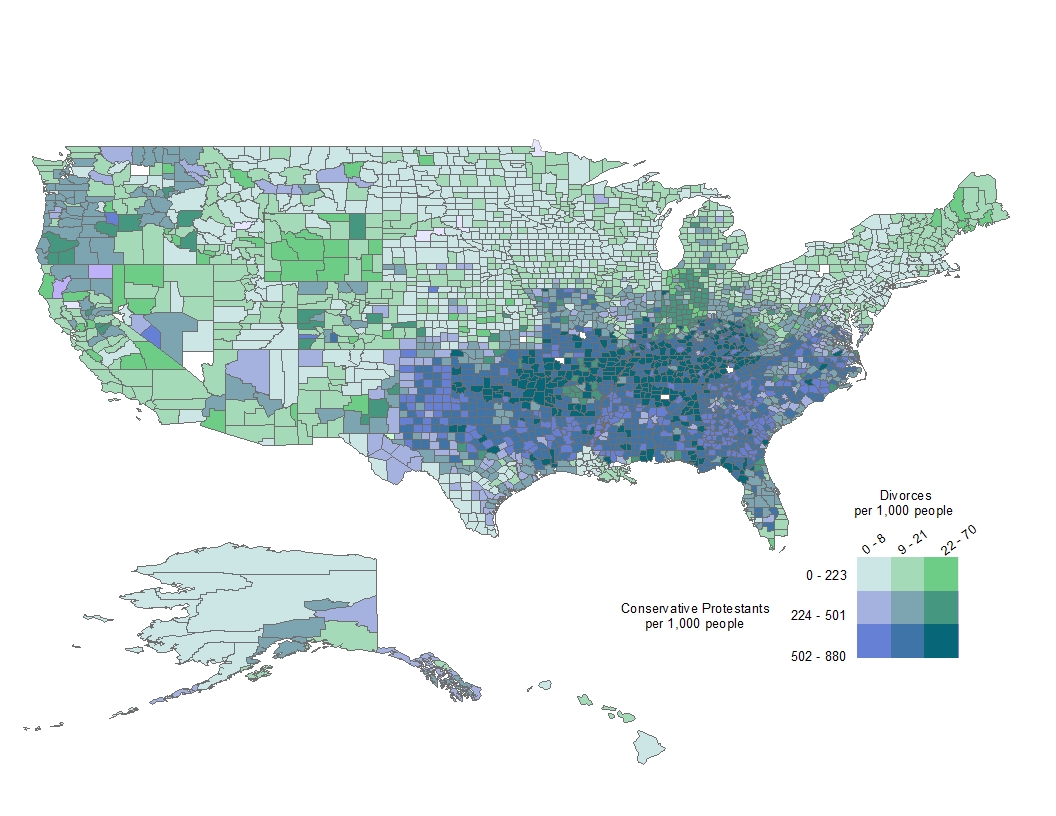
Why are divorce rates higher in religiously conservative “red” states and lower in less religiously conservative “blue” states? After all, most conservatives frown upon divorce, and religious commitment is believed to strengthen marriage, not erode it. Even so, religiously conservative states Alabama and Arkansas have the second and third highest divorce rates in the U.S., at 13 per 1000 people per year while New Jersey and Massachusetts, more liberal states, are two of the lowest at 6 and 7 per 1000 people per year.

Evangelicals and divorce. For a study earlier this year in the American Journal of Sociology (abstract only), Demographers Jennifer Glass at the University of Texas and Philip Levchak at the University of Iowa looked at the entire map of the United States, going county by county, to examine where divorces occurred in 2000 and what the characteristics of those counties were. Their work confirms that one of the strongest factors predicting divorce rates (per 1000 married couples) is the concentration of conservative or evangelical Protestants in that county.

DivorceFinalPrevious discussions of this puzzling paradox have focused on three alternative explanations.

Is it poverty? Some scholars argue that it has nothing to do with religious beliefs and practices, but reflects the fact that conservative religious groups are most concentrated in rural and Southern counties, which tend to have lower wages than the national average and higher rates of poverty. And research does show that such conditions do raise the risk of divorce. Yet even controlling for income and region, divorce rates tend to be especially high in areas where conservative religious groups are prominent. more...

Click for image source.

The following is a re-post in honor of the (2014) 50th Anniversary of the Civil Rights Act.

Greater Acceptance, Persisting Antipathy:

Catholic and Jewish Americans Since The Civil Rights Era

The Civil Rights Act of 1964 not only ushered in stronger federal protections for racial and ethnic minorities and women, but also for religious minorities. Antipathy toward Catholics and Jews in the US was a persistent and prevalent theme through much of American history. It was common for these groups to be labeled “un-American” and even categorized as “non-white.” Members of these religions were often discriminated against in hiring and in admission to institutions of higher learning (this was especially common for Jewish applicants) and excluded from many neighborhoods, clubs, and political positions. From the late 19th through the mid-20th century, organized hate groups, most notably the Ku Klux Klan, used the threat of violence to intimidate not only African-Americans but Jews and Catholics as well.

After World War II, these restrictions and prejudices eased somewhat. By 1955 the now-classic essay Protestant Catholic Jew could proclaim that although these three religions were the primary sources of identity in America, they were now “alternative ways of being an American” rather than two of them being seen as Un-American.

Still, anti-Semitism and anti-Catholicism persisted. In the 1960s, some commentators worried that President Kennedy, a Catholic, would take orders from the Pope. In the 1970s, President Richard Nixon was recorded making several anti-Semitic comments. And even today nativist hate groups continue to perpetuate centuries-old hostilities against Catholic and Jewish Americans. But the Civil Rights Act did give these minorities protection against outright exclusion and discrimination, and other religious minorities have also looked to it for security as the American religious landscape has diversified. more...