culture

I decided to take a methods course in the Women’s Studies department this spring. The first assignment was to identify a word central to our research interests and to trace the etymology of our choice. As a sociologist primarily interested in families and inequality, I decided on the word marriage, thinking it might offer insight into the transformation of American families today.

Marriage Definitions_timeline
. . . . …………… |Marriage Definitions Timeline

Although marriage has been a universal social institution throughout recorded history, with one exception (the Na people of China), there is no consensus on a definition of marriage.[i] When researching the word’s origins, I started where I always do, with historian and family scholar Stephanie Coontz. In her book “Marriage, a History: From Obedience to Intimacy, or How Love Conquered Marriage,” Coontz details in Chapter 2 the historical challenges of defining precisely what marriage means. Across societies and time, marriage has included (but has not been limited to) the union of: two families; one man and one woman; one woman and one ghost; one man and many women; two people who have a child together; and one woman and all brothers in a family. More recently, regulations of personal unions have centered around age, race, and sex (e.g., in the U.S., minimum age limits, Loving v. Virginia, Obergefell v. Hodges).

While marriage regulates social rights and obligations, nearly every function of marriage has been achieved by a mechanism other than marriage in one society or another. According to Coontz, stories that marriage was invented either for the protection of women or to keep women oppressed are probably not true. More likely, Coontz argues, marriage was an informal social mechanism to organize the daily tasks of life, sexual relationships, and child rearing. As greater economic disparity grew, marriage transitioned from functioning as a vehicle for creating community connections into a means to consolidate resources and transmit property. The meaning of marriage shifted dramatically in the twentieth century, moving from an institutional marriage to a companionate marriage.[ii] Essentially, spouses were assumed to be each other’s friend, a role not central to earlier definitions of marriage.[iii] The second transition was from companionate marriages to individualized marriages. In this conceptualization, the emphasis is on personal development whereby marriage leads to fulfillment and growth for both partners.
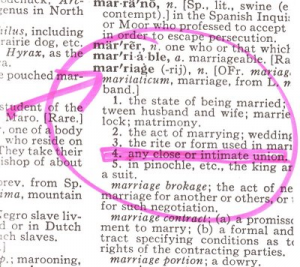
It is challenging to untangle contemporary definitions of marriage from definitions of wife and husband. Wife is a noun, defined in relation to another. According to Merriam-Webster dictionary, wife means “the woman someone is married to.” Wives often take on adjectives such as military wife, political wife, housewife, and so on.[iv] Author Anne Kingston reports the first appearance of the word wife in the Bible is in Genesis 2:18: “And the Lord God said, it is not good that the man should be alone; I will make him an help meet for him.” As a concept, wife understood, quite literally, as a helpmate. Husband, on the other hand, is either a noun or a verb, meaning “a male partner in a marriage,” “to save,” “a frugal manager,” or “to till the ground, to cultivate.”

Last year, the definition of marriage was central to the U.S. Supreme Court case Obergefell v. Hodges, which ultimately granted same-sex couples the right to marry in the U.S. While a somewhat oversimplified interpretation, the case hinged on the Justices’ acceptance that the definition of marriage evolves over time.[v] Justice Kennedy wrote, on behalf of the majority: “The history of marriage is one of both continuity and change. Changes, such as the decline of arranged marriages and the abandonment of the law of coverture, have worked deep transformations in the structure of marriage, affecting aspects of marriage once viewed as essential. These new insights have strengthened, not weakened, the institution. Changed understandings of marriage are characteristic of a Nation where new dimensions of freedom become apparent to new generations.” Kennedy added, “This view of marriage as timeless and unchanging was contradicted by an abundance of scholarly work.”[vi]

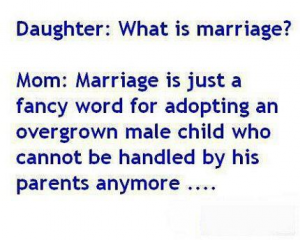
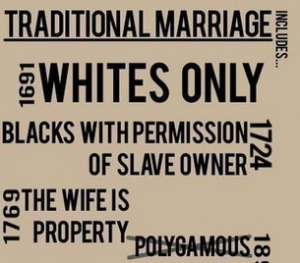
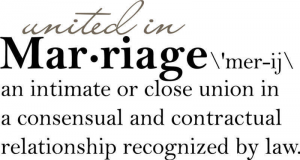
For further fun, I decided to see what Google images appear with the search term “marriage definition.” Some of my favorites, because they are insightful, funny, appalling, or thought-provoking, are posted below. Full disclosure, I skipped the hate-filled images.

m2m6
Joanna R. Pepin is a PhD candidate in the Department of Sociology at the University of Maryland. She primarily researches romantic relationships and inequality, such as power between partners and the association between romantic partnerships and social stratification.

Follow her on Twitter: @CoffeeBaseball

[i] Coontz, Stephanie. 2005. Marriage, a History: How Love Conquered Marriage. Reprint edition. New York: Penguin Books.

[ii] Cherlin, Andrew J. 2004. “The Deinstitutionalization of American Marriage.” Journal of Marriage and Family 66(4):848–61.

[iii] Burgess, Ernest W. and Harvey J. Locke. 1945. The Family: From Institution to Companionship. New York: American Book Company.

[iv] Kingston, Anne. 2004. The Meaning of Wife: A Provocative Look at Women and Marriage in the Twenty-First Century. New York: Picador.

[v] Obergefell v. Hodges. 576 U.S. ___ 2015. Justia Law. Retrieved February 1, 2016 (https://supreme.justia.com/cases/federal/us/576/14-556/).

[vi] Perry, David M. 2015. “A New Right Grounded in the Long History of Marriage.” The Atlantic, June 26. Retrieved February 1, 2016 (http://www.theatlantic.com/politics/archive/2015/06/history-marriage-supreme-court/396443/).
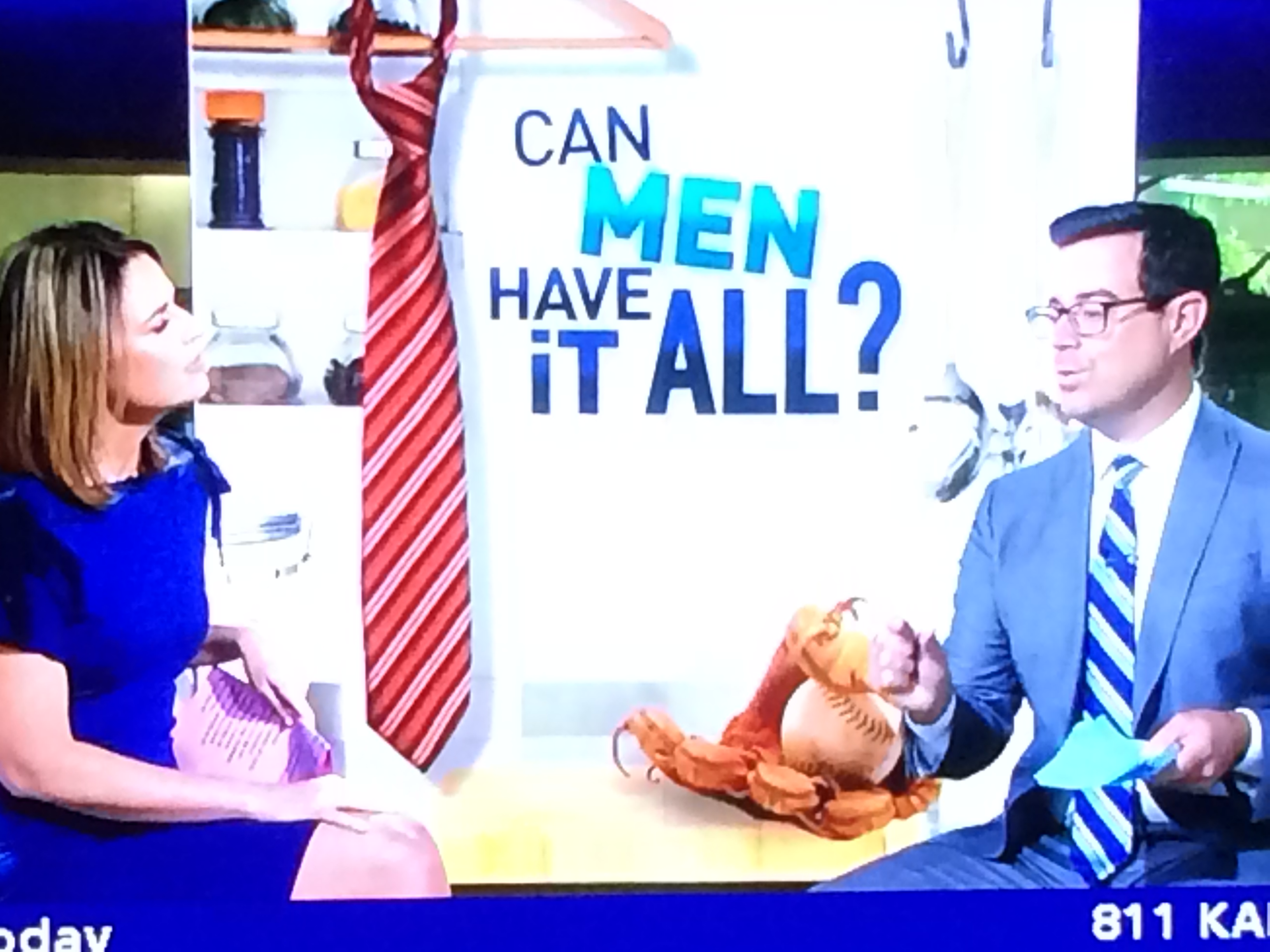

Screenshot courtesy Letta Page

Over at Families as They Really Are, Erin Anderson has posted about men’s lagging uptake of family leave when it is available. Over here, we have prepared a round-up on how men are doing in families by looking back at papers from the Council on Contemporary Families.

An issue related to use (or not) of family leave has to do with the underlying security of jobs: In the CCF June 2013 Symposium on the Equal Pay Act, economist Heidi Shierholz wrote about the erosion of men’s wages in the past few decades. She explains, “In the late 1970s, after a long period of holding fairly steady, the gap in wages between men and women began improving. In 1979, the median hourly wage for women was 62.7 percent of the median hourly wage for men; by 2012, it was 82.8 percent. However, a big chunk of that improvement—more than a quarter of it—happened because of men’s wage losses, rather than women’s wage gains.” Read more here. more...

Despite substantial increases in married mothers’ employment and the expressed desire of the majority of women and men to share employment and caregiving responsibilities, gender remains the most influential determinant of who does the housework and child care today. Many observers have attributed the seeming unwillingness of men to increase their time in housework and child care as the linchpin of gender inequality, a manifestation of men’s patriarchal power to prioritize activities that provide economic rewards, such as paid work, or enjoyment, such as leisure (Goode 1992; Jackman 1994).

One strain of feminist and academic scholarship holds that men feel no need to do more child care or housework because they reap the benefits of marriage and fatherhood (e.g. marriage and fatherhood wage premiums, living in a clean, well-run household, and children’s performance of filial duties) without having to spend time producing them — cooking, cleaning, or taking on the everyday, physical care of children. Rather, they can expect wives and mothers to shoulder the burden of feeding and caring for children and families, regardless of women’s other time demands. Such an analysis builds on the work of Jessie Bernard, an influential feminist sociologist, who argued that marriage is a gendered institution that privileges men and disadvantages women.

One key assumption of this argument has been that men do not want to become involved with children except when they can have fun with them. But this argument does not hold up when we analyze both the quantitative time diary data on mothers’ and fathers’ child care time and the qualitative literature on what fathers want. Instead, careful examination reveals a more complex story about the interplay between gender, marriage, parenthood, and class-differentiated patterns of childrearing that are more about ensuring upward mobility among children than about gender oppression. more...

Horia Varlan, Flickr CC.

Does marriage lead women to take on a larger share of housework? In the 1950s and 1960s, marriage was clearly unfair to women. The social and legal definition of marriage made it a woman’s duty, but not a man’s, to provide services in and around the home. Husbands had the final say over many family matters, such as where a couple would live and how the finances were managed. Married women were expected to take care of the meals and housework without any assistance from their husbands, whether they worked outside the home or not.

Values have changed since then, but some scholars argue that marriage still carries powerful role expectations that differ by gender and that lead women to start doing more housework and men to start doing less. Since the 1990s, several studies have compared the behavior of couples who are married and couples who live together. They find that unmarried cohabiting couples split the housework and paid work more equally than married couples, where wives tend to do a larger share of unpaid housework and husbands to do more paid work. Some have concluded from this comparison that there is something about marriage roles, and the expectations surrounding those, that causes couples to become more traditional after marriage.

But these studies were not comparing the same types of couples before and after marriage. They were comparing all cohabitors, even ones that didn’t intend to ever get married, with all married couples, even those that did not cohabit before marriage. more...

Online dating is starting to look a bit more like the idealized world of a Bennetton ad.

Despite growing approval of interracial dating, researchers have long documented the existence of a racial hierarchy within the dating world, with white women and men the most preferred partners, blacks the least preferred, and Asians and Hispanics in between. But where do the growing numbers of biracial and multiracial individuals fit into this hierarchy? Do they too get ranked by descending shades of lightness?

Between 2000 and 2010, the number of individuals who identified themselves to Census takers as being of two or more races increased by a third. These nine million individuals still represent less than three percent of the population. But studies predict that by the year 2050, nearly one in five Americans may claim a multiracial background. How will this affect dating and marriage patterns in the United States? more...

Tiring? Never! Photo by Harsha K R via Flickr CC.

In a dramatic shift in attitudes from just 40 years ago, most modern couples want to share the duties and rewards of work and family equally. However, this is particularly difficult for new parents in the U.S. in light of limited governmental support and persistent traditional gender norms. The U.S. offers inadequate paid parental leave and few options for cutting hours at work, while the cost of quality infant child care is exceptionally high. Thus parenthood is especially challenging for U.S. couples—the majority of whom are dual-earners who strive to achieve a work/family balance.

We studied 182 different-sex couples who were expecting their first child. Most were professionals who were well-positioned to equally share housework, parenting, and paid work responsibilities due to their high levels of education and the fact that both partners were working full-time. During the last trimester of the woman’s pregnancy and at 9-months postpartum, we had these men and women keep time diaries, recording every activity they engaged in during a 24-hour workday and non-workday. We also surveyed them about their own attitudes and perceptions of their division of labor at the beginning of our study and again when their child was nine months old.

more...

For many years, family researchers and working mothers have talked about “the second shift” – the extra work that employed women put in at home after their paid work day ends. And for just as long, feminist assessments of marriage have been shaped by earlier findings that when people married, the women began doing more household work, while the men started doing less.

Some research still seems to support this. Women continue to do a disproportionate amount of housework in families, despite an increase in men’s housework since the 1960s. Furthermore, in the late 1990s and early 2000s, the increase in men’s housework slowed or even declined, as did several others measures of progress toward gender equity. And on average, notes Liana Sayer, director of the Maryland Time Use Laboratory, women get 30 minutes less leisure time per day than men. That gap increases to an hour when researchers adjust for employment, education, family status, and age. more...

Recent months have seen a dramatic increase in media and government attention to gender-based violence, particularly sexual assault. Unfortunately, that attention has largely focused on a relatively elite group of young women – those enrolled in 4-year colleges. Much of the discussion has focused on the prevalence of a so-called “rape culture” in such settings, characterized by widespread tolerance of sexual violence. This essay presents evidence that sexualized violence and tolerance of such violence are actually more prevalent among youths who are not enrolled in college. more...

A report and commentary prepared for the Council on Contemporary Families.

A set of tables released by the U.S. Census this month provides new evidence of how much the structure, composition, and life-course of American families have changed over the past 55 years. Poverty figures in the same report show that having two parents may help in keeping children out of poverty, but by no means guarantee it. And other research shows that the relationship between income and family structure goes both ways: People who are well above the poverty line are more likely to get and stay married.

In 1960, according to Census figures from that year, nearly 90 percent American children lived in two-parent families, with only 8 percent in mother-only families. A miniscule 1 percent resided in father-only families, and 3 percent lived either with grandparents, other relatives, or in other arrangements (Census, 1960).

By 2014, according to figures newly released by the U.S. Census Bureau (CPS ASEC, 2015), almost a quarter of American children (24 percent) lived in a mother-only household, a 300 percent increase since 1960. Four percent lived in a father-only household, still a small percentage but a four-fold increase since 1960. Another 4 percent were living either with grandparents or in other arrangements. Just 68 percent of American children were living in two-parent families. more...

What do you plan to give your valentine this February 14th – a bouquet of flowers, a heart-shaped box of chocolates, a candlelit dinner? If celebration plans include any type of sexual activities, then perhaps it is worth considering how to avoid giving or receiving one of the most-unwanted gifts: a sexually transmitted disease (STD).

The reality is that several STDs have reached epidemic proportions here in the U.S. and have become pandemics throughout the rest of the world. Therefore, a day that celebrates love, romance, and sexuality is a good reason to focus on sexual health. While researchers have discovered a lot of useful information about STDs, many people continue to come up with reasons to avoid learning the truth about these socially taboo infections. So, whether or not sex is part of your plans for this Valentine’s Day, consider these myths and facts about STDs: more...