Tag Archives: nation: Iceland

International Comparisons on Social Justice Measures

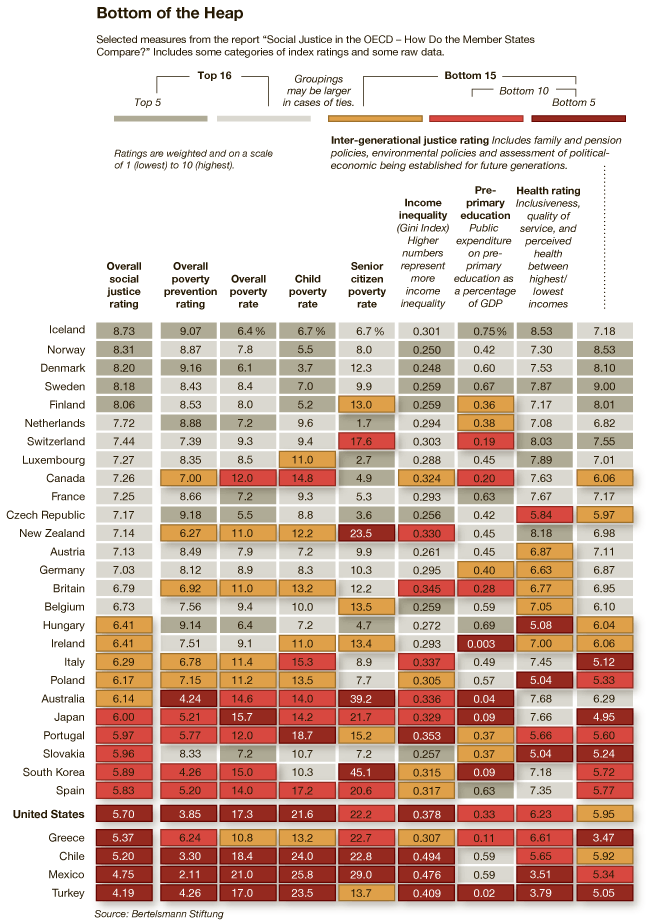
How does the U.S. compare to other developed countries on measures of social justice? According to the New York Times, not very well.  The visual below compares countries’ poverty rates, poverty prevention measures, income inequality, spending on pre-primary education, and citizen health.  The “overall” rating is on the far left and the U.S. ranks 27th out of 31.


Via Feministing.  See also how the U.S. ranks on measures of equality and prosperity(33 out of 33, for what it’s worth). Thanks to Dolores R. for the link!

—————————

Lisa Wade is a professor of sociology at Occidental College. You can follow her on Twitter and Facebook.

Global women’s progress report

Cross-posted at Family Inequality.

I have criticized sloppy statistical work by some international feminist organizations, so I’m glad to have a chance to point out a useful new report and website.

The Progress of the World’s Women is from the United Nations Entity for Gender Equality and the Empowerment of Women. The full-blown site has an executive summary, a long report, and a statistics index page with a download of the complete spreadsheet. I selected a few of the interesting graphics.

Skewed sex ratios (which I’ve written about here and here) are in the news, with the publication of Unnatural Selection, by Mara Hvistendahl. The report shows some of the countries with the most skewed sex ratios, reflecting the practice of parents aborting female fetuses (Vietnam and Taiwan should  be in there, too). With the exception of Korea, they’ve all gotten more skewed since the 1990s, when ultrasounds became more widely available, allowing parents to find out the sex of the fetus early in the pregnancy.

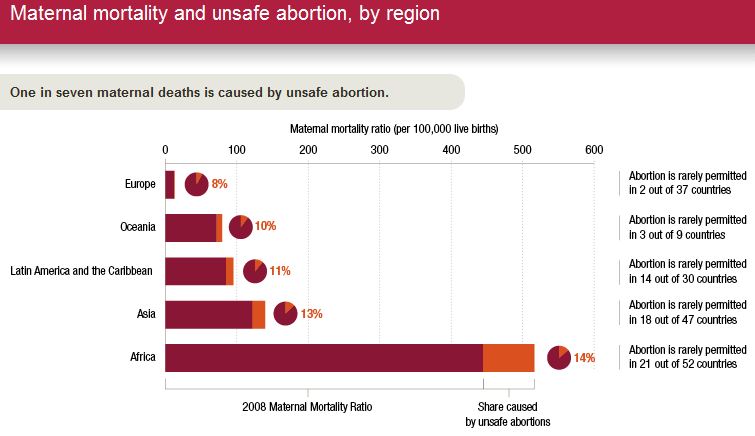
The most egregious inequality between women of the world is probably in maternal mortality. This chart shows, for example, that the chance of a woman dying during pregnancy or birth is about 100- 39-times higher in Africa than Europe. The chart also shows how many of those deaths are from unsafe abortions.

Finally, I made this one myself, showing women as a percentage of parliament in most of the world’s rich countries (the spreadsheet has the whole list). The USA, with 90 women out of 535 members of Congress, comes in at 17%.

The report focuses on law and justice issues, including rape and violence against women, as well as reparations, property rights, and judicial reform. They boil down their conclusions to: “Ten proven approaches to make justice systems work for women“:

1. Support women’s legal organizations

2. Support one-stop shops and specialized services to reduce attrition in the justice chain [that refers to rape cases, for example, not making their way from charge to conviction -pnc]

3. Implement gender-sensitive law reform

4. Use quotas to boost the number of women legislators

5. Put women on the front line of law enforcement

6. Train judges and monitor decisions

7. Increase women’s access to courts and truth commissions in conflict and post-conflict contexts.

8. Implement gender-responsive reparations programmes

9. Invest in women’s access to justice

10. Put gender equality at the heart of the Millennium Development Goals

Cross-National Comparisons of Years in Retirement

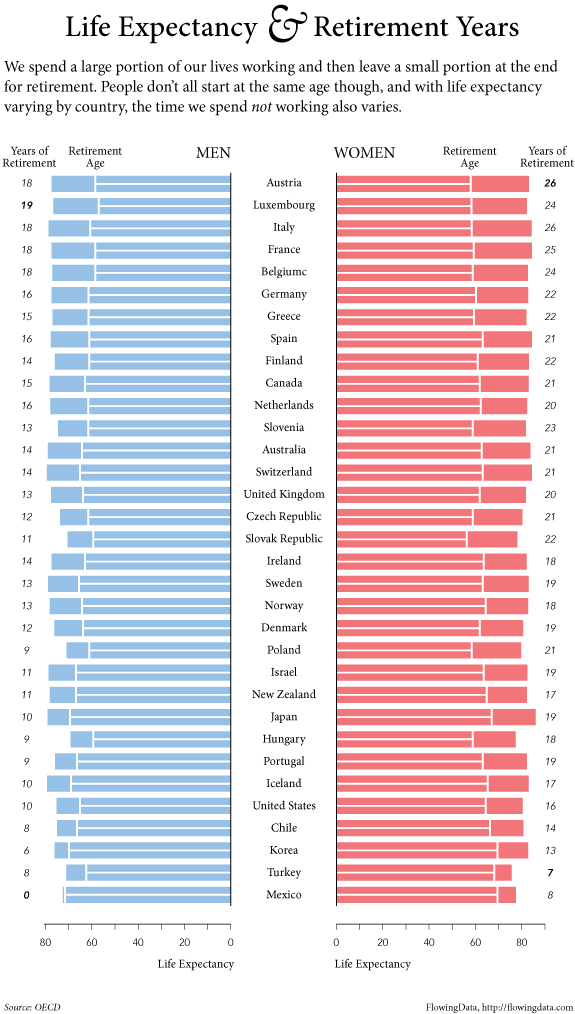
Does American prosperity translate into long retirements?  Not compared to other developed countries in the world.  Flowing Data borrowed OECD numbers on life expectancy and age of retirement to calculate the average number of years in retirement for men and women across many different countries.  The portion of each bar with the line is the average number of years working, while the non-lined portion represents years in retirement.

Largely because of life expectancy, women enjoy more years than men in all states except Turkey, but the number of years varies quite tremendously, from an average of zero years for men in Mexico, to an average of 26 years for women in Austria and Italy.  The United States is way down on this list, not doing so well relatively after all.

International Comparisons of Equality and Prosperity

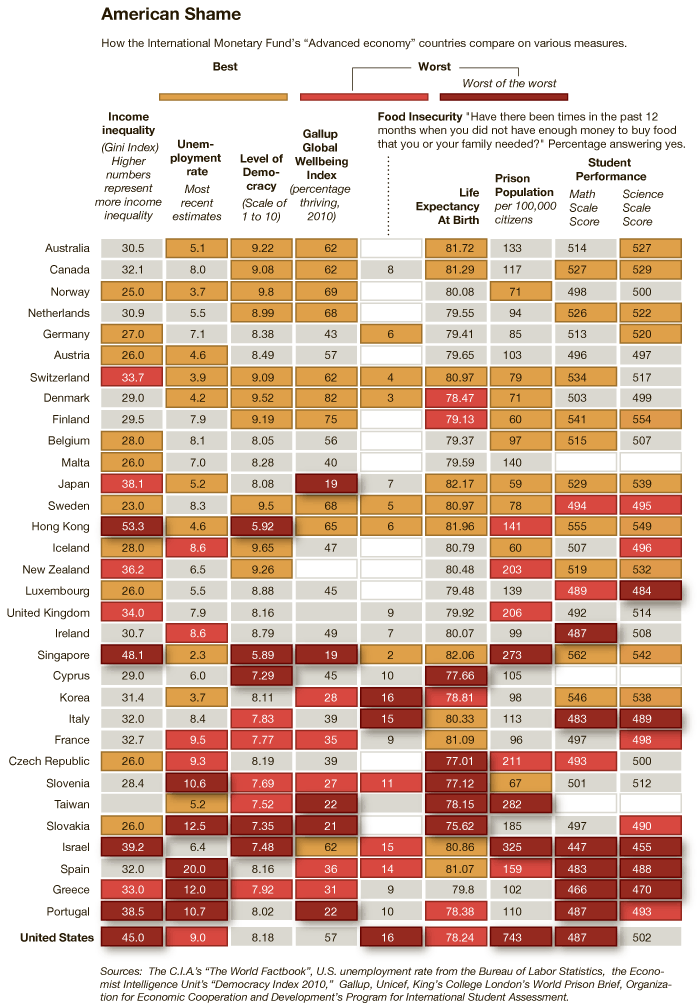
An infographic accompanying an article at the New York Times reveals how “advanced economies” compare on various measures of equality, well-being, educational attainment, and more.  To illustrate this, for each measure countries that rank well are coded tan, countries that rank poorly and very poorly are coded orange and red respectively, and countries that are in the middle are grey.  The countries are then ranked from best to worst overall, with Australia coming in #1 and the United States coming in last.  You might be surprised how some of these countries measure up.

Thanks to Dmitriy T.M. for the link.

The Casual Nature of Women’s Sexual Objectification

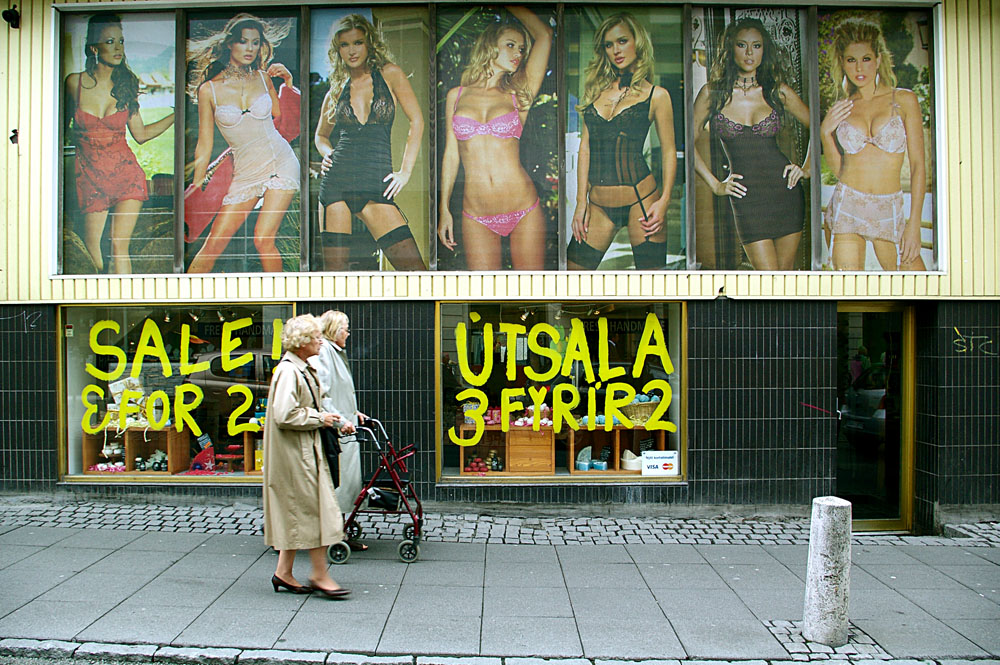
Fannar Þór Guðmundsson sent in a photograph that he took a few years back in his hometown of Reykjavík, Iceland.  The simple street, the mundane household items for sale, and the elderly couple contrast starkly with the lingerie-clad models with their come hither looks.  They contrast starkly, that is, if you are not already inured to the fact that such images are absolutely everywhere.

Global Recognition of Same-Sex Marriages

Courtesy of FiveThirtyEight, this graph shows the increase since 2001 in the number of people worldwide who live in jurisdictions where gay same-sex (or homogamous, if you prefer) marriage is legal. As of 2010, roughly 250 million people live in such areas (each column represents the total number for that year, broken into individual colors to show the number in each region):

The spike in 2008 is due to the California courts recognizing same-sex marriages, so the U.S. data pushed the total number upward; that, of course, was quickly reversed by Prop 8, so that bump disappears in 2009. Currently within the U.S., same-sex marriages are legal in Vermont, New Hampshire, Iowa, Connecticut, Massachusetts, and Washington, D.C., while apparently New York, New Mexico, California, and Rhode Island don’t allow them to be performed but recognize those performed elsewhere (a friend of mine who lives in Rhode Island couldn’t marry his boyfriend there, but drove a half hour from their home into Massachusetts to do so and then went home, where his out-of-state marriage was then entirely legal). California recognizes those same-sex marriages that occurred between June and November 2008, before Prop 8 passed. Within Europe (which is all thrown together here, unfortunately), as far as I know the specific countries where it’s legal are Sweden, Norway, the Netherlands, Belgium, Spain, Portugal, and Iceland), with Portugal and Iceland both doing so this year. In Mexico, same-sex marriages are legal only in Mexico City, but if performed there, must be recognized in other areas. And Argentina became the first country in South America to legalize them just last Thursday. (I’m not including domestic partnerships and other arrangements that are somewhat equivalent to, but clearly distinguished from, marriage here; adding those would certainly increase the number significantly.)

This is a small percentage (about 3.7%) of the total global population of nearly 7 billion, and they are highly concentrated in (Western) Europe and North America, with those in Africa, Asia, and Central and South America largely excluded. But the global pattern is a slow but steady rise over time just over the past decade in the recognition of same-sex marriages.

A Peek Into Private Plane Travel

My friend Steve sells Cessnas (single engine propeller planes, usually with between two and four seats).  A four-seater basic single-engine Cessna will cost you about $200,000, plus insurance, hanger fees, regular maintenance, and check-ups.   They aren’t particularly fast (not jets): the $200,000 one will get you somewhere about twice as fast as a car.  The gas will cost you about twice as much.   And there’s a much bigger carbon footprint.

Last summer, Steve sold a six-seater single-engine Cessna to France.  Since someone had to fly it (and the trip was paid for), we decided to take it there ourselves.  (Okay, Steve decided to take it there himself; I decided to sit in the passenger seat.)  Among other things, the adventure was a fascinating look at how the other half, eh em, top one percent lives.  In this post, I’m going to talk about the terminals serving private planes (also posted about here).   If you fly by private plane, you don’t go to the main terminal.  There is a separate private terminal.  We went through a lot of those terminals as we flew from Omaha, Nebraska; to Bangor, Maine; to Goose Bay-Happy Valley, Canada (Newfoundland-Labrador border); to Narsarsuaq, Greenland; to Reykjavik, Iceland; to Aarhus, Denmark; and, finally, to Nice, France.

Because I have my priorities straight, the first thing I noticed about these terminals is that they all have free treats: muffins, candy, or cookies:


There was also always free coffee and soda and bottled water. (This, I gotta tell you, was torture because I was off caffeine for the trip and, on top of that, couldn’t drink anything before taking off because of the whole no-bathroom-on-the-plane-thing and living below the poverty line until you’re 32 really instills a desire to pilfer anything that’s not nailed down.)

Private plane travel is figuratively as well as literally delicious.  There is no “long-term parking.”  You park your car right up front in the complimentary parking lot.  Honestly, going to the grocery store is more challenging.  In the private terminal, you can wander about as you please; your things will not be confiscated if you leave them unattended. There are no announcements.  You will not wait in line.  There is no security, except that which is designed to make your life more comfortable. You will not be asked to walk through an x-ray machine or show anyone any paperwork. There are computers available if you would like to use them and free wireless if you brought your own. You will leave whenever you like and stay as long as you please.  And how nice, since the facilities are incredibly comfortable.

Steve let me borrow these photos from the Houston Million Air.  The main desk:

CIMG3372

A lovely place to sit and watch TV comfortably:

CIMG3373

And if that isn’t good enough for you, a free, private cinema:

CIMG3371

CIMG3367

There were also free magazines about things like investments, yachts, and other expensive things:


This is where I got the ads and articles aimed at exeedingly rich people that I have been posting recently (see here, here and here).

When we decide to leave, we just waltz out to our plane, jump in and taxi to the runway.  We would call ground control, say “we’re ready,” and they’d say “go ahead.”   We never waited more than three or four minutes to get clearance to take off.

When we landed, we’d taxi over to the terminal, jump out of the plane and wander in.  The interaction would go something like this:

THEM: Welcome Sir and Miss. Can we get your bags?

STEVE: Please.

[They go out and start unloading the plane.]

THEM: Can we arrange for a hotel?

STEVE: Why yes.

THEM: Will do. Would you prefer downtown or on the water?

STEVE: The water will be lovely.

THEM: One moment, please. [The hotel is called.] Your room is booked. Would you like us to arrange a rental car for you or would you like a ride to the hotel?

STEVE: We will take a rental car, please.

THEM: It will be just a few minutes. Please enjoy our complimentary beverages, delightful morsels, overstuffed chairs, and free wireless while you wait.

STEVE: We certainly will.

I am totally not kidding.

You could also call ahead and request a rental car.  In this case, they would drive it right up to your plane, unload your bags for you, and you’d just scoot across the tarmac and be off!

One final tidbit:

Steve and I left the U.S. and entered five different countries over the course of our trip.  We got through Canada and Greenland without being asked for our passports.  Iceland would be both the first and the last place we were required to show I.D.  Denmark and France welcomed us with wide arms and trust.  We were the special people.

UPDATE: Several commenters pointed out that once Steve and I were through Iceland, the law grants us entry to Denmark and France without I.D. Thanks for the correction!

Modern Reproductions of Old Racist Images

Long, long ago I posted a political cartoon from an Icelandic newspaper. And lo, the comments did come. The number of them was…unexpected. One commenter, Icelander, pointed us in the direction of this site (thanks to Breck for reminding me about it), with images of pages from the book Tíu Litlir Negrastrákar (10 Little Negro Boys), a republication of the original, which came out in 1922. The rhyme was taken from English, but the drawings were by an Icelandic artist (info from Icelandic Review Online). It became a best-selling children’s book of 2007 in Iceland, apparently mostly due to adults purchasing it for themselves, not kids. (Note: I am sure Iceland is a lovely place with fantastic people and I do not go around trying to collect things from Iceland that use colonial-era depictions of Africans. I swear! If people sent me other sociologically-interesting stuff from/about/regarding Iceland, I’d post that too.)

In the rhyme, the boys die one by one from various accidents or stupid behaviors (gluttony, etc.).

I have no idea what that page of text says; if we have any Icelandic speakers reading and the page says anything interesting/useful to add to this post, a translation would be greatly appreciated.

The republication of the book got me thinking about these two “mammy” figurines I found at an antique/craft shop in Cedar City, Utah, a couple of years ago:

I was at the store, which sold both antiques and new stuff, just looking around, and I came upon the figurine on the left sitting on a shelf. I was looking at it and thinking how bright the paint was and how well it had been preserved, and that it was odd that an old mammy figurine wouldn’t have any scratches or anything on it. And I picked it up and looked at the bottom…and noticed that it said “made in China.” I turned around, which is when I saw a big barrel full of these two figurines. Tons of them. And I realized it wasn’t an antique at all; they are currently being mass-produced in China because there is apparently a market for new versions of old racist stuff. I cursed myself for not having a camera phone so I could just take a picture of them, and after considering for a little while, decided to go ahead and buy $5 worth of racist reproductions to use as examples in my classes (no, it did not occur to me to take a picture of them and return them; that just occurred to me right now).

Anyway, the book and the figurines puzzle me. They’re not valuable (the figurines were both $3.99) and they aren’t artifacts of our past, since they weren’t around during the heyday of these types of images any more than iPods were. I can at least conceive of why someone who likes antiques in general, or is fascinated by colonial-era images, might buy actual antique books or figurines with these types of images. But what is the motivation for buying modern reproductions of them? And clearly someone guessed there would be enough of a market for these two items to arrange to have them produced (and at least in the case of the book, they were correct; I have no idea how well the figurines have sold, obviously).

What does it mean that these types of reproductions exist? That they sell so well? What are the implications of that? I suspect many people would say they’re just cute or funny and that people no longer connect them to specific racist sentiments. Regarding the book, its popularity was attributed to “nostalgia.” That brings up the whole issue of whether/how racist images can be detached from the racist ideologies that originally led to their production. And if people say that they buy a new mammy figurine but that the figurines aren’t racist or offensive and no longer bring with them any larger historical implications…does that mean it’s true? Who gets to decide that? And what are people being nostalgic for, if that’s why they buy them?

Also see this post about patterns for making black mammy-type dolls.