Tag Archives: guns

Changes in Gun Ownership and Support for the Right to Own Them

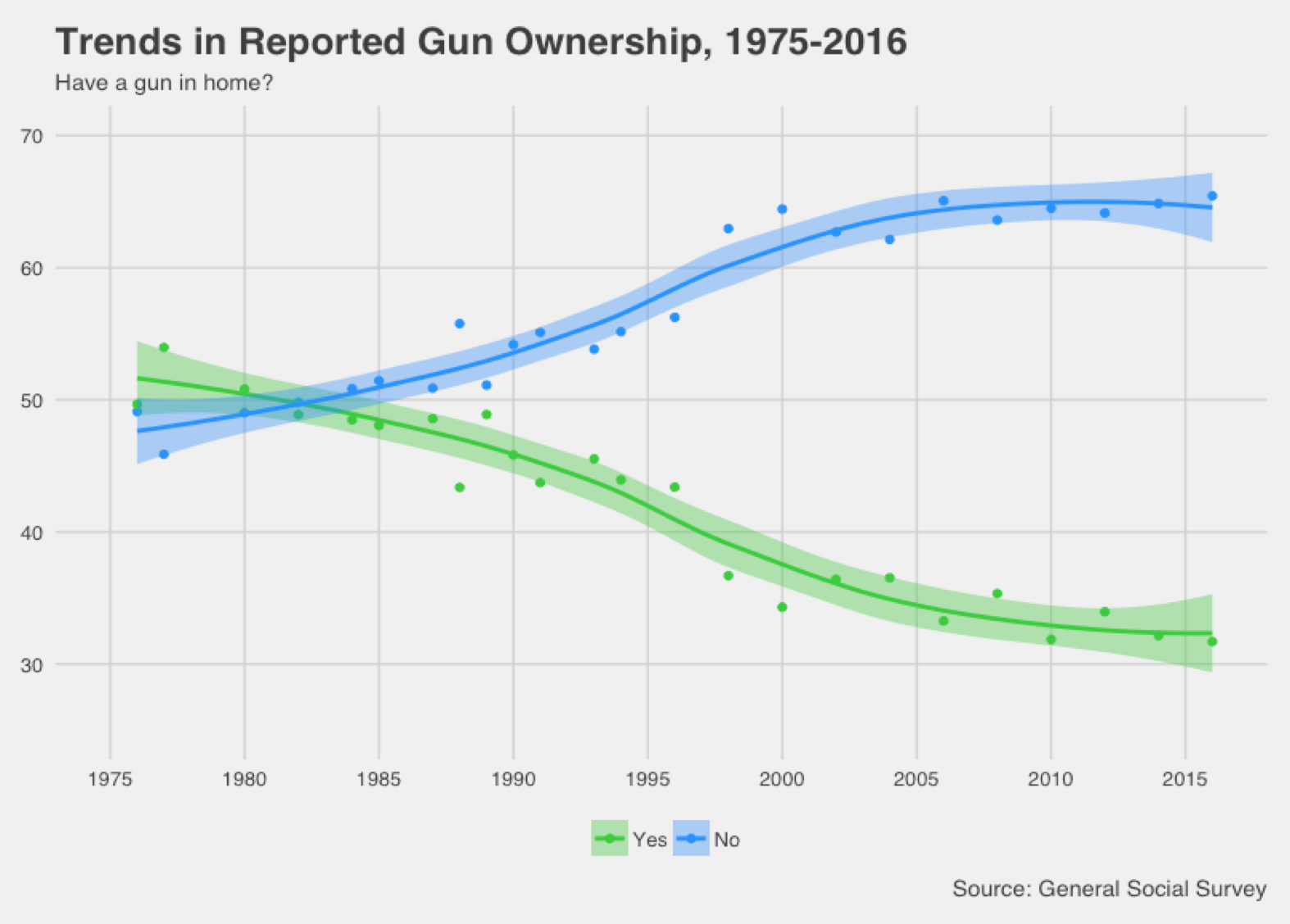
FiveThirtyEight has up a post about attitudes toward gun ownership in the U.S. Drawing on General Social Survey data, they show actual ownership of guns has gone down over time; less than 40% of American households now report having one:

You might expect that, as fewer Americans own guns themselves, support for the right to own personal firearms might decrease, as fewer people might feel a strong personal interest in the issue and restricting or banning access to guns wouldn’t, presumably, affect them directly or bring up an emotional image of agents storming into their homes.  Yet we don’t see this at all. In fact, Gallup poll data indicate that support for banning handguns has decreased over time as well, with fewer than one third of Americans supporting such a policy:

Silver suggests that changes in political rhetoric, particularly more vocal and unequivocal support for gun rights by the Republicans and less emphasis on banning guns by Democrats, may explain some of this change. I’m sure that’s part of it; but that leaves unanswered why the political rhetoric changed, particularly after 1992 (when, as Silver demonstrates, the Republican Party platform became more pro-gun/anti-restriction, while the Democrats made sure to start stressing their overall support for some basic right to gun ownership by individuals, though still pushing for some regulations). And aside from that, the biggest drop in support for banning handguns came during the ’60s and ’70s, before the change in party rhetoric, so what do we make of that?

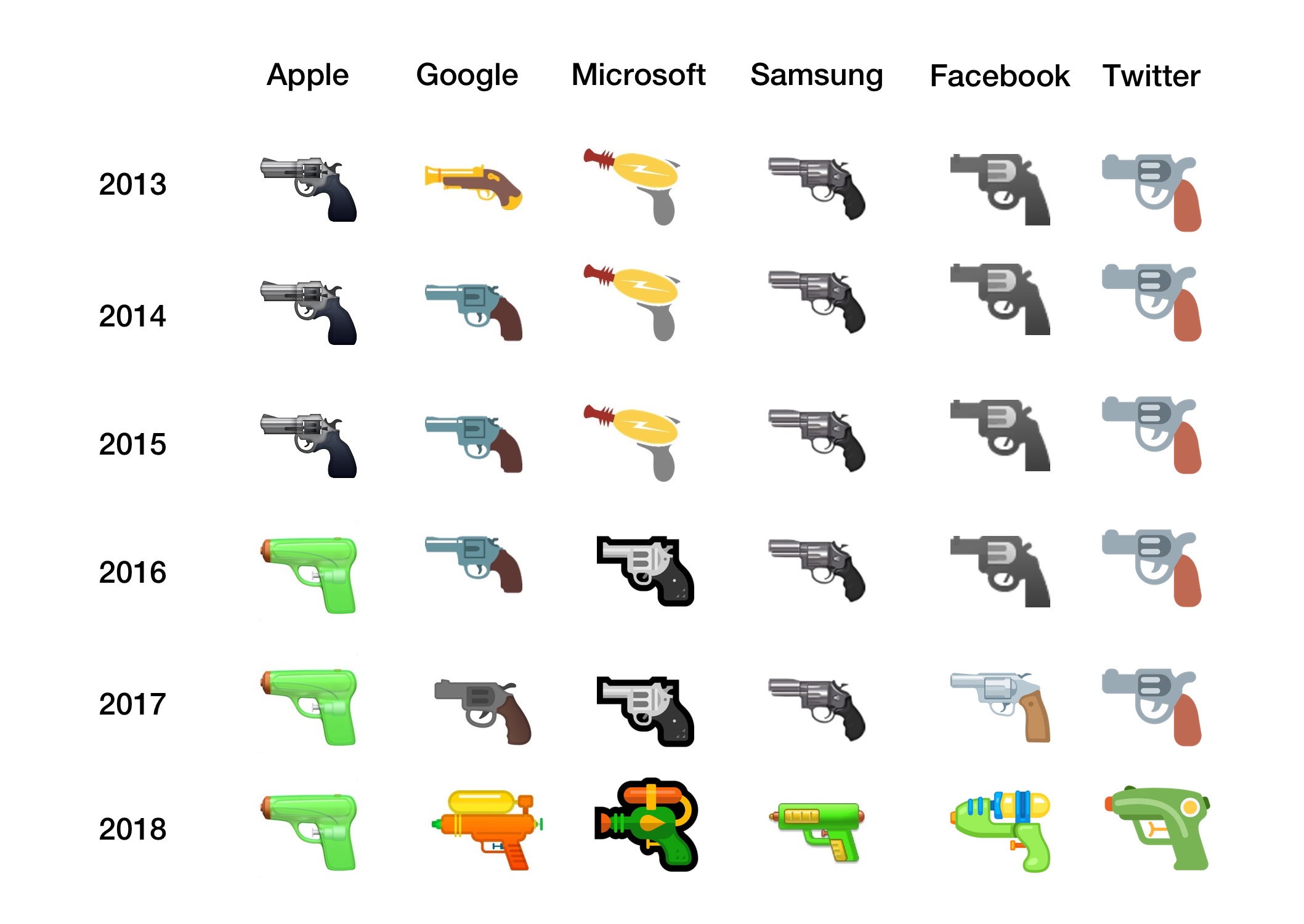
Also see our post on concealed weapon laws, increases in gun sale background checks, and changing images of guns in pop culture.

Guns for Christmas

In the same vein as our post featuring vintage ads suggesting that cigarettes are an excellent Christmas gift, comes these vintage ads suggesting the same for guns.  This is not to say that either guns or cigarettes are bad Christmas gifts, but only to point out how things change.
From 1939:

hs2idz

Date unknown:

329024228cedbd0cf0bobdc

Found here and here.

Which Americans Are Republicans Pledging To?

As you may have heard, this week the Republican Party released what they’ve termed a “Pledge to America,” a document that lists their agenda for the next legislative session. Erin Echols, a student at Kennesaw State U., took a look at it and was struck by the contents, particularly the images.

Of the 48 total pages of the document, 14 consist of images, either a single one or a collage of several. Of course, in a document of this sort, you’re going to have the required patriotic images — the Statue of Liberty, Mount Rushmore, the Capitol and other buildings in D.C. Nothing surprising there. But Erin points out that the cowboy seems to be a recurring theme. There’s a full-page silhouette:

Two pages prominently show people wearing cowboy hats (these are both from collages):

It reminded me of a post by Macon D. over at Racialicious a while back about some ads by a Republican primary candidate for Agricultural  Commissioner in Alabama:

The hat, the horse, the rifle, the sweeping music that makes me think of old Western movies…it all evokes what Macon D. calls the “Independent (White) Cowboy Myth,” a version of rugged, stand-alone, honest manhood. Macon D. quotes Mel at BroadSnark:

In this mythology, the cowboy is a white man. He is a crusty frontiersman taming the west and paving the way for civilization. He is the good guy fighting the dangerous Indian. He is free and independent. He is in charge of his own destiny.

Here’s the follow-up ad he made after losing:

And, for the record, I’m not arguing this presentation of Dale Peterson is necessarily fake; for all I know he dresses and acts like that all the time. People do; I’m related to some of them. I’m not saying Peterson is a fraud who really wears tuxes and has never been on a horse. That’s irrelevant. What I’m interested in is the power of a particular cowboy mythology, the one on display in Peterson’s ads.

As Macon D. points out, Ronald Reagan actively appropriated the cowboy persona, often wearing cowboy hats and jeans, sometimes alongside a horse (he had also played cowboys in a couple of movies). He openly identified with the “Sagebrush Rebellion,” an effort by groups in the western U.S. in the ’70s and ’80s to stop designation of federal lands as protected wilderness areas, push for more mining and livestock grazing rights on public land, and oppose some other environmental and land use regulations, depicted as impositions from distant elites.

Macon D. quotes Sarah Watts on the appeal of the White cowboy myth when Theodore Roosevelt first used it:

…he met the psychological desires in their imagination, making them into masters of their own fate, propelling them into violent adventure and comradeship, believing them at home in nature, not in the hothouse interiors of office buildings or middle-class homes.

The cowboy myth, then, arose partly to allay deep anxieties about changes in American society. But the myth is just that — a myth, a romanticized notion largely unmoored from the realities of cowboys’ lives. Mel says,

Cowboys were itinerant workers who, while paid fairly well when they had work, spent much of the year begging for odd jobs.  Many did not even own the horse they rode.  Frequently, they worked for large cattle companies owned by stockholders from the Northeast and Europe, not for small family operations (a la Bonanza).  The few times cowboys tried to organize, they were brutally oppressed by ranchers.

This isn’t true just in the past. I know people who work as hired hands on ranches now. They love many aspects of the life. But most of them aren’t particularly well-paid; they don’t have retirement benefits or health insurance; they aren’t on a path to being able to buy their own ranch and be a self-reliant family farmer. Some become managers, with more responsibility and money, as in any occupation. But sometimes what initially seemed like a great deal — getting free housing as part of the job — turns out to have downsides, such as being expected to be available round-the-clock since you’re right there on the property, or fearing that if you piss off your employer and get fired, you’re out of a place to live immediately as well.

The examples I’ve given here have all been Republicans. Democrats use the cowboy mythology as well — Secretary of the Interior Ken Salazar is well known for often appearing in a cowboy hat and nearly always wearing a bolo tie rather than a necktie. However, Republicans seem to appropriate the cowboy persona more often, or at least more successfully.

Anyway…back to Erin’s analysis of the “Pledge to America.” The other interesting feature of the images is their overwhelming Whiteness. Some examples of group photos:

This one has what in a larger version appears may be an Asian-American woman, in the red dress on the lower left:

The photo on the second tier on the right here looks like it might have a Black woman in it, seated second from the right:

Overall, the photos show a sea of Whiteness. As Erin says, whether it’s an unintentional oversight or a calculated choice, the resulting message is that America’s citizens, the hard-working, patriotic folks who matter and to whom the party is making pledges, are White. Given the current racialized tone of much of our political debate (especially regarding Hispanic immigrants and Muslims, a racialized group often conflated with “Arabs”), it’s a portrait of America that is likely to speak to, and soothe, the fears of some groups more than others.

Racial Violence in the Aftermath of Katrina

This is an excerpt from a much longer account of the Hurricane Katrina disaster, published at Caroline Heldman’s blog.

Trigger warning: racial violence and racist language.

A disturbing picture of racial slaughter emerges in the days following Katrina, at the hands of private residents and police officers. Racially-motivated murders were carried out in Algiers Point, a predominately white enclave nestled in mostly black Algiers, not far from Gretna. This part of the city is connected to the rest of New Orleans by bridge and ferry only, and it did not experience flooding. After the storm, a band of 15 to 30 white men formed a loose militia targeting anyone whom they deemed “didn’t belong” in their predominately white neighborhood (source). They blocked off streets with downed trees, stockpiled weapons, and ran patrols.

At least eleven black men were shot, although some locals expect that the actual number is much higher. On July 16, 2010, Roland Bourgeois was charged with shooting three black men in Algiers in the days following Katrina (source). He allegedly came back to the militia home base with a bloody baseball cap from Ronald Herrington, a man he shot, and told a witness that “Anything coming up this street darker than a paper bag is getting shot.”

To date, this is the only arrest of militia members, but the FBI is investigating the situation and will likely make more arrests given that two Danish filmmakers interviewed multiple residents who admitted shooting black people. In “Welcome to New Orleans,” militia member Wayne Janak smiles at the camera: “It was great! It was like pheasant season in South Dakota. If it moved, you shot it.” A woman nearby adds “He understands the N-word now… In this neighborhood, we take care of our own.” Many of the victims reported that militia members called them racial epithets during attacks, and a family member of militia members reports that her uncle and cousins considered it a “free-for-all—white against black,” and her cousin was happy they were “shooting niggers.”

Malik Rahim, a long-time Algiers resident and activist who co-founded Common Ground Relief after the storm, took me on a tour of bodies in his neighborhood a week or so after the storm. I only made it through one viewing – a bloated body of a man under a piece of cardboard with a gunshot wound to his back. I assumed that this death was being investigated, but should have known otherwise given that the state had essentially sanctioned these actions with a “shoot to kill” order that allowed civilians to make their own assessments of who should live or die.

One of Many New Orleans Vigilante T-Shirts Slogans:

The Daintification of Masculinity

Mindy J. and Andrea F. sent in a really interesting project by artist Nathan Vincent.  Vincent recreates masculine items and ideas with feminine crafts in order to upset the gender binary.  He explains:

My work explores gender permissions and the challenges that arise from straying from the prescribed norms. It questions the qualities of gender by considering what constitutes masculine and feminine. It critiques stereotypical gender mediums by creating “masculine objects” using “feminine processes” such as crochet, sewing, and applique.

For example:

Vincent and his bear rug:

More examples of his work:


Political Attitudes on OkCupid: Prioritizing Rights and Flag Burning

DragonRidingSorceress sent us a link to an interesting map, based on OkCupid data:

Photobucket

Hunting down the data source led me to another map. This one asked if burning the national flag should be illegal:

Photobucket

I suppose neither pattern will seem hugely surprising to most people given what we know about political affiliations, social attitudes, and geography in the U.S. And you could certainly criticize the first question for forcing people into a dichotomy that might not accurately represent their actual views (that is, probably most people would respond “neither” if given that option). But scholars argue that “forced choice” questions can give useful info about priorities and preferences — after all, even if you’d choose “neither” or “I value these rights equally” if given those options, choosing one or the other when forced does say something about which right seems more relevant if you have to hypothetically choose.

Concealed Weapon Laws, 1986-2010

Francisco G. sent in a link to some maps that show the adoption of laws that allow people to carry concealed weapons.

Green indicates there were no restrictions on carrying a concealed weapon. Blue means state law required that anyone who passes a background check and gun safety course must be issued a concealed weapon permit if they request one. Yellow states may allow concealed weapon permits, but residents don’t automatically get one after a background check and safety course. And states colored in red do not allow concealed carrying of weapons.

We see a very clear trend. In the mid-80s, the vast majority of states either didn’t provide permits for concealed weapons or didn’t automatically allow them to anyone who got a general gun permit:

Photobucket

By 1993 a number of states passed more permissive concealed-carry laws:

Photobucket

We see a huge jump between 1993 and 1996 in the number of states that grant anyone who passes a background check and safety class a concealed-carry permit:

Photobucket

Today, the vast majority of states have permissive concealed-carry permits:

Photobucket

Arizona recently became an “unrestricted” state, meaning that as of this summer you don’t have to have a separate gun permit to carry a concealed weapon.

Regardless of the arguments you’ll hear so often that gun rights are being increasingly infringed upon, at least on this issue, it appears that gun-rights advocates have made significant progress at affecting the legislative process at the state level.

Who Would You Shoot?

In 2002, a study by Joshua Correll and colleagues, called The Police Officer’s Dilemma, was published. In the study, researchers reported that they presented photos of black and white men holding either a gun or a non-threatening object (like a wallet) in a video game style setting.  Participants were asked to make a rapid decision to “shoot” or “don’t shoot” each of the men based on whether the target was armed.

They found that people hesitated longer to shoot an armed white target (and they were more likely to accidentally not shoot). Participants were quicker and more accurate with black armed targets but there were more “false alarms” (shooting them when they were unarmed). These effects were present even though participants did not hold any explicit discriminatory views and wanted to treat all targets fairly.

The effect we see here is a subconscious but measurable preference to give white men the benefit of the doubt in these ambiguous situations. Decision times can vary by a fraction of a second, but that fraction can mean life or death for the person on the other end of the gun.

A terrible reminder of this bias was brought back into the headlines on March 2nd when a black student in Gainesville Florida was shot in the face with a rifle by a police officer. The conditions surrounding the shooting are murky, as the police are extremely hesitant to release details.

It appears that Kofi Adu-Brempong, an international graduate student and teacher’s assistant, was in a stress-induced panic and was worried about his student visa. On the day of the incident, his neighbors heard yelling in his apartment and called the police. It has been suggested that he may have suffered from some mental health problems that related to his panics (although this is not known for sure) and that he had resisted police in the past.

Even so, when the police arrived they broke down his door, citing that they did not know if there was someone else in danger inside the apartment. Adu refused to cooperate and the situation escalated to the point where police tried to subdue him with a tazer and a bean-bag gun. Then a policeman shot him. Adu is now in the hospital in critical condition and has sustained serious damages to his tongue and lower jaw. The police claimed that Adu was wielding a lead pipe and a knife and started violently threatening them with the weapons.

In fact, there was no lead pipe and there was no knife in his hand. When the police approached Adu after he had been shot, the pipe showed itself to be a cane- a cane that Adu constantly used due to a case of childhood polio. And the knife they saw in his hand was actually sitting on the kitchen counter.

Instances like these are tragic reminders of the mistakes that can be made in split second decisions and how race can play into those decisions.

———————————-

Lauren McGuire is an assistant to a disability activist. She lives in Pasadena, CA,with four guys, one bathroom, and a dog. She studied psychology in school and is an enthusiastic amateur in writing, blogging, sewing, photography, and general creative buffoonery.  She’s just launched her own blog, The Fatal Foxtrot, that is focused on the awkward passage into adulthood.

If you would like to write a post for Sociological Images, please see our Guidelines for Guest Bloggers.