Tag Archives: bodies: fat

“Sexy” according to Victoria’s Secret

Victoria’s Secret has released this year’s list of the sexiest womenin 18 categories. Alongside the obvious, 16 of the 21 women are blond, er “blond.” Maybe 15.  Whatever. Have at it in the comments.

Also, Britney’s back? When did that happen?

Thanks to Dolores R.

—————————

Lisa Wade is a professor of sociology at Occidental College. You can follow her on Twitter and Facebook.

The Story of My Man-Boobs

Cross-posted at My Own Private Guantanamo and Jezebel.

Of the many nicknames I’ve acquired over the years, there’s one I’m reminded of today. The name was given to me by a bully shortly after I entered the sixth grade. I had been a fat kid since elementary school, but as puberty began to kick in, parts of me started growing differently than expected. The doctors said I had gynecomastia. “Man boobs,” or “moobs” in the jeering parlance of our popular culture.

But my bully simply called them “tits.” And so this also became my name in the school hallways.

I was Tits.

He would pass me in the hall and catcall “Hey Tits!” and his buddies would laugh. Sometimes, if he was feeling extra bold, he might actually grab one of my breasts, and squeeze it in front of the other kids. Not everyone laughed. But many did.

As direct as this bullying was, growing up with gynecomastia was characterized by smaller insults. Most kids would just ask “Why don’t you wear a bra?” Even adults could be cruel. “Are you a boy or a girl?” I was often asked.

When wearing shirts, it was crucial that they be loose fitting. If a T-shirt had shrunk in the dryer, I would spend hours and days stretching it out, so that it didn’t cling to my body. You can see fat boys do this every day. Pulling at their shirts to hide the shape of their bodies, but particularly their breasts.

As a fat kid, and one who hated competition, I learned to loathe sports, and especially, physical education. The one form of exercise which I enjoyed from childhood was swimming. Unfortunately, as my breasts grew, so did my shame about removing my shirt. At summer camp, I never set foot in the swimming pool. I knew that taking off my shirt would bring ridicule, and that leaving it on while swimming would show that I felt ashamed of my body. So, I pretended that I was above swimming — that I was too cool for the pool.

By high school, I had developed remarkable powers of verbal self defense. I absorbed cruelty and learned how to mete it back out in sharp doses. There’s no doubt that this shaped the person I became, for better and for worse. In high school, I managed to carve out a social niche for myself. The bullying stopped. But the shirts stayed loose-fitting. I rarely went swimming.

The doctors thought that perhaps I suffered from low testosterone. I found this funny, since my sex drive had been in high gear since the time I was a sophomore. I assured them that this was not the case. Finally, the doctors said that my excess breast tissue was probably just a result of being fat. Lose the weight and the breasts will go away.

So I lost weight. I don’t remember how much. But by senior year, I was slender. Girls were starting to talk to me. I was more confident. And I still had breasts. After graduation, the doctors congratulated me on my thin body. Now it was time to get rid of my breasts.

In the first surgery, I was placed under general anesthesia. The doctor made a half moon incision under each nipple and cut out the excess breast tissue, finishing the job with some liposuction. Unfortunately the surgery wasn’t a complete success. My breasts were smaller, but lumpy, and my nipples were puckered. It took a second surgery to make everything look “normal.”

I was nineteen. On New Year’s Eve, I went to a party and got drunk for the first time in my life. There, I met a girl who took my virginity. She was too drunk to insist on taking my shirt off. This was a relief, because under my shirt was a sports bra, and under that layers of gauze. My chest was still healing from the second surgery. In many senses of the word, I was still becoming a man.

I’m reminded of this recently, oddly enough, after reading one of those “humorous” snarky news stories that pop up in the right column of The Huffington Post. Perhaps you’ve seen the photo making the rounds. It’s of Barney Frank’s “moobs.” The photo inspired similar stories at gay culture site Queerty, Gawker and Slate, which used the incident as the pretense for a scientific column.
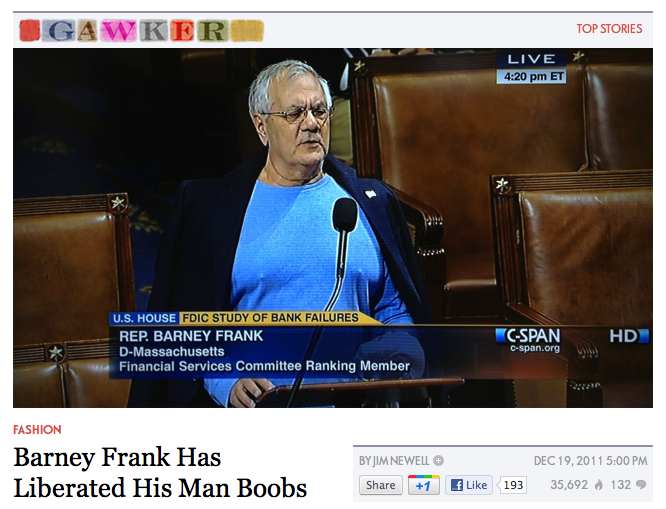
While all of these nominally liberal sites pay lip service to the dignity of gay and transgender people, they miss one thing that is very clear to me. Aside from the obvious fat shaming in these stories, the fixation on “man boobs” reveals our culture’s obsession with binary gender. As I noted on The Huffington Post’s comment thread, before a moderator whisked my comment away, “the only breasts The Huffington Post approves of are those of thin, white female celebrities.”

Here’s one of the many comments Huffpo didn’t delete:

It’s culturally ubiquitous. PETA, for example, is a habitual offender:
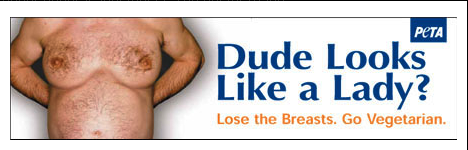
Men are supposed to have flat chests, hairy bodies and big penises. Women are supposed to have large breasts, thin hairless bodies and tidy labias. (If a woman’s labia are too big, it just might remind us that, with a little testosterone, the same tissue would make a penis.)

We have all the evidence we need that biological sex and gender are not as rigid or fixed as we imagine. There are intersexed people. There are transgender people and genderqueer people. There are millions of men and boys like me, who also have large breasts, or gynecomastia, a medically harmless (though socially lethal) condition that your insurance just might pay to correct. The prevalence of gynecomastia in adolescent boys is estimated to be as low as 4% and as high as 69% . As one article notes: “These differences probably result from variations in what is perceived to be normal.” You think?

We’re so entrenched in that snips ‘n snails bullshit, that we can’t accept bodies which don’t fall on either extreme of the gender continuum. Transgender men and women encounter these attitudes in direct, and sometimes life-threatening ways. And, given the misogyny that pervades our society, these pressures are even harder for women and girls, whether they’re cisgender or transgender. Their bodies are hated and desired in equal measure. When my bully grabbed my breasts and called me “Tits,” he was taking what he wanted. He was also reminding me that I was no better than a girl. I was beneath him.

With the explosion of social media and the surveillance society, body policing has gotten much more intense. We live in an age of crowdsourced bullying. I cannot imagine what it would be like to grow up as a boy with breasts in 2011. I suppose I’d spend hours in Photoshop digitally sculpting my body, to remove fat from my face, belly and chest before uploading my profile photos. If I were a fat girl, I might become very skilled at using light and angles to disguise my less than ideal body, to avoid being dubbed a “SIF” or “secret internet fatty,” by my tech-savvy peers. I would probably become vigilant about removing tags from unflattering photos and obsess over remarks people made about me on comment threads.

Twenty years have gone by, and I miss my breasts. As a chubby adult male, I still have a small set of breasts, but not the ones I was born with. The two surgeries also deprived my nipples of their sensitivity.

I’ve often joked that if I knew I was going to become a performance artist, I would have kept my breasts. The breasts I have now are smaller, but still capable of stoking the body police. I once scandalized a fancy pool party in Las Vegas simply by taking off my shirt. I realize that, as a man, it is my privilege to do so. In most parts of our society, it is either illegal or strongly frowned upon for a woman to go topless. (Female breasts are either for maternity or for male sexual pleasure, not for baring at polite parties.) Perhaps my breasts, which remind people of this prohibition, invite a similar kind of censure.

I’ve performed naked enough in my adult life to know that the body police can always find a new area to target. I was recently stunned to hear porn actress Dana DeArmond describe me during a podcast interview as a “fat lady” while her host Joe Rogan openly theorized that my small penis was somehow connected to my feminism. Rogan’s view of gender is so restrictive that he can only conceive of male feminism if it is in a feminized body. (This is probably also why men who support feminism are often dubbed “manginas” by misogynists.)

There might actually be tens of thousands of words devoted to describing my fat body and small penis on the internet. It’s almost a point of pride. Now, I don’t just use my sharp tongue for self defense. I also use my body itself, as an argument, and as a provocation.

I am Tits. Got a problem with that?

—————————-

 Matt Cornell is an artist, performer and film programmer. From 2000 to 2004 he was a business consultant in San Francisco for outsider artist eXtreme Elvis. Matt lives and works in Los Angeles. Contact him at matt@mattcornell.org or follow him @mattcornell.

The Quaker Oats Man Gets a Makeover

Given our collection of toy make-overs, I was curious when I heard that Quaker Oats had re-vamped their mascot, Larry.  In the toys we’ve covered, the trend is towards greater feminization and sexualization.  Larry, though, is a dude.  And do we really need to sexualize our oatmeal?  (Well, you never know.)

It turns out what prompted the mascot make-over wasn’t an effort to make Larry sexier, but to make him look healthier.  According to the Wall Street Journal, the director of Quaker’s brand-design firm wanted to reinforce people’s association of oatmeal with “energy and healthy choices.”  And by “healthy,” they mean “thin.”   They reduced the roundness of his chin and cheeks.  They also gave him a hair cut in order to expose the sides of his neck.  Another representative of the brand redesign explains: ”It’s the same neck,” but the haircut “makes him look thinner… We took about five pounds off him.”

If it’s tough for you to tell the difference between the two, it’s by design.  Quaker wants the changes to work on a subconscious level.  A fascinating peak into the motives and tactics of brand management.

—————————

Lisa Wade is a professor of sociology at Occidental College. You can follow her on Twitter and Facebook.

Exotic Dancers in 1890 and the Plump Body Ideal

I recently had the pleasure of reading Peter Stearns’ Fat History: Bodies and Beauty in the Modern West.  The book chronicles the shift in American history from a plump to a thin ideal.  The beauty of Stearns’ book is his resistance to reducing the shift in norms to a simple cause. Instead, he traces the changes to conflicts between capitalism and religion, the backlash against women’s equality, industrialization and the devaluation of maternal roles, fashion trends, the professionalization of medicine, our cultural relationship to food, and more.

Stearns is quite specific in timing the change, however, pointing to the years between 1890 and 1910.  In these 20 years, he writes:

…middle-class America began its ongoing battle aginst body fat.  Never previously an item of systemic public concern, dieting or guilt about not dieting became an increasing staple of private life, along with a surprisingly strong current of disgust directed against people labeled obese.

I thought of Stearns’ book when I came across a delightful collection of photographs of exotic dancers taken in 1890, the year he pinpoints as the beginning of the shift to thinness.  From a contemporary perspective, they would likely be judged as “too fat,” but their plumpness was exactly what made these dancers so desirable at the time.

More at Retronaut.

—————————

Lisa Wade is a professor of sociology at Occidental College. You can follow her on Twitter and Facebook.

The Marilyn Meme

Originally posted at Shameless.

Marilyn Monroe is often held up as the antidote to the idea that only thin can be beautiful. “Marilyn was a size 10/12/14,” goes a common refrain (though sizing basically means nothing these days, so what does that even prove?). There have been a couple Marilyn Monroe memes floating around Facebook in the past couple months, and both are troubling. The focus is on Marilyn’s curves, and how her swimsuit clad body is different from what movie stars look like today (oh, the tyranny of the “Best Beach Bodies!” issue). What’s supposed to be an empowering message to women – you don’t have to be a Victoria’s Secret model to be beautiful – is completely undermined by two much older memes: divide and conquer and the male gaze.

In the first photo, Marilyn is compared to another woman in a bikini, who is much thinner. The text reads: “This [pointing to Monroe] is more attractive than this [pointing to the other woman].” While I can totally get behind the title “fuck society,” and add “and its stupid expectations” for good measure, there’s nothing anti-establishment about what’s being done here. This is a common tactic, in which women are pitted against each other, so that we lose sight of the real problem: namely, society. If women are fighting amongst ourselves about who is more “beautiful,” if we compare ourselves to other women endlessly, we don’t have time to notice that we’re trapped in a hamster-wheel of low self-esteem. Society hopes that you’ll buy things, to try and make yourself feel better. In the meantime, it’s hoped that we as women won’t critically examine what beauty is, what’s being sold to us, and most importantly, who profits from all this. Fuck Society, sure, because society tells you that if you’re not extremely thin, you’re worthless. However, extremely thin women? They’re still people. Further, bodies are just bodies. They have no intrinsic worth, no moral value, other than what we assign them. The thought behind this comparison photo is to turn the dominant paradigm on its head, but what it really does is reinforce that for one woman to be good, another must be bad. And that kind of thinking isn’t going to get us anywhere.

The second is the same photo of Marilyn, this time alone in the Motivational Poster style. The text reads: “PROOF: That you can be adored by thousands of men, even when your thighs touch.” From the start this would seem like a better message. No comparison photo, no pitting women against each other. For some reason, though, this photo troubles and angers me more than the first one does. Because here’s the thing: you are worth more than what men think of you. Marilyn Monroe was, to put it mildly, very sad, very often. She was a sex symbol, and thus, stopped existing as human being, a regular girl. Almost everything that fucked up Marilyn’s later life had to do with being “adored” by men. Men used her, or deified her (and that’s a hard come-down for those dudes when they found a human being in their bed the morning after). Political brothers purportedly passed her around like a toy. Conventional wisdom, political conspiracy aside, has it that Monroe killed herself. Being “adored by thousands of men” didn’t stop her demons from consuming her. It angers me to no end that, again, in the name of self-esteem we’re going to make a poster girl (literally) out of a woman who was notoriously down on herself.

I want very much for us to stop thinking that there is only one body type that is acceptable. I would prefer the focus be on health, rather than appearance. The Monroe Meme seems about the furthest thing from healthy. This is a woman who abused alcohol and sleeping pills later in her life, this is a woman who (probably) died due to depression. But, hey, as long as someone thinks she looks good, I guess that’s what matters.

——————————

Heather Cromarty has written for The Walrus Blog, and writes about books and bookish miscellany at In The Midst of Life, We Are in Debt, Etc. Follow her on Twitter: @la_panique.

If you would like to write a post for Sociological Images, please see our Guidelines for Guest Bloggers.

New Obesity Prevention Campaign Rife with Fat-Shaming

The Physicians Committee for Responsible Medicine (PCRM) sponsored two new billboards in Albany, NY, warning residents that cheese makes you fat in what is possibly most irresponsible way ever. The first features an obese man’s disembodied torso and the words, “Your abs on cheese.” The second features an obese woman’s butt and thighs and the words, “Your thighs on cheese.” The images make a very clear statement: fat people are disgusting.
The PCRM advocates for a vegan diet. The aim of this campaign is to get Albany residents to reduce their cheese intake, as cheese is a common source of saturated fat and, according to the PRCM, a major contributor to obesity in the United States. In Albany, home to several dairy farms, 63 percent of adults are obese. This is higher than the statewide obesity level of 59 percent. Obesity prevention is a valid cause, to be sure, but at what cost to other health issues?

According to their website, the PCRM is “a nonprofit health organization that promotes preventive medicine, conducts clinical research, and encourages higher standards for ethics and effectiveness in research.” For an organization so concerned with ethical standards, the PCRM has sunk pretty low with this offensive and damaging campaign. In the jargon of health communication ethics, the PCRM have committed a common and classic misstep: the failure to consider the unintended consequences of their message.

Just like a single food item (in this case, cheese) is not responsible for the entire obesity epidemic, obesity is not the only serious health problem facing Americans. We are also struggling with our body image and self-esteem as we cope with the barrage of photoshopped and unrealistic “ideal bodies” in the media. The National Eating Disorders Association states that “in the United States, as many as 10 million women and 1 million men are fighting a life and death battle with an eating disorder such as anorexia or bulimia. Millions more are struggling with binge eating disorder.”

In the medical hegemony, physical health tends to outrank mental health in “importance.” But the line between physical and mental health issues is not always clear, especially with the confluence of obesity, body image disturbance, eating disorders, and self-esteem. The PRCM is wearing blinders to these interrelated health issues in their dogmatic pursuit of a singular, isolated objective.

Physicians are taught to “do no harm.” The PRCM needs to understand that insensitive words and pictures are absolutely harmful to our health. There are better ways to educate and motivate people to make healthier food choices; ethical health campaigns do not sacrifice one health issue to promote another.

————————

Leah Berkenwald is a graduate student of Health Communication at Emerson College, in collaboration with the Tufts University School of Medicine, and holds a MA in American Studies from the University of Nottingham. She is currently designing a social marketing campaign on body image for the Massachusetts Institute of Technology. She also works as the Online Communications Specialist at the Jewish Women’s Archive, and blogs at talkinreckless.com.

If you would like to write a post for Sociological Images, please see our Guidelines for Guest Bloggers.

Fat-Shaming Pert Plus Ad

This commercial is good evidence that we still think nothing of being cruel towards people deemed “overweight”:

Via Copyranter.

—————————

Lisa Wade is a professor of sociology at Occidental College. You can follow her on Twitter and Facebook.

Conflating Fat with Unhealthy

Nickey R. sent in a commercial by Blue Cross and Blue Shield of Minnesota that aims to encouraging people to stop putting off exercising, eating healthy, and quitting smoking. The problem with these ads is a simple one. It represents all unhealthy people as overweight… or smokers. It ends by flashing the phrase “for the health of all.”

But while exercise and eating healthy may correlate with being thin (and to what degree this is true is still very much up for debate), there are, in fact, lots of non-thin people who do exercise and eat right and lots of thin people who do not. Being thin is not the same thing as being healthy (as research and real people demonstrate), but these ads say that it is, justifying anti-fat prejudice and miseducating the public.

—————————

Lisa Wade is a professor of sociology at Occidental College. You can follow her on Twitter and Facebook.