The Revolutions Will Not Be Globalized?

Mohammed Bamyeh
Mohammed Bamyeh is in the sociology department at the University of Pittsburgh. He is the author of Anarchy as Order: The History and Future of Civic Humanity.
Michael Kazin
Michael Kazin is in the history department at Georgetown University. He is the author of American Dreamers: How the Left Changed a Nation.
James Jasper
James Jasper is in the Graduate Center at the City University of New York. He is the editor, with Jeff Goodwin, of Contention in Context: Political Opportunities and the Emergence of Protest.
Francesca Polletta
Francesca Polletta is in the sociology department at the University of California, Irvine. She is the author of It Was Like a Fever: Storytelling in Protest and Politics.

The Arab Spring, Greek riots. Protests in Wisconsin and Indignados in Spain. The Chilean education conflict, rural uprisings in China, and the Occupy Movement. 2011 was a year of social uprisings. As we leave their anniversaries behind, we asked some of the top social movements scholars to reflect on these events and what we can learn from them.

First, we wanted to know what these revolutions, protests and occupations had in common. Is it fair, we asked, to characterize them collectively as a “global uprising”? Our respondents pointed out the similarities between mobilization strategies, but were skeptical about common goals.

Francesca Polletta: All these actions combined the physical occupation of public spaces with a reliance on virtual strategies and identities. What would the Egyptian Revolution have been without Tahrir Square? What would the Occupy movement have been without the encampment first in Zucotti Park and then in cities as far flung as Sydney, Berlin, and Mexico City? Occupying physical spaces nonviolently, calling for goals of freedom, democracy, and economic equality—these all seem about as 20th century a repertoire of protest as you can get. Yet, the latest in digital media have been vital to the 2011 movements.

Certainly, activists around the globe have taken inspiration and ideas from the uprisings in the Middle East. Activists communicate with each other; they learn from each other; they are emboldened by one another. But it would be a mistake to see a global movement in the making. Global justice activists fought long and hard for just that. But insofar as ordinary people today are conscious of the costs of neoliberalism, it is much more as a result of their experience of how the global financial crisis has rendered precarious their own economic futures than it is of their awareness of what transnational actors like the World Bank or the IMF are doing elsewhere. Nation states are still the name of the game when it comes to much of the policy that matters. I think we will continue to see movements in solidarity with one another but still animated by national identities and targeting national actors.

Michael Kazin: There was clearly an uprising against existing authorities in 2011, but what they had in common is not so clear. In the Maghreb, it was a revolt against authoritarian rulers who had ruled over an economy, which did not deliver the goods to most of their citizens. In the U.S., it was a protest against those at the top (and not really “in charge”) of a financial order that threw the rest of the economy into recession. Democratically elected officials were viewed as abetting “Wall Street,” but the protest didn’t aim to overthrow them. The Wisconsin case is an exception here.

But it is clear that each major uprising helped inspire and, in some instances, even organize later ones. So what happened in Tahrir Square and Madison in February was emulated, at least tactically, by those in the plazas of Madrid, Barcelona, and other Spanish cities in May and June. And some indignados traveled to New York to teach the Occupiers-to-be how to hold “general assemblies” and organize tent encampments. The huge demonstrations in Tel Aviv last summer, unfortunately, don’t seem to have had this same impact—no doubt, because of the dim view most leftists have of Israel and Israelis.

James Jasper: Perhaps the greatest failing of intellectuals is to believe that they are living through a world historical moment, the culmination of this or that Hegelian trend. Some of these protests inspired others, and many were opposed to neoliberalization, but most had distinct roots, especially the Arab Spring and the Chinese protests. I suspect that a global civic culture, like cosmopolitanism, is the dream of a few globe-trotting intellectuals.

Mohammed Bamyeh underlined the common language used by different movements, signaling the birth of a “global culture of protest,” if not a global set of goals.

MB: One can identify first and foremost the power of example: all these movements are aware of each other, and the latter ones clearly draw inspiration from earlier ones, even though the specific local grievances may not be the same, and even as the nature of the political system confronted by each of these movements differ greatly. To see Arabs as example for anything positive in the contemporary age is itself a remarkable development. But it shows that the perceived essential differences, “clashes of civilization” and so on, have been more than ever discredited as we see the emergence of a new global culture of protest.

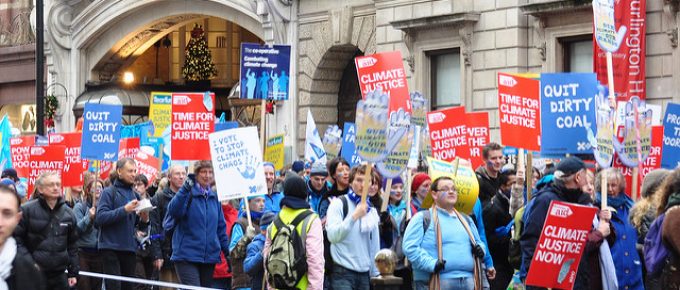
A sign at the Madison, WI protests demonstrates the common language of 2011's uprisings. Photo by OnTask via flickr.com.

A sign at the Madison, WI protests demonstrates the common language of 2011's uprisings. Photo by OnTask via flickr.com.

Beyond the power of example, one can note some astonishing similarity in slogans. In particular, six common themes define the language of all these movements: first, they see themselves as movements against corruption. The system, whether democratic or not, is regarded increasingly as answerable in the final analysis to special, if not secretive, interests, rather than to a popular will. Second, and related to that, there is the notion that the little person is less and less represented in the system, even in a democracy. Third, there is the notion that the protest addresses the interests of “the people” as a whole, or at least 99% or some super-majority, rather than the interests of a specific class (say the working class). Fourth, these movements seem to be suspicious of parties and organizations in the traditional sense, with a clear preference for loose structures, informal networks and resistance to precise or detailed ideologies, as well as to leaders. Fifth, basic to all these movements is a rejection of the “no alternative” claims of ruling elites, who in recent years have appeared to provide populace with only minor variations on the same basic socio-economic blueprint, thus making democracy itself less meaningful as the arena for the production of genuine alternatives. Finally, there is a certain enticing vagueness as to specific demands. This vagueness, while it may make the movements appear less focused, it also makes them more attractive for the purpose of expressing indignation at the system as a whole. This vagueness is tolerated, it seems, partially because it provides these movements with a sense of experimental youthfulness.

[On the other hand] one should [also] be careful here. It would simply be preposterous to compare the Libyan Revolution, with a death toll of probably 60,000, to anything that happens on Wall Street. The same could be said of Syria, where it took almost a year for an originally peaceful to assume features of armed resistance, after confronting relentless and appalling regime violence. The real risk to their very life taken by protesters in Egypt, Yemen, or Bahrain are not easily comparable to anything we see elsewhere.

After probing for commonalities across locations, we asked after commonalities across history. Did our respondents think social uprisings of 2011 would hold world historical-importance comparable to, say, the student movements of 1968 or the European revolutions of 1848? All were cautious.

MK: As any historian will tell you, it’s far too soon to tell.

JJ: Like Michael, I know better than to make predictions like that.

FP: The revolutions in the Arab world will undoubtedly transform those societies, albeit in hard to anticipate ways. At the same time, European anti-austerity demonstrations, the Occupy movement, Chilean education protests, and other protests centered on economic inequality will be seen as expressions of discontent wrought by the global economic crisis. The question, to which I honestly don’t know the answer, is whether the latter mobilizations will also result in substantial government reforms.

Bamyeh agreed that time would tell, but retained hope for the power of creativity inherent in social uprisings.

Photo by Denis Bocquet via flickr.com

Photo by Denis Bocquet via flickr.com

MB: If they aren’t, we are in for a long period of hopelessness, which is likely to be expressed in the political culture by increasing demagoguery and symbolic posturing, and in the culture at large by nihilistic tendencies. But there are reasons for optimism. In the final analysis, what provides a movement with a world historical importance is its world historical creativity. This is what makes it referenced by later generations as an influence to be reckoned with, or as a legend even when it had failed. The failure of the Paris Commune in 1871, for example, did not it diminish its significance for revolutionaries throughout the world for generations afterwards, and many of its own reforms were eventually integrated into the French educational system itself. But in that case, what we call “creativity” occasioned what participants felt as their license to alter social and political relations in ways that had been inconceivable from the point of view of their immediate prehistory. Are we at this stage? Do we feel entitled to such a radical license?

While we were on the subject of creativity, we asked about the mobilization techniques that made the protests of 2011 so visible. Polletta and Jasper drew attention to the role of new communication technologies in these movements.

FP: Activists are using new media to do old things, like coordinating demonstrations and communicating with allies, but also to do new things. In places with state controlled media, activists have used digital media to breach the state’s censorship and to build support both within and outside the country. In China, a new industry of online news outlets has served as a forum for citizens’ exposes of local corruption. As Christoph Steinhardt shows, local protests have forced party officials to discipline provincial authorities, lest the protests spread to the center. In places with a free press but where protest activities usually fly under the radar of news outfits, activists have used cell phone footage of police brutalizing protesters to gain national and international attention for their cause. Interestingly, mainstream media have been eager disseminators of citizen-generated news.

JJ: The media have made a lot of Facebook’s role in Egypt and elsewhere. It seems the latest in a long series of steps that have made communication, and thus mobilization, easier. But opponents usually find ways to counter every innovation, such as shutting down the phone network. The strategic initiative goes back and forth.

FP: One thing I learned is that, in some ways, virtual collective identity—the kind created online—may be more effective in mobilizing than the collective identity forged in church basements and college dorm lounges by people holding hands and singing “We Shall Overcome.” We tend to assume that people develop a stronger bond when they see, hear, and feel one another. Yet, social psychological research has shown that when it comes to some identities, such as nationality, people are more likely to feel a common bond with people they can’t see. Why? Because the less anonymous the people with whom they you are interacting, the more likely you are to be distracted by other things about them, things that make them not like you. So a collective identify forged online may be mobilizing precisely insofar is it is virtual, and therefore partial and even ambiguous. Digital media may make possible an imagined community that is in some ways closer to what supporters want it to be than what it really is.

But for Bamyeh, the highlight of last year’s tactics was the almost old-fashioned occupation of public space, as this tactic offers both time and space for participation and deliberation.

MB: Clearly important are the loose structures, the role of social networks, and declining role of parties, old organizations, and leaders.

Day 21 of the Zucotti Park Occupation. Photo by david_shankbone via flickr.com.

Day 21 of the Zucotti Park Occupation. Photo by david_shankbone via flickr.com.

Occupying public places for an extended and sometimes indefinite period has become symbolically significant, and there appears to be less stress on marches and demonstrations. The occupation tactic gives you a more conversational revolution, one whose aims are discovered in the debating process itself rather than arrived at beforehand. Ordinary participants learn in this case what the revolution should be about, and a range of new concepts quickly become relevant in the street: without prior schooling, for example, one may learn about liberalism, socialism, representation, or more significantly, how such abstractions may be interpreted in terms of one’s own life history and social experience.

For his part, Kazin emphasized continuity over rupture or innovation:

MK: Obviously, the uprisings of 2011 used “social” cybermedia more than any previous, comparable insurgencies. But I am not (yet) convinced that such forms of communication have rendered obsolete what Charles Tilly called the “repertoire” of protest initiated two centuries ago. Big street demonstrations, stirring rhetoric (even if transmitted via mobile phone), and demands agreed to by assemblies of activists—these go back to the beginnings of modern social movements and continue to be necessary for mobilizing large numbers of people today.

As academics work furiously to write papers and commentary on the protests, we wondered how social scientists hoped to meet the challenge of interpretation. Jasper contended that the protests confirmed and advanced theory production “already under way.”

JJ: Scholars have mostly responded emotionally. These protests make us feel good, excited, and optimistic. If they advance our theories, I would guess that it will be by encouraging trends already under way: more focus on individuals, such as Bouazizi; better understanding of how violent repression can sometimes stimulate protest rather than always dampening it; and generally more attention to the micro-level mechanisms (emotions, decisions, interactions) that comprise politics.

Bamyeh saw a bigger challenge to theory production, especially in its capacity to account for the spontaneous and the unexpected:

MB: In the middle of the revolution in Cairo, I felt that a lot of social science was anti-human, driven by an impulse to substitute all humanity with mechanical models that stand in for it. The problem is that much of social science is dominated by an orientation to structures and determinations, and sees no point in exploring dimensions of human creativity and agency that cannot be easily contained in such structures. It sees no humans facing complex choices and experimenting with creative spontaneous solutions. But it is precisely these dimensions of creativity that give us the greatest movements in history, producing innovation precisely where it was least expected. The best social science, I think, is one that enjoys surprises, including failures of prediction. So I learned to appreciate the complexity of ordinary humans, and now find it imperative to describe as best as I could the details of this story, and in doing so think about it at both the micro and macro levels simultaneously, without privileging one or the other, and explore local and global facets, again without assuming that one is more important than the other.

I do not think that we should be too quick to theorize about these movements without paying attention to what they actually say, nor assume that we can just easily “translate” their common slogans into some abstraction that we like them to be against. Rather, theorizing should focus on taking seriously the concrete distress and felt insults that move people into the streets by the millions.

Our roundtable would not be complete without asking for predictions about the future, including prospects for the protests and suppression of dissent. Jasper emphasized how new technologies and techniques empower both the protestors and the police.

Illustration by phloatingman via flickr.com

Illustration by phloatingman via flickr.com.

JJ: American police have learned techniques for corralling participants into uncomfortable spots, but these have not spread globally. On the other hand, protestors have learned to videotape unpleasant encounters with the police. The more of these you make, the more likely you are to capture an instance that will make the news—the best example being the University of California Davis policeman pepper spraying protestors.

Kazin maintained that the “fate” of the protests still depended on national power structures.

MK: Despite all the talk about a globalized market, media, and politics, the fate of each of these uprisings depends, and is likely to continue to depend, on the particularities of the political culture and history of each nation-state in which a particular uprising occurred. Compare, for example, the democratic triumph of Islamist parties in Egypt with the fragmentation of the Occupy movement in the United States (and, perhaps, in Britain too). The Islamists worked for decades under dictatorship to prepare for their day in the sun; but most Occupiers were fairly new to activism, and they live in a nation with a long, uninterrupted history of democratic elections, however cynical they might be about the limits of the policies that elected officials enact.

While Polletta remarked that suppression could travel as much as protest does, Bamyeh closed by reminding us of the possibility of co-optation.

FP: All the things that students of revolution have seen as important in accounting for revolutionary trajectories—the configuration and strength of opposition groups, who controls the military, the independence of the judiciary, the role of foreign allies—surely will play a role in how the uprisings play out in those countries. More generally, we know that challengers’ innovations are studied and responded to by authorities in a kind of battle of tactical innovation. Today we see authorities in one country responding to events in other countries, trying to prevent the spread of revolutionary fervor. The Chinese government imprisoned scores of activists and shut down Internet access. Zimbabwe arrested six activists for watching video footage of the Arab protests. The Russian media bombarded its citizenry with messages about the chaos created by the Arab revolts—with the clear implication that anti-Putin protests in Russia would wreak the same havoc. Activists in Israel and Iran were suppressed. The result, according to the most recent Freedom House report, is that by the end of 2011 more countries registered declines in political liberties than the year before. Are these the defensive reactions of authoritarian regimes in jeopardy? Or do they signal further repression? It’s unclear. I’m also wary of calling this an organized global reaction to the global uprising. Just as protesters in Boston drew inspiration and ideas from protesters in Madrid, Santiago, and Cairo, so authorities are undoubtedly paying attention to what works and what doesn’t in quelling protest in other cities and countries.

MB: It is to be expected that ruling interests seek whenever they can to co-opt revolutions and all protest movements. In those Arab countries where the revolutionary situation was less developed, we saw the beginning of unprecedented (though hardly radical) reform process from the top. In the U.S., the Occupy Movement’s general aims are claimed as well by various prominent politicians. Yet, there is not yet a vigorous global counter-revolution or counter-reaction, except perhaps in the case of Russia, whose government has sought to undermine the Arab spring and where there is a real battle concerning the future of Putin and, along with him, the Russian experiment with democracy as a whole. Elsewhere governments face the problem of dealing with either a widespread perception of a deep-seated politico-economic corruption, as in the U.S., or absence of choice about austerity and related policies, as in Europe, and the insufficiently representative nature of political systems nearly everywhere. The latter will only become more acute given the global and thus impersonal nature of various large crises, which could only be tolerated if we have a global democracy. But we do not. So if these protests finally encourage us to reflect seriously on the most glaring absence in the world, namely the absence of a global democracy, then they would have already ushered in a world-historical project.

Sinan Erensu, Kyle Green, Sarah Lageson, and Stephen Suh are sociology graduate students at the University of Minnesota. They are all members of The Society Pages’ graduate editorial board.

For further information, our readers might turn to the interdisciplinary website Mobilizing Ideas, based in the The Center for the Study of Social Movements at the University of Notre Dame.

Linsanity and the Model Minority Myth

Carrington
Ben Carrington is in the department of sociology at the University of Texas at Austin. He studies the media, popular culture, and sport, as well as race, ethnicity, and culture.
Rosalind Chou
Rosalind S. Chou is in the sociology department at Georgia State University. She is the author, with Joe R. Feagin, of The Myth of the Model Minority: Asian Americans Facing Racism.
C.N. Le
C.N. Le is in the department of sociology at the University of Massachusetts, Amherst. He writes for The Color Line, a TSP Community Page, and is the author of Asian American Assimilation: Ethnicit, Immigration, and Socioeconomic Attainment.

In February, New York Knicks point guard Jeremy Lin seemingly came out of nowhere to propel the struggling Knicks to seven straight victories. Suddenly, the Knicks were relevant again and “Linsanity” was in full force. Drafted in 2010, Lin is the first Taiwanese American to play in the NBA and the first Harvard graduate to do so since the 1950s.

Now, just a few months removed from this improbable craze, Jeremy Lin has all but disappeared from the public radar; he will likely miss the remainder of the NBA season with an injury. We rounded up three leading scholars on race and sports to reflect upon Jeremy Lin’s stint as a media sensation.

First, we asked the simple question: why all the fuss about Jeremy Lin? Rosalind Chou answers:

RC: He’s surprising people because he doesn’t meet the stereotypes of Asian American men. His popularity among Asians and Asian Americans who aren’t fans of the NBA has something to do with pride and, in some ways, relief. Pride in the fact that someone of Asian descent has broken racial barriers and is disrupting the hegemonic masculine hierarchy.

The relief is based on the fact that, finally, there is a public Asian American male figure that gets to retain his manhood. The way masculinity is constructed for men in sports organizations like the NBA and NFL are contrary to the stereotypes of Asian and Asian American men. So, in the case of professional tennis player Michael Chang, while he was a successful, top athlete, his success didn’t break racial stereotypes because tennis players aren’t constructed as “manly” or “tough” as professional football and basketball players typically are. The NFL and NBA are exclusive male spaces for the biggest, strongest, men in the country, or even the world. So the media has been running with the Lin story because it seems so impossible and improbable.

A 1996 Discover Card ad featuring tennis phenom Michael Chang

C.N. Le explains how some positive stereotypes about Asian Americans—often called the Model Minority image—has negative implications for Asian American athletes:

CNL: The model minority image has basically framed Asian Americans as being very good at certain things such as math, science, and educational attainment in general, but has also limited Americans’ views of what Asian Americans can do outside of those “traditional” areas. In other words, Asian Americans can win a Nobel Prize but still struggle to be taken seriously as political leaders or in Jeremy’s case, as professional athletes.

RC: Lin’s “model minority” status has also been played up with emphasis on his Ivy League pedigree. He’s been called a “smart player” and “student of the game.” Colorblind language has been used to emphasis how “clean cut” he is compared to “tattooed” or “thuggish” other players (implicating black and Latino athletes). I think these media articulations of his race are very much in line with how Asians and Asian Americans are traditionally racialized in the US, with the exception of the emphasis on his devout Christianity. I think in some ways the discussion around his religion “normalizes” and makes him relatable to other Americans.

It’s very similar to the Susan Boyle phenomenon on Britain’s Got Talent. Someone who looked like her couldn’t possibly sing like an angel. Someone that looks like Jeremy Lin couldn’t possibly be a talented basketball player because it doesn’t meet the racialized ideology embedded into our society.

Ben Carrington frames the success of Jeremy Lin’s story in terms of American ideals about sports and meritocracy:

BC: It’s undoubtedly the case that the Lin story directly taps into a number of powerful American myths concerning hard work, social mobility and perseverance: the belief that Lin succeeded “against the odds” and that his religious convictions as a devout Christian gave him the faith in his own abilities to keep pursuing his dream of a professional basketball career. Such a story line, that was successfully spun by the sports-media complex, has resonance way beyond the NBA, and in part helps to explain the level of attention he has attracted.

Sports are one of the few arenas in life where people – both sports fans and those who don’t follow sports – are most likely to believe that a meritocracy actually exists, that the best player always gets picked to play and comes first, and that hard work and dedication pay off in the end. People tend to have an idealized notion of sports as free from politics and discrimination thus often there’s an over-investment in what we might call The Myth of Sport as this meritocratic arena. Now, given that basketball, at least in the US, is racially coded as an “urban sport”, played predominately by black, working-class male youth, Lin’s presumed atypicality gives the story an extra “edge”, provides a reversal of sorts, a novelty factor that serves to both reaffirm The Myth of Sport and allow for a series of not always informed discussions about race, difference and identity to take place.

And, of course, he’s playing in New York, not in Utah, so the potential media interest in a story involving a Knicks’ player will be greater. Thus, given all these factors, plus perhaps the desire for a “feel good” sports story in place of the usual drugs, corruption and cheating scandals, the Lin story hit at just the right time.

Amidst the media coverage of “Linsanity,” several incidents brought Lin’s race to the fore. For instance, after the Knicks’ first post-Linsanity loss, ESPN ran a story with the headline “A Chink in the Armor.” C.N. Le comments on this episode and media coverage of Lin:

ESPN Screenshot

ESPN.com's controversial headline captured in a screenshot by Myles Brown

CNL: To the extent that his race is mentioned, I think the mainstream media has treated him and his racial identity well. But in most cases, keeping with the prevailing “colorblind” mentality that most Americans (particularly White Americans) have, I think people generally are reluctant to talk about his race and probably feel that it’s “safer” to focus instead on his basketball performance. Unfortunately, it’s also this colorblind mentality and unwillingness to talk about race that leads to racial ignorance. This was exemplified in the ESPN “chink in the armor” episode and how those involved either had no idea or did not care that that particular phrase was offensive when used in reference to Asian Americans. To ESPN’s credit, they reacted quickly and decisively in firing and suspending the employees who used that term (I wrote more about this in a blog post.

Controversy also ensued after boxer Floyd Mayweather claimed “Jeremy Lin is a good player but all the hype is because he’s Asian. Black players do what he does every night and don’t get the same praise.” Carrington points out that Lin’s race has cut both ways: increasing positive attention now, but also in being responsible for decades of discrimination:

BC: Floyd Mayweather was of course right, in the narrow sense, when he suggested that while Jeremy Lin was a good player the “hype” around him was largely due to his Asian identity. Race has been central to the coverage. In the US there is no popular notion of “the Asian athlete”. Prior to this year whenever I would ask my students to name a significant and well known Asian American athlete, their answers, after a long pause, would be Yao Ming, “that female golfer”, and sometimes Michael Chang. Well Ming is obviously Chinese and no longer plays in the NBA, the fact that most students can’t even name Michelle Wie is instructive, and Chang retired from top-level tennis nearly a decade ago.

It is also apparent, although the media and the pundits have had a hard time acknowledging this, that the primary reason why Lin was overlooked for so long—when he was a stand-out high school player but was not picked up by any of the major basketball powerhouses at the college level, when he was outstanding at Harvard and yet still not drafted, when he outplayed NBA draft picks in the summer leagues and still didn’t get a professional contract commensurate with his talents, when he was cut by teams after getting limited playing time (and remember he was weeks from getting cut by the Knicks too)—is the fact that he’s Asian. The racial lens through which we read, judge and assess human potential meant that all of these great coaches and scouts and General Managers couldn’t see past Lin’s race, which coded him as anything but a professional ball player.

As my UT Austin colleague Eric Tang puts it, stereotypes regarding Asian American identity produced a kind of blindness that kept Lin “hidden in plain sight.” When people say that Lin “came out of nowhere,” they talk as if he suddenly walked into Madison Square Garden off the streets of Manhattan! Lin didn’t come out of nowhere. He was there the whole time. Playing brilliant basketball. It was the power of race, or more precisely racism, in structuring how we see, what we see and how we make sense of what we see, that led him to be overlooked for so long, until he seized upon his likely final chance to show his talents and he performed to such a high level that his abilities were finally recognized.

Finally, we asked our roundtable participants to predict the long-term impact of “Linsanity”:

SBNation Screenshot Bal-Lin

Spike Lee shows his Linsanity at the NBA All-Star weekend in this TNT screenshot from SBNation.com

BC: We simply don’t know. One of the interesting aspects about sports is that (for the most part), we don’t even know how a particular match will end, let alone a professional sports career that has barely started. Lin has already been injured this season and is unlikely to play again. Lin is clearly a very good basketball player, and potentially a great player. But he may also end up being an average player, an injury-prone player, or someone who, like hundreds of others, gets cut and disappears from the public view in a year or two.

I also don’t think we are at a historical moment where we’re about to witness the creation of “the Asian American athlete” like we saw just over a hundred years ago when Jack Johnson became the first black heavyweight boxing champion of the world and who ushered into popular consciousness the idea of “the black athlete.” Lin will probably be defined as the exception. Racial ideology was always been able to accommodate exceptions and contradictions. The crude forms of anti-Asian American racism and stereotyping that have come to the fore in the past few months helps us to see how the simplistic notion that sports dissolve questions of race and racial difference and that we are in a post-racial era is just that, simplistic.

Le and Chou, however, were optimistic that Jeremy Lin’s success could inspire challenges to stereotypes:

CNL: As time passes, Lin’s success and prospects for continued success, perhaps ironically, will hopefully be less and less of a big deal. In other words, hopefully his success is a meaningful step toward the ultimate goal of colorblindness—when people will see Asian Americans succeeding in professional sports as “normal” just as it is seen for white Americans and African Americans.

RC: Jeremy Lin redefines what it means to be an Asian man in the United States. He breaks down racialized stereotypes about Asian American men, about their masculinity, their bodies, about their sexuality, and he provides a role model for any Asian boys or men that have ever been bullied or taunted about their manhood… When I was young, a teacher told me that people who looked like me “were not athletes.” I refused to believe him. Jeremy Lin refused to believe all the people who overlooked him or ignored him… The United States still has problems with racial inequality and racism, but I also believe that we are continuing to progress. My hope is that future generations will see many more stories like Jeremy Lin’s, in which racial stereotypes are being dismantled and discarded, even if just briefly.

Stephen Suh and Kyle Green are graduate students in sociology at the University of Minnesota. They are members of The Society Pages’ graduate student board.

Laughter and the Political Landscape

R. Lance Holbert
R. Lance Holbert is in the The Ohio State University's School of Communications. He is the author (with Maxwell McCombs, Spiro Kiousus, and Wayne Wanta) of The News & Public Opinion: Media Effects on the Elements of Civic Life.
Heather LaMarre
Heather LaMarre is an Assistant Professor in the University of Minnesota's School of Journalism and Mass Communication and is an affiliate of the Center for the Study of Political Psychology. She studies how and why social and entertainment media are changing public relations, politics, and news.
Kristen Landreville
Kristen Landreville is in the department of communication and journalism at the University of Wyoming. She studies the intersection of mass and interpersonal communication on political and social outcomes.
Don Waisanan
Don Waisanen is in the department of communication in the Baruch College School of Public Affairs. He is a former journalist and political speechwriter, and he is a contributor to the TSP Community Page ThickCulture.
Bruce Williams
Bruce Williams is in media studies at the University of Virginia. He is the author (with Michael Delli Carpini) of After Broadcast News: Media Regimes, Democracy, and the New Information Environment.
Dannagal Young
Dannagal Young is in the communications department at the University of Delaware. She is the founder of Breaking Boundaries, an online forum for the interdisciplinary study of politics and entertainment.

Making fun of politicians is a fundamental part of American culture—particularly as we race toward each major election. As this group of scholars points out, political humor is unique in its ability humanize and criticize, while also creating serious political and social commentary through satire, standup, and other comedic forms. Social science helps untangle the meanings and effects of American political humor.

What are the dominant forms and persistent themes of political humor?

Kristen Landreville: Popular venues for political humor today include late-night comedy shows and satirical websites. While oftentimes the humor focuses on more trivial matters, such as a politician’s appearance or personality, political humor also has a serious side that sometimes provides serious political, social, or economic commentary. It is this type of political humor that politicians, institutions, and authority figures over the centuries have feared the most. For example, satire… can make politicians nervous because of [its] attacks on their character, policy, or even larger issues like the electoral system. …The cogs start spinning in people’s minds, and, soon enough, people begin to deeply question a particular politician, authority figure, or group.

History shows us that politicians have been persistently cautious, and sometimes hostile, to political humor and satire. Plato saw satire as a type of magic that needed legal penalties. In early Rome, emperors banned satire and employed a punishment of death to satirists. British authority also banned it during the Middle Ages. You get the point: it’s tough to be an authority figure and love political satire.

Don Waisanen: I think the label “humor” can often gloss over an incredibly rich diversity of comedic forms. For instance, some political humor is based upon exaggerating characters, imitating an individual’s physical tics, quirky mannerisms, or unreflective slogans—such as Stephen Colbert’s parody of combative media figures. On the other hand, comedians like Jon Stewart are more satirical …primarily attacking substance rather than style. …[A] as soon as a statement might be made about dominant types of humor, we find examples of evasive and evolving comedy that defy traditional categories. Some comics now even create humor through a type of paradoxical “anti-comedy.” Fred Armisen’s bad political comedian character on Saturday Night Live is one such example.

Bruce Williams: [W]e live in a world now where professional journalists speaking through newspapers and network news broadcasts have lost a lot of their authority to shape the kind of language and narrative of politics in the United States. Now …political information is coming at us through a bewildering number of conduits [and] individuals are much more able to shape the kind of media diet they consume…. That’s a very different situation than by the end of the 1980s, when 8 out of every 10 television sets that were turned on were watching one of the three nightly news broadcasts, not because people were more committed or were better citizens then, but because it was the only thing on!

Image by Edalisse Hirst via flickr.com

Image by Edalisse Hirst via flickr.com

…Jon Stewart has to attract and keep his audience every single night. …[O]ne of the concepts that I am most skeptical about is the idea that there somehow is a sharp distinction between news and entertainment or between serious stuff and stuff that’s less serious or fluffy. …[H]umor…is just one of the ways in which, in a fragmented market, providers of information or people who want to comment on the political world can attract and maintain an audience. …[T]he context is different even if the kinds of humor that get deployed are not that different.

What are the limits to what’s “appropriate” to joke about in politics?

Robert (Lance) Holbert: There are some classic rules that apply to joke telling in general which are also applicable to politics. For example, there are certain political events which require some time or emotional distance before humorous perspectives can be offered about them. This issue was made salient after the 9/11 tragedies. This issue is a classic one concerning the tragedy-comedy dichotomy—when can we make the switch from tragedy to comedy?

As for satire, this question speaks to the issue of effectiveness. When will a piece of satire be well received and deemed to have possible influence on a public? One perspective offered on this matter argues that there needs to be an implicit agreement between the satirist and the satiree (i.e., the audience member consuming the satire) that the subject of the satirical material (i.e., the satirized) is worthy of satirization. Two questions are usually raised when judging worthiness: (a) Has the person being satirized made choices which have led them to being a public figure?; (b) Is the characteristic of the person being satirized a genuine example of human folly/weakness? If you can answer in the affirmative on both counts, then the object is worthy of possible satirization. So, there can be a satirical piece about President Obama and how he often thinks very highly of his intellectual abilities (i.e., hubris as human weakness). However, a piece of satire about the President’s daughters, who have not chosen to be public figures, and their academic performance would be deemed off limits for a majority of the American public.

Kristin: The limits are perpetually being tested and re-drawn. Comedians and satirists push the limits of commentary on religion, race, capitalism, gender identity, sexual affiliation, the political system, stereotypes, and a myriad of other topics that parents typically teach their children not to discuss around polite company. However, the extent to which limits are pushed depends largely on the media outlet. While television broadcasters and cable networks have to obey Federal Communication Commission laws on obscenity and indecency, print outlets and websites such as The Onion do not have such heavy restrictions. No matter what media outlet the humor is showcased, I believe that calls for violence, bigotry, and xenophobia are less tolerated as humorous. For example, The New Yorker magazine learned that not all satire is perceived the same way. Recall its July 2008 cover of Barack Obama dressed as a Muslim and Michelle Obama dressed as a terrorist, with a photo of Osama bin Laden in the background and a burning American flag in the fireplace. [M]any people thought the satire went too far and reinforced stereotypes…. This example tells us that there are limits to certain groups’ tolerance of satire.

Don: Mark Katz, President Clinton’s humor writer (yes, this was an official position!), said that in politics, you “can do jokes about the smoke and not the fire. We can do jokes about the hoopla of impeachment, but not what brought us to the brink of impeachment.” I also once read The Daily Show correspondent Mo Rocca’s comments that during the Iraq War, “since we couldn’t make fun of the events themselves, we could make fun of some of the coverage of the events.” While perhaps not holding true in every situation, these comments generally tell us that there are serious limitations to humor itself—primarily that it’s only one… mode of communicating among many other choices that might be made. Of course, any effort to curtail what is or is not appropriate in comic discourses should also be seen as suspect, as comedians are some of our best critics and free speech advocates, providing alternative interpretations and attitudes about public events when sorely needed.

Heather LaMarre: [O]ne of the comedian’s roles is to test limits. And right now we have that going on with Colbert’s SuperPAC, this would be a perfect example of limit-testing. Never before can I think of that, in a time when a piece of satire was taken outside the comedic… form. And he has now created satirical PSAs, he’s raising real money, real people are actually contributing their real dollars to this satirical SuperPAC. …[Colbert is] forcing the media to pay attention because he’s moving outside his late night show.

Bruce: [F]or all its faults, the rules of professional journalism are very explicit…. It is a profession, people are trained how to do it. …When we get to comedy as an increasingly influential way in which citizens understand the political world, then… I get a little queasy, because I think the rules are very unclear about what someone like Jon Stewart is doing and what he’s not doing… I don’t think we have a good way of thinking about “What is their responsibility? What is it okay to talk about and how is it okay to talk about it?”

Has humor always played a key role in politics?

Lance: There is a long history of political leaders calling for satirists to be jailed, excommunicated, or censored. …I would argue that the jury is still out on the degree and nature of satire’s influence. There is much more work to be done at a wide range of levels of analysis before we can offer any valid or reliable conclusions in relation to this empirical question.

Dannagal Young: Humor has always played an important role in political life. In fact, satirists like Aristophanes writing in Ancient Greece used rich political satire and irony to expose hypocrisy and flaws among elites and within policies and institutions. What we see now is a media environment in which the former division between entertainment and information has become obsolete, hence we tend to think of political humor as a “new” thing. …In reality, humor has always had a very natural place in politics, particularly in democratic regimes where elected officials are accountable for their actions and citizens look at them with a critical eye.

Don: Humor has probably played a role in just about every election and political circumstance. While we can look back to ancient figures such as Cicero for advice on how wit can be used in the political realm, I would argue humor’s centrality to the political process has less to do with politics and more to do with how humor is found in every human society. What might be found humorous in one society or culture often differs from another, but I think one would be hard pressed to find a situation where humor was not involved to some extent. Even when humor is not a part of “official” public discourse, humor is a regular part of group communication and is thus as much a part of “unofficial” interpersonal communication and backroom, informal political conversations as anything else.

Bruce:I think that humor has always played a part in American elections and politics, but we notice it more at

Thomas Nast cartoon lampooning Andrew Jackson, 1866

Thomas Nast cartoon lampooning Andrew Jackson, 1866

some points than others… [I]f you go back to the earliest days of the American republic… a lot of the campaign arguments were made in political cartoons. I show my class cartoons that were aimed at Thomas Jefferson, that pointed to his supposed loyalty to France, um, you know, there were no mentions of “freedom fries” at that point, but, the idea that he was more loyal to France was brought out in cartoons. There were allusions to his relationship with Sally Hemmings in the newspapers of the time; there was the kind of, you know, satirical character assassination that we take for granted today. Also, if you think about the late 19th century and the political cartoons of Thomas Nast… they were effective in reaching the audience he wanted.

What are the effects of humorous media?

Lance: Political satire programming attracts a highly knowledgeable audience (you need to know a thing or two about politics if you are going to get the jokes), so does political satire generate humor or are those individuals who are already knowledgeable about politics selectively exposing themselves to this material? It is most likely a bit of both.

As for attitudes and behaviors, there is no question… political entertainment media can impact an audience member’s attitudes…. However, questions still remain concerning how long lasting these effects are, how well they stand up to counter-persuasion, and whether insights generated from satire can impact how other pieces of political information (e.g., from news) are processed cognitively. On the behavioral front, there has been work done on how political entertainment media exposure can generate political discussion. Someone sees something funny about a political topic and then discusses it with others, or a piece of political humor is not fully understood by an audience member and they talk to friends or family members about it in order to gain some clarification about the message’s meaning.

Kristin: [C]onflicting findings… suggest that political humor and satire are much more nuanced than researchers once believed. Humor and satire can be complicated messages that demand quite a bit of cognitive energy for people to decode, or humor and satire can be fairly simple messages that people disregard and do not pay much attention to. Both ways of processing these messages (critically and uncritically) can lead to different effects…. Thus, it is very difficult to summarize effects of such a diverse and complicated genre. However, there have been links [found between] late-night comedy viewing to increased presidential debate viewing for young people… [and] to increased traditional media use for political information. These studies are evidence for a democratizing effect of late-night comedy. Other studies have found increased cynicism for politicians after exposure to late-night comedy and a lack of information acquisition and memory… It’s complicated.

Dannagal: Literature to date has demonstrated nuanced effects of political humor… For instance, exposure to political humor programming, particularly among those people who are not politically engaged, can spark an interest and attention to politics, leading to information-seeking. ..In addition, Political humor has been found to increase the “salience” of issues and concepts that rest at the heart of political jokes. This means that people who frequently watch late-night comedy jokes about a political candidate for being boring, unintelligent, or dishonest will be more likely to have that trait come to mind when they think of that particular candidate in the future. We know that people who report watching shows like The Daily Show are more politically interested in general, more politically knowledgeable, more participatory in political life, and more likely to discuss politics with friends and family than people who do not watch such programming. While these are merely correlational findings, they do suggest that there is a unique audience of young, politically savvy people who are tuning into these shows.

In terms of the subtle cognitive implications of political humor, one of the reasons that political humor has received so much attention from scholars [is that] humor seems to hold a certain persuasive capacity that other forms of discourse do not. Recent work has… [found] that humor is actually less likely to foster the kind of “counter-argumentation” or “argument scrutiny” that serious discourse usually receives. …–[P]eople just do not scrutinize arguments received through humor to the extent that they do when [it’s] presented seriously.

Heather: [I]t’s long been thought that the effect was limited because people used it in a cathartic way: they laughed at the comedian and then they went home and went about their business. And it’s only in, probably since the 80s, that we started doing effects research, looking at what happens after they leave the play or they leave the standup comedy club or they turn the TV off and go about their lives daily.

In that area, we are starting to understand a couple of basic things. One is message receptivity. People have their guard down… so they’re more open and receptive to messages [than] maybe otherwise… [humor] sort of disarms them…. There’s a gateway hypothesis… that entertainment brings in, the “politically uninterested”—especially young people, and that leads to more information-seeking, participatory behavior, voting.

Bruce: First, I think that, I think that The Daily Show and The Colbert Report, for their audience, do the same thing that the nightly network news broadcasts used to do… The Daily Show… provides, in 30 minutes (less commercials)… a way of thinking about what’s happened [and] the media that delivered that information to you. And how are you going to do that in a way where people can just change the channel any time they want?

Well, I think humor is a real… a very effective way of doing that. …[W]e trust Jon Stewart, just like we trusted Walter Cronkite, and I think that part of that trust for Jon Stewart is the idea that you know who he is. You know that he is gonna make fun of things, but he’s not gonna make stuff up. That he’s going to be scrupulous about the kind of facts that he introduces. …I think we’re gonna see what happens in 2012. We’re gonna see where the youth vote goes. We’re gonna see whether new media mobilizes people [and how it’s] gonna affect mobilization and participation [over] the next couple of elections.

Does humor help people engage in politics create apathy toward the process?

Lance: Researchers who are critical of various types of political entertainment argue that it makes a skeptical citizenry (i.e., a democratic good) into a cynical citizenry (i.e., a democratic evil). There is some empirical evidence to support this claim, but it is also the case that those who are more cynical about politics naturally gravitate to this material as well (once again, an issue of selective exposure). With this being stated, there are a host of potentially positive effects which have been linked to various types of political entertainment media outlets. Empirical studies have shown that certain political entertainment messages can generate critical thinking on political issues, create greater breadth and depth of attitudinal structures, and (at least indirectly) increase political behaviors like giving money to political causes, talking about politics, or watching political debates.

Heather: We’ve answered the question of whether it engages audiences, we know that. But engages them how and to what end? We’re not sure. In some cases, we find they learn more about the issues. In other cases, we find they don’t understand the sarcasm or satire, and so they come away misinformed. In a lot of cases, we find evidence that, because comedians… cherry-pick segments and then use them to an exaggerated point to make it funny, sometimes audiences don’t understand that it was exaggerated.

Is political humor just for liberals?

Kristen: Political humor and especially satire is about deconstructing politics, politicians, policy, institutions, and authority. This deconstruction often involves questioning, mocking, and criticizing the status quo, the traditions, and the standards. From mocking a politician’s expensive haircut to mocking the hypocritical politician who employs illegal residents yet rails against immigration, humorists are making statements about society. Perhaps liberals are more attracted to satire and humor that exposes the hypocrisy of traditions and traditional society because part of being liberal is being progressive and deconstructive of restrictive societal norms. However, conservatives are certainly attracted to satire and humor that exposes the hypocrisy of liberalism and progressive society. That is probably why some conservatives watch The Daily Show and The Colbert Report and view it as interesting and insightful comedy on liberals—these shows do not hold back on criticizing anyone. In the end, I think all shades of political red, blue, and purple benefit from political humor.

Don: This issue is far more complicated than it might appear. Certainly, comedians like Jon Stewart have tended to embrace a leftist political perspective, while in recent years, others like Dennis Miller have leveraged their comic credentials toward conservative political causes. …But I think a more important consideration is to move beyond thinking about in this issue in terms of people or political worldviews, asking instead what kind of radical or conservative perspective might be invited by any particular act of political humor. That is, how much does any comic act, like a particular joke, invite its audiences to think of their worlds in ways that maintain or interrogate the status quo? In a single HBO stand-up special by someone like Chris Rock, for example, I think we can note ways that some jokes both embrace and perpetuate racial and ethnic stereotypes as much as other jokes invite us to think critically about them. As such, the politics of comedy is probably best described and evaluated as close to each text and context as possible.

Finally, what happens when politicians try to be funny?

Lance: It depends on the type of humor. There are certain politicians who have comedic timing. President Obama is one …Former Governor Mike Huckabee of Arkansas is another recent politico who comes to mind…. When they have [comedic skill], they can use it to connect to an audience. However, if the presentation of humorous material appears forced, then, just as at dinner parties, people seek other company really quick.

A special case of humor often used by politicians is self-deprecation. Senator John McCain is a classic example of someone who uses self-deprecation well [as was] Vice-President Albert Gore, Jr. in the latter years of the Clinton presidency. …Politicians as elites are always looking for ways to appear more common, and self-deprecation is one way to go about achieving this goal. However, …self-deprecation is effective only when the focus of the deprecation is perceived to be a true personal weakness/character flaw. For example, former President Bill Clinton may make fun of his famous temper, [but] if the politician pokes fun at a personal characteristic that many perceive to be an actual positive trait, then the act of self-deprecation could be seen by many as a tawdry attempt to receive praise. Such acts of praise seeking are never well received by the general public.

Self-deprecation can also be used for image repair. A recent example would be Governor Rick Perry who ran a series of television advertisements leading up to the Iowa caucuses where he pokes fun at himself for not being the best debater… the most effective strategic communication decision his campaign could make was to acknowledge the personal weakness and make light of it in some way in these advertisements.

Kristen: It is risky business. When politicians attempt to correct a perceived failure, such as Rick Perry’s “oops” moment in a Republican presidential debate, and use humor to do so… they could be making themselves more down-to-earth and carefree, but they could also be bringing more attention to a negative event…. Also, if the attempt at humor is awkward and uncomfortable, then the politician will be portrayed as stiff, unlikeable, and elitist. Clearly, playing with humor is like playing with fire for politicians.

Don: To an extent, humor always both unites and divides audiences. When politicians try to be funny, they can unite one audience while dividing another. Ronald Reagan was known for his humor, but it’s easy to see how a quip like “The nine most terrifying words in the English language are: ‘I’m from the government and I’m here to help’” could reinforce one audience’s belief that the government was a problem, as much as it confirmed for another that the President’s beliefs were a problem. Some humor can unite more than divide, but in so doing, may run the risk of losing its critical edge. Think Jay Leno versus Jon Stewart. Leno plays his humor relatively safe and maintains a mainstream, large audience, while Stewart plays to a smaller cable audience with humor that is more divisive and critical. This is the tough tightrope that politicians themselves walk when attempting to use humor.

Bruce: [W]ho was it that has on their tombstone something like “Dying is easy, comedy is hard”? Comedy is really hard. And some people can do it, and some people can’t… you have to have a certain amount of being relaxed enough and comfortable in—at least seeming to be comfortable in—your own skin to make jokes. …[O]ne of the ways that comedy can often help politicians [is in] humaniz[ing] them. Nixon, as uncomfortable as he looked saying “Sock it to me!” there was something about his willingness to do that.

…[O]ften, when it comes to celebrity—and politicians are celebrities—is we have this desire to get to know who they really are, as if we can kind of puncture somehow the public image that they show us. And often humor is used or seems to be a way to get past that public mask.

Heather: I think it depends on when you use it and do it. President Obama sent Betty White a Happy Birthday message [recently], and he cracked a joke about wanting to see her birth certificate. And I, myself, found that hysterical! …[E]ven the leader of the free world can tell a joke. I think the big question is going to be …whether people under 30 are… developing a sense of humor about politics that’s good for democracy or a disgust about politics that’s bad for democracy. That remains to be seen!

Authors Sarah LagesonSinan Erensu, and Kyle Green, are graduate students in sociology at the University of Minnesota.

Social Scientists Studying Social Movements

Jeffrey Alexander
Jeffrey Alexander is in the department of sociology at Yale University. He is the author of Performative Revolution in Egypt: An Essay in Cultural Power.
Neal Caren
Neal Caren is a sociologist at the University of North Carolina at Chapel Hill. His forthcoming American Sociological Review article with Raj Andrew Ghoshal and Vanesa Ribas is titled "A Social Movement Generation."
Nathan_Clough
Nathan Clough is a geographer at the University of Minnesota Duluth. His work concerns the relationship of resistance and contestation to social control and political power, especially in the context of American social movements, policing and security, and public space.
Myra Marx Ferree
Myra Marx Ferree is in the department of sociology and directs the Center for German and European Studies at the University of Wisconsin, where she is also a member of the gender and women’s studies department. She is the author of Varieties of Feminism: German Gender Politics in Global Perspective.
sarah-gaby
Sarah Gaby is a PhD candidate in sociology studying social movements at the University of North Carolina at Chapel Hill.
4654
David S. Meyer is in the departments of sociology, political science, and planning, policy, and design at the University of California Irvine. He blogs at politicsoutdoors.com and is the author of The Politics of Protest: Social Movements in America.

Eds. Note: This is the first of many Roundtable installments to come—a wide-ranging attempt to look at a topic through many different sociological lenses. Soon, we’ll be taking on politics and humor and how sociologists and political scientists each have a different idea of just what polling is and does. Enjoy!

A Minnesotan by the name of Bob Dylan once sang “the times they are a changin’.” It was the ‘60s then, but with the rise of the Tea Party, ”The Arab Spring,” the Wisconsin state house standoff, and the global spread of the Occupy Movement, Dylan’s lyrics seem just as fresh in 2012. In this, our first Round Table, we turn to a number of scholars (sociologists along with a political scientist and a geographer) who have spent time studying social movements to get a better sense of conducting their research and the difficult decisions they make during the process. We sought scholars who have not only produced excellent work, but who also represent a variety of methodological approaches—historical, theoretical, ethnographic, and quantitative—and we hope you find their insights as fascinating as we do. 

Briefly describe your study and what drew you to this topic?

Myra Marx Ferree: I’ve looked at various feminist organizing practices and organizations in the U.S., Germany, and Russia. I’ll focus on the German cases, since many of the methods issues of studying movements come to the fore. I actually got involved in studying German feminists when I was teaching for a semester in Frankfurt and had feminist students in my class—their comments made clear that my assumptions about how “feminism” operated were based on my American experience and I needed to rethink the role of political context more.

Fabio Rojas: I am a sociologist who focuses on organizational behavior and politics. I was drawn to this topic in graduate school when I wanted to study curricular change in universities. I discovered that many academic disciplines are promoted by social movements, and that resulted in my book on the rise of Black Studies. Later, I began a longitudinal study of the anti-Iraq War movement, so that I might study a movement in progress, rather than retrospectively.

Jeffrey Alexander: My Performative Revolution in Egypt: An Essay in Cultural Power emerged from a confluence of intellectual and political interests. Intellectually, I had the ambition to extend the strong program in cultural sociology to a revolutionary event. Politically, beginning in late January 2011, I became intensely involved as a spectator in the events that were unfolding in Tahrir Square in Cairo.

Nathan Clough: My dissertation research was an ethnographic study of the social mobilization against the 2008 Republican National Convention in St. Paul, Minnesota. In particular, I examined the interactions between the anarchist RNC Welcoming Committee, which attempted to organize a blockade to prevent Republican delegates from reaching the convention site, and a broad anti-war coalition of national and local progressive groups that organized a large-scale march to decry Republican priorities. My research documented how the anarchists and the anti-war liberals negotiated each others’ use of public space in order to advance their respective protest goals.

Neal Caren and Sarah Gaby: We were interested in how protest movements use social networking sites. Our prior research had focused on how white nationalists were able to form an online community, and then we noticed that Occupy Wall Street had a large presence on Facebook, even though the movement’s focus was clearly on off-line activism. We were interested in exploring how many people were active on Facebook Occupy sites and what people were doing there. …The density [of activity] was greatest in college towns. Students were adapting the networking tool they were familiar with for sharing pictures of cute cats to share pictures of WWII veterans holding up signs about corporate welfare. 

David S. Meyer: I wrote my doctoral dissertation 100 years ago on the nuclear freeze movement. I’ve been interested in social movements and social change since long before college, and I was determined to write about something contemporary. Although I wasn’t particularly interested in nuclear weapons issues when I was in graduate school, that was the largest contemporary movement. 

What was your original methodological plan?

Myra: I began with a mix of ethnographic observations—including a lot of hanging out in places that my students suggested—and collecting movement documents, both things that feminists produced and things written about feminists (mostly not friendly) by other student movements and left organizations like unions. I then went back to Germany some years later to specifically study the institutionalization of what had been very assertively anti-bureaucratic feminist projects and their rapprochement with the male left (both in the “new left” Green party and in “old left” unions). Having made friends in earlier years with feminist activists, their introductions both helped me define a sample of movement folks who were going into government positions and get access to them.

Fabio: At first, my collaborator, Michael Heaney of the University of Michigan, and I focused on a survey of antiwar protestors. So far, we have collected over 10,000 surveys from people who attended antiwar events from 2004 to 2010. Later, we decided to employ a mixed method strategy, realizing we had an excellent opportunity to directly observe the inner workings of a major American social movement. We could also do ethnography, interviews, and collect qualitative data, since we were already at the protests and knew many of the key players. After seven years, we now have one of the deepest collections of materials on any social movement ever assembled. This will allow us to write an unusually rich and nuanced account of a major social movement and perhaps expand our project beyond the study of street protest to ask broader questions about how movements relate to political parties and other institutions.

Jeff: I knew from that beginning of my research that I would approach this social movement entirely through published texts aimed at expanding or restricting sympathy with the movement. I used newspaper and television texts in four Western countries (the U.S., the U.K., France, and Italy) and print, television, and social media in Egypt, in both English and Arabic. This is what I call a “media ethnography” because, unlike most studies of social movements, it does not involve personal contact with the groups—in this case the revolutionaries and their supporters and opponents.

Nathan: My methodological plan was to join the RNC Welcoming Committee and undertake a participatory action project to create connections between that group and other protest organizations. My methodology was unorthodox because I suspected that the group I was working with might be subject to significant police repression, so I took precautions to avoid taking notes on any tactical operations discussed or carried out, focusing instead on the ways that a diversity of tactics impacted alliance politics between groups.

Neal and Sarah: Facebook has developed a set of tools for developers to integrate Facebook data with other applications. Facebook, unlike Twitter, also stores data for a very long time. While posts to an average person’s Facebook page are private, for very good reasons, those set up for public groups like Occupy Wall Street or Occupy Durham are public. This means anyone can see all the posts or comments, and that any researcher can download the data. So we cobbled together a list of the 400+ Occupy pages and wrote a script that would download all their Facebook posts and comments. We are particularly interested in those who are active on multiple Occupy pages. To what extent can we use these folks to measure the degree of connectedness between different Occupations?

Increasingly, scholars will have access to what movement participants and sympathizers are discussing as a movement progresses…This level and volume of detail can help us explore a series of questions about how sympathizers understand and interact with movements.

David: I started with just a determination to learn everything I could. Pretty haphazardly, I stumbled into a three-pronged approach: I began participating in a local activist group, I started working as a researcher in a think tank engaged in the movement, and I began historical research using every kind of document I could find. Almost all the data I used in the dissertation and in my first book came from the third stream of research. But activist ties allowed me interview access to national leaders, and my co-workers at the think tank were an invaluable source of source information on policy.

Was gaining access to the group difficult? Did anyone question your motivation? And how did you figure out what to focus on?

Myra: I had the advantage of being a foreigner, which made me a bit of a curiosity. It also was a good excuse for asking “stupid” questions about politics and still being accepted as a feminist. For example, I was instructed that I should never use the formal form of the German “you” with another feminist, but that was done kindly and not as a rejection of my feminist credentials. So I could ask just about anything. On the whole, I followed the topic not a specific group… I wanted to get views both of those who were doing this radical thing and those who hated the very idea.

Fabio: Protesters are surprisingly easy to study because most protests are boring. Even though protesters are excited, they often have to wait a long time for the march or speech. Therefore, they are usually quite happy to fill out a short survey. Over the years, my partner and I got to know the leadership of the movement, which facilitated interviews and observation. At first, our focus was on the ordinary folks who attended protests. As the project matured, we have tried to interview or observe a much wider range of people, including as elected leaders, movement organizers, and movement activists. People do occasionally question my motivation; some think I work for the police. However, I explain that I am a university-based researcher and that assures most people.

Nathan: The group I studied maintained an open policy, you just had to agree to the principles of unity, which consisted of pledging an opposition to capitalism, the state, racism, colonialism, sexism, etc. I started attending meetings study the politics of the RNC, but not to study the social movement itself. After several months of participating in group meetings I brought up my desire to study the interaction between the anarchists and the more mainstream liberal groups; the other members had no objections after I made it clear that I would not be taking notes on our meetings or studying any tactical issues. I think that if I had just walked in and asked the members if I could study them on day one, I would have been laughed out of the room. Anarchists in the U.S. have a reputation for a certain anti-intellectualism, but I think this is deeply misplaced. They are some of the most intellectual activists I’ve ever met, they just have no respect at all for the hierarchy that comes along with higher ed (pun intended). It was really incumbent upon me to tell them how my research was secondary to my activism, but also how I thought my analysis of the events of the RNC could be useful for future mobilizations—a claim I would be much more hesitant to make at this point.

David: I realized fairly early on that I had to pursue answers to questions for which I really wanted answers instead of seeking to validate political positions I was committed to. This meant, for example, that I wouldn’t consider the merits of the nuclear freeze as an arms control proposal in my dissertation. I was interested in why ideas took off at some times and not others, and I stumbled into this question through conversations with activists… I found that in order to understand the movement, I had to understand the issues that it engaged and the patterns of nuclear weapons politics over a long period of time. This pushed me into looking at the structure of political opportunities.

How did you negotiate your own political views?

Myra: I was asked a lot about what American feminist groups were like and what our government was doing. I found the comparisons useful as they forced me to clarify not only what I was seeing that was different from “at home” but to try to figure out why that would be. I was also amused by the self-evidentness with which some German feminists said that “Americans are ahead of us” in feminism as in other democratic politics back in the early ‘80s—a trope that totally disappeared by the late ‘90s.

Fabio: Many antiwar activists advocate views I do not agree with. For example, some openly advocate socialism, a philosophy I do not share. However, I do not let these disagreements affect my research. My view is that I am a social scientist… I choose research topics because they present an opportunity to test or explore a theory of human behavior. Furthermore, I am a bit of an optimist. Even if I disagree with some antiwar protesters, I do believe that they want a fair and just world….

Jeff: In fact, my own sympathy with the revolution made me sensitive to the rationales underlying its opponents. I was fascinated to learn of the Mubarak regime’s extensive ideological work and of its initial appeal.

Nathan: Politically I thought I was an anarchist when I began the project, but by the end I was far less certain. Many of the anarchists engaged in direct action protest in the U.S. would call themselves “green anarchists,” which designates a certain environmental philosophy that is very critical of civilization, modernity, science, etc. I always thought I was more of a libertarian socialist or “red anarchist,” and there were few others of my ilk in the group. I agreed with some of the commitments held by most group members and disagreed with other commitments they held in common. However, I tried not to engage in too many arguments… the group really wanted to focus on what we all had in common as anti-authoritarians.

Neal and Sarah: This idea was more relevant for our research on white nationalists. Exploring the complicated conspiracy theories of some of those folks is fascinating. In a way, it would be tougher to navigate if white nationalists were less extreme or more influential. Their claims can be so incredible… that it is hard to take them seriously. On the other hand, when people associated with the site are tied to violent bias crimes that make the national news, it is a reminder that this about more than keyboard fantasies.

David: My politics shaped my questions, but not my answers. I remained in contact with some of the people I’d worked with for a long time, and gave copies of my first book to people I’d interviewed or admired. Over a very long period of time, some of these relationships have eroded with distance and new political issues. But for my first project, I was trying to do double-duty politics and research at the same time. I think this is pretty common and far from optimal. At the personal level, the double-duty dream really didn’t work; …at the aggregate level, we have much less material on some movements, often those staged by people most academics don’t like.

There are a couple of serious challenges in being an engaged activist in a particular movement while trying at the same time to do academic work. First, your field of vision as an activist necessarily highlights the present dilemma; you have to be concerned with the particular [and] it’s harder to see the general, much less theory. Second, in my activist life, I spent a lot of time trying to frame issues in ways that were convincing, and this often meant negotiating slogans and simplifying points of view. There was stuff that went on backstage (nothing nefarious in my experience) that I didn’t want to discuss with a broader public—or even academics. Finally, in deciding to work for a nuclear freeze resolution, I made a commitment to advocate, which sometimes superseded my commitments as an analyst. Even when I separated my analytical foci from the advocacy positions I took, academic audiences didn’t always recognize this … it wasn’t helpful to the way my work was read, nor to my career.

How did your research project evolve during your time in the field?

Myra: I was already in the field studying feminist institutionalization when boom, the Berlin Wall fell and unification began. I had to totally shift gears and start a second, simultaneous research project on the East German feminism in the streets while still keeping up data collection on the West (for which I had gotten the research grant). I just talked and talked and talked to everybody and rode the S-Bahn back and forth..,  My perspective changed more by getting a view of the East that… was my own. …I also began to positively value my outsider role more, and didn’t want to be mistaken for German (my American accent became an asset, to my surprise).

Fabio: Initially, our research focused on organizational networks. We asked questions like: “What organizations recruited you to be here today?” Later, as our project grew, we had data on many facets of the movement. Right now, we can study how the movement changes over time, the careers of activists, and how the antiwar movement relates to the Democratic Party. By collecting a massive amount of data on the antiwar movement, we can study it from multiple perspectives.

Jeff: The main challenge in doing such a media ethnography of a revolution is to satisfy yourself that you are not simply getting what journalists think, but what actually happened on the ground from the point of view of participants themselves. I became more confident about this as I read literally hundreds of statements, including interviews with Egyptians across a wide range of political, economic, and religious fields. There was an impressive similarity, as well, in the journalistic descriptions of motives and relations among the revolutionary leaders and followers in English, French, Italian, and Arabic. I looked closely at Al Jazeera broadcasts, mostly in English but also in Arabic. I also made extensive use of the Facebook pages created by the revolutionaries to grow their movement inside Egypt and to increase support for it outside. Finally, I had access to raw field notes from an Egyptian sociologist who participated in the movements, and my account was also read by two other journalists who were there.

Did your relationship with the group continue after the research was complete?

Myra: It still continues. I can’t seem to stop doing comparative analysis as both movements change and I try to figure out why and how by talking to activists there. I get invited often to Germany and other European countries to present such comparative arguments. I learn a lot every time from the question (and challenge) period, and I try to keep refining my own analysis from what I get back! But I am privileged that my research is “on” people who are sharing the kinds of feminist and academic venues in which I am most at home anyway, so there is no real reason to disengage.

…I am not now—and never was—a crusader, but my commitment to feminist causes is both broad and deep and so it bubbles up in academic and non-academic settings. But unlike some who really get deeply engaged and put in passionate hours and years with a particular political organization, I tend to stay on the margins of the fray by inclination. This a temperment that allows an easier connection between scholar and activist roles than would be the case for those with more focused dedication to one organizational way of working for a cause.

Fabio: Our antiwar research continues and we maintain a good relationship with antiwar movement leaders. Our work has been discussed in the media, such as NPR, the Wall Street Journal, and ABC News. We have also had discussions with both the movement leadership and rank-and-file activists about our research. We believe that sociological research should be accessible to the public and we welcome comments and criticism.

Jeff: I spent five days in Egypt this last September following up on the post-revolution. I interviewed some 25 people who represented great diversity.

Nathan: I had planned on staying involved, but by the time the demonstrations were over, the differences between myself and most of the group had become quite clear \. I did participate in a lawsuit for two years after the protests as a representative of the RNC Welcoming Committee and we were eventually successful in our action against the city of St. Paul. The settlement money has been given to several Twin Cities radical projects, but the majority of my cut is going to an anarchist free space in south Minneapolis.

Why do we need sociological research on social movements when they are covered in detail not only by mainstream media, but also by diverse actors such bloggers and Twitter users?

Myra: For me at least, it is the historical dimension that adds the most to my understanding of the how and why of specific present developments. People can tell you a lot about their own and their organizations’ histories without being aware of how these legacies continue to be important to them. It’s the variation among the cases (within an organization or a country or between them) that is most informative to me, both by what it includes and what it leaves out. Most people focus just on their own specific experience or on a single site or moment; that leaves a lot of the important relationships out.

Fabio: Social scientists do one very important thing that the mass media and blogosphere do not do: we systematically collect data to support or reject theories of how the social world works. Here is one example from my research. For many years, critics of the antiwar movement have claimed that protesters were driven by partisan motivations. People only protested the war because it was initiated by a Republican president. In 2011, we published a paper showing a partisan demobilization after the Obama election. That paper was based on an analysis of 5,000 surveys showing that Democrats were a much smaller fraction of an antiwar protest after the Obama inauguration. During the Bush presidency, about 50% of protesters were Democrats. That number dropped to 20% after Obama’s inauguration. What some critics in the media suspected, social science research was able to test with hard data.

Jeff: We need to get beyond the self-understandings of actors themselves, even as we use these understandings as a starting point for our own cultural sociological explanations.

Nathan: Studying social movements provides a way for theory to follow action rather than attempting to guide it from above (as it were). The biggest problem with so much radical theory of the past century and a half has been the presumption of intellectuals that they should tell the working class, the colonized, minorities, whoever, how they should run their struggle. Instead, keeping an empirical focus on actual movements keeps theory in touch and researchers honest about what is happening and how that could influence what might be a possible future… So, I think it is important to foster a pragmatic humility in terms of utility, but cultivate an optimistic intentionality nevertheless.

Neal and Sarah: I wish there were more people in the blogosphere doing social movements research. If there were someone like Nate Silver who produced an interesting quantitative finding about contemporary social movements every week, our field would be better off.

David: Journalism and blogs provide boatloads of raw material, but thorough research on patterns of engagement and quiescence are quite something else. 

Any advice for the next generation of people setting out to research social movements?

Myra: Read widely and not only about “your” movement or historical moment. First, there are many alternative paths that could be taken by events or organizations and yet only some of them will seem possible or desirable to actors in the moment. Moments matter – it was important that Tiananmen Square was a few months before the Leipzig protests (important to both the police and the protesters), and that Egypt came before Wisconsin. Follow those specific tropes and references to see what is thought possible or not. Look beyond the present to try to figure out what participants in the movement imagine for the future – what frightens them and what emboldens them. Meanings matter as much as material resources, and we lost sight of that for a while. Second, knowing how people NOT in the movement see it as well as how participants view their own actions and others’ reactions is important since that perception produces the context, in which actions and claims will either resonate or not and make practical headway – or radicalize the actors who are not being heard. Media coverage is thus important for what it doesn’t say and what it distorts, not just as a reflection of what happened or was said.

Fabio: First, exploit the landscape. I think we are seeing a great awakening of social movements, from the Arab Spring, to the Tea Party, to Occupy Wall Street. Study these movements while they happen. Don’t be timid, embrace the world. Second, I would urge social movement researchers to think big and be ambitious. We have amazing tools for research – surveys, ethnography, computer based data collection (i.e., “scraping” web sites). Use these tools to forge the next generation of research.

Jeff: I would be careful, in fact, of the tendency of social movement research to tell the story only from the perspective of the movement itself. One needs also to focus on the broader public sphere toward whose transformation the movement aims, which means looking closely at the mediascape that surrounds the movement events.

Nathan: Be honest, be humble, be careful. Things are serious right now and if you screw up you could really get people into trouble. This was hammered home for me when “intelligence” officers from the local Sheriff’s Department came to my house and threatened to have me kicked out of school if I didn’t turn state’s witness. I told them to talk to my lawyer and haven’t heard from them since, but their interest in my work underscored the potential of social movement research to be used for the suppression of dissent. I think that those of us studying social movements need to always keep this in mind.

Neal and Sarah: I think the rise of big data from places like Google, Twitter and Facebook means that sociologists in general will have to be able to develop a whole new toolkit for collecting and analyzing data. The workflow for downloading and analyzing a 1,200-person survey is very different from that of downloading and analyzing two million Facebook posts or comments. One of the more interesting trends is the rise of quantitative electoral analysis by non-political scientists… at their best, the models test both political science theories and conventional wisdom about campaigns and elections. They help influence the media narrative. If there was a group of activists doing the same for protests, social movement scholarship would be more relevant and more influential.

David: I always urge people who want to study social movements to pick questions that are really questions to them–not the chance to make arguments. If you desperately want to know the answer to something, you’ll be rigorous in reviewing what existing research says and ways to find out if it’s true or not. This means staying away from questions where you already have a vested interest in a particular answer. I think this is far more important than a rigid commitment to a particular method or analytical strategy.

By the way, it’s also important to pick a question you care about because research is hard and everything takes a long time. Remembering that you’re searching for the truth really helps in fortifying yourself for the effort.

Authors Kyle Green, Sinan Erensu, and Sarah Lageson are graduate students in sociology at the University of Minnesota.