politics

American companies have a new trick for an old trend of saving money by going overseas – moving their headquarters to countries with lower taxes.  These recent corporate inversions in which U.S. based companies, such as Medtronic and Burger King, reincorporate abroad in order to avoid taxes is part of an ongoing process in which corporations go global to offshore work and shuffle money through “tax havens” to boost profits. Commentators such as Allen Sloan condemn these tactics as unpatriotic and bad corporate citizenship. This highlights the tension between national interests and the pressures of globalization. We know that firms are not tied to particular national borders—a fundamental aspect of capitalism that classic theorists like Max Weber and Karl Marx observed in the 19th and early 20th century— but why are these publicly unpopular actions so prevalent today?

While nation-states have lost some power in the past 30 years, they created the very policies that contributed to economic globalization. U.S. policy since the 1970s has led to an increased financialization of the economy and the opening of global capital flows. Corporations aren’t just moving overseas due to greedy and unpatriotic CEOs, but the result of decades of change in policy and the global economy. 
Firms also have immediate financial interests in increasing shareholder value and avoiding taxes, even if that means harming national interests or engaging in immoral behaviors. Organizational dynamics, leadership and culture shape business strategies as well as the broader policy and economic context. 

The past few weeks have seen furious debate about the College Board’s new framework for AP U.S. History. At issue is the framework’s emphasis on topics like racial conflict and social inequality. To the Board and its advocates, like James R. Grossman, executive director of the American Historical Association, these topics encourage “learning how to ask historical questions, interpret documents and reflect both appreciatively and critically on history.” To the new framework’s detractors, however, this curriculum neglects core American values and demonizes the U.S. from a global perspective. This debate about education and curriculum became a political flashpoint in August, when the Republican National Committee passed a resolution condemning the new framework as “radically revisionist.” What kind of history does the College Board want students to learn, and what kind of history are Republicans accusing the Board of revising? The debate over AP U.S. History is more than a skirmish over education policy—it reflects an ongoing struggle over cultural authority.

Sociologist James Loewen, in a now classic book published in 1995, argued that most standard U.S. history textbooks supplied “irrelevant and even erroneous details, while omitting pivotal questions … textbooks rarely present the various sides of historical controversies and almost never reveal to students the evidence on which each side bases its position.”
What conservatives are calling revisionist, then, is a way of thinking and learning that challenges common assumptions about how, why, and for whom social change has taken place throughout American history. Banks shows that education, far from a neutral dissemination of facts, reflects the political and social interests of those doing the teaching. History is written by the conquerors.
The debate over education also plays out in a context where conservatives’ trust in science and academic knowledge is declining. Sociologist Gordon Gauchat shows that in the period from 1974-2010, conservatives’ trust in science as a source of cultural authority declined precipitously, and suggests that academic and scientific forms of knowledge have become strongly politicized as a result.

The Rockefellers, powerful American industrialists with vast wealth built from the oil industry, are now ditching fossil fuels. According to an announcement from the Rockefeller Brother’s Fund, the organization has pledged to withdraw their investments from fossil fuels and instead invest in clean energy. Corporations and institutions respond to pressure when social norms shift and change, especially when it impacts their public image and the bottom line.

Corporations can be pressured to enact socially responsible behaviors through government policy, nonprofits, civil society groups, social movements, and internal culture and leadership.
Yet, this announcement may also represent a corporate public relations and greenwashing campaign that fails to address the underlying causes of climate change. Either way, the direct impact on energy industries may be less important than the symbolic impact of the gesture.

For the first time since 2006, the Census finds a .5 percentage drop in the poverty rate, with children and Hispanics seeing the biggest declines. Before taking these encouraging statistics at face value, it is important to put them into context. Briefs produced by the Stanford Center on Poverty and Equality and the Center for American Progress outline important factors that often get ignored when focusing on the poverty rate alone, including the consistent struggle for young adults and minorities to find work and the ever-increasing working poor that often get left out of the poverty conversation entirely.

The high poverty rate among young adults is cause for concern. Experiencing poverty in early adulthood has been found to hinder future earnings, especially within minority populations. Young people may stay hungry if our definition of poverty doesn’t grow up with them.
While the poverty rate may have dropped slightly, this is largely due to the increase in the working poor. Millions of families are trapped in the middle, earning just enough to be considered above the poverty line but making far from enough to be considered economically secure. Poverty among working adults is linked to a broader decline in labor unions.
Most of the discussion around the poverty rate centers on what David Cotter calls “person poverty” as opposed to “place poverty.” In his analysis of Census data, Cotter finds that, regardless of any individual characteristic, households in rural America are more likely to experience poverty than their metropolitan counterparts.

Our partner Scholars Strategy Network has tons of great briefs on this issue, including this one on the need for a more comprehensive measure of poverty.

Image via Annette Burnhardt via Flickr Creative Commons

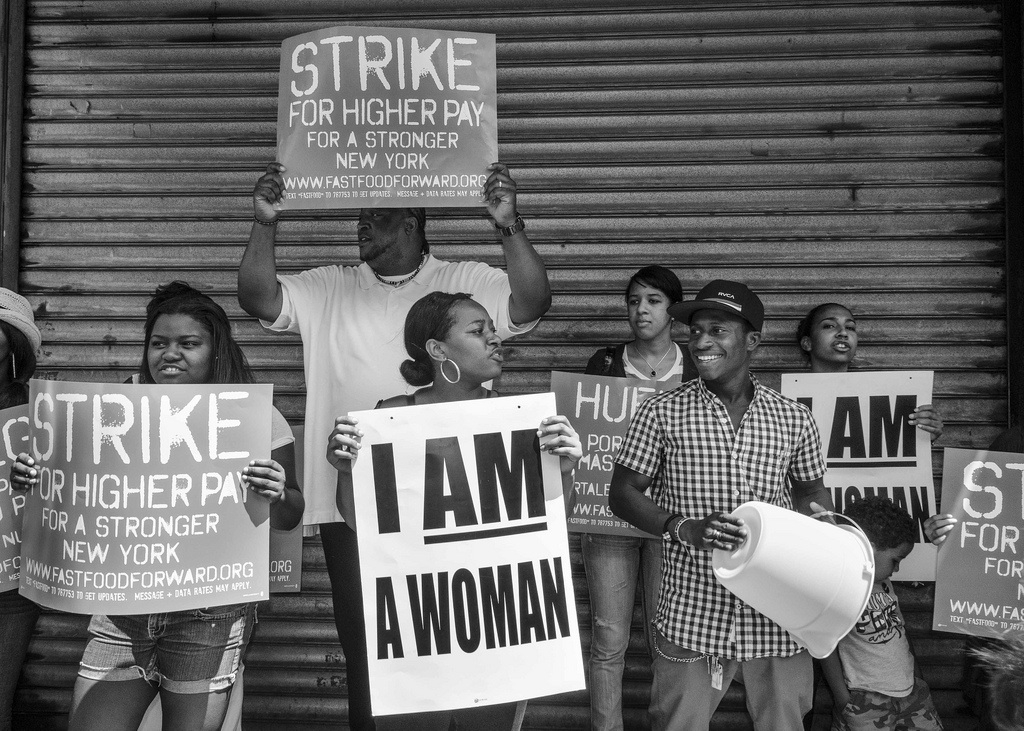
Flipping burgers at McDonald’s is the iconic dead-end job of the U.S. service economy with low-wages, few benefits and certainly no labor unions. But now a national movement of fast-food and other low-paid workers is growing and organizing to improve working conditions. In the past two years there have been seven national fast-food strikes, which reflect a broader resurgence in the U.S. labor movement and new forms of social mobilization from Occupy Wall Street to the Walmart Black Friday strikes. These recent protests have mobilized often marginalized communities in ways that question the service economy model based on cheap non-unionized labor.

Service work, and fast-food in particular, is a growing sector of employment that is indicative of larger trends in the U.S. economy towards contingent, temporary employment and low wages. Violations of workplace laws like mandatory overtime and minimum wage are part of corporate cost-cutting and common in low-wage industries, and unionization could help give workers power to resist these practices.
This revitalized labor movement is also mobilizing women, people of color and immigrants who were largely left out of the traditional craft and industrial unions.
Broader decline of unionization and decrease in the minimum wage has contributed to rising income inequality, and so attempts to organize low-wage workers could help all U.S. workers and reduce this inequality. Union membership provides a wage boost for workers, especially women, people of color and those with less education.

For more on the inclusive power of unions, check out this Girl w/Pen! post.

Fears of a “terror pipeline” running from Western countries to ISIL and other militant groups are on the rise. The New York Times reports that at least a dozen men have left Minnesota to join radical Islamist groups. Community leaders and FBI officials suggest that cultural isolation, social discontent, and economic challenges drive recent immigrants abroad to fight, and expert accounts in the media argue solving these local problems is the best means of curbing the trend.

Social science has two things to say about this: first,  sincere religious belief, political ideology, and rationalistic behavior may play a stronger role than the media recognize. Second, Western media and governments may have an interest in portraying the motivations for militancy in particular ways.

Ethnographic research shows that the incentive structures of fundamentalist Islam make militancy an appealing choice. Young men who spend hundreds of hours per year in prayer groups and become leaders in their local mosque communities come to view radicalism as the only sure path to Heaven. They don’t join militant organizations because they are confused, isolated, or have no other choices, but because they sincerely believe that doing so is the right path.
This type of radical religious behavior becomes more appealing in times of political uncertainty. Given the instability of Iraq’s fledgling democracy following the U.S. occupation, conservative Muslims may see ISIL’s rise as an opportunity to reclaim the region after a more secular approach to governing failed.
Western media organizations have strong incentives to blame militancy on local social and cultural problems. In times of moral or cultural panic, audiences look to pundits to see who to blame. “Disaffected Muslim youth” may be one such constructed class.
And, once blame has been placed, media accounts perpetuate that particular frame of the situation through a “fringe effect” where angry arguments from the margins become mainstream.

For more on why people may flee micro-agressions at home, check out this Reading List.

This week Scotland goes to the polls for a fundamental decision: should it declare independence from the United Kingdom? Discover Society has an excellent summary of the issue, and everyone from The Economist, to Jacobin (on both sides), to The Simpsons’ Groundskeeper Willie has weighed in on the debate. The “Yes” side argues for “embedded independence”—separate nationhood but with strong financial and regulatory ties to the rest of the UK—claiming an independent Scotland can provide better social services to the people. The “No” side thinks the status quo with the UK and the rest of Europe is a good deal, but is willing to compromise with the devolution of some welfare and tax policies back to national control. With a black and white vote, though, social scientists often have to look at the bigger forces behind nuanced policy issues. 

While the meat of the debate is about public policy, accusations of “nationalism” fly in the background. Sociologists can be critical of nationalism; Puri’s work shows how it shapes the desires of society in both progressive and troubling ways. However, authors like Calhoun remind us that national identity also helps create a necessary sense of belonging and social solidarity. Either way, national sentiment is neither unimportant nor just irrationally passionate.
Scottish public opinion on the yes/no referendum has converged over time and is now closer than ever. With much of the debate centered around social welfare policies, it is important to understand that Great Britain is a strange case; it is much more like the U.S. in terms of market-based social policy, but its public opinion shows a wide range of support for government intervention. This contradiction shows the debate about what the Scottish nation should be is rooted in disagreement about what a nation should do.

In the latest push against an FCC proposal that would create fee-based “fast lanes” on the Internet, a coalition of tech companies purposely slowed download speeds on their websites. The idea – to demonstrate to users how the new rules might slow traffic on non-paying sites – generated quite a stir: as of September 10th, the FCC received a record-breaking 1.4 million public comments on the proposal.

The coalition of protesting firms includes a roster of sites that rely heavily on user uploads: Mozilla, Etsy, PornHub, Kickstarter, Vimeo, and Reddit all voluntarily slowed traffic. Netflix also joined, displaying a message explaining to users “If there were Internet slow lanes, you’d still be waiting.” Tech giants Google and Twitter added their opposition as well. Protest organizers are asking the FCC to reclassify the Internet as a “Common Carrier” under Title II of the Telecommunications Act, thereby granting the government special regulatory powers designed to protect the web as a kind of public commons.

For most of us, the idea of a “commons” calls to mind a kind of protected natural resource, like the public lands that ecologist Garrett Hardin wrote about in his classic article, “Tragedy of the Commons.” The protesters, though, are asking the FCC to create a “commons” from a service that was built in-part by Internet service providers who now want to charge for speed. So, where might the government stake its claim on a proprietary public service? David Harvey and other social scientists have shown how and why capitalist societies engage in this kind of “commoning.”
The incredible outpouring of individual action in this protest owes a great deal to the organizing efforts of a number of large corporations, each with its own ideological and financial interests in the final ruling. What do you call a campaign that uses grassroots tactics, but takes cues from big business? “Astroturfing”, says Sociologist Edward Walker – and it’s more common than you might think.

In the wake of protests responding to the killing of Michael Brown by police in Ferguson, Missouri, sociologists began building a large body of resources to explain how these events fit into a broader pattern of racial bias in the United States’ criminal justice system. Sociologists for Justice has both a public statement on the matter and a syllabus on source material related to racialized policing. Sociology Toolbox has recent data on racial disparities and militarized police departments in Ferguson and nationwide. In addition to the conversation about racial injustice, Ferguson also calls into question our assumptions about how to maintain public safety.

Policing in communities of color presents a paradox. The state offers very little attention for social services, but also embeds itself in residents’ everyday lives through strong policing practices.
While there isn’t much research on the effectiveness of policing tactics, we do know that a militaristic approach which maximizes coercion does little to make a community feel safer. In fact, this approach may actually increase future crime and conflict as community members start to resist coercion.
In addition to racial bias in policing, there is also a gendered dimension to military tactics. Precincts develop a sense of male solidarity through military scorn of feminine traits, and even manufacturers of nonlethal police weapons appeal to these masculine sensibilities to sell their products.  

While President Obama is hosting an economic summit with African leaders this week, the Ebola outbreak is overshadowing major economic news. Experts argue that the epidemic can be curbed, but note rampant distrust toward aid organizations in rural communities makes treatment and prevention difficult. Social scientific research helps explain how media and governments shape the way citizens respond to outbreaks.

We usually think media fans the flames of mass panic, but research on previous Ebola shows media sources actually turn toward a “containment” narrative, emphasizing that it’s hard to catch Ebola and the outbreak is “somewhere else.”
It isn’t that local communities “don’t understand” that aid workers are there to help. Epidemics often manufacture misunderstandings and mass panic. Recently, in New York City’s Chinatown, Asians were “stigmatized during the SARS epidemic despite having no SARS cases.”
Political context also matters, including the actions of national governments and international NGOs. Comparative work on Uganda and South Africa’s approaches to HIV/AIDS has shown top-down strategies don’t calm the infection rate. Bottom-up approaches, like changing hygiene behaviors, are more effective at the local level. However, this tactic requires an environment of “representation and democratic participation” that governments and international organizations have to build and frame.