
politics

spatz_2011, Flickr CC

Volkswagen’s CEO, Martin Winterkorn, recently stepped down amid a scandal over manipulated emissions tests. Researchers at West Virginia University found that VW diesel models used “defeat devices” that activated emission control systems only when being tested—that’s how they dodged emissions standards set by the Environmental Protection Agency. To what extent is Winterkorn responsible for this corporate skullduggery? And does the use of these devices constitute a “crime”?

Classic theories about corporate scandal stress “amoral calculus,” where individual decision makers of an organization weigh the costs and benefits of their actions. One example is the Ford Pinto debacle, when the company failed to recall Pintos with defective gas tanks because its “internal ‘cost-benefit analysis’” indicated the financial costs of a recall outweighed the potential cost of human lives (Dowie 1977). The media often responds to these corporate scandals by labeling white-collar criminals “bad apples,” shifting the public’s attention to the guilt of individual decision makers while hiding the social context that shapes norms within organizations
Sociologists show risky decision making stems from the “normalization of deviance” within an organization. Conforming to the culture, work group members can redefine deviant actions as normal or commonplace. In the Ford Pinto case, fuel tank ruptures were categorized as acceptable risk due to prevailing safety priorities and long-standing industry norms. In the Challenger Space Shuttle Disaster, escalating levels of technical failure were redefined as normal and acceptable due to increased bureaucratic pressures, NASA’s cultural understandings of risk acceptance, and high levels of organizational secrecy.
Other scholarship suggests that the Volkswagen emission fraud will not be labeled as criminal. Our definitions of what is criminal reflect societal beliefs rather than the “objective” dangers and risks posed to us. As such, we tend to emphasize poor or petty “street crime” while downplaying the acts of elites and corporations, or “white collar crime.” These corporate acts, however, result in serious harm and often parallel (or exceed) the harm caused by “street crime”. Fudging emission performance, however, might be defined as “corporate non-compliance,” rather than a criminal act. Subsequently, some of the costs, both physical and social, of corporate crime can go unnoticed.
Elvert Barnes, Flickr CC

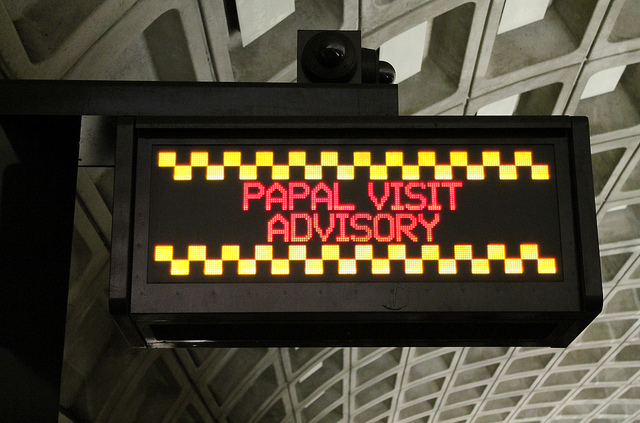
Since his election in March 2013, Pope Francis has gained attention for his efforts to refocus the Catholic Church on issues of social justice. His recent visit to the U.S. was met with acclaim from religious leaders and political liberals, but also sparked consternation among cultural and political conservatives. U.S. Rep. Paul Gosar (R-AZ), a Catholic himself, boycotted Francis’s address to Congress and accused him of adopting “socialist talking points presented to guilt people into leftist politics.”

The cultural divisions within American Catholicism exposed by Pope Francis’s visit are not new. While Gosar may be more vocal than most conservative Catholics, his protest reveals a split between interpretations of the Catholic faith that have been simmering for generations.

Mary Ellen Konieczny shows that the narratives American Catholics use to construct their religious identities have profound political consequences. Some congregations use the language of community to structure their worship, while others structure their activities around the concept of family. In parishes where community talk is dominant, social justice is usually the focus of ministry, but in congregations where family is the main narrative, concerns about personal and sexual morality get more attention. Neither model is more Catholic than the other: both types of congregations draw upon doctrines and use ritual practices central to the Catholic tradition. Hence, the variation Konieczny observes has less to do with texts or doctrines than with the ways people interact in group settings.

The ideological divide in Catholicism also has historical roots in the relationships between the papacy and states. Gene Burns argues that as European states liberalized in the 19th century, Popes struggled to retain political influence for the church. Attempts to engage questions of poverty were seen as intrusions into government affairs, but through discussions of personal morality, the Church could carve out a space where its authority still dominated. As a result, the Church’s ideological emphases turned toward sexual morality and family issues, while sociopolitical concerns grew peripheral.
The postwar period saw a revitalization of Catholic religious activity in the politics of economic justice. Jose Casanova shows how the Solidarity movement in Poland and letter-writing campaigns among American nuns after Vatican II helped to steer church activity back toward social justice work, and John O’Brien charts the influence of labor activist-priest George G. Higgins on Catholic social thought in the 20th century.

Pope Francis’s return to social justice issues does not necessarily make him a “liberal” pope. We might better view him as interested in returning the Catholic church to a language of social justice, firmly rooted in Church history, despite being obscured by previous Popes’ focus on other issues.

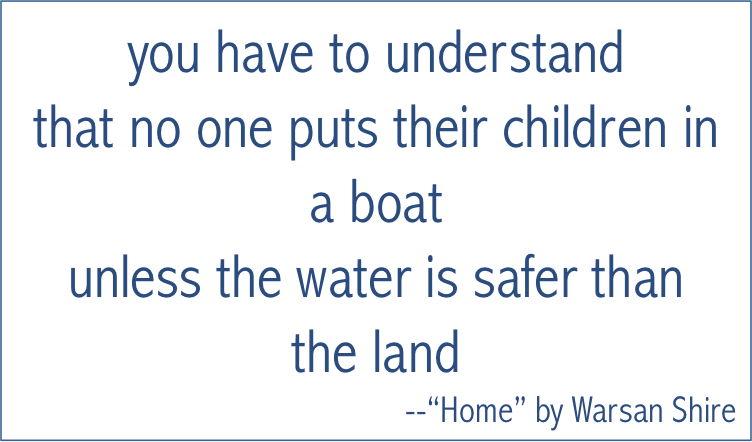
Click for full poem.

Europe is facing a major refugee crisis. Some nations welcome refugees, some do not. Much of the media attention is focused on how these countries are dealing with large populations fleeing from Syria. There is ongoing debate as to whether the Syrians fleeing war are “migrants” or “refugees”. We usually think “migrants” move for economic reasons, while “refugees” move during temporary political crises. Social science on the motives and meaning of migration shows a clear difference in why these two groups travel, but also how the places where they move can blur the lines between them.

Syria has faced civil unrest since 2011, when civilians took to the streets to protest against Bashar Al Assad’s regime. The unrest escalated quickly to a civil war with a total of 220,000 deaths as of January 2015. Approximately 4,000,000 Syrians have been displaced. This has ignited international conversation on the future of Syria and its refugees.

Refugees have a distinct set of reasons for leaving their home countries. In many cases, they are highly skilled workers forced out by extreme violence and social instability. They are more likely to request asylum from countries that have passed domestic refugee laws or ratified more human rights treaties than countries that are economically affluent.

Refugees are looking for a society in which to build a new life, but public policy in destination nations shapes those cultural opportunities. Receiving countries often have their own foreign policy interests at heart when they decide to accept some people as refugees and deny others as migrants. These labels affect future outcomes. Studies of second-generation migrants show that they do better in countries that have many different ways to integrate new-comers, including cultural, economic, and social supports.


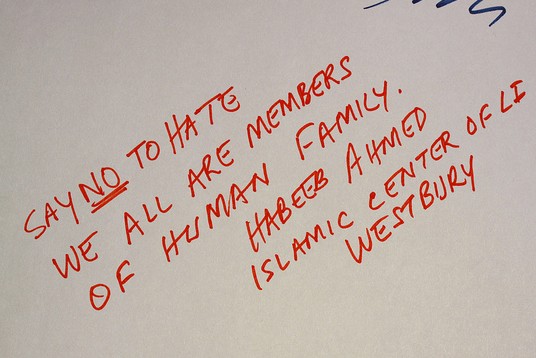
A message left at a memorial for Marcelo Lucero, a Hispanic victim of a hate crime on Long Island. Photo by Long Island Twins via Flickr.

The Emmanuel AME shootings in Charleston, South Carolina have reignited public discussion of both terrorism and hate crimes. While the media often focuses on foreign religious extremism as a motivation for domestic attacks, data show more radicalization has taken place on the political far-right (independent of religion or race) than among Muslims in the United States. Since 9/11, only 25 recorded attacks have been committed by Muslim extremists, while 65 attacks were driven by right-wing extremists at home. So what’s the difference between terror and a hate crime? Is there a difference? Sociological research shows how public discourse and community differences can change the story.

Words like “terrorism” and “hate crime” change across social contexts. In the U.S., acts of violence perpetrated by minority populations are more likely to be defined as acts of terrorism, whereas “home-grown” offenders are likely to be dismissed as crazy, deranged, or evil—“bad apples” rather than people motivated by hate or politics. For hate-crimes, the pattern is reversed. Hate crimes that involve majority perpetrators, particularly in interracial incidents, are linked to higher seriousness ratings. In both cases, the social position of both perpetrator and victim changes how we interpret the violence.
American anti-black hate crimes are most prevalent in communities with a high concentration of white residents that are undergoing black in-migration. This suggests that majority members may try to “defend turf” from the perceived threat of “outsiders”. Compliance with hate crime law is less likely in high-percentage black communities, particularly in the southern U.S. Within these black communities, past lynchings (between 1882-1930) are associated with lower compliance with hate crime law in the present and a lower likelihood of prosecution of hate crime cases.

For more on this issue, check out our other TROT! post, “How Hate Crimes Count.”

Photo Phiend, Flickr Creative Commons

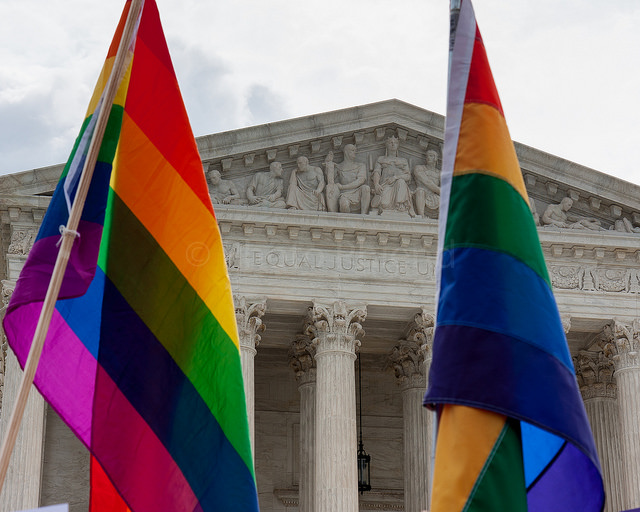
With the Supreme Court’s ruling in Obergefell v. Hodges, states must legally recognize same-sex marriage nationwide. The fight for equality isn’t over, however, as many states do not have explicit protections for same-sex couples against practices like hiring discrimination. The Texas Attorney General also ruled that individual county clerks can refuse to offer marriage licenses to same sex couples on the grounds of their religious beliefs, even if the clerks’ office must ultimately grant the license. This is the challenge with nationwide legislation: laws on the books often differs from the law in action. History shows inequality can thrive in low level bureaucracy, sometimes in spite of national policy.

Policy changes take time to wind through organizations, especially those with large bureaucratic structures like the U.S. government. Autonomous managers in the middle construct their own reasons for adopting policies, often distancing themselves from big changes at the top of the chain. An institutional culture affects the implementation of a policy as much as the policy itself.
We can see these institutional boundaries in broader patterns of hiring discrimination against LGBT citizens that appear in experimental studies, even when employers don’t intend to discriminate. The history of federal regulation in immigration, the military, and welfare policies shows that the U.S. slowly built a bureaucratic system interested in measuring and controlling sexuality long before public battles over LGBT rights came on the scene.
Similar bureaucratic patterns happen around race. When the Supreme Court repealed laws against interracial marriage in Loving v. Virginia, for example, mixed-race couples still faced clerks who were often unwilling to grant them licenses. While the GI Bill was a sweeping national effort in which many U.S. citizens got better housing and education, veterans of color often had trouble registering for those benefits in uncooperative local offices.
Via aclu.org.
Via aclu.org.

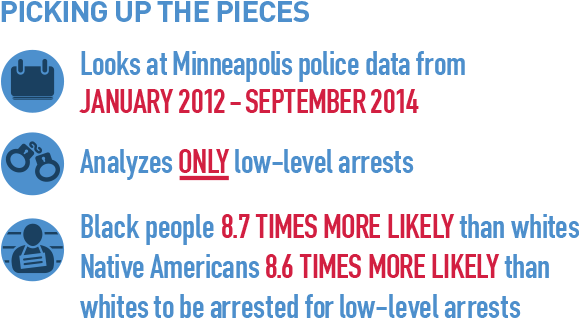
A recently released ACLU investigation a found that black residents of Minneapolis were 8.7 times more likely to be arrested for low-level offenses than white residents between January 2012 and September 2014. The report is the latest in eight city case studies, all of which “describe police departments that reserve their most aggressive enforcement for people of color.” The Minneapolis City Council also recently repealed spitting and lurking ordinances, two examples of the low level offenses cited by the report. Recent sociological research strikes a similar chord; it demonstrates how modern law enforcement isn’t just about crime, but controlling groups of people with minor rules and regulations.

Public discussion about crime tends to focus on felonies, but the majority of law enforcement activity today is geared toward misdemeanors. Even without conviction and sentencing, these minor offenses bring more people into the criminal justice system. The procedural hassle of dealing with a minor criminal record means more people are under this systematic control at any given time, regardless of their guilt or innocence.
The ACLU report finds people experiencing homelessness are the most vulnerable to this system, and many are charged for minor offenses that directly result from being homeless (like panhandling or sleeping outside). Many cities criminalize these behaviors as a way to control space, even to the point that those with criminal records are barred from entering certain neighborhoods.
This law enforcement isn’t just about crime, but also about power in communities of color. Neighborhood-level analysis shows that the stereotypical relationship between race and violent crime rates disappears for communities with more African Americans politically organizing and serving, either in office or on civilian review boards for the police. One of the ACLU’s recommendations to improve the situation in Minneapolis is to establish such review boards.

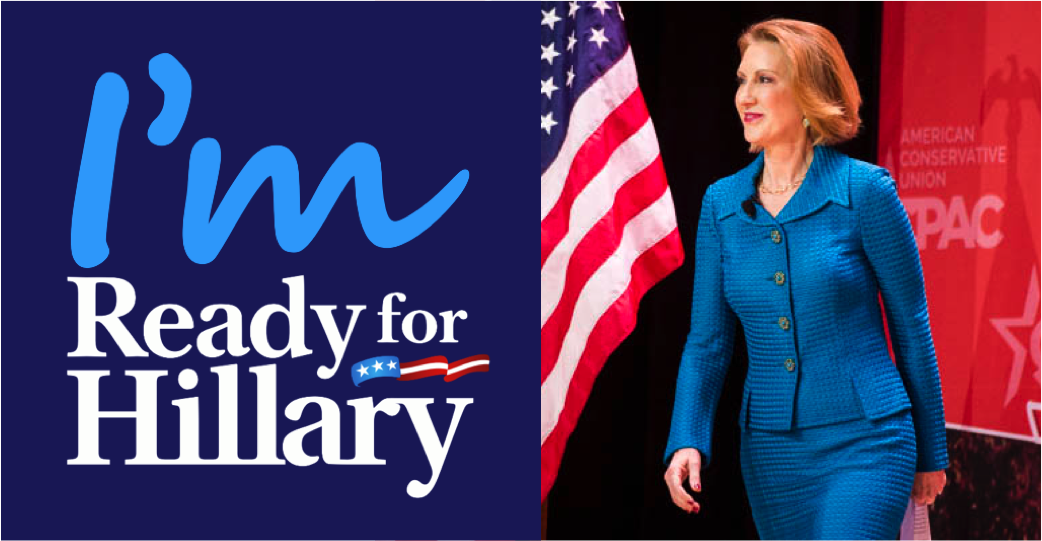
Most of the buzz around Hillary Clinton and Carly Fiorina’s candidacies are about getting into the White House as the first woman president, but what will life be like if one actually makes it?

Just winning the election won’t make politics more female friendly. Studies show that when women enter male-dominated fields, they find it difficult to work in an arena designed by men for men. For example, some jobs involve networking in masculine spaces like bars and golf courses that traditional and symbolically exclude women. When they hit the glass ceiling or find themselves undervalued, many women attribute limited opportunities or personal difficulties at work to problems with individual sexists or difficult personalities rather than a gendered workplace structure. However, restructuring the work environment to center more on teamwork than individual success may help women by giving them more contact with others at work, thus weakening gender stereotypes, providing more networking opportunities, and leading to more promotions.

Hillary Carly


With Hillary Clinton’s official announcement of her presidential candidacy—and now Carly Fiorina’s GOP candidacy—we have seen the immediate and constant sexism that will undoubtedly plague the campaign coverage until election day. Time Magazine, for example, ran a piece focusing on Clinton’s presumed post-menopausal estrogen levels as an asset to her presidential leadership skills (we have yet to spot an article on the testosterone levels of Jeb Bush or Bernie Sanders).

Media outlets often pay a disproportionately higher rate of attention to female candidate’s wardrobe, appearance, and age than to that of male candidates, treating women as novelties rather than serious contenders. The focus on appearance objectifies and sexualizes, delegitimizing their authority.
People evaluate “appropriate” roles for women in public office based on gender stereotypes about policy and issue competency more than on personality traits. Public opinion survey respondents indicate that they find female candidates more capable of handling “feminine” topics like education and healthcare, while male candidates are more qualified to deal with “masculine” issues like terrorism and the economy.
Contrary to expectations, neither higher numbers of educated women nor the type of political system translates to more women in national office. In fact, female congressional candidates win at similar rates to men in general elections. Instead, ideologies about women’s roles and positions in societies influence women’s abilities to enter politics as candidates and survive the primary process.

For more on this topic, check out Scholars Strategy Network and Sociological Images

Photo by blulaces. Click for original.
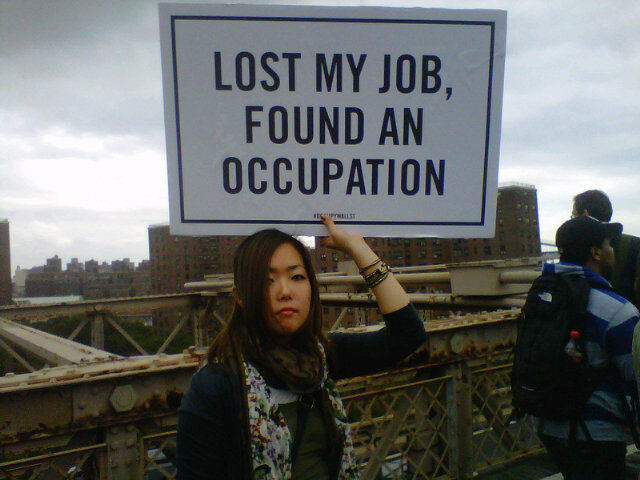
In addition to current labor activism, movements for economic justice have also emerged from students, retirees, consumers, and other communities outside traditional unions and leftist political parties. Today’s mass movements range from the Indignados movement in Spain to Occupy in the U.S. to anti-austerity protests in Greece to massive student demonstrations in Chile. Protestors are contesting the inevitability of privatization, cuts to public spending, and rising inequality, among other issues worldwide.

Read Part I (The U.S. & Inequality) and Part II (Global Labor).

workers of the world

Workers of the World, Unite!

Since the late 1800s May Day—the first of May and a traditional European spring celebration—has been recognized as International Workers Day. It’s a time to celebrate working people and the possibilities for international solidarity. On May Day 2015, the state of workers looks rather grim: expanding inequality, increasing fiscal austerity, and degrading working conditions. Amid these negative trends, though, there are glimmers of hope as global workers organize and mobilize to assert their rights, curtail corporate power, and create a more equitable world.

To mark May Day, we are exploring issues of inequality, labor, and social movements in a three-part series.

Part I: The U.S. & Inequality

Deregulation, privatization, and declining unionization have exacerbated the gulf between rich and poor in the past 50 years. Researchers have documented how much of the increase in wage inequality is due to the weakening of policies and institutions that have historically protected and empowered workers—unions, minimum wage laws, unemployment insurance, and labor law—in addition to structural changes in the economy and labor market.

Read May Day Part II: Global Labor. There’s Research on That!

Read May Day Part III: Social & Political Movements. There’s Research on That!