gender

4238252310_b81af757bd_z

Originally posted November 22, 2016.

For many Americans, this weekend is the time for food, football, and family we don’t see often. Given the heightened tensions surrounding the presidential election, social media is teeming with advice on how to constructively engage with friends and family who have different political views. Avoidance, wine, and crying is one strategy, but thinking about what family meals mean and actually engaging in constructive conversations about political issues may be more fruitful.

We often think of Thanksgiving as a time to have a family meal together and strengthen family bonds. But research shows that family dinner does not actually increase well-being in and of itself – it only works if the meal-time discussion is used to actually engage with those at the table and learn about their day-to-day lives. In other words, “polite” conversation may not be the best way to bring everyone together.
We know that people avoid talking politics because they want to seem polite and avoid conflict. But this does not necessarily mean they don’t have political views. In fact, being “not political” is a cultural performance that people do with different styles. It takes work to not be political and those strategies can be overcome without necessarily causing conflict. In fact, a recent study found that having a 10-minute canvassing conversation about trans-related issues was associated with reduced prejudice, at least in the short term.
For those of us who are academics, it is important to remember that engaging in these discussions does not mean spouting off your best summary of Gramsci’s theory of hegemony or Bonilla-Silva’s take on color-blind racism. We need to do as much, if not more, listening than we do talking, because listening to how others are thinking about and responding to the current political climate can help all of us better understand our shared situation. And if and when we do bring up social science theories and research, we should do it in a way that is approachable, not pedantic. As bell hooks argues, “Any theory that cannot be shared in everyday conversation cannot be used to educate the public.”
That’s not to say that academics cannot effectively draw on their experiences as teachers. There are many strategies we use in the classroom to teach things like race, gender, and class that can be useful outside of the classroom. Relying on personal examples and discussions about family histories instead of facts and figures is one example of how to do this. Focusing on experiences that you or your loved ones have had with racial discrimination, generational mobility, or gender role conflict can help them connect the social construction of race, class, and gender to concrete events and stories from their own lives.
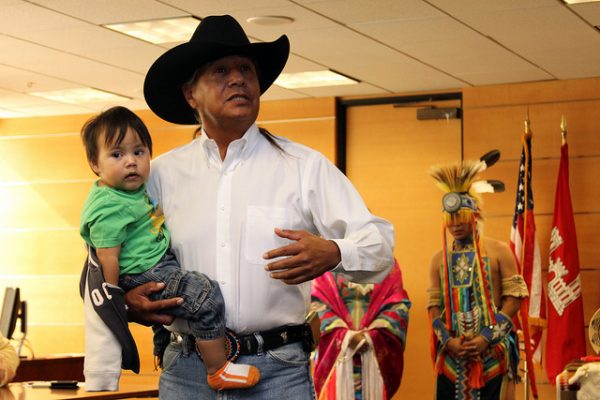
Photo of a Seminole man holding his child at an American Indian Heritage Month celebration. Photo by Los Angeles District, Flickr CC

After years of debate, the Indian Child Welfare Act (ICWA) — which sets minimum requirements for caseworkers handling state child custody proceedings involving Native children — was recently ruled unconstitutional by a Texas federal judge. The judge argued that ICWA violates constitutional rights to Equal Protection because it “elevates a child’s race over their best interest” — despite the fact that Native children are actually citizens of federally recognized tribes. Social science research helps us understand the historical context necessitating ICWA’s creation, with respect to the problematic history of child removal from Native communities as shaped by racialized, gendered, and cultural ideas.

The ICWA was enacted in 1978, a time when Native children were being removed from their homes and placed in foster care at staggering numbers under the guise of protecting children. At that time, 25-35% of Native children were removed from their homes by state child welfare or by private adoption companies. And the majority (about 85%) of these children were placed outside of their families and communities, even when relatives were willing to take them. Today, despite the minimal protections offered by the ICWA, Minnesota places more Native children in foster care than any other state, making up 20% of children in the system.
The ICWA’s creation and implementation has not only been a response to child-removal through adoption, however. Even earlier, Native children were sent to government or Christian-run boarding schools where teachers forced children to abandon their distinct tribal cultures — they cut Native children’s hair, did not allow them to speak their native languages or participate in cultural practices, and enforced strict discipline through corporal punishment. The boarding school era prevented generations of Native people from learning (and passing on) parenting tools. This separation of families, along with the disruption to Native cultural and spiritual practices, has been linked to symptoms similar to post-traumatic stress disorder, increased exposure to physical violence, and substance abuse in Native communities.
The removal of Native children is also couched in deep-set racialized, gendered, and cultural notions of family, specifically the white middle class ideal of the nuclear family, characterized by two married parents and children. Conversely, non-Native supporters of these adoption practices often relied on stereotypes of Native women as sexualized, unmarried, and thus unfit, which pathologized Native families as neglectful. They have also argued that each child’s best interests should be considered on an individual basis, rathering than acknowledging what tribes see as the importance of culture and identity, tribal rights, and belonging. In other words, supporters of Native adoption saw “disadvantaged” Native children that needed to be “rescued” by individual acts of goodwill (from white, middle class Americans).

So what will legal reconsideration of the Indian Child Welfare Act bring? Many tribes fear that the Texas ruling sets a dangerous precedent that could dismantle the federal laws put in place to correct historical injustices like the boarding school system. Other tribal leaders see the ruling as an attempt to destroy their right to political and cultural survival through their children, while simultaneously compromising efforts to heal from the wrongdoings inflicted upon tribal communities. In the context of the current political division over the treatment of immigrant children separated from their parents at the U.S. border, such concerns warrant serious attention.

Photo by Tom Lee, Flickr CC

Originally posted October 18. 2017

If you like Halloween, you know that witches are a popular costume choice and decoration this time of year. But the history of witches involves much more than bubbling cauldrons and flying broomsticks. Social science shows us that witchcraft has a long history of empowering marginalized groups, like women and sexual minorities, who question more traditional religious practices.

While popular images of witches often focus on magic spells, brooms, and pointed hats, witchcraft and other forms of neo-paganism have historically been used by women to push back against male-dominated religions. More traditional, hierarchical religions like Christianity and Islam often place women in a subordinate role to men, and research finds that many women are drawn to witchcraft and other alternative spiritualities because they emphasize female empowerment, embodied rituals, and sexual freedom.
People who practice witchcraft and neo-paganism typically see sexuality and gender as key sites for social transformation and personal healing, pushing back against the Christian idea that sex and bodies are sinful. Since neo-paganism values sexual freedom and sexual diversity, LGBTQ folks and people practicing polyamory often feel a sense of belonging that they don’t find in other religious spaces.
This has also been true for young adults. In general, young adults practice religion and spirituality differently than do older generations. For example, millennials are the least likely to participate in traditional religious institutions or identify with one single religious belief system, but many still desire some combination of spirituality and community. The increase in portrayals of witchcraft and other neo-pagan religions in popular media has exposed younger generations to these communities, and research finds that teens are more often drawn to these alternative spiritual practices as a means of self-discovery and community, rather than the promise of magical powers.
Photo by Eva Cristescu, Flickr CC

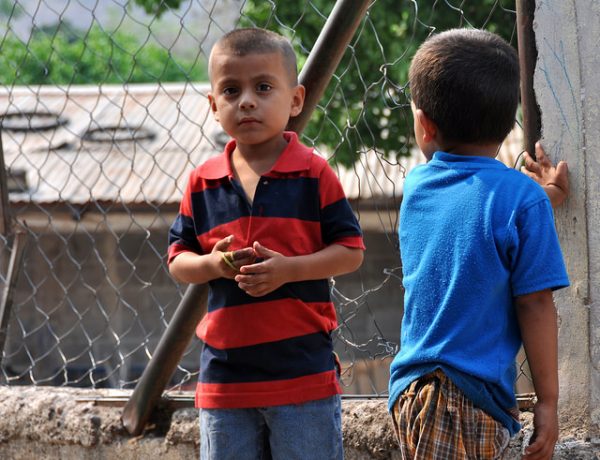
Unaccompanied minors have been migrating to the United States from Central America for decades, but media coverage of this harrowing journey rarely focuses on the reasons behind migration. Though violence and economic peril tend to drive these migration patterns, the journey from Central America is dangerous itself, and the backgrounds of child migrants are not always well understood. Fortunately, sociological research on migration can provide context on the difficulty of the decisions and experiences involved in migration.

Structural conditions, like violence or poverty, do not alone predict unaccompanied child migration. Recent analysis finds that when a parent migrates, their child is more likely to follow them — especially compared to children who do not have parents that migrated. Indeed, unaccompanied migrant children are most likely to migrate the same year as their parents. Gender is also a factor — girls are less likely than boys to migrate when they had parents who migrated, and even less likely when these were unauthorized trips.
Some unaccompanied minors make this dangerous journey in order to flee life-threatening gang violence at home, which leads many children to claim asylum or special immigrant status upon arrival in the United States. Upon arrival, however, they may be placed in a detention center or be deported back to their countries of origin. Further, to cover costs for the journey to the United States, Central American families gather their money and take on debt. And this all may be for naught if their child is apprehended and deported back to their country of origin.
Photo by Mike Baird, Flickr CC

The recent treatment of superstar tennis player Serena Williams provides plenty for discussions of discrimination against women of color in sports and more broadly, in public. Even before this most recent incident involving her technical violations for supposedly “aggressive” behavior against the match’s umpire, Williams received a violation in the French Open for her black athletic catsuit, despite numerous instances of white players sporting similar wear at the French Open in prior years. Serena Williams’ experience is not only familiar to adult women of color, but also to girls of color. Social science research highlights how enduring patterns of policing and regulating racial minorities begins at an early age — often within educational institutions

Schools have long served as sites for social control and discipline that hinder the educational attainment of minority youth. Girls of color experience a unique set of institutional discriminatory practices that are coded in both racialized and gendered controlling images. All too often, these images depict girls of color as overly aggressive, hypersexual, and too adult-like. One two-year ethnographic study showed that while some teachers appreciated Black girls’ assertiveness in the classroom, by and large, teachers and administrators discouraged Black girls from talking in “loud” or aggressive manners, especially when such behaviors threatened teachers’ authority. They attempted to incentive Black girls into more quiet and docile behavior in order to achieve status as young “ladies” — a status shrouded in ideals of white female innocence.
Dress code enforcement serves as one of the primary ways educational institutions police girls of color. In one study, girls were told, “Don’t come in here with no hoochie-mama dress all tight up on your butt!” Similar remarks demanded that girls “Close [their] legs” and act like ladies. At times, girls resisted these policies and the racialized and gendered stereotypes that emerged alongside them. Still, girls also participated in the regulation of their female peers’ clothing by degrading those who wore “sleazy clothes.” Such policies and practices reinforce educational institutions as sites that perpetually reproduce simultaneous race, gender, sexuality, and class inequalities.
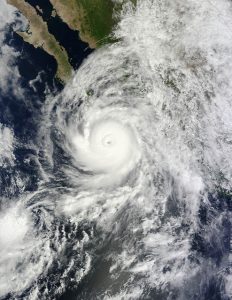
NASA image by Jeff Schmaltz, Flickr CC

Originally Posted October 19, 2016.

The rain and wind of Hurricane Matthew may have stopped, but much of North Carolina is still under water. The hard work of repairing and rebuilding has begun across the southeastern U.S. and the Caribbean, particularly in Haiti where they are still reeling from the 2010 earthquake. Hurricanes – so called natural disasters –  are not simply the result of the weather but become “disasters” because of how society shapes people’s risks and how people prepare, adapt, and respond.

Extreme weather events like hurricanes often become problems because of the ways society has changed the environment, such as locating cities in areas at risk of flooding, filling in wetlands for development, and building homes on eroding coastlines. Government policies are also major factors in where, why, and when an event becomes a human disaster because development policies have contributed to creating risky areas while response plans are often inadequate.
The risks and burdens of disasters are not evenly distributed. Communities with the least economic, social, and political power often face the greatest threats from natural disasters and are also the least able to prepare, evacuate and rebuild. Socio-economic status affects where people live and the quality of their housing. Poor and working class communities also tend to bear greater physical, emotional, and psychological impacts of displacement and have fewer resources and government support to rebuild and recover after a catastrophe.
Economic inequality and race also contribute to different levels of vulnerability and resiliency between countries around the globe. Communities of color are more likely to be threatened by environmental disasters and be less prepared, while government evacuation and reconstruction programs tend be limited for these communities. Researchers who studied Hurricane Katrina point to how experiences of the storm were shaped by institutional racism and how the effects exacerbated racial and class inequalities. For example, government aid was slower to reach African American communities who also spent more time in shoddy temporary housing and had more trouble rebuilding their neighborhoods.
Women and children also bear a greater burden and risk from disasters because they tend to have fewer resources. Women typically have more responsibilities of caring for children and aging relatives, yet they have also been leaders in the recovery process after countless disasters, organizing their communities to rebuild and demanding a government response. Natural disasters have a large impact on children due to the trauma, displacement, and disruption of their lives. Research found that childrens’ ability to respond and adapt after Katrina was related to their family’s race and class, with more vulnerable children experiencing greater detrimental effects on their well-being after the storm.
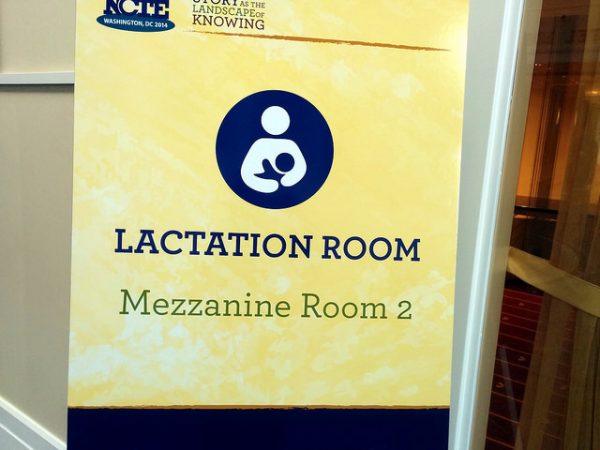
Lactation Room Sign. Photo by Cory Doctorow, Flickr CC

Recently, Utah and Idaho legalized public breastfeeding, finally making the practice lawful in all parts of the United States. Yet, even where public breastfeeding is legal — and has been for some time — breastfeeding mothers still face stigma. For instance, a pool patron and a staff member recently asked a breastfeeding mother in Mora, Minnesota to cover herself while at a public pool. Many have pointed out the contradictions between observers’ acceptance of women’s skin in certain public domains (like at the beach or on the cover of a magazine) and the public shaming women receive when their skin is exposed during breastfeeding.

In U.S. society especially, breasts are sexual symbols. And since motherhood is not highly sexualized, public breastfeeding presents a cultural contradiction in the United States. Because of these shared understandings of breasts as sexual, mothers must consciously negotiate spaces where they can breastfeed. For example, mothers report they engage in a variety of behaviors, like avoiding breastfeeding in certain spaces where they might face scrutiny or draping a blanket over the baby to hide their breasts, in order to not be viewed as sexual while breastfeeding.

In other words, one reason people respond to public breastfeeding with discomfort and sometimes hostility is that breasts have a particular meaning within U.S. culture and breastfeeding in public challenges that meaning.

Photo by Indi Samarajiva, Flickr CC
The word “rave”evokes different responses depending upon one’s generation. For many it symbolizes fun all-night dance parties with friends. While the public may be quick to associate rave culture with youth delinquency, social science explores the broader range of social, spiritual, and cultural elements of raves and electronic dance music (EDM). Raves began in 1980s Britain and quickly spread to the United States. Youth created these anti-establishment and and underground events to celebrate peace, love, unity, and respect — otherwise known as “PLUR.” However, heavy drug consumption resulted in media scrutiny and government crackdowns of these underground locations in the 1990s and early 2000s, pushing raves into more formal spaces like clubs.
Social scientists have explored raves and the electronic dance music scene from two different perspectives. The cultural perspective emphasizes a sense of community and empathy for its members as the roots of the scene. From this perspective, drug use enhances these experiences. The rave has been portrayed as a youth cultural phenomenon, characterized by belonging, self-expression, acceptance, camaraderie, escape, and solidarity, and where drugs — particularly ecstasy or “E” — are often central to the scene or tools in rebellion. From the public health perspective, excessive drug use is the defining feature of rave culture. Here raves and the electronic dance music scene are perceived as dangerous drug subcultures that increased drug-related health problems in the United States. However, some debate these claims and argue that the effects of ecstasy itself are linked to feelings of closeness and solidarity at raves.
While typically not linked to public perceptions of rave culture, some scholars connect raves and electronic dance music culture (EDMC) to religion and spirituality. In particular, scholars point to the non-Christian religiosity of rave’s dance “ritual,” likening it to the non-denominational “new church.” Further, EDM inherits its ritualistic, chanting, and percussive elements from African, Asian, and Indigenous cultures in North America, and African American, Latino, and gay communities in Chicago and New York City in the 1970s and 1980s. Thus, youth promoted raves as place of growth, sacredness, and unity, where youth were not divided through class, ethnicity, and gender.

Though the shape and form of raves and rave culture continues to change, both cultural and public health scholars agree that these events are much more than sporadic, all night dance parties.

Photo by Sara Star NS, Flickr CC
Despite the stressful experiences and the poverty that often accompany immigration, social science research shows that Hispanics as a whole fare better in health outcomes than non-Hispanic Whites. The ‘Hispanic Paradox’ refers to the fact that these good health conditions in Hispanic populations represent a curious puzzle for researchers. This is because Hispanics also exhibit low-income status, disproportionate exposure to stress factors associated with the immigration process such as learning a new language, adapting to an unfamiliar environment, and encountering persistent discrimination — factors associated with poor health outcomes.
Some studies explain the ‘Hispanic Paradox” based on Hispanic culture-specific features that act as protective factors of health and wellbeing. They include the cultural emphasis in the development of social resources, family ties, and religious affiliations. Hispanic mothers in the United States, for example, enjoy favorable birth outcomes due to their close relationships with family, friends, and community members who provide a protective network of informal prenatal care. However, new research has found that Hispanic mothers’ adaptation to the norms of U.S. society — known as acculturation — erode these healthy behaviors.
Notably, the Hispanic Paradox may not remain consistent when researchers consider the specific composition of Hispanic populations living in the United States, compared to Hispanic populations in their places of origin. For instance, Hispanics who migrate may have better health conditions than those who stay in their home countries, known as the ‘healthy migrant effect’. On the other hand, less healthy Hispanics may be more likely to return to their home countries and thus less likely to participate in research studies, what is called ‘the salmon bias’. A study of Hispanics tested both the ‘healthy migrant’ and ‘the salmon bias’ effects among Cubans (for whom returning to their home countries is not feasible), Puerto Ricans, and U.S.-born Hispanics (whose deaths are recorded in the U.S. national statistics). Findings reveal that lower mortality for Hispanics remains constant, even when controlling for these alternative hypotheses.

Alberto Palloni and Elizabeth Arias. 2004. “Paradox Lost: Explaining the Hispanic Adult Mortality Advantage.Demography 41(3): 385-415.

Ana F. Abraido-Lanza, Bruce P. Dohrenwend, Daisy S. Ng-Mak, and J. Blake Turner. 1999. “The Latino Mortality Paradox: A Test of the” Salmon Bias” and Healthy Migrant Hypotheses.” American Journal of Public Health 89(10): 1543-1548.

Studies on the Hispanic Paradox shine a light on how ethnicity can affect health outcomes. However, concerns about health outcomes among minorities require both strengthening the benefits and preventing potential harmful consequences of being Hispanic in the United States.

Photo by Debra Sweet, Flickr CC

With the appointment of a new Supreme Court Justice looming, Roe v. Wade — the landmark legislation that legalized abortion across the United States — faces an increasing threat of being overturned. While we often talk about the women who have or seek abortions, we tend to forget about the providers who perform them. Abortion providers today certainly face many challenges to performing this service, but before Roe v. Wade, choosing to perform abortions was usually illegal and dangerous. Despite this precarity, many providers risked their lives to ensure women had access to abortions.

Abortion didn’t always receive public concern. In fact, prior to the mid 1900s, abortion was considered a strictly medical matter. In the late 1800s, medical professionals began advocating for the criminalization of abortion, arguing that women who sought them were medically ignorant about pregnancy. And, at a time when a growing number of immigrant groups seemed to threaten the dominance of White, Anglo-Saxons, doctors vehemently opposed abortions for White, Anglo-Saxon women who defied their “natural” purpose — to reproduce. Many doctors remained opposed to abortion into the mid to late 1900s, but not all. These others doctors — known as “doctors of conscience” — performed illegal abortions, often requiring the women they served to wear blindfolds so they could not identify the doctors if they were later arrested.
It was not only trained medical professionals who performed illegal abortions. Some providers had little to no legitimate medical training. For example, members of the underground abortion service in Chicago — known as “Jane” — sought training so they would not need to rely on outsiders to perform services. Surprisingly perhaps, many clergy used their status and privilege of confidentiality with clients to provide referrals and assistance to women seeking abortions through an organization known as the Clergy Consultation Service (CCS).

The CCS alone estimates that the abortion providers they worked with were able to supply hundreds of thousands of women with abortion services before Roe v. Wade. And this was only possibly through the collaborative efforts of individuals who formed organizations and networks, and used their privileges and resources to help women who sought their assistance. Today women continue to fight for reproductive rights, and with the possibility of Roe v. Wade‘s overturning, many worry that women will once again need to rely on providers like doctors of conscience to meet their reproductive needs. 


This episode of the podcast, Criminal has more about the Clergy Consultation Service.