Search results for embed

In this video sociologist Devah Pager describes her experimental research on race, criminal records, and employment with Dalton Conley.  Using matched pairs of black and white students posing as job applicants, she finds, stunningly, that black men without a criminal record are as likely to get a call back for a job as white men with one (see the tables here).  Black men with criminal records receive call backs for only about one in 20 completed job applications.

See also our post in which one man explains the “hidden life sentence” he received after a crime 20 years past.

Lisa Wade, PhD is an Associate Professor at Tulane University. She is the author of American Hookup, a book about college sexual culture; a textbook about gender; and a forthcoming introductory text: Terrible Magnificent Sociology. You can follow her on Twitter and Instagram.

George H.W. Bush’s 1988 “Willie Horton” campaign ad is infamous for racializing fears of crime, encouraging stereotypes of African American men as violent and threatening. The ad is widely believed to have destroyed Michael Dukakis’s chances for winning the presidency, presenting him as soft on crime. It’s a classic example of race-baiting in political campaigns — ads that present racial/ethnic minorities as threatening. Jesse Helms took a different approach with his affirmative action ad, which draws on some Whites’ fears that they are losing out on jobs because of affirmative action.

This election cycle, a number of candidates have produced ads that clearly attempt to stoke and benefit from anti-Hispanic immigrant sentiment. Talking Points Memo posted a mailer sent out by the Yuma County, Arizona, Republican Party as part of its campaign against Democratic state Representative Rae Waters. One side shows a stop sign full of bullet holes and makes a link between immigrants and neighborhood crime:

SB 1070 is the controversial Arizona law that allows law enforcement officials to check the immigration status of people they have stopped for other violations if there is a “reasonable suspicion” they might be undocumented or not carrying the appropriate papers.

To drive the message home, the other side of the mailer contains an image of a blond child, looking a little disturbed, and again links opposition to SB 1070 to “drugs and violence”:

Here in Nevada, Senate candidate Sharon Angle is currently running this commercial that calls Harry Reid the best friend of “illegals,” who are “putting Americans’ safety and jobs at risk.”

The commercial ends with this image:

She has a second commercial that plays on the same themes:

In West Virginia, this ad against Nick Rahall, a Christian Lebanese-American, prominently displays the phrase “Arab Americans” (he chaired Arab Americans for Obama) while scary music plays in the background:

If you have other examples of racialized or anti-immigrant imagery in current campaign ads, let us know.

UPDATE: S. Elle let us know about this ad by Senator David Vitter, of Louisiana, which is very similar to the Angle commercials:

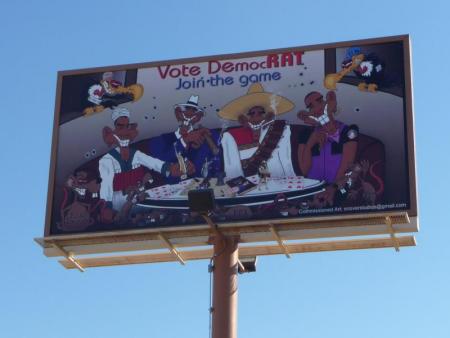
And kantmakm provided a link to this billboard outside Grand Junction, Colorado:

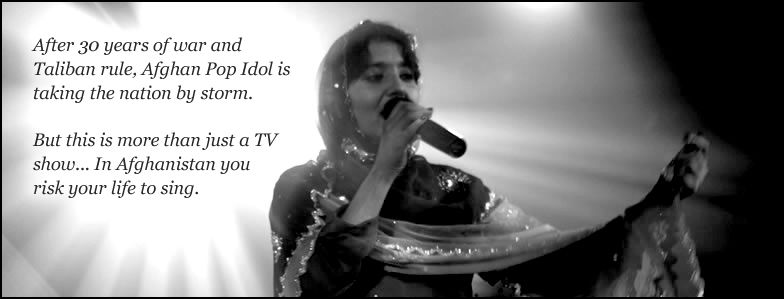
In the comments thread to a recent post presenting an image of Afghanistan that doesn’t focus on war, violence, and misery, a Reader by the name of “S” linked to a documentary called Afghan Star.  The film documents an American Idol-style competition, one that places contestants at risk of violence, but also engenders intense devotion from some Afghanis.  It reveals another side of Afghanistan that Americans typically do not see.

The trailer:

Thanks to Myaisha for catching the comment!

Lisa Wade, PhD is an Associate Professor at Tulane University. She is the author of American Hookup, a book about college sexual culture; a textbook about gender; and a forthcoming introductory text: Terrible Magnificent Sociology. You can follow her on Twitter and Instagram.

History isn’t fact, but a narrative.  Nations narrate their own histories, telling the stories about themselves that they prefer.  Holidays are one way in which these stories are told and re-told.

At www.america.gov, the U.S. government describes Columbus Day as a”commemoration” of Columbus’ “landing in the New World” (they astutely avoid the term “discovery”) and initiating a “lasting encounter” between the mis-named “Indians” and Europeans (no mention of genocide or the stealing of land).

Contesting this particular version of history, an organization calling itself Reconsider Columbus Day is asking Americans to adopt an alternative national narrative, one that both acknowledges and emphasizes the oppressive and unjust outcomes of the ongoing “lasting encounter” between American “Indians” and Europeans-now-Americans.

The narrative and counter-narrative is an interesting example of how nation-founding memories are not set, but always potentially changing as the national ethos and distribution of power shifts underneath them.

For more on national memories, see our post comparing the German approach to the Holocaust and the America approach to slavery.

Lisa Wade, PhD is an Associate Professor at Tulane University. She is the author of American Hookup, a book about college sexual culture; a textbook about gender; and a forthcoming introductory text: Terrible Magnificent Sociology. You can follow her on Twitter and Instagram.


In this video, suggested by Dmitriy T.M., photographer Aaron Huey powerfully illustrates the history of the relationship between the U.S. and the Lakota of the Sioux Nation.   It includes the making and breaking of treaties, the use of the idea of private property to strip the Lakota of their land, the Battle of Wounded Knee, the stealing of the Black Hills, and the socio-economic (and related) disadvantages faced by the Lakota today.

Lisa Wade, PhD is an Associate Professor at Tulane University. She is the author of American Hookup, a book about college sexual culture; a textbook about gender; and a forthcoming introductory text: Terrible Magnificent Sociology. You can follow her on Twitter and Instagram.
El sent in a really interesting example of the re-fashioning of a real body into one believed to be more appealing to consumers. In the video below, real footage of gymnast Shawn Johnson is shown alongside the video game designed to allow Wii players to “play” her. El notes:

…the video Shawn is significantly thinner and long-limbed whereas the real Shawn has a short muscular body. The real Shawn’s leotards are red and blue, while the video image is wearing a pink leotard. In addition, the hair of the video version is blonder.

There has been a clear effort here to feminize the image of Shawn and to make her body conform to less athletic ideals… While Shawn’s name and fame is used to sell the video (presumably primarily to little girls), the video sends the message that Shawn herself must be altered, even though I would guess most people buying the game are fans of Shawn, know what she look like, and admire her as she is.

Lisa Wade, PhD is an Associate Professor at Tulane University. She is the author of American Hookup, a book about college sexual culture; a textbook about gender; and a forthcoming introductory text: Terrible Magnificent Sociology. You can follow her on Twitter and Instagram.
Jezebel recently posted this Australian PSA about the dangers of fast food:

It made me think of this British PSA from 1967 that addressed childhood obesity. Our ideas of what you should be eating may have changed in the past 40 years, but the tendency to rely on individualistic explanations and to blame moms for not providing children better food, as though the food they choose for their kids exists outside of any larger social context, seems to have quite the shelf life.

This 23-minute documentary, The Colony, explores Chinese immigration to Senegal. The immigrants are drawn to Africa by the promise of lucrative entrepreneurship and they are changing the economic landscape, to the pleasure and displeasure of locals.

At Al Jazeera.

Lisa Wade, PhD is an Associate Professor at Tulane University. She is the author of American Hookup, a book about college sexual culture; a textbook about gender; and a forthcoming introductory text: Terrible Magnificent Sociology. You can follow her on Twitter and Instagram.